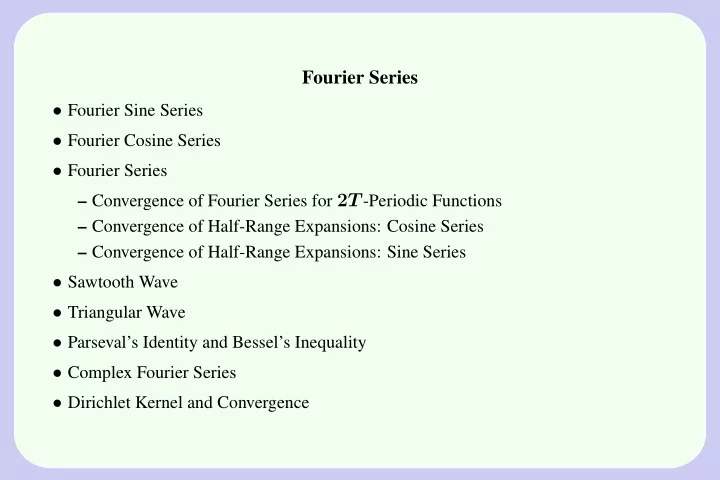
Fourier Series Fourier Sine Series Fourier Cosine Series Fourier - - PowerPoint PPT Presentation

fourier series
SMART_READER_LITE
LIVE PREVIEW

Fourier Series Fourier Sine Series Fourier Cosine Series Fourier - - PowerPoint PPT Presentation

Fourier Series Fourier Sine Series Fourier Cosine Series Fourier Series Convergence of Fourier Series for 2 T -Periodic Functions Convergence of Half-Range Expansions: Cosine Series Convergence of Half-Range Expansions: Sine


slide-1
SLIDE 1

Fourier Series

  • Fourier Sine Series
  • Fourier Cosine Series
  • Fourier Series

– Convergence of Fourier Series for 2T -Periodic Functions – Convergence of Half-Range Expansions: Cosine Series – Convergence of Half-Range Expansions: Sine Series

  • Sawtooth Wave
  • Triangular Wave
  • Parseval’s Identity and Bessel’s Inequality
  • Complex Fourier Series
  • Dirichlet Kernel and Convergence
slide-2
SLIDE 2

Fourier Sine Series

  • Definition. Consider the orthogonal system {sin
  • nπx

T

  • }∞

n=1 on [−T, T ]. A Fourier

sine series with coefficients {bn}∞

n=1 is the expression

F (x) =

  • n=1

bn sin

nπx

T

  • Theorem. A Fourier sine series F (x) is an odd 2T -periodic function.
  • Theorem. The coefficients {bn}∞

n=1 in a Fourier sine series F (x) are determined by the

formulas (inner product on [−T, T ])

bn =

  • F, sin
  • nπx

T

  • sin
  • nπx

T

  • , sin
  • nπx

T

= 2

T

T

F (x) sin

nπx

T

  • dx.
slide-3
SLIDE 3

Fourier Cosine Series

  • Definition. Consider the orthogonal system {cos
  • mπx

T

  • }∞

m=0 on [−T, T ]. A Fourier

cosine series with coefficients {am}∞

m=0 is the expression

F (x) =

  • m=0

am cos

mπx

T

  • Theorem. A Fourier cosine series F (x) is an even 2T -periodic function.
  • Theorem. The coefficients {am}∞

m=0 in a Fourier cosine series F (x) are determined by

the formulas (inner product on [−T, T ])

am =

  • F, cos
  • mπx

T

  • cos
  • mπx

T

  • , cos
  • mπx

T

=   

2 T

T

0 F (x) cos

  • mπx

T

  • dx m > 0,

1 T

T

0 F (x) dx

m = 0.

slide-4
SLIDE 4

Fourier Series

  • Definition. Consider the orthogonal system {cos
  • mπx

T

  • }∞

m=0, {sin

  • nπx

T

  • }∞

n=1 , on

[−T, T ]. A Fourier series with coefficients {am}∞

m=0, {bn}∞ n=1 is the expression

F (x) =

  • m=0

am cos

mπx

T

  • +

  • n=1

bn sin

nπx

T

  • Theorem. A Fourier series F (x) is a 2T -periodic function.
  • Theorem. The coefficients {am}∞

m=0, {bn}∞ n=1 in a Fourier series F (x) are determined

by the formulas (inner product on [−T, T ])

am =

  • F, cos
  • mπx

T

  • cos
  • mπx

T

  • , cos
  • mπx

T

=   

1 T

T

−T F (x) cos

  • mπx

T

  • dx m > 0,

1 2T

T

−T F (x) dx

m = 0. bn =

  • F, sin
  • nπx

T

  • sin
  • nπx

T

  • , sin
  • nπx

T

= 1

T

T

−T

F (x) sin

nπx

T

  • dx.
slide-5
SLIDE 5

Convergence of Fourier Series for 2T -Periodic Functions The Fourier series of a 2T -periodic piecewise smooth function f(x) is

a0 +

  • n=1
  • an cos

nπx

T

  • + bn sin

nπx

T

  • where

a0 = 1 2T

T

−T

f(x)dx, an = 1 T

T

−T

f(x) cos

nπx

T

  • dx,

bn = 1 T

T

−T

f(x) sin

nπx

T

  • dx.

The series converges to f(x) at points of continuity of f and to f(x+)+f(x−)

2

  • therwise.
slide-6
SLIDE 6

Convergence of Half-Range Expansions: Cosine Series The Fourier cosine series of a piecewise smooth function f(x) on [0, T ] is the even 2T - periodic function

a0 +

  • n=1

an cos

nπx

T

  • where

a0 = 1 T

T

f(x)dx, an = 2 T

T

f(x) cos

nπx

T

  • dx.

The series converges on 0 < x < T to f(x) at points of continuity of f and to

f(x+)+f(x−) 2

  • therwise.
slide-7
SLIDE 7

Convergence of Half-Range Expansions: Sine Series The Fourier sine series of a piecewise smooth function f(x) on [0, T ] is the odd 2T - periodic function

  • n=1

bn sin

nπx

T

  • where

bn = 2 T

T

f(x) sin

nπx

T

  • dx.

The series converges on 0 < x < T to f(x) at points of continuity of f and to

f(x+)+f(x−) 2

  • therwise.
slide-8
SLIDE 8

Sawtooth Wave

  • Definition. The sawtooth wave is the odd 2π-periodic function defined on −π ≤ x ≤

π by the formula sawtooth(x) =

        

1 2(π − x)

0 < x ≤ π,

1 2(−π − x)

−π ≤ x < 0, x = 0.

  • Theorem. The sawtooth wave has Fourier sine series

sawtooth(x) =

  • n=1

1 n sin nx.

slide-9
SLIDE 9

Triangular Wave

  • Definition. The triangular wave is the even 2π-periodic function defined on −π ≤

x ≤ π by the formula twave(x) =

π − x

0 < x ≤ π, π + x −π ≤ x ≤ 0.

  • Theorem. The triangular wave has Fourier cosine series

twave(x) = π 2 + 4 π

  • k=0

1 (2k + 1)2 cos(2k + 1)x.

slide-10
SLIDE 10

ParsevaL’s Identity and Bessel’s Inequality

  • Theorem. (Bessel’s Inequality)

a2

0 + 1

2

  • n=1

a2

n + b2 n

≤ 1

2T

T

−T

|f(x)|2dx

  • Theorem. (Parseval’s Identity)

1 2T

T

−T

|f(x)|2dx = a2

0 + 1

2

  • n=1

a2

n + b2 n

  • Theorem. Parseval’s identity for the sawtooth function implies

π2 12 = 1 2

  • n=1

1 n2

slide-11
SLIDE 11

Complex Fourier Series

  • Definition. Let f(x) be 2T -periodic and piecewise smooth. The complex Fourier series
  • f f is

  • n=−∞

cne

inπx T ,

cn = 1 2T

T

−T

f(x)e

−inπx T

dx

  • Theorem. The complex series converges to f(x) at points of continuity of f and to

f(x+)+f(x−) 2

  • therwise.
  • Theorem. (Complex Parseval Identity)

1 2T

T

−T

|f(x)|2dx =

  • n=−∞

|cn|2

slide-12
SLIDE 12

Dirichlet Kernel and Convergence

  • Theorem. (Dirichlet Kernel Identity)

1 2 + cos u + cos 2u + · · · + cos nu = sin

  • n + 1

2

  • u
  • 2 sin
  • 1

2u

  • Theorem. (Riemann-Lebesgue)

For piecewise continuous g(x), lim

N→∞

π

−π

g(x) sin(Nx)dx = 0.

Proof: Integration theory implies it suffices to establish the result for smooth g. Integrate by parts to

  • btain 1

n(g(−π) − g(π))(−1)n + 1 n

π

−π g(x) cos(nx)dx. Letting n → ∞ implies the result.

  • Theorem. Let f(x) be 2π-periodic and smooth on the whole real line. Then the Fourier

series of f(x) converges uniformly to f(x).

slide-13
SLIDE 13

Convergence Proof STEP 1. Let sN(x) denote the Fourier series partial sum. Using Dirichlet’s kernel for- mula, we verify the identity

f(x) − sN(x) = 1 π

x+π

x−π

(f(x) − f(x + w))

  • sin((N + 1/2)w)

2 sin(w/2)

  • dw

STEP 2. The integrand I is re-written as

I = f(x) − f(x + w) w w 2 sin(w/2) sin((N + 1/2)w).

STEP 3. The function g(w) = f(x) − f(x + w)

w w sin(w/2)

is piecewise continu-

  • us. Apply the Riemann-Lebesgue Theorem to complete the proof of the theorem.
slide-14
SLIDE 14

Gibbs’ Phenomena Engineering Interpretation: The graph of f(x) and the graph of

a0 + N

n=1(an cos nx + bn sin nx)

are identical to pixel resolution, provided N is sufficiently large. Computers can therefore graph f(x) using a truncated Fourier series. If f(x) is only piecewise smooth, then pointwise convergence is still true, at points of continuity of f, but uniformity of the convergence fails near discontinuities of f and f ′. Gibbs discovered the fixed-jump artifact, which appears at discontinuities of f.