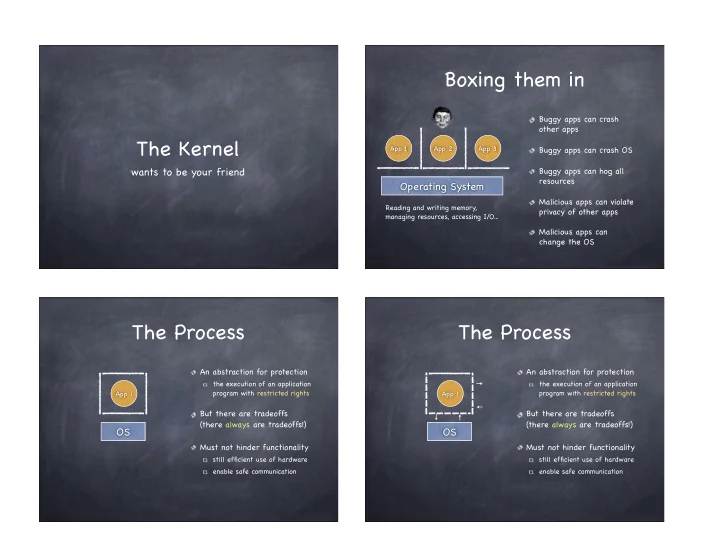
Boxing them in Buggy apps can crash other apps The Kernel App 1 - - PowerPoint PPT Presentation

boxing them in
SMART_READER_LITE
LIVE PREVIEW

Boxing them in Buggy apps can crash other apps The Kernel App 1 - - PowerPoint PPT Presentation

Boxing them in Buggy apps can crash other apps The Kernel App 1 App 2 App 3 Buggy apps can crash OS wants to be your friend Buggy apps can hog all resources Operating System Malicious apps can violate Reading and writing memory, privacy


slide-1
SLIDE 1

The Kernel

wants to be your friend

Boxing them in

Buggy apps can crash

  • ther apps

Buggy apps can crash OS Buggy apps can hog all resources Malicious apps can violate privacy of other apps

App 1 App 2 App 3

Operating System

Reading and writing memory, managing resources, accessing I/O...

Malicious apps can change the OS

The Process

An abstraction for protection

the execution of an application program with restricted rights

But there are tradeoffs (there always are tradeoffs!) Must not hinder functionality

still efficient use of hardware enable safe communication App 1

OS

The Process

An abstraction for protection

the execution of an application program with restricted rights

But there are tradeoffs (there always are tradeoffs!) Must not hinder functionality

still efficient use of hardware enable safe communication App 1

OS

slide-2
SLIDE 2

I know what you are thinking…

Actually…

Special

Part of the OS all kernel is in the OS not all the OS is in the kernel (why not? robustness) widgets libraries, window managers etc

Process: Getting to know you

A process is a program during execution

program is a static file process = executing program = program + execution state

Source code

compiler

Code Header Initialized data

Executable Image

Code Data Heap Stack Code Data Heap Stack

Physical memory OS copy

Keeping track of a process

A process has code

OS must track program counter

A process has a stack

OS must track stack pointer

OS stores state of process in Process Control Block (PCB)

Data (program instructions, stack & heap) resides in memory, metadata is in PCB

PC Stack Pointer Registers PID UID Priority List of open files Process status … Process Control Block

slide-3
SLIDE 3

How can the OS enforce restricted rights?

Easy: kernel interprets each instruction!

slow many instructions are safe: do we really need to involve the OS?

How can the OS enforce restricted rights?

Easy: kernel interprets each instruction!

slow many instructions are safe: do we really need to involve the OS?

Dual Mode Operation

hardware to the rescue: use a mode bit in user mode, processor checks every instruction in kernel mode, unrestricted rights hardware to the rescue (again) to make checks efficient

Efficient protection in dual mode operation

Privileged instructions

in user mode, no way to execute potentially unsafe instructions

Memory protection

in user mode, memory accesses outside a process’ memory region are prohibited

Timer interrupts

kernel must be able to periodically regain control from running process

Efficient mechanism for switching modes

+

  • I. Privileged instructions

Examples: Set mode bit; set accessible memory; disable interrupts; etc But how can an app do I/O then?

system calls achieve access to kernel mode only at specific locations specified by OS

Executing a privileged instruction while in user mode causes a processor exception.... ...which passes control to the kernel

slide-4
SLIDE 4
  • II. Memory Protection

Virtual address space: set of memory addresses that process can “touch” CPU works with virtual addresses Physical address space: set of memory addresses supported by hardware

Virtual address space

Stack Code Initialized data Heap DLL ’ s mapped segments

Step 1: Virtualize Memory

  • II. Memory Protection

Implement a function mapping

a486d9 5e3a07

Virtual Physical Advantages: protection relocation data sharing multiplexing

⟨pid, virtual address⟩ physical address pi

Step 2: Address Translation

into

Protection

At all times, the functions used by different processes map to disjoint ranges

pi pj

Relocation

The range of the function used by a process can change over time

pi

slide-5
SLIDE 5

Relocation

The range of the function used by a process can change over time

pi

Data Sharing

Map different virtual addresses of different processes to the same physical address

pi pj

5e3a07 04d26a 119af3

Multiplexing

Create illusion of almost infinite memory by changing domain (set of virtual addresses) that maps to a given range of physical addresses pi

Multiplexing

The domain (set of virtual addresses) that map to a given range of physical addresses can change over time pi

slide-6
SLIDE 6

Multiplexing

The domain (set of virtual addresses) that map to a given range of physical addresses can change over time pi

Multiplexing

The domain (set of virtual addresses) that map to a given range of physical addresses can change over time pi

Multiplexing

The domain (set of virtual addresses) that map to a given range of physical addresses can change over time pi

A simple mapping mechanism: Base & Bound

CPU

Bound Register Base Register

1500 1000 MAXsys

500 1000

p’ s physical address space ≤ + yes no Memory Exception Logical addresses Physical addresses

slide-7
SLIDE 7

On Base & Limit

Contiguous Allocation: contiguous virtual addresses are mapped to contiguous physical addresses Protection is easy, but sharing is hard

Two copies of emacs: want to share code, but have data and stack distinct...

And there is more…

Hard to relocate We want them as far as as possible in virtual address space, but...

  • III. Timer Interrupts

Hardware timer can be set to expire after specified delay (time or instructions) when it does, control is passed back to the kernel Other interrupts (e.g. I/O completion) also give control to kernel

Crossing the line

user process kernel

user process executing calls system call return from system call execute system call

trap mode bit := 0 mode bit := 1 return mode bit = 1 mode bit = 0

From user mode to kernel mode...

Interrupts

HW device requires OS service

timer, I/O device, interprocessor

asynchronous

Exceptions

user program acts silly (e.g. division by zero) attempt to perform a privileged instruction

sometime on purpose! (breakpoints)

synchronous

System calls/traps

user program requests OS service

synchronous

slide-8
SLIDE 8

...and viceversa

User-level upcall

a sort of user-level interrupt handling

q

If new process

copy program in memory, set PC and SP toggle mode p

Resume after exception, interrupt or syscall

restore PC, SP, registers; toggle mode

Switch to different process

load PC, SP, registers from ’ s PCB toggles mode

q

Making the transition: Safe mode switch

Common sequences of instructions to cross boundary, which provide: Limited entry

entry point in the kernel set up by kernel

Atomic changes to process state

PC, SP, memory protection, mode

Transparent restartable execution

user program must be restarted exactly as it was before kernel got control

Interrupt vector

handleTimerInterrupt() { ... } 31 handleDivideByZero() { ... } 128 255 handleTrap() { ... } 32

Processor Register Interrupt Vector

Hardware identifies why boundary is crossed trap? interrupt (which device)? exception? Hardware selects entry from interrupt vector Appropriate handler is invoked

Interrupt stack

Stores execution context of interrupted process HW saves SP, PC Handler saves remaining registers Stores handler’ s local variables Pointed by privileged register One per process (or per thread!) Why not use the stack in user’ s space?

slide-9
SLIDE 9

Interrupt masking

What if an interrupt occurs while running an interrupt handler? Disable interrupts via privileged instruction

Overdramatic… it actually defers them

Just use the current SP of Interrupt stack

Mode switch on x86

User-level Process Registers Kernel

Code

foo() { while(...) { x = x+1; y = y-2 } }

Stack Code

handler() { pusha ... }

Interrupt Stack EFLAGS Other Registers: EAX, EBX, ... SS:ESP

Stack segment Offset

CS:EIP

Code segment Offset

Mode switch on x86

User-level Process Registers Kernel

Code

foo() { while(...) { x = x+1; y = y-2 } }

Stack Code

handler() { pusha ... }

Interrupt Stack Other Registers: EAX, EBX, ... EFLAGS SS:ESP CS:EIP

  • 1. Disable interrupts
  • 2. Save key registers
  • 3. Switch onto the kernel interrupt stack

EFLAGS SS:ESP CS:EIP

Mode switch on x86

User-level Process Registers Kernel

Code

foo() { while(...) { x = x+1; y = y-2 } }

Stack Code

handler() { pusha ... }

Interrupt Stack Other Registers: EAX, EBX, ... EFLAGS SS:ESP CS:EIP

  • 1. Disable interrupts
  • 2. Save key registers
  • 3. Switch onto the kernel interrupt stack
  • 4. Push key registers onto new stack

EFLAGS SS:ESP CS:EIP

slide-10
SLIDE 10

Mode switch on x86

User-level Process Registers Kernel

Code

foo() { while(...) { x = x+1; y = y-2 } }

Stack Code

handler() { pusha ... }

Interrupt Stack Other Registers: EAX, EBX, ... EFLAGS SS:ESP CS:EIP

  • 1. Disable interrupts
  • 2. Save key registers
  • 3. Switch onto the kernel interrupt stack
  • 4. Push key registers onto new stack

EFLAGS SS:ESP CS:EIP

Mode switch on x86

User-level Process Registers Kernel

Code

foo() { while(...) { x = x+1; y = y-2 } }

Stack Code

handler() { pusha ... }

Interrupt Stack Other Registers: EAX, EBX, ... EFLAGS SS:ESP CS:EIP

  • 1. Disable interrupts
  • 2. Save key registers
  • 3. Switch onto the kernel interrupt stack
  • 4. Push key registers onto new stack
  • 5. Save error code (optional)

EFLAGS SS:ESP CS:EIP

Mode switch on x86

User-level Process Registers Kernel

Code

foo() { while(...) { x = x+1; y = y-2 } }

Stack Code

handler() { pusha ... }

Interrupt Stack Other Registers: EAX, EBX, ... EFLAGS SS:ESP CS:EIP

  • 1. Disable interrupts
  • 2. Save key registers
  • 3. Switch onto the kernel interrupt stack
  • 4. Push key registers onto new stack
  • 5. Save error code (optional)

EFLAGS SS:ESP CS:EIP Error

Mode switch on x86

User-level Process Registers Kernel

Code

foo() { while(...) { x = x+1; y = y-2 } }

Stack Code

handler() { pusha ... }

Interrupt Stack Other Registers: EAX, EBX, ... EFLAGS SS:ESP CS:EIP

  • 1. Disable interrupts
  • 2. Save key registers
  • 3. Switch onto the kernel interrupt stack
  • 4. Push key registers onto new stack
  • 5. Save error code (optional)
  • 6. Invoke interrupt handler

EFLAGS SS:ESP CS:EIP Error

slide-11
SLIDE 11

Mode switch on x86

User-level Process Registers Kernel

Code

foo() { while(...) { x = x+1; y = y-2 } }

Stack Code

handler() { pusha ... }

Interrupt Stack Other Registers: EAX, EBX, ... EFLAGS SS:ESP CS:EIP

EFLAGS SS:ESP CS:EIP Error

  • 1. Disable interrupt
  • 2. Save key registers
  • 3. Switch onto the kernel interrupt stack
  • 4. Push key registers onto new stack
  • 5. Save error code (optional)
  • 6. Invoke interrupt handler

7 . Handler pushes all registers on stack

Mode switch on x86

User-level Process Registers Kernel

Code

foo() { while(...) { x = x+1; y = y-2 } }

Stack Code

handler() { pusha ... }

Interrupt Stack Other Registers: EAX, EBX, ... EFLAGS SS:ESP CS:EIP

  • 1. Disable interrupt
  • 2. Save key registers
  • 3. Switch onto the kernel interrupt stack
  • 4. Push key registers onto new stack
  • 5. Save error code (optional)
  • 6. Invoke interrupt handler

7 . Handler pushes all registers on stack

EFLAGS SS:ESP CS:EIP Error ALL Registers: SS,ESP,CS,EIP, EAX, EBX,...

Switching back

From an interrupt, just reverse all steps! From exception and system call, increment PC

  • n return
  • n exception, handler changes PC at the

base of the stack

  • n system call, increment is done by hw

when saving user level state

System calls

Programming interface to the services provided by the OS Mostly accessed through an API (Application Programming Interface)

Win32, POSIX, Java API

Parameters passed according to calling convention

registers, stack, etc.

User Program system call interface

  • pen()

i

  • pen()

implementation of

  • pen() system call

. . . return

slide-12
SLIDE 12

System call stubs

Set up parameters call int 080 to context switch Validate parameters

defend against errors in content and format of args

Copy before check

prevent TOCTOU

Copy back any result

User Kernel

  • pen:

movl #SysCall_Open, %eax int 080 ret

The Skinny

System call interface

Portable OS Kernel Portable OS Library

x86 ARM PowerPC 10Mbps/100Mbps/1Gbps Ethernet 1802.11 a/b/g/n SCSI Graphics accellerators LCD Screens Web Browsers Email Databases Word Processing Compilers Web Servers

Syscall interface allows separation of concern Innovation Narrow simple powerful highly portable robust

Upcalls: virtualizing interrupts

Hardware-defined Interrupts & exceptions Interrupt vector for handlers (kernel) Interrupt stack (kernel) Interrupt masking (kernel) Processor state (kernel) Kernel-defined signals Handlers (user) Signal stack (user) Signal masking (user) Processor State (user)

Interrupts/Exceptions Upcalls/Signals

Signaling

Why? To terminate an application To suspend it/resume it (e.g., for debugging) To alert of timer expiration Upon receipt: Ignore Terminate process Catch through handler

slide-13
SLIDE 13

ID Name Default Action Corresponding Event 2 SIGINT Terminate Interrupt (e.g., CTRL-C from keyboard) 9 SIGKILL Terminate Kill program (cannot override or ignore) 14 SIGALRM Terminate Tmer signal 17 SIGCHLD Ignore Child stopped or terminated 20 SIGSTP Stop until SIGCONT Stop signal from terminal (e.g., CTRL-Z from keyboard)

More on signals

Unix signals

foo() { while(...) { x = x+1; y = y-2 } }

Code Stack Other Registers: EAX, EBX, ... EFLAGS SS:ESP CS:EIP Interrupt Stack Code

signal_handler() { ... }

Kernel

EFLAGS SS:ESP CS:EIP HW copies current user state in Interrupt stack

1

Other Registers: EAX, EBX, ...

User-level Process Registers

Unix signals

User-level Process

foo() { while(...) { x = x+1; y = y-2 } }

Code Stack Other Registers: EAX, EBX, ... EFLAGS SS:ESP CS:EIP Interrupt Stack Code

signal_handler() { ... }

Kernel

EFLAGS SS:ESP CS:EIP Kernel copies user state

  • n user stack

2

SS:ESP CS:EIP EFLAGS

Other Registers: EAX, EBX, …

SS:ESP CS:EIP EFLAGS

Other Registers: EAX, EBX, …

Registers

foo() { while(...) { x = x+1; y = y-2 } }

Code Stack Other Registers: EAX, EBX, ... EFLAGS SS:ESP CS:EIP Interrupt Stack Code

signal_handler() { ... }

Kernel

EFLAGS SS:ESP CS:EIP Kernel changes PC saved on Interrupt stack to point to handler and SP to point after state saved

  • n user stack

3

SS:ESP’ CS:EIP' EFLAGS

Other Registers: EAX, EBX, …

SS:ESP CS:EIP EFLAGS

Other Registers: EAX, EBX, …

User-level Process Registers

Unix signals

SS:ESP CS:EIP

slide-14
SLIDE 14

SS:ESP’ CS:EIP’ EFLAGS

Other Registers: EAX, EBX, …

foo() { while(...) { x = x+1; y = y-2 } }

Code Stack Other Registers: EAX, EBX, ... EFLAGS SS:ESP CS:EIP Interrupt Stack Code

signal_handler() { ... }

Kernel

Kernel exits; Interrupt stack copied back into registers

4

SS:ESP’ CS:EIP' EFLAGS

Other Registers: EAX, EBX, …

SS:ESP CS:EIP EFLAGS

Other Registers: EAX, EBX, …

User-level Process Registers

Unix signals

foo() { while(...) { x = x+1; y = y-2 } }

Code Stack Other Registers: EAX, EBX, ... EFLAGS SS:ESP’ CS:EIP’ Interrupt Stack Code

signal_handler() { ... }

Kernel

Kernel exits; Interrupt stack copied back into registers

4

SS:ESP CS:EIP EFLAGS

Other Registers: EAX, EBX, …

User-level Process Registers

Unix signals

foo() { while(...) { x = x+1; y = y-2 } }

Code Stack Interrupt Stack Code

signal_handler() { ... }

Kernel

Signal handler returns

5

SS:ESP CS:EIP EFLAGS

Other Registers: EAX, EBX, …

User-level Process Registers

Unix signals

Other Registers: EAX, EBX, ... EFLAGS SS:ESP’ CS:EIP’ SS:ESP CS:EIP

Booting an OS Kernel

Basic Input/Output System In ROM, includes the first instructions fetched and executed BIOS copies bootloader, using a cryptographic signature to make sure it has not been tampered with

BIOS

bootloader OS Kernel login app bootloader OS Kernel

slide-15
SLIDE 15

Booting an OS Kernel

Bootloader copies OS kernel, checking its cryptographic signature

BIOS

bootloader OS Kernel login app bootloader OS Kernel

Booting an OS Kernel

Kernel initializes its data structures Starts first process by copying it from disk

BIOS

bootloader OS Kernel login app bootloader OS Kernel login app

Let the dance BEGIN!

Shall we dance?

All processes are progeny of that first process Created with a little help from its friend… …via system calls!

Starting a new process

A simple recipe:

Allocate & initialize PCB Create and initialize a new address space Load program into address space Allocate user-level and kernel-level stacks Initialize hw context to start execution at “start” Copy arguments (if any) to the base of the user- level stack Inform scheduler process new process is ready Transfer control to user-mode

slide-16
SLIDE 16

Which API?

Windows: CreateProcessSystem Call

if (!CreateProcess( NULL, / / No module name (use command line) argv[1], / / Command line NULL, / / Process handle not inheritable NULL, / / Thread handle not inheritable FALSE, / / Set handle inheritance to FALSE 0, / / No creation flags NULL, / / Use parent's environment block NULL, / / Use parent's starting directory &si, / / Pointer to STARTUPINFO structure &pi ) / / Ptr to PROCESS_INFORMATION structure )

Unix: fork and exec

fork()

Creates a complete copy (child) of the invoking process (parent) — but for return value: child := 0; parent := child’ s pid

A simple recipe: Allocate & initialize PCB Create and initialize a new address space Load program into address space Copy arguments (if any) to the base of the user-level stack Initialize address space with copy of entire content of parent’ s address space Allocate user-level and kernel-level stacks Initialize hw context to start execution at “start” Inherit execution context of parent (e.g., open files) Inform scheduler process new process is ready Transfer control to user-mode

So what? exec()

Loads executable in memory & starts executing it pid of invoking process does not change code, stack, heap are overwritten if call is successful, the process is now running a different program!

slide-17
SLIDE 17

wait() and exit()

wait() causes parent to wait until child terminates parent gets return value from child if no children alive, wait() return immediately exit() is called after program terminates deallocates memory dellaocates most OS structures, but…

In action

/* See Figure 3.5 in textbook*/ #include <stdio.h> #include <unistd.h> int main() { int child_pid = fork(); if (child_pid == 0) { / / child process printf("I am process #%d\n", getpid()); return 0; } else { / / parent process printf("I am the parent of process #%d\n", child_pid); return 0; } }

In action

pid = fork(); if (pid==0) exec(B); else wait(pid); Process 13 Program A PC pid ? pid = fork(); if (pid==0) exec(B); else wait(pid); Process 13 Program A pid PC 14 pid = fork(); if (pid==0) exec(B); else wait(pid); Process 14 Program A pid PC main() { … } PC pid Process 14 Program B

Shell

Runs programs on behalf of the user Allows programmer to create/manage set of programs sh Original Unix shell (Bourne, 1977) csh BSD Unix C shell (tcsh enhances it) bash “Bourne again” shell Every command typed in the shell starts a child process of the shell