
SLIDE 1
BoxyBot II
Intermediate Presentation
Fin Design, Programmation, Simulation & Testing
Author: Benjamin Fankhauser Assistants: A. Crespi, M.Porez Professor: A.J.Ijspeert
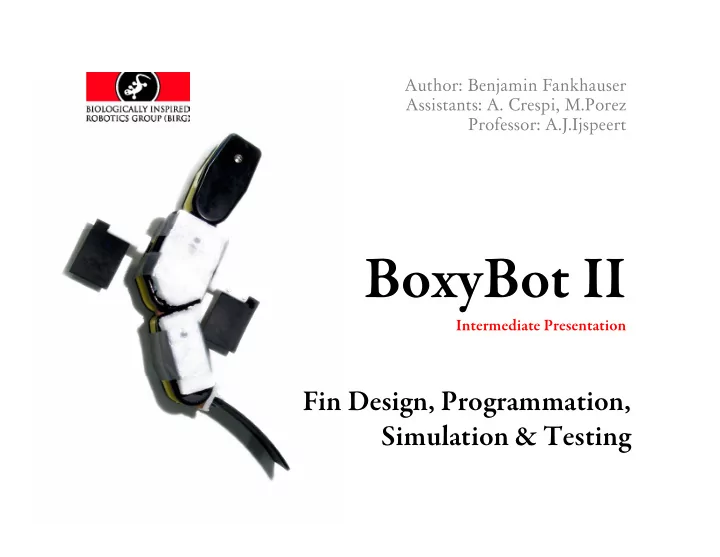
BoxyBot II Intermediate Presentation Fin Design, Programmation, - - PowerPoint PPT Presentation
Author: Benjamin Fankhauser Assistants: A. Crespi, M.Porez Professor: A.J.Ijspeert BoxyBot II Intermediate Presentation Fin Design, Programmation, Simulation & Testing Content Overview General Design Programmation using a CPG
Intermediate Presentation
Fin Design, Programmation, Simulation & Testing
Author: Benjamin Fankhauser Assistants: A. Crespi, M.Porez Professor: A.J.Ijspeert
– Resonance frequency – Efficiency Estimation
)) sin( (
− − ⋅ ⋅ + =
j ij i j j ij i i
r ϕ φ φ ω ω φ & − − =
i i i r r i
r r R a a r & & & ) ( 4
− − =
i i i x x i
x x X a a x & & & ) ( 4
) cos( i
i i
x φ θ + =
) cos( ) ( lim
, 0 i i i i i t
t R X t φ ω θ + ⋅ + =
∞ →
[1] [2]
http://birg.epfl.ch/webdav/site/birg/users/196786/public/BoxyBotII%20‐ %20with%20Controller%20(5%20MB).avi http://birg.epfl.ch/webdav/site/birg/users/196786/public/BoxyBotII%20‐ %20without%20Controller%20(3%20MB).avi
a f r
m m k f + ⋅ = π 2 1
3 3 3
4 l t w E l I E k ⋅ ⋅ ⋅ = ⋅ =
Spring Constant:
Fin 1 : 95x40 mm FR1=0.7±0.1 Hz Fin 2 : 95x60 mm FR2=0.6±0.1 Hz Amplitude vs. Frequency for fin 2
Simulated and Real Amplitude vs. Frequency for fin 2 (FR2=0.6±0.1 Hz), Excitation Amplitude 40°, 60° and 80°
http://birg.epfl.ch/webdav/site/birg/users/196786/public/Simul ation%20‐%20Freq%200.6%20‐%20Resonance%20(1%20MB).avi http://birg.epfl.ch/webdav/site/birg/users/196786/public/Simul ation%20‐%20Freq%201.2%20(1%20MB).avi http://birg.epfl.ch/webdav/site/birg/users/196786/public/Simul ation%20‐%20Freq%201.8%20(1%20MB).avi
Speed and Amplitude vs. Frequency for fin 2 (FR2=0.6±0.1 Hz), Excitation Amplitude 40°
Speed vs. Frequency for fin 2 (FR2=0.6±0.1 Hz)
Simulated and Real Speed vs. Frequency for fin 2, Excitation Amplitude 60°
http://birg.epfl.ch/webdav/site/birg/users/196786/public/BoxyBotII%20‐ %20CaudalFin%20BodySegment%20(3%20MB).avi http://birg.epfl.ch/webdav/site/birg/users/196786/public/BoxyBotII%20‐ %20Pectoral%20Fins%20(2%20MB).avi http://birg.epfl.ch/webdav/site/birg/users/196786/public/BoxyBotII%20‐ %20All%20Fins%20(3%20MB).avi
v f A St ⋅ = Strouhal Number:
[3][4]
– Resonance Frequency FR – Good Efficiency around FR – Use only Caudal Fins for Propulsion
– Comparable Amplitude Plot – Model needs Optimizing
1. A.Crespi, D.Lachat, A.Pasquier, A.J.Ijspeert: „Controlling swimming and crawling in a sh robot using a central pattern generator“, BIRG, School of Computer and Communication Science, Ecole Polytechnique Fédérale de Lausanne (EPFL), Switzerland, 2005 2.
swims using a central pattern generator“, in: Proceedings of the 9th International Conference on Climbing and Walking Robots (CLAWAR 2006), 2006. 3. S.Heo, T.Wiguna, H.Ch.Park, N.S.Goo: “Effect of an Artificial Caudal Fin on the Performance of a Biomimetic Fish Robot Propelled by Piezoelectric Actuators”, Journal of Bionic Engineering 4, 151‐158, 2007 4. J.J.Rohr, F.E.Fish: “Strouhal numbers and optimization of swimming by odontocete cetaceans”, The Journal of Experimental Biology 207, 1633‐1642, 2004