Bridge 10 on VT 242 over Jay Branch Presented by Christopher P. - - PowerPoint PPT Presentation

bridge 10 on vt 242 over jay branch
SMART_READER_LITE
LIVE PREVIEW

Bridge 10 on VT 242 over Jay Branch Presented by Christopher P. - - PowerPoint PPT Presentation

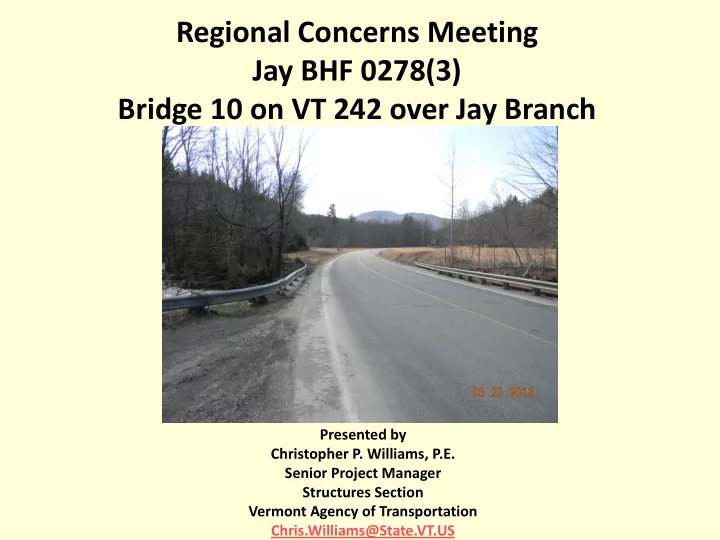
Regional Concerns Meeting Jay BHF 0278(3) Bridge 10 on VT 242 over Jay Branch Presented by Christopher P. Williams, P.E. Senior Project Manager Structures Section Vermont Agency of Transportation Chris.Williams@State.VT.US Location Map


slide-1
SLIDE 1

Regional Concerns Meeting Jay BHF 0278(3) Bridge 10 on VT 242 over Jay Branch

Presented by Christopher P. Williams, P.E. Senior Project Manager Structures Section Vermont Agency of Transportation Chris.Williams@State.VT.US
slide-2
SLIDE 2

Location Map

slide-3
SLIDE 3

Meeting Outline

  • Purpose of the Meeting
  • Structures Section re-organization
  • Existing bridge deficiencies
  • Alternatives considered
  • Summary and recommendation-
slide-4
SLIDE 4

Purpose of Meeting

  • Present the alternatives that we have considered
  • Explain the constraints to the project
  • Help you understand our approach to the project
  • Provide you with the chance to ask questions.
  • Provide you with the chance to voice concerns
  • Build consensus for the recommended alternative -
slide-5
SLIDE 5

Accelerated Bridge Program

  • Began in January 2012
  • Bridges are deteriorating faster than we can fix them
  • Accelerated Bridge Construction (ABC) with short-term

closures used when appropriate

  • Impacts to property and resources is minimized
  • Results in project being delivered faster
  • Goal of 25% of projects into Accelerated Bridge Program
  • Goal of 2 year design phase for ABP (5 years conventional)
  • Visit the website at acceleratedbridge.vermont.gov
slide-6
SLIDE 6

Project Initiation & Innovation Team

  • Part of re-organization in January 2012
  • Currently team of 5
  • All projects will begin in the PIIT
  • Very efficient process
  • Look for innovative solutions whenever possible
  • Involved until Project Scope is defined
  • Hand off to Design Project Manager to continue Project

Design phase -

slide-7
SLIDE 7

Phases of Development

Project Definition Project Design Construction Project Funded Project Defined Contract Award

Identify resources & constraints Evaluate alternatives Public Participation

  • Quantify areas of

impact

  • Environmental

permits

  • Develop plans,

estimate and specifications

slide-8
SLIDE 8

Description of Terms Used

Beams (Superstructure) Deck Abutment (Substructure) Bridge Rail

Cross Section of Bridge

slide-9
SLIDE 9

More Terms Used

Beam (Superstructure) Deck Abutment (Substructure) Span Pier (Substructure) Water Span Bridge Length

Elevation View of Bridge

slide-10
SLIDE 10

Project Background

  • Existing bridge is a single span concrete T-beam bridge
  • Span length =28’
  • Bridge width = 30’
  • Built in 1927 (86 years old) – reconstructed in 1964
  • Posted speed limit = 40 mph
  • Owned and maintained by the State (no local funds)
  • VT 14 functional classification is Rural Major Collector
  • Priority 24 in the State Bridge Program-
slide-11
SLIDE 11

Project Background

  • Traffic Data

TRAFFIC DATA

2015 2035 AADT 1,400 1,500 DHV 290 300 ADTT 170 240 %T 11.6 15.6

slide-12
SLIDE 12

EXISTING BRIDGE DEFICIENCIES

Deficiencies

  • Structural Capacity/Condition of the Bridge Deck and T-beams
  • The bridge is undersized hydraulically
  • Undermining and scour on the downstream wingwall on the north abut

Inspection Report Information (Based on a scale of 9) Bridge Deck Rating 4 Poor Superstructure Rating 5 Fair Substructure Rating 6 Satisfactory

slide-13
SLIDE 13

Looking North

slide-14
SLIDE 14

Bridge Looking South

slide-15
SLIDE 15

Looking Upstream

slide-16
SLIDE 16

Utility along west side

slide-17
SLIDE 17

Southeast Wingwall (Utility under bridge)

slide-18
SLIDE 18

Northeast Wingwall

slide-19
SLIDE 19

Southwest Wingwall

slide-20
SLIDE 20

Underside of Deck

slide-21
SLIDE 21

Layout Showing Constraints

Constraints Right-of-Way Archeologically Sensitive Areas Underground Utilities both sides

slide-22
SLIDE 22

Alternatives Considered

Note that several alternatives were considered in the Scoping Report that did not warrant future consideration so are not included in this presentation

  • Superstructure Replacement
  • Full Bridge Replacement

Note that the method to maintain traffic will be addressed later

slide-23
SLIDE 23

Superstructure Replacement

  • Use 11’ lanes and 4’ shoulders (30’ rail-rail width)
  • Keep existing abutments
  • Address scour at outlet end
  • Maintain existing centerline of road
  • Maintain vertical grade of road
  • Structural deficiencies would be addressed
  • No improvement to hydraulic capacity
  • Complicated by the presence of underground utilities
  • Predicted 40 year life expectancy-
slide-24
SLIDE 24

Full Bridge Replacement

  • Use 11’ lanes and 4’ shoulders (30’ rail-rail width)
  • Increase span to approximately 48 feet
  • Maintain existing centerline of road
  • Maintain vertical grade of road
  • All design criteria would be met
  • Improvement to hydraulic capacity
  • Underground utilities would be relocated
  • Right-of-Way would be required to remove portion of

existing structure

  • Predicted 80 year life expectancy-
slide-25
SLIDE 25

Proposed Bridge Typical

slide-26
SLIDE 26

Layout – Full Replacement

slide-27
SLIDE 27

Profile – Full Replacement

48’ Span

slide-28
SLIDE 28

Methods to Maintain Traffic

  • Off-site Detour
  • Phased Construction
  • Temporary Bridge
slide-29
SLIDE 29

Off Site Detour Option

Closed Bridge

Mileage Summary A-B Thru = 13 miles A-B Detour = 29 miles Added Miles = 16 miles End-End Dist. = 41 miles Major Factors Traffic Volume = 1,400 Added Miles = 16 miles Duration = 6 weeks Note that there are local roads that could be used during a bridge closure but they would not be designated detour routes

slide-30
SLIDE 30

Phased Construction Option

  • Build half new bridge while traffic is on half of old bridge
  • One-Way alternating traffic with lights
  • Queue lengths and queue times can be inconvenient
  • Access to side drives/buildings needs to be considered
  • Relatively long construction duration
  • Workers & motorists in close proximity
  • Can usually be done without ROW acquisition
slide-31
SLIDE 31

Phase 1 – Build half of new bridge

slide-32
SLIDE 32

Phase 2 - Build remainder of new bridge

slide-33
SLIDE 33

One-Way Temporary Bridge w/ Lights

slide-34
SLIDE 34

Alternatives Matrix

Super Replacement w/ Temp Bridge Super Replacement w/ Phased Super Replacement w/ Detour Complete Replacement w/ Temp Bridge Complete Replacement w/ Phased Complete Replacement w/ Detour Maintenance of Traffic $100,000 $40,000 $15,000 $100,000 $40,000 $15,000 Construction w/ CE + Contingencies $673,700 $621,000 $527,800 $870,800 $835,700 $717,600 Preliminary Engineering $174,700 $161,000 $142,100 $258,000 $247,600 $220,800 Right of Way $65,000 $0 $0 $65,000 $40,700 $40,700 Total Cost $913,400 $782,000 $669,900 $1,193,800 $1,124,000 $979,100

36% over Base 17% over Base Base 22% over Base 15% over Base Base

Project Development Duration 5 years 3 years 3 years 5 years 4 years 4 years Construction Duration 18 months 18 months 4 months 18 months 18 months 6 months Mobility Impacts 32 weeks 8 weeks 3 weeks 32 weeks 12 weeks 6 weeks

slide-35
SLIDE 35

Conclusion and Recommendation

Complete bridge replacement while maintaining traffic using phased construction. The primary reasons for this recommendation are:

  • Improves the hydraulic capacity while balancing the

constraints on the project

  • Long term (80 year) solution
  • Short-term bridge closure can not be justified with the

volume of traffic, detour distance and duration

  • Underground utilities add complication to design and

construction phases so difficult to accelerate

  • Temporary bridge can not be justified due to increased

impacts and longer project delivery time-

slide-36
SLIDE 36

A Look Ahead to the Next Steps

  • Evaluate and consider comments received at this meeting
  • Proceed based on recommended alternative unless

adequate justification for reconsidering alternatives

  • Develop Conceptual plans and distribute for comment
  • Prepare for Public 502 Hearing to inform public
  • Reach Project Defined milestone and begin Design phase
slide-37
SLIDE 37

Questions

Direct any questions to: Christopher P. Williams, P.E. Chris.Williams@State.VT.US

https://outside.vermont.gov/agency/vtrans/external/Projects/Lists/Vtrans%20Project%20List/AllItems.aspx

This presentation is available at the web address shown below