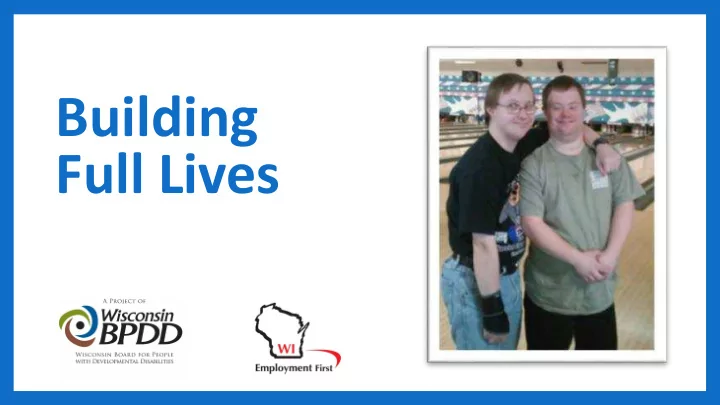
Building Full Lives Refresher: What are the BFL grants? Grants - - PowerPoint PPT Presentation
Building Full Lives Refresher: What are the BFL grants? Grants that provide technical assistance (TA) from content experts to support organizations who want to shift from segregated to integrated community services. The TA assists
Refresher: What are the BFL grants?
- Grants that provide technical assistance
(TA) from content experts to support
- rganizations who want to shift from
segregated to integrated community services.
- The TA assists organizations to help
people have FULL Lives by providing high quality community employment and day services.
Why did we start doing Building FULL Lives (BFL) project?
- Interest expressed by many service
providers when Worklink presented at 2015 EF Conference
- Major need for organizations to
change the way they provide services given new rules that all services must be provided in community settings
- Need for training and technical
assistance to help organizations make the change.
What technical assistance is provided?
- On Site and Remote TA is provided
for one year including:
- Two day on site visit to help
sites conduct an organizational assessment that leads to an action/transformation plan
- Remote coaching ( e.g.,
webinars, skype) to guide sites in implementing the action plan
What technical assistance is provided?
- In person training on Customized Employment
- Training on community mapping and using community
connectors/ instructors
- Training/coaching on the business/fiscal aspects of
transformation
- Training with organizational staff, leadership, families, board
members
What is the grant application process?
- Request for Application is distributed
- Open to any organizations that want
to apply
- Includes a list of expectations for
grantee
- Applicants respond to a set of
questions
- A review team score the applications
based upon a set of criteria
- The highest scoring proposals receive
the Grant
BPDD and the Building Full Lives Project
- BFL Project started in 2016 with 4 service
providers
- Board decided to make it part of the five year
state plan (2017-2021)
- Added five more providers in 2017
BFL Service Providers
Round 1 (2016)
- Goodwill of Southeast Wisconsin
(Milwaukee)
- ODC Inc (WI Rapids and Marshfield)
- Headwaters Inc (Rhinelander)
- Bridge for Community Life (Hudson)
Round 2 (2017)
- VIP Inc (Elkhorn)
- Threshold (Westbend)
- Easterseals Southeast Wisconsin
(Waukesha)
- Green Valley Enterprises (Beaver
Dam)
- Bethesda (Watertown)
BFL Project Goals
For the Organizations Involved:
- Shift business models from segregated to
integrated supports and services
- Increase in number of people moving
from segregated to integrated services
- Increase capacity to provide high quality,
community- based day and employment services
- Increase integrated employment rates
For the Individuals Involved:
- Increase in the amount of time spent
in the community connecting with people who are not paid supports
- Increase in skills and level of
independence
- Increase in time spent working in a
paid job
- Learning Collaborative
- Service proposal
development
- DHS/MCO/ICA involvement
- Project evaluation
- Individual assessment
and reporting tools
- Webinars
- Face to Face Training
- Coaching and Technical
Assistance
- Lean Value Stream
Mapping
- Action Plan
Development
- Pilot groups
Organizational Self Assessment Technical Assistance Learning Collaborative Evaluation
What have been some of the challenges?
- Shifting the culture of
- rganizations/staff attitude
- Huge organizational change—re-
writing job descriptions, re-training staff
- Family fear/opposition
- Understanding the business/fiscal
piece of making such a huge transformation
- Developing solid, consistent service
agreements with funders/MCO’s and DVR
BFL Outcomes So Far
BFL Impact – Service Provider Responses
All sites report that BFL pilot participants are:
- Significantly increasing their skills and ability to be
more independent in the community;
- Spending significantly more time in paid employment
in the community;
- Expressing more happiness/satisfaction while
participating in the program;
- Making more choices about how they spend their day;
- Significantly increasing the number of unpaid
connections they have in the community.
BFL Impact – Service Provider Responses
All sites report as a result of participating in the BFL grant their organization is:
- Experiencing significant changes in philosophy, culture
and values;
- Increasing expectations for paid work in the community
for individuals with disabilities;
- Increasing the number of policies/practices that
support integrated employment in the community;
- Better supporting individuals with disabilities to
develop connections in the community;
- Better supporting individuals to make informed choices;
- Better supporting individuals to develop skills to be
more independent in the community.
BFL Impact – IE Outcomes
Out of 46 individuals with disabilities in the pilot, 26 now have paid work in the community.
Organizational Outcomes Achieved
- Shutting doors to work centers-no new entries
- Organizational restructuring--Creation of new
job descriptions/duties that focused on community based services
- Increase in staff skills level in developing
community connections, finding jobs
This Photo by Unknown Author is licensed under CC BY-NC-SA
Reported Project Highlights:
- “Decreased in house/center based prevocational
hours by 4500.”
- “Increased community connections for 77
individuals.”
- “We have utilized the tools provided by the grant to
build the foundation for our transformation from 100% facility based to community”
- “Decreased the number of hours people are
participating in sub minimum wage.”
- “Staff are more skilled in developing community
connections for individuals with disabilities.”
More Highlights…
- “My organization is now having significant open
conversations about the difference between community “outings” and community engagement and life skills training.”
- “We have been having meaningful conversations with
all individuals participating in our program about how they want to spend their day.”
- “We have had an organizational mind shift that has
people thinking and talking about getting more involved in the community through work and non- work connections.”
- “The work we have done with our current pilot
participants is already getting other folks we serve (i.e., that are not in the pilot) excited about what they might be able to do in the community.”
More…
- “We are working with all staff who work for us, and
everyone who participates in our program/families to understand that community integrated employment is an expectation for everyone we serve.”
- “Our biggest accomplishment is seeing the growth in
self-confidence of all of the individuals in the pilot and the positive results of each person getting a job along the way.”
- “The pilot has been a catalyst for change—people are
supporting breaking down silos.”
And More!
- “There has been a change in staff attitude. They are seeing things/people changing in a
positive way and actually hearing it from the people they serve.”
- “Staff listening skills have improved dramatically –they are listening, threading and
making change happen for individuals.”
- “Staff are working with the whole person—not separate silos—i.e., one for work and
- ne for community day services.”
- “We are seeing major changes in people’s lives—whole different kind of life—whole
different conversations. Other people are saying ‘I want to do that’.”