Building Mental Toughness St Finbars Catholic Primary School, - - PowerPoint PPT Presentation

building mental toughness
SMART_READER_LITE
LIVE PREVIEW

Building Mental Toughness St Finbars Catholic Primary School, - - PowerPoint PPT Presentation

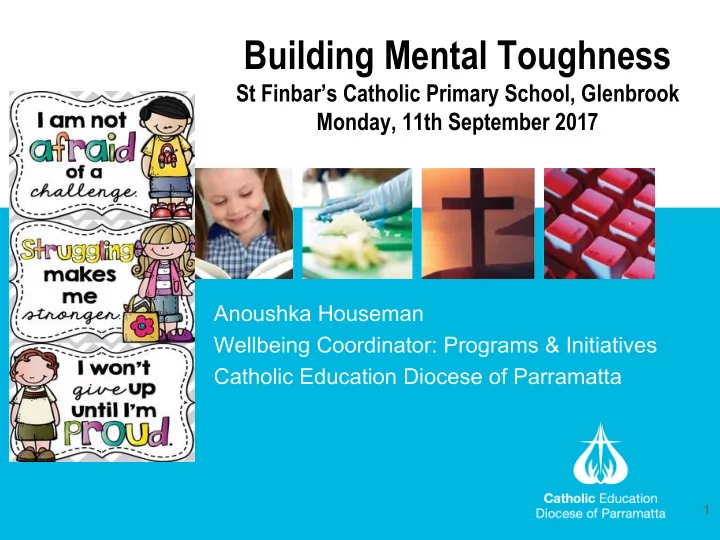
Building Mental Toughness St Finbars Catholic Primary School, Glenbrook Monday, 11th September 2017 Author Anoushka Houseman Wellbeing Coordinator: Programs & Initiatives Catholic Education Diocese of Parramatta 1 What is Mental

slide-1
SLIDE 1

Author

Building Mental Toughness

St Finbar’s Catholic Primary School, Glenbrook Monday, 11th September 2017

Anoushka Houseman Wellbeing Coordinator: Programs & Initiatives Catholic Education Diocese of Parramatta

1

slide-2
SLIDE 2

What is Mental Toughness?

Being able to:

  • cope with and bounce back from difficult experiences
  • adapt to challenging situations and experiences
  • maintain a sense of hope and positivity
  • believe that you have the ability and resourcefulness to

get through these experiences

  • persevere and show determination (never give up!)

Mental Toughness is about being RESILIENT

2

slide-3
SLIDE 3

What it doesn’t mean...

Mental toughness is not about:

  • being happy all the time
  • rarely experiencing disappointment / sadness / anger
  • always reaching your goals
  • being uncompromising or rigid in your beliefs
  • always being sure of yourself

3

slide-4
SLIDE 4

What makes some kids MORE resilient than others?

  • Positive modelling from key adults around them
  • Being naturally more optimistic
  • Being able to self regulate their emotions
  • Being more connected with others
  • Experiencing success
  • A sense of independence
  • Having high self esteem
  • Being empathic towards others
  • Being able to manage anxiety better

4

slide-5
SLIDE 5

Anxiety

  • Anxiety is a normal and necessary emotion, which can

help us detect and avoid danger.

  • Normal anxiety is transient, manageable and can be

motivating.

  • The fight - flight response is a natural and evolved

reaction to danger.

  • We need anxiety - it protects us and helps us to focus!
  • However sometimes our brains may perceive a threat

that’s not actually real or is out of proportion to the event.

  • Event -> thought (alarm) -> feeling-> behaviour

5

slide-6
SLIDE 6

Excessive Anxiety

  • A “false alarm” when there is no actual danger or threat
  • An exaggerated response to a perceived threat
  • Anxiety can be a problem when it stops children from

progressing in the three responsibilities of childhood: learning, making friends and having fun.

  • 1 in 5 students are at risk of developing an anxiety

disorder.

  • Anxiety may be defined as a disorder when these

responses to stress are more intense than would be considered appropriate, are more frequent and non-transient and disrupt the child’s ability to function normally.

6

slide-7
SLIDE 7

What makes some kids more anxious?

  • Genetics (about 30 - 40% of anxiety is considered to be

genetic/inherited)

  • Environmental factors (e.g., high conflict in the home,

trauma, peer rejection, chronic illness, disruption in schooling, overly protected, unrealistic expectations, modelling etc)

  • A combination of both

7

slide-8
SLIDE 8

Understanding Anxiety

  • Helping young people to understand anxiety can really help

them regain their sense of power and control over their emotions.

  • Anxiety can be scary but it cannot hurt you. It is designed to

protect you.

  • Notice physical symptoms: fast breathing, heart rate increases,

butterflies in stomach, shaky or jittery etc and understanding why you are experiencing them can be helpful.

  • Understand why these physical symptoms are happening in

your body and how to combat it.

8

slide-9
SLIDE 9

What Can Anxiety Look Like (Behaviours)?

  • Perfectionism
  • Difficulty coping with changes /rigid thinking - resistance
  • Always needing to be right
  • Wanting to take charge / control
  • ‘Shutting down’ / non responsive
  • ‘Perfect’ at school (often not at home!)
  • Oppositionality / stubbornness
  • Avoidance of certain things/people
  • School refusal
  • Self harm

9

slide-10
SLIDE 10

Thoughts Feelings and Behaviours

  • We often assume it is the situation that determines how we will feel
  • Actually it is the way we perceive or think about the situation that

determines how we will feel about it and act

  • How we feel about the situation may then determine how we will

act

  • Example: Two students who both spent very little time on a

homework project and get low marks = SITUATION

  • Thought 1: I am stupid, I can’t do schoolwork
  • Action 1: Give up on future projects

versus

  • Thought 2: I didn’t prepare and paid the price
  • Action 2: more effort put into future projects

10

slide-11
SLIDE 11

Unhelpful Thinking Styles

  • All or nothing / black & white thinking / labelling
  • Jumping to conclusions (mind reading, predicting)
  • Personalisation (self blaming)
  • Overgeneralisation (one time means every time from now on)
  • Catastrophising (expect worst possible outcomes)
  • Emotional reasoning (using our emotions as evidence)
  • Filtering (not seeing the full picture)
  • ‘Should have’ statements

11

slide-12
SLIDE 12

Challenging Unhelpful Thoughts

  • Not just about thinking positively
  • It’s about REALISTIC thinking
  • Do we have genuine evidence for these unhelpful thoughts
  • r are we getting trapped into an unhealthy style of

thinking?

  • Challenge unhelpful thoughts by collecting conflicting

evidence (idea of being a thought detective)

  • Replace unhelpful thought with a more realistic or

alternative thought that is more positive and helpful

  • Remembering thoughts do not have to dictate our actions

12

slide-13
SLIDE 13

What else increases anxiety?

  • Avoidance of things that worry you breeds more anxiety
  • Messages and/or modelling of key adults around them that

are consistent with the belief that something is dangerous

  • r scary (e.g., helicopter parenting)
  • A lack of independence
  • Overexposure to news media (vicarious trauma)
  • Social media can contribute and exacerbate
  • A sense of helplessness
  • Not feeling connected with others / isolated

13

slide-14
SLIDE 14

More ways to teach mental toughness

Teaching:

  • Growth mindset
  • Mindfulness skills
  • Social skills to interact positively with others
  • Empathy and helping behaviours
  • Emotion coaching
  • Effective goal setting
  • A positive self concept
  • Optimism and hope
  • Change is part of life

14

slide-15
SLIDE 15

What is a Growth Mindset?

  • Embracing challenges
  • Persist despite setbacks
  • Learning from criticism
  • Understand that effort and practice is needed to get

better at something

  • Learning from others and being inspired by others

successes

  • +ve academic and social outcomes

15

slide-16
SLIDE 16

Mindfulness

  • Mindfulness is an awareness of the here and now
  • Not the past, not the future, not being on auto pilot
  • It is using all the senses to ground yourself in the present

and pay attention to what is happening right now without any judgment - accepting

  • Awareness & acceptance
  • Takes practice to get good at
  • Consider the Smiling Mind app

16

slide-17
SLIDE 17

DIY Glitter Jars - As A Calming Tool

Glitter jar - "Just Breathe" clip

17

slide-18
SLIDE 18

Social Skills to promote

  • Observing successes and skills in others
  • Modelling of positive behaviours observed in others (e.g.,

eye contact and positive body language, admitting mistakes, forgiving etc)

  • Assertiveness (as opposed to aggression or meekness)
  • How to start and continue conversations with others
  • Reading social cues
  • Developing problem solving skills

18

slide-19
SLIDE 19

Problem Solving

19

slide-20
SLIDE 20

Teaching Empathy & Helping Behaviours

  • Kids feel empowered by helping others
  • Teach kids from an early age to understand what it is like

to walk in someone else’s shoes

  • Helping others increases self esteem and empathy
  • Helping others also contributes to a sense of

accomplishment and self confidence

  • Use emotion coaching to help develop empathy and

emotion regulation.

20

slide-21
SLIDE 21

Emotion Coaching

  • Children need feedback about their feelings and thoughts to

learn self-control

  • Over time children learn to use ‘feeling’ words to describe

their experiences to others

  • ‘When children experience an attuned connection

[empathy] from a responsive adult they feel good about themselves because their emotions have been given some resonance and reflection.’ Siegel, D. 1999 The Developing Mind Guilford Press

  • This helps children to learn emotional regulation.

21

slide-22
SLIDE 22

How to do Emotion Coaching

  • Time it when noticing early stages of emotion
  • Reflect on their perspective
  • Then use 3 - 4 statements indicating you understand what

they are feeling

  • Check your understanding of what they are going through

by reflecting what you think you have heard from them.

  • Validate their emotions not their behaviour. Focus only on

emotion at this point.

22

slide-23
SLIDE 23

Emotion Coaching continued...

  • Use ‘stem’ statements to help label the emotion and

show empathy:

– ‘I’m guessing you’re feeling ….’ – ‘It’s horrible when you feel….’ – ‘It seems like you’re …’ – ‘If somebody said/did that to me, I’d be feeling pretty …’

  • Although we may worry that by doing this we are

increasing their emotion, the reality is the opposite

  • This helps to calm them / emotionally regulate
  • Deal with behaviour /problem solve later if needed

23

slide-24
SLIDE 24

Goal Setting

  • Ensure goals are specific and realistic
  • Breakdown goals into smaller steps
  • Build a ladder with ultimate goal at the top
  • Make sure the ladder has gradual steps to mastery
  • Start at the bottom step and set up rewards for achieving

success at each step

  • Use problem solving skills
  • Goals may be about achieving anxiety goals or about

learning goals or friendship goals etc - can be anything!

  • Focus on one goal at a time
  • Celebrate all successes and effort!

24

slide-25
SLIDE 25

25

slide-26
SLIDE 26

Positive Self Concept

  • Build on your child’s strengths
  • Encourage independence (self efficacy and autonomy)
  • Limit reassurance (encourage them to try to work out

answers to their own questions)

  • Avoid rescuing your child (‘helicopter’ parenting!) - they need

experience to develop a positive self concept

  • Remind kids about instances where they have successfully

handled previous difficult situations

26

slide-27
SLIDE 27

Optimism and Hope

  • Model this glass half full approach
  • Gratitude jars can help remind yourself of what is good in

your life (helps re-focus to positives)

  • Teach and promote humour and model how we can laugh

at ourselves and see the light side

  • Help kids to keep things in perspective
  • Encourage them to know they can get

through a difficult situation

  • it won’t always be like this

27

slide-28
SLIDE 28

Change as part of life

  • Change is a natural part of life
  • Change is inevitable
  • Although changes can sometimes feel scary, many

changes can be positive. Give kids examples of positive changes they have experienced

  • When things first change it can be difficult to get used to but

with time, we learn to adapt

  • Change can help us to grow and mature

28

slide-29
SLIDE 29

Other ways parents can help...

  • Give a clear message that you believe in your child’s ability

to handle situations but you are always available to help

  • Your role is to facilitate and develop their skills to handle

situations NOT to take over!

  • Model positive coping behaviour when you experience

anxiety yourself

  • Try not to lose control of your own emotions or let your own

frustrations through

  • Have a united approach to parenting with all key adults in

their lives

  • Provide calm, clear consequences when necessary
  • Avoid excessive reassurance

29

slide-30
SLIDE 30

30