SLIDE 1
+
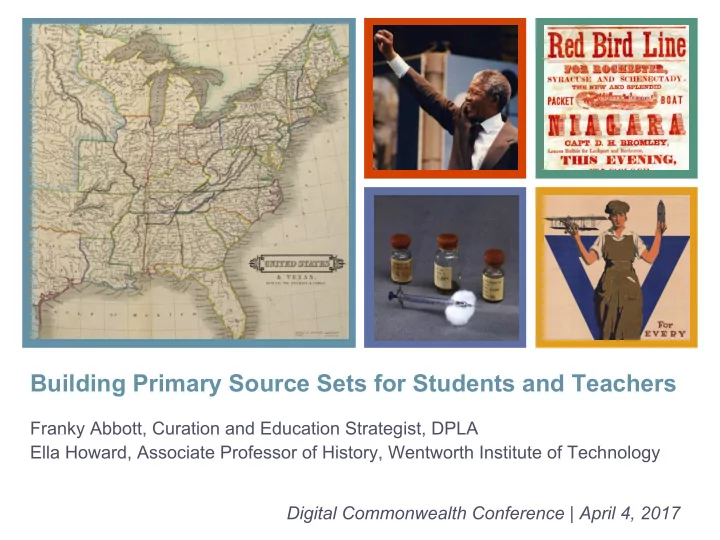
Building Primary Source Sets for Students and Teachers
Franky Abbott, Curation and Education Strategist, DPLA Ella Howard, Associate Professor of History, Wentworth Institute of Technology Digital Commonwealth Conference | April 4, 2017
SLIDE 2 What is DPLA?
library that provides access to materials from libraries, archives, and museums across the US
who make their content available through a single website
Courtesy of David Rumsey
SLIDE 3 What does DPLA offer?
- Cultural heritage materials
- Rich and varied primary sources
- American history and culture and more
SLIDE 4 What does DPLA offer?
- National and local sources
- Vetted and described by information
professionals
+
SLIDE 5 Value of Primary Sources
context!
based instruction
storytelling, DBQs, timelines, and other research projects
SLIDE 6 What are the DPLA Primary Source Sets?
- Topic-based “highlight reels”
Topical collections of primary source images, documents and text excerpts, audio/video clips, and more
- For Middle School through Higher Ed
Designed to be used in grades 6-12 and early years of higher education to add richness to units of study and opportunities for students to consider primary sources
- By Teachers, For Teachers & Students
Created by secondary and collegiate educators who comprise the DPLA’s Education Advisory Committee
- 100 interdisciplinary topics
Currently 100 topics in US history, American literature, World History, History of Science & Technology, and Art History
SLIDE 7
Exploring the Primary Source Sets
dp.la/primary-source-sets
SLIDE 8 Subjects, such as:
Literature, World History
Americans, Science and Technology Time Period, such as:
- Civil War and Reconstruction
- Great Depression and World
War II
Finding the right DPLA Primary Source Set
You can use filters to browse Primary Source Sets by:
Courtesy of Atlanta History Center via Digital Library of Georgia
SLIDE 9
Front page of a Primary Source Set
SLIDE 10 Source Page
Space for additional description and/or transcription as needed.
SLIDE 11
Teaching Guide
SLIDE 12
SLIDE 13 Discussion question #5: After reading the letter from Samuel Adams, Paul Revere, and others, reflect
- n what events or actions may have been planned or considered at this
- meeting. What organizations may have attended or planned the meeting?
SLIDE 14
SLIDE 15
Discussion question #4: Why was the postcard such a popular method of communication for both suffragists and anti-suffragists? What are its advantages? With the 1915 postcard of Kewpie dolls, which strategies was the National Woman’s Party using to appeal to readers?
SLIDE 16
SLIDE 17
SLIDE 18
Classroom Activity: Ask students to label the map of Salem Village with specific scenes from The Crucible where the action takes place. Students should determine if the scene is part of the exposition, rising action, climax, falling action, or resolution.
SLIDE 19
SLIDE 20 Discussion question #3: Using the Black Panther Party Platform, explain what resources and
- pportunities the Party members wanted for the African American
community.
SLIDE 21 Implementation Ideas from Teachers
Courtesy of Cooper Hewitt, Smithsonian Design Museum
SLIDE 22 Practice Document-Based Questions
Document-Based Questions (DBQs) ask students to use source evidence to support an argument or position. Pull sources from the sets to devise a DBQ for your students
- r assign a DBQ from one of the teaching guides. Use a
shorter selection or the whole excerpt.
Excerpt from the 1916 Congressional bill that established the National Park Service from Environmental Preservation in the Progressive Era.
SLIDE 23
Example
Discussion question #4 from Jacksonian Democracy?: “Using Andrew Jackson’s message to Congress concerning Indian Removal and the 1830 pamphlet by the Cherokee nation, explain whether Indian Removal was a democratic action taken by the federal government or an invasion of Cherokee sovereignty.
SLIDE 24 Introduce a topic
Ask students to analyze, interpret, or respond to a specific primary source from the sets to kick off your class session or lesson unit. Or let students pick a source! Use an opener to engage prior knowledge, practice primary source analysis, and establish a purpose for learning.
A postcard showing an armed man taking on a disease-carrying mosquito, 1905, from The Yellow Fever Epidemic of 1878.
SLIDE 25 Example
Begin your unit on late nineteenth century immigration this photograph. What does it reveal about the experience of immigrating to the US? What questions does it raise?
A photograph of immigrants arriving at Ellis Island, ca. 1900. from Immigration and Americanization, 1880-1930.
SLIDE 26 Build students’ independent research skills
Have students pick a set and use the sources in their next research project on that topic. For a more focused selection, try a thematic subset like Science and Technology or Women.
Alexander Graham Bell's 1876 “large box” telephone from The Invention of the Telephone.
SLIDE 27
Experiment with a classroom activity
Each teaching guide has at least one classroom activity. Try a new way of bringing primary sources to life in your classroom. Examples:
Create – Students create a vintage radio or TV advertisement in small groups to raise awareness about polio prevention in the activity from There is No Cure for Polio Debate – Students teams stake a claim and debate each other in the activity from the Texas Revolution set.
SLIDE 28
Contextualize current events
Use the primary source sets to help students make connections between past and present. Examples:
Ida B. Wells and Anti-Lynching Activism may offer an important historical counterpart to the #BlackLivesMatter Movement. Sets on the Fifteenth Amendment and Fannie Lou Hamer and the Civil Rights Movement in Mississippi could help contextualize voting rights activism today. Sets on immigration provide a historical lens for contemporary news stories about immigration of Latinos, Muslims, and Syrian refugees.
SLIDE 29
Contextualize literature
Use the primary source sets to teach works of literature in historical and cultural context.
SLIDE 30
Compare media
Select examples of a type of media (postcards, posters, buttons, pamphlets, political cartoons, advertisements, etc) featured throughout the sets and analyze how they communicate a message to their audiences.
SLIDE 31
Example
For example, analyze three posters from the sets to introduce students to visual reading and build interpretation skills. What makes a poster powerful? Who is its audience? How does it share its message? Why pick a poster to share a message?
SLIDE 32 Future Primary Source Sets
Courtesy of the University of Virginia Library.
60 new sets by Dec 2018 New EAC members Anyone can suggest new topics
SLIDE 33
BUILDING PRIMARY SOURCE SETS FOR STUDENTS AND TEACHERS
Ella Howard Associate Professor of History Wentworth Institute of Technology
SLIDE 34
Education Advisory Committee
§ K-12 Teachers § College Professors § Librarians § Learning Objectives
SLIDE 35
SLIDE 36
SLIDE 37
SLIDE 38
SLIDE 39
SLIDE 40
Classroom Uses
§ Supplement textbook § Foster discussion § Writing assignments § Springboard for research § Information literacy
SLIDE 41
Benefits
§ Efficient use of time § Efficient use of energy § Allows self-directed learning