C Grou p Huar d and llerelupmen t Centr e Note for Dr . L . C . F . - - PDF document

c
SMART_READER_LITE
LIVE PREVIEW

C Grou p Huar d and llerelupmen t Centr e Note for Dr . L . C . F . - - PDF document

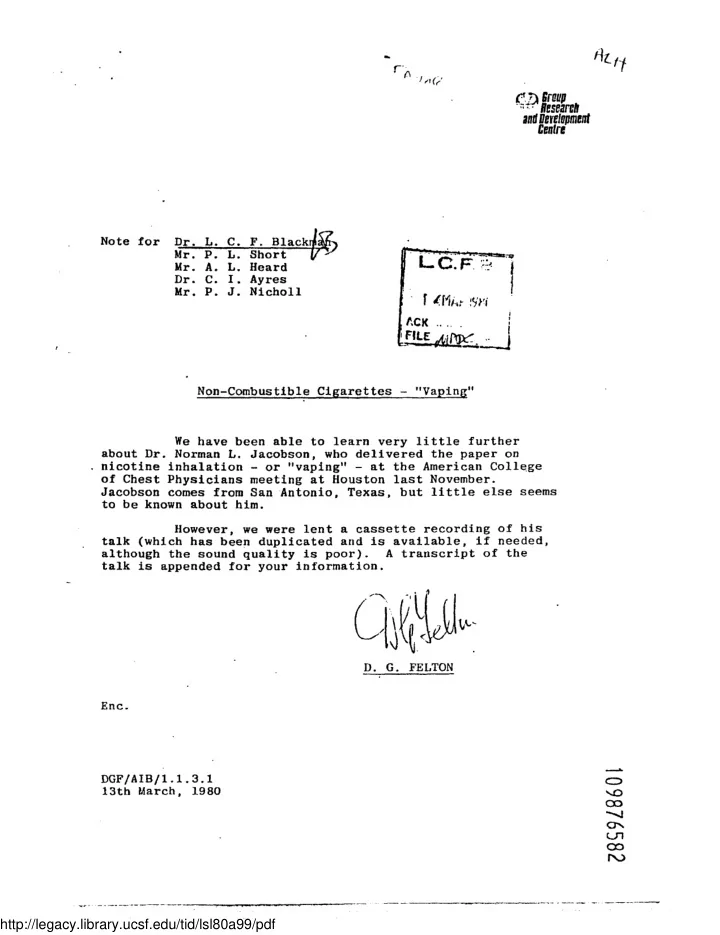
r n C Grou p Huar d and llerelupmen t Centr e Note for Dr . L . C . F . Black r~a l Mr . P . L . Shor t Mr . A . L . Hear d Dr . C . I . Ayre s Mr . P . J . Nichol l Non-Combustible Cigarettes - "Vaping " We have been able to learn very


slide-1
SLIDE 1

r n

C

Group

Huard

and llerelupment Centre

Note for Dr . L. C . F . Black r~al Mr . P . L . Shor t Mr .

A .

L . Hear d Dr . C. I . Ayres Mr . P . J . Nichol l Non-Combustible Cigarettes - "Vaping " We have been able to learn very little furthe r about Dr . Norman L . Jacobson, who delivered the paper on . nicotine inhalation - or "vaping" - at the American Colleg e

  • f Chest Physicians meeting at Houston last November

.

Jacobson comes from San Antonio, Texas, but little else seem s to be known about him . However, we were lent a cassette recording of hi s . talk (which has been duplicated and is available, if needed

,

although the sound quality is poor) . A transcript of the talk is appended for your information . D . G . FELTON Enc . DGF/AIB/1 .1 .3 . 1 13th March, 1980

http://legacy.library.ucsf.edu/tid/lsl80a99/pdf
slide-2
SLIDE 2

Presentation by Dr . Norman L . Jacobson of San Antonio to a meeting of the American College of Chest Physicians at Housto n

  • n 4-8th November, 1979 .

Non-combustible Cigarette : Alternative Method of Nicotine Deliver y Good Morning, Chairman, Colleagues . Now I am about to propose a cigarette for an alternativ e method of nicotine delivery . If nicotine is truly addicting an d if tar, carbon monoxide and other by-products of smoking ar e injurious to health, then obviously, it would be beneficial t o develop a cigarette which supplies nicotine, but eliminates the

  • ther toxic ingredients . Numerous efforts to deliver nicotine
  • nly through other vehicles including nicotine tablets

,

injections, aerosols and gum have been partially successful , but have been found impractical or unsatisfying

.

This presentation describes a practical and apparentl y satisfying method of administering nicotine by nicotine vapou r inhalation via a non-combustible cigarette, hereafter referre d to as an NCC . To our knowledge, a method of inhaling pure nicotine vapour has not been reported previously . To simplif y description, we will hereafter refer to nicotine vapou r inhalation through an NCC as vaping and people who inhal e nicotine vapour as vapers . The NCC closely approximates the size and appearanc e

  • f a standard cigarette . It allows a slightly impeded flow o f

inhaled air and is designed to deliver approximately 50

ug o f

nicotine per 300 cc of inhalation . This is approximately hal f

  • f the quantity of nicotine delivered from each cigarette puff

.

The difference between cigarette smoking and inhaling nicotin e vapour through an NCC requires description . Cigarette smoking consists of a bolus of smoke, approximately 30-50 cc in size

,

drawn into the mouth and held and subsequently inhaled an d dispersed throughout the lungs . Vaping represents the immediat e inhalation of 3-400 cc of nicotine laced air directly into th e lungs .

  • CO

v

LTI CO

W http://legacy.library.ucsf.edu/tid/lsl80a99/pdf

slide-3
SLIDE 3

i

  • 2-

In this study, six subjects were tested over nin e consecutive days . Cigarettes only were smoked ad libitum o n days 1 thro 9 and NCC's only were inhaled ad libitum on days

4

thro 9 . .Blood carboxyhaemoglobin levels were determined dail y to verifythat subjects were either smoking standard cigarette s

  • r not smoking cigarettes . 24 hour urines for cotinine wer e

collected daily and measured by gas chromatography . Cotinine is the main metabolite of nicotine and is used as an estimat e for total nicotine consumption . Serum nicotine estimations were performed using a regular immunoassay method

  • n the secon d

and third day of cigarette smoking and on the last two days o f

1
  • NCC inhalation . The test results reliability were checked i n

the usual fashion using split samples and controls containin g known quantities of nicotine and cotinine . Carboxyhaemoglobi n levels during cigarette smoking varied between 3 .3% and 8 .6% , with an average of 5% . These levels are consistent with carbon monoxide measurements in other smoking studies

.

Following conversion, NCC's on day 4 of the experiment , the daily average level promptly dropped 0 .8%, a level consisten t with non smokers . 24 hour urine cotinine excretion varied between 1 .9 and 5 .8 mgs during cigarette smoking, which are level s similar to those recorded in other smoking studies . Between

0 .4 and 8 .6 mgs of cotinine were excreted by using NCC's . Th e

highest urine cotinine levels on cigarettes and NCC's were i n the most experienced vaper . Four subjects, 2 naive vapors an d 2 experienced vapers, excreted less cotinine with NCC's tha n with cigarettes_ These four subjects gradually reduced thei r urine cotinine excretion after changing from standard cigarette s to NCC's, until reaching their rather fixed daily excretion rate

.

This raises the possibility that less nicotine is required fro m a pure vapour source to provide equivalent satisfaction in som e people . One experienced vaper excreted similar quantities o f nicotine with NCC's and cigarettes and another excreted mor e nicotine - excuse me - cotinine with NCC's . The two high cotinine ._ excretors demonstrated widely variable daily cotinine excretions . A learning factor may exist, as a subsequent study on one of the CO naive vapers yielded substantially higher cotinine and nicotin e levels . Serum nicotine levels were measured before, 2 minutes

UO

after and 5 minutes after smoking a 1 .2 mg nicotine Lark filte r

cigarette for

  • lf1 mi ni~tn norin .t

http://legacy.library.ucsf.edu/tid/lsl80a99/pdf

slide-4
SLIDE 4

I

  • 3-

Serum nicotine levels 2 minutes after smoking rose to a n average of 40 .5 ng per ml on the second day and 48 ng per ml

  • n the third day . This corresponds to values obtained b y
  • ther workers .

Changing from the puffing technique fo r cigarette smoking to nicotine vapour inhalation was easil y accomplished by all subjects . No serum nicotine measurement s were made on days 4 through 7 in order to permit practic e vaping . Serum for nicotine was collected on the 8th and 9th day at 2 hour intervals between 9 a .m . and 7 p .m . The 11 a.m . ,

3 p .m . and 7 p .m .

specimens were secured randomly and the 9 a .m .

,

1 p .m . and 5 p .m . specimens were secured 2 minutes afte r

inhaling nicotine through the NCC every 30 seconds for 10 minutes . The figure shows a rather haphazard array of nicotine levels

.

Each subject demonstrated a wide variation of results on bot h days . There was also a wide range of average nicotine level s among the subjects . Plateau effect was not demonstrated . The peaking and trough patterns did not consistently correspond to the alternating programmed nicotine inhalation and rando m sampling . There was no definite relationship between the levels

  • f serum nicotdne• .reached while smoking cigarettes and those while

vaping . For example, the subject represented by the open square averaged 35 ng per ml at 2 minutes after smoking a cigarett e and averaged 50 ng per ml while vaping . On the other hand, th e subject represented by the solid triangle averaged 59 ng per ml at 2 minutes after smoking and only 23 ng per ml while vaping

.

No side effects occurred with normal NCC usage . I n an acute study, one :experienced vaperb efforts to reach toxi c levels of nicotine with rapid inhalation of nicotine vapour , produced hiccups at

a comparatively low serum nicotine leve l

  • f 25 ng per ml . No hiccups occurred, though faintness did ,

with rapid forced cigarette smoking, which produced a ver y high serum nicotine level of 149 ng per ml . Similar bloo d pressure elevations and increased pulse rates were demonstrate d with forced vaping and smoking . It is noteworthy tha t nicotine gum chewing also produces numerous side effect s including hiccups at levels lower than or equivalent t o cigarette smoking .

http://legacy.library.ucsf.edu/tid/lsl80a99/pdf

slide-5
SLIDE 5 I

f

  • 4 -

These findings imply that smoking reduces th e appearance of nicotine side effects through an undefine d mechanism . Perhaps carbon monoxide or other products of pyrolysis suppress central nervous system nicotine receptors

  • r otherwise alter the autonomic nervous system . If so ,

smoking may suffer the additional stigma of reducing the body' s response to nicotine and consequently increasing the nicotin e requirement to produce desired physiologic responses . Nicotine inhalation seems satisfying and the four experienced vapers are far more heavy cigarette , smokers and presently are inveterate vapers or can easily transfer betwee n NCC's and cigarettes . The two subjects who were first expose d to NCC's during this study,minimised or eliminated their cigarett e consumption while on study and continued vaping until thei r supply of NCC's was halted . We have demonstrated that nicotine vapour can b e inhaled and that meaningful levels of serum nicotine and urin e cotinine are achieved by inhalation . Nicotine vapour inhalatio n varies from person to person as does nicotine consumption var y among cigarette smokers . It is likely that experienced vapers will titrate their inhalation to maintain a certain nicotin e level in the same fashion as cigarette smokers . The vapers have the advantage of vaping while working, attending clas s and flying, since there are no noxious fumes and odours to offen d non smokers . If NCC's are widely accepted, it will substantiat e the growing conviction that nicotine alone is the habituatin g 'ingredient in cigarette smoking . Subsequently, it will b e necessary to determine if inhaling NCC causes a reduction o f diseases attributed to cigarette smoking . Since it is likel y that nicotine alone produces long term harmful effects, th e

NCC does not represent a safe cigarette, but it may be a worth y

alternative to the standard tobacco cigarette .

  • Thank you .

http://legacy.library.ucsf.edu/tid/lsl80a99/pdf

slide-6
SLIDE 6
  • 5-

Questions and Answers Hassan (?) from Philadelphi a Q .

  • What do you
  • in this study, you just ha d

the subjects with cigarette smoking and vapour smoking ? A .

  • That is correct .

Norman . There has been a lot of trial nicotine gum as a technique to help people stop smoking . Can you vary th e amount of nicotine or gradually taper off the nicotin e content of NCC's? Would it be a viable tool perhaps fo r smokers cessation ? A .

  • Yes . That is in our expense(?) department .

They are not expensive, you know, as an experimental tool

,

at this point, so really it is hard to define the cost

,

but, Yes, the dosage can be varied and of course, nicotin e chewing gum has had a few problems :

1 . It is not socially ideal . It is hard to featur e

°lawyers and bankers at meetings chewing gum and also yo u know the problem of getting a bolus or an adequate dose o f nicotine by chewing gum . It is not as effective as inhalation, which is a more rapid and effective way o f administering nicotine and furthermore, nicotine chewin g gum tends to have side effects, as Russell has shown

.

Q .

http://legacy.library.ucsf.edu/tid/lsl80a99/pdf

slide-7
SLIDE 7

isnt!vsceet.-.vr+sce

  • cur
1'~e,~aa.rib56~a~« .k=«=4sn`r,.aw :Mw .7~654ast

..'a&we ..,7-A.,~r :.=.A~-°-. .- .'.•urn vn.,k:a .e :: :~x :,;:

$85918601

http://legacy.library.ucsf.edu/tid/lsl80a99/pdf