Canadian Records Management February 2005 Summit Canadian Records - - PDF document

canadian records management february 2005 summit
SMART_READER_LITE
LIVE PREVIEW

Canadian Records Management February 2005 Summit Canadian Records - - PDF document

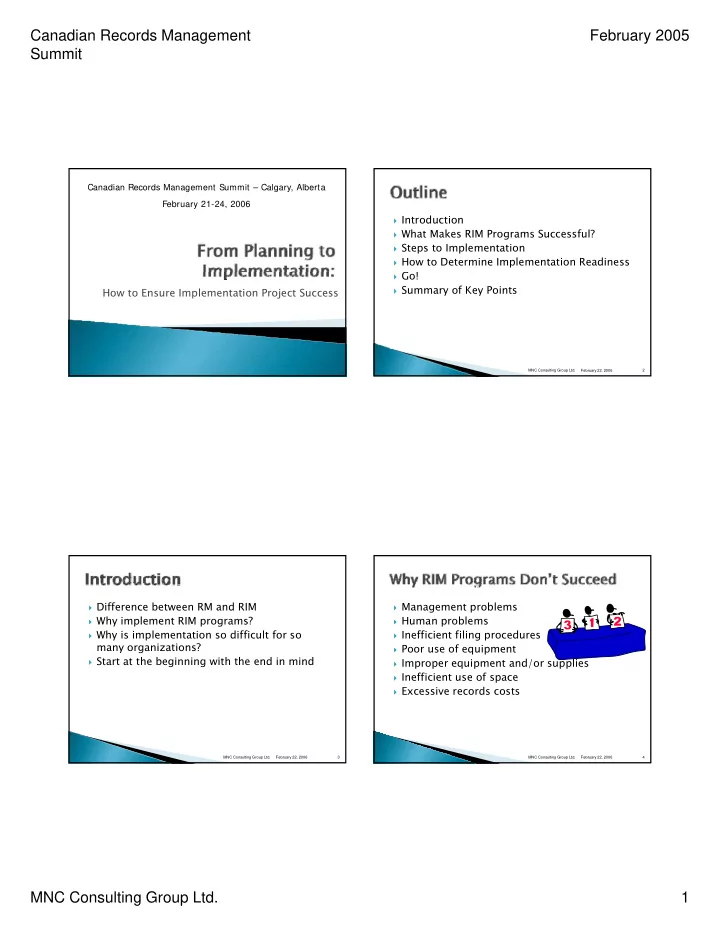
Canadian Records Management February 2005 Summit Canadian Records Management Summit Calgary, Alberta February 21-24, 2006 Introduction What Makes RIM Programs Successful? Steps to Implementation How to Determine


slide-1
SLIDE 1

Canadian Records Management Summit February 2005 MNC Consulting Group Ltd. 1

Canadian Records Management Summit – Calgary, Alberta February 21-24, 2006

How to Ensure Implementation Project Success

 Introduction  What Makes RIM Programs Successful?  Steps to Implementation  How to Determine Implementation Readiness

G !

 Go!  Summary of Key Points

February 22, 2006 MNC Consulting Group Ltd. 2

 Difference between RM and RIM  Why implement RIM programs?  Why is implementation so difficult for so

many organizations? St t t th b i i ith th d i i d

 Start at the beginning with the end in mind

February 22, 2006 MNC Consulting Group Ltd. 3

 Management problems  Human problems  Inefficient filing procedures  Poor use of equipment

I i d/ li

 Improper equipment and/or supplies  Inefficient use of space  Excessive records costs

February 22, 2006 MNC Consulting Group Ltd. 4

slide-2
SLIDE 2

Canadian Records Management Summit February 2005 MNC Consulting Group Ltd. 2

 Include ALL staff, all phases  Continuous improvement to systems  Up-to-date with filing  Educate and educate again!

A di

 Audit  Work towards program intent ALWAYS

February 22, 2006 MNC Consulting Group Ltd. 5

 Collect data – previous assessments, available

literature, org charts, file lists, what is/should be, etc.

 Ask questions – fact finding interviews  Prepare a table to summarize needs (Figure 1)  Prepare a table to summarize needs (Figure 1)

February 22, 2006 MNC Consulting Group Ltd. 6

What does the What does the

  • rganization do
  • rganization do

now? now? What does the What does the

  • rganization need?
  • rganization need?

How will having this How will having this improve RIM for the improve RIM for the

  • rganization?
  • rganization?

Uses old space Uses old space-

  • inefficient vertical

inefficient vertical bi t bi t Space efficient lateral Space efficient lateral end end-

  • tab filing

tab filing i t i t More efficient use of More efficient use of space space cabinets cabinets equipment equipment Uses top Uses top-

  • tab legal size

tab legal size file folders file folders End End-

  • tab letter

tab letter-

  • size file

size file folders folders More efficient file More efficient file retrieval retrieval Everybody does their Everybody does their

  • wn thing with filing
  • wn thing with filing

Records classification Records classification system system Consistent method of Consistent method of classifying records classifying records across the across the

  • rganization
  • rganization

February 22, 2006 MNC Consulting Group Ltd. 7

 Needs assessments don’t provide diagnosis  Needs assessments do not identify the “root”

  • f the problem(s)

 Conduct diagnosis by analyzing your data

H d t 1 A l Y D t

 Handout 1 – Analyze Your Data

February 22, 2006 MNC Consulting Group Ltd. 8

slide-3
SLIDE 3

Canadian Records Management Summit February 2005 MNC Consulting Group Ltd. 3

 Break down the “whole” into “parts”  Need to look at:

  • Issue
  • Evidence
  • Possible Causes

Possible Causes

  • Other Relationships and Impacts
  • Organization’s Potential to Resolve the Issue (Low,

Moderate, High) *

February 22, 2006 MNC Consulting Group Ltd. 9

 ISSUE: Inconsistent filing standards across the

  • rganization

 EVIDENCE: Different departments use different  EVIDENCE: Different departments use different

filing systems – e.g., alphabetic, numeric, block numeric, other…

February 22, 2006 MNC Consulting Group Ltd. 10

 POSSIBLE CAUSES: Lack of knowledge, lack of

training, no organization-wide records contact, etc.

 OTHER RELATIONSHIPS/IMPACTS:

/

  • Lack of staff to maintain files,
  • Inexperienced staff,
  • Not in my job description,
  • Other?

February 22, 2006 MNC Consulting Group Ltd. 11

 ORGANIZATION’S POTENTIAL TO RESOLVE THE

ISSUE:

  • L/M/H – identify the potential!
  • How can the organization resolve the issue?

 Set policy for RIM  Train staff  Make budget to set up a RIM program  Hire Corporate Records Officer

February 22, 2006 MNC Consulting Group Ltd. 12

slide-4
SLIDE 4

Canadian Records Management Summit February 2005 MNC Consulting Group Ltd. 4

 Put the “parts” back together again  Past experience, Gap, SWOT, forced

relationships, brainstorming, etc.

February 22, 2006 MNC Consulting Group Ltd. 13

 Strengths, Weaknesses, Opportunities, Threats  Build two matrices:

  • Strengths/Weaknesses + Opportunities
  • Strengths/Weaknesses + Threats

g

 Handout 2 – Synthesize Data using SWOT

February 22, 2006 MNC Consulting Group Ltd. 14

 Based on synthesis  Based on organization’s ability to resolve the issue

(L/M/H)

 Brainstorm with staff for other ideas  Brainstorm with staff for other ideas  Set up Priority Project/Justification guide based on

risks, conditions and future …

February 22, 2006 MNC Consulting Group Ltd. 15

 Identify the risks involved for each solution –

e.g.,

  • The solution has never been used before.
  • Some employees will probably be against it.
  • The real investment and/or operating costs may be

/ p g y higher than foreseen.

  • Etc.

February 22, 2006 MNC Consulting Group Ltd. 16

slide-5
SLIDE 5

Canadian Records Management Summit February 2005 MNC Consulting Group Ltd. 5

 Discuss the conditions the organization must

create and maintain – e.g.,

  • A high discipline in classifying all records will be

needed.

  • Maintenance has to be improved.

p

  • A Corporate Records Office must be created.
  • Etc.

February 22, 2006 MNC Consulting Group Ltd. 17

 Focus on future perspectives – e.g.,

  • The solution proposed does or does not anticipate

future developments such as an EDRMS.

  • How will government legislation impact the
  • rganization’s records keeping?
  • What is the organization’s overall efficiency now vs.

the future? Can we improve?

  • Etc.

February 22, 2006 MNC Consulting Group Ltd. 18 Highest

ce

2 3 4 5 6 7 8 11 12 14

Speed to I mplement

Fastest < 30 days Slowest > 60 days

Lowest

I mportanc

30 to 60 days

1 9 10 13 15

February 22, 2006 MNC Consulting Group Ltd. 19

 How do you know if your organization is

ready to accept an implementation project?

  • Executive approval
  • Implementation plan approval

February 22, 2006 MNC Consulting Group Ltd. 20

slide-6
SLIDE 6

Canadian Records Management Summit February 2005 MNC Consulting Group Ltd. 6

 Each implementation “project” should be

detailed in a separate implementation plan

 Examples of implementation “projects:”

  • Classification system design
  • RIM procedures policy guidelines

RIM procedures, policy, guidelines

  • EDRMS implementation
  • Etc.

February 22, 2006 MNC Consulting Group Ltd. 21

Include such topics as:

 Software requirements  Training requirements  Communications plan  Change management plan  Change management plan  Budget requirements  Schedule for implementation  Business readiness evaluation

February 22, 2006 MNC Consulting Group Ltd. 22

 The business readiness assessment will help

determine if your organization is ready to accept the project

 Conduct separate business readiness

assessments for each department

February 22, 2006 MNC Consulting Group Ltd. 23

 Determine level of readiness for each factor

being assessed:

  • 3 = Full Ready
  • 2 = Partially Ready
  • 1 = Planning to Do

g

  • 0 = Forgot to Do

 Combine this with level of importance

assessment …

February 22, 2006 MNC Consulting Group Ltd. 24

slide-7
SLIDE 7

Canadian Records Management Summit February 2005 MNC Consulting Group Ltd. 7

 Determine level of importance for each factor

being assessed:

  • H or M PLUS level of readiness of 1 or 0 = the

affected business area has NOT made the required effort to get ready

  • H or M PLUS level of readiness of 3 or 2 = the

affected business area HAS made the required effort to get ready

 Example factors

February 22, 2006 MNC Consulting Group Ltd. 25

 Does the affected business area clearly understand

and agree with the business process changes that are required in order to accommodate the new or changed system functions?

 Has an implementation plan been prepared that

identifies the various activities, timeframes and ? resources?

 Have all new staff roles and responsibilities been

defined and approved?

 Has the necessary hardware and software been

installed in the affected department?

 Is the department ready for implementation?  Etc…..

February 22, 2006 MNC Consulting Group Ltd. 26

 Cognitive Dissonance  “Take time to plan your work, then take time

to work your plan”

 Monitor implementation

Adj t h

 Adjust where necessary  Be smart about change!

February 22, 2006 MNC Consulting Group Ltd. 27

 Best Method

  • Identification of change
  • Internalization of change

SPECIFIC GENERAL

28 February 22, 2006 MNC Consulting Group Ltd.

slide-8
SLIDE 8

Canadian Records Management Summit February 2005 MNC Consulting Group Ltd. 8

 Spaced practice

  • “Quick and often”
  • Introduce new methods in a short period, ample

rest periods

  • Provides better learning than “continuous practice”

February 22, 2006 MNC Consulting Group Ltd. 29

 Rehearsal, rehearsal, rehearsal!  Facilitate new learning by having learner in an

“anxious” state rather than a “comfortable” state – don’t start from what they know!

 Set demanding goals but respect the

g g p “absorptive capacity”

 Reinforce learning through evidence &

feedback

February 22, 2006 MNC Consulting Group Ltd. 30

 Include ALL staff in the RIM program  Obtain Executive approval/support  Analyze your data  Synthesize your data  Prioritize your projects  Prioritize your projects  Prepare implementation plan  Assess business readiness  Manage change

February 22, 2006 MNC Consulting Group Ltd. 31