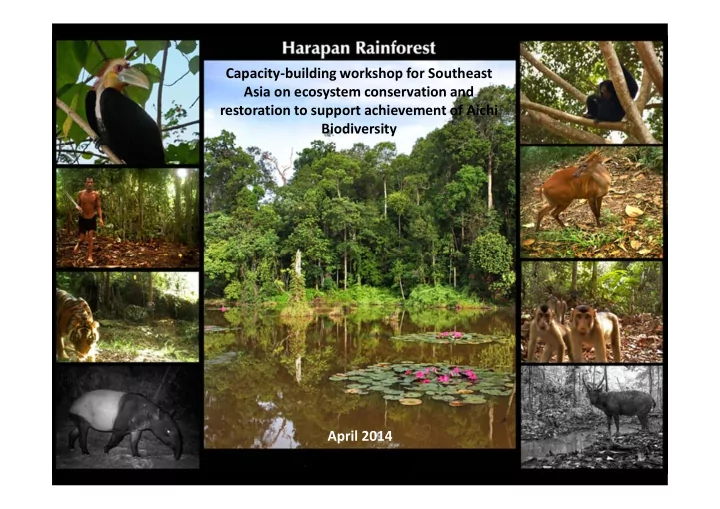
SLIDE 1 April 2014 Capacity-building workshop for Southeast Asia on ecosystem conservation and restoration to support achievement of Aichi Biodiversity
SLIDE 2 First Ecosystem Restoration concession in Indonesia
Concession Area
SLIDE 3 Why Indonesia and why Sumatra?
Species density
1 16-24
Density map of globally-threatened birds across the world
Millennium Ecosystem Assessment (2005) Biodiversity synthesis report
SLIDE 4
SLIDE 5
- 1900: 16 million ha
- 1997: 2.2 million ha
- 2002: 650,000 ha
- 2011: 500,000 ha
- 2014: ???? ha
Harapan Rainforest Concession: 98,555 ha now represents 20%+ of all remaining dry lowland rainforest in Sumatra
SLIDE 6
SLIDE 7 Harapan Rainforest Ecosystem Restoration Concession
Production Forest managed for Ecosystem Restoration
South Sumatra (52,170 ha): 2007 for 100 years Jambi (46,385 ha): 2010 for 60 + 35 years
- Rights to benefit from: Non-Timber Forest Products and
environmental services
- Not permitted: Timber harvesting, agricultural development and
mining
SLIDE 8 Mission:
As forest stewards we will:
- Protect and restore the productivity and ecosystem
services of Indonesia’s natural forest.
- Sustainably manage the forest resources in harmony with
nature and people’s needs.
- Collaborate with diverse partners and demonstrate
innovative techniques.
Vision:
‘Restoring Indonesia’s Forests For Future Needs’
SLIDE 9 Long-term aims
- A viable and healthy ecosystem for Indonesia and
the world
- Financially self-sustained
- A productive landscape in the region, contributing
to local economy
- Multi-stakeholder participation
- Broad base of collaborative supporters
SLIDE 10
Existing Land Use Plan (2008)
SLIDE 11 LUP Allocation Conservation: 52% Livelihood: 5% Collaboration: 11% Intensive Restore: 2% Wood Production: 25% Shareholder: 3% Infrastructure: 2%
Draft Land Use Plan (2014)
SLIDE 12 Management activities
- Forest protection
- Environmental monitoring
- Research and Development
- Restoration
- Community partnership
- Business development
SLIDE 13 Forest Protection
Self-defense training
Classroom Instruction Fire Management
SLIDE 14
Forest Fire Management
SLIDE 15
SLIDE 16 Environmental monitoring
Species Type Total Species Identified IUCN Protection Status CR EN VU NT Birds 305
8 67 Mammals 64 2 8 9 5 Amphibians 38
Reptiles 57
122 1 3
2
728 4 6 11
1,316 7 17 31 78
SLIDE 17
SLIDE 18
Monitoring flora, fauna and abiotic systems across the whole forest
SLIDE 19 Research and Development
Forest restoration based on science. Interpolations and modeling of current forest condition.
Basal area
(m2 ha-1) High secondary forest Open land
Pioneer proportion of stem frequency
Pioneer dominated Climax dominated
SLIDE 20 Current research collaborators
National
- Universitas Jambi
- Universitas Bogor (IPB)
- Universitas Andalas
- FORDA
International
- University of Copenhagen
- University of Gottingen
- University of Hamburg
- Kew Gardens
SLIDE 21 Forest Restoration
– Nurseries: producing high value wood, NTFP and biodiversity seedlings for the forest
- Assisting natural regeneration
– Removing pioneer species and noxious plants which inhibit natural growth – Reducing competition for targeted tree species
SLIDE 22
Community nursery Central nursery
SLIDE 23 Community partnership
- Bathin sembilan (SAD)
- Approximately 200 families
SLIDE 24
SLIDE 25
Sekola bersamo Klinik bersamo
SLIDE 26
Planting day with students from local schools
SLIDE 27 Business development
financing
– Honey – Bamboo – Rattan – Rubber – Jelutung – Jernang – Gaharu
- Carbon crediting
- Eco-tourism
SLIDE 28
Collaborating with community businesses – rubber extraction
SLIDE 29
Challenges to ERC Sustainability
1980’s 2002
2008 2013
SLIDE 30
Forest Access
1980’s 2002
June 2013
SLIDE 31
Harapan Base Camp, Jambi Province, Sumatra
SLIDE 32 Donors: Partners: