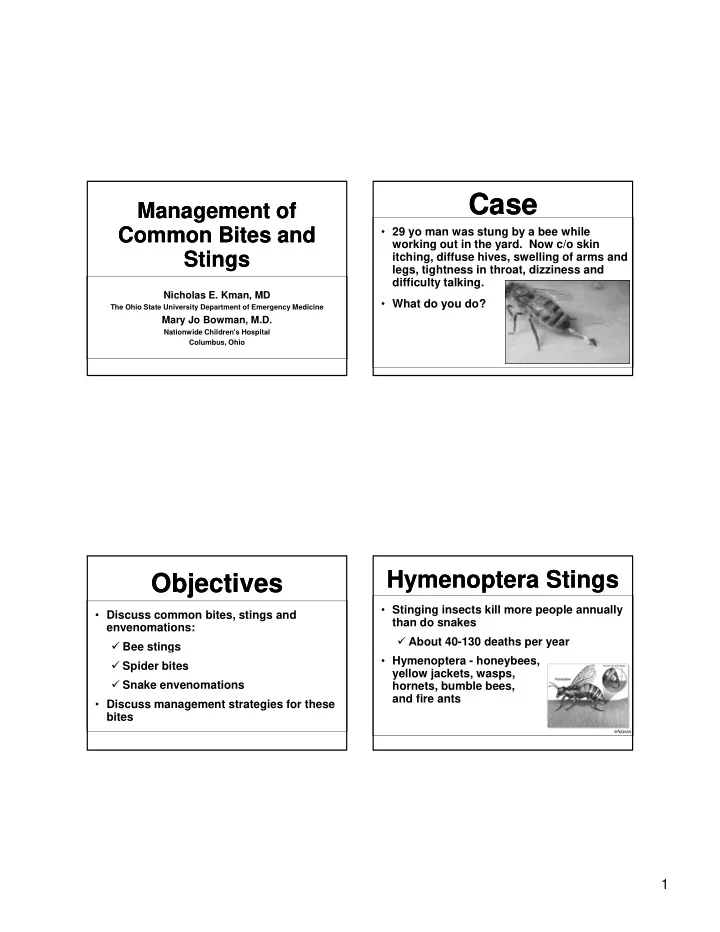
Case Case Management of Management of Common Bites and Common - - PDF document

case case
SMART_READER_LITE
LIVE PREVIEW

Case Case Management of Management of Common Bites and Common - - PDF document

Case Case Management of Management of Common Bites and Common Bites and 29 yo man was stung by a bee while working out in the yard. Now c/o skin Stings Stings itching, diffuse hives, swelling of arms and legs, tightness in throat,


slide-1
SLIDE 1

1

Management of Common Bites and Stings Management of Common Bites and Stings

Nicholas E. Kman, MD

The Ohio State University Department of Emergency Medicine

Mary Jo Bowman, M.D.

Nationwide Children's Hospital Columbus, Ohio

Objectives Objectives

  • Discuss common bites, stings and

envenomations: Bee stings Spider bites Snake envenomations

  • Discuss management strategies for these

bites

Case Case

  • 29 yo man was stung by a bee while

working out in the yard. Now c/o skin itching, diffuse hives, swelling of arms and legs, tightness in throat, dizziness and diffi lt t lki difficulty talking.

  • What do you do?

Hymenoptera Stings Hymenoptera Stings

  • Stinging insects kill more people annually

than do snakes About 40-130 deaths per year

  • Hymenoptera - honeybees,

yellow jackets, wasps, hornets, bumble bees, and fire ants

slide-2
SLIDE 2

2

Hymenoptera and Distribution Hymenoptera and Distribution

Freeman TM. Hypersensitivity to Hymenoptera Stings. N Engl J Med 2004;351:1978-84.

Types of Reactions Types of Reactions

  • Local
  • Mild generalized
  • Severe generalized

Local Local

  • Majority of cases
  • Local redness, pain, swelling
  • May extend > 6 inches beyond sting

y y g

  • May persist > 24 hours
  • Remove stinger
  • Ice, elevate
  • Antihistamines, steroids, tetanus

prophylaxis

Mild Generalized Mild Generalized

  • Symptoms away from site of sting –

itching, hives, nausea, wheezing

  • Antihistamines, steroids

I h l d b i f h i

  • Inhaled beta-agonists for wheezing
  • Consider epinephrine if wheezing
  • Tetanus prophylaxis
  • Local care
  • Observation for 6-8 hrs
slide-3
SLIDE 3

3

Severe Generalized Severe Generalized

  • Classically IgE-antibody

mediated

  • Anaphylaxis, laryngoedema,

circulatory collapse, LOC circulatory collapse, LOC

  • Most deaths generally
  • ccur within 1st hour

Severe Generalized Severe Generalized

  • ABCs – intubate early
  • IVF – support blood pressure
  • Epinephrine is drug of choice (0.1 mg/Kg of

1:1000 solution – initially given IM but may 1:1000 solution – initially given IM but may need IV drip

  • Steroids
  • Inhaled beta-agonists for bronchospasm
  • H1/H2 blockers (Diphenhydramine and

Cimetidine)

Severe Generalized Severe Generalized

  • Admit all
  • Home with Epi-Pen
  • e

t p e

  • Refer for

desensitization therapy

Ant Stings Ant Stings

  • Ants sting 9.3 million people each year.

Other Hymenoptera account for more than 1 million stings annually.

  • Fire-ant venom is

composed primarily of a transpiperidine alkaloid that causes tissue necrosis.

slide-4
SLIDE 4

4

Ant Stings Ant Stings

  • Most fire-ant stings produce blister within

24 hours, which fills with necrotic material, gi ing appearance of p st le giving appearance of pustule.

  • Despite appearance,

blisters are not infected and should be left intact.

Key Points: Bee Stings Key Points: Bee Stings

  • ABC's
  • Remove Stinger
  • Epi for generalized reactions
  • Steroids, Benadryl, Pepcid
  • Admit all severe reactions, d/c with Epi Pen

Case Case

  • 41 yo male presents to ED after fishing all

day at a local reservoir. Friends say he may have stuck himself with a fish hook b/c y he complained of pain in hand when looking thru tackle box.

  • Now with severe abdominal pain, cramping,

N/V, and diaphoresis.

Ohio’s Biting Spiders Ohio’s Biting Spiders

  • 2 main groups of spiders; the recluse

spiders and the widow spiders.

  • The black widow, Latrodectus mactans,

d th th id L t d t and the northern widow, Latrodectus variolus.

slide-5
SLIDE 5

5

Black Widow Black Widow

  • Latrodectus mactans
  • Leading cause of death from spider bites in

U S U.S.

  • Shiny black with brilliant red hourglass

marking on the abdomen

  • Venom is complex protein that includes a

neurotoxin

Black Widow Black Widow

  • >40,000 presumed bites reported to

poison centers in last 20 years

  • Warm, dark, dry places – woodpiles,
  • uthouses outdoors; basements,

garages indoors

Black Widow Black Widow

Clinical Manifestations

  • Few local symptoms associated with bite
  • Generalized pain and rigidity of muscles 1-8 hrs

after bite after bite

  • Pain felt in abdomen, thighs, flanks, chest
  • Nausea, vomiting, urinary retention, chills
  • 4-5% mortality rate, with death due to

cardiovascular collapse

slide-6
SLIDE 6

6

Black Widow Black Widow

  • No cytotoxic agents
  • Neurotoxins – induce symptoms by
  • Neurotoxins – induce symptoms by

stimulating the release of peripheral and central nervous system neurotransmitters

Alpha-Latrotoxin Alpha-Latrotoxin

  • Acts at pre-synaptic membrane of the

neuromuscular junction, opening cation channels, and decreasing reuptake of t l h li hi h lt i acetylcholine which results in severe muscle cramping

  • Can also trigger release of dopamine,

norepinephrine, glutamate, GABA, and

  • ther neuropeptides

Black Widow Black Widow

Management

  • General supportive care-ABC’s, local wound care,

tetanus prophylaxis, loosely immobilize and l t t it elevate extremity

  • Benzodiazepines and/or narcotics for pain and

muscle spasm

  • WATCH RESPIRATORY STATUS
  • Calcium gluconate no longer recommended

Black Widow Black Widow

Management

  • Latrodectus antivenom-use in respiratory

arrest, seizures, uncontrolled hypertension, arrest, seizures, uncontrolled hypertension, pregnancy

  • Dose is 1-3 vials
  • Admit – symptomatic children, pregnant

women, pts. with history of hypertension

slide-7
SLIDE 7

7

Key Points: Black Widow Key Points: Black Widow

  • Black Widow (lactodectus)

Red hourglass on ventral aspect Neurotoxic

  • Muscle cramps, pain, stiffness, rigid

abdomen without tenderness to palpation abdomen without tenderness to palpation

  • Can see systemic symptoms tachycardia,

hypertension, sweating

  • Supportive care; May d/c in 4h if no

systemic sx

  • Indications for antivenin (controversial):

–Severe pain, severe htn, pregnant

Case Case

  • 2 yo girl presents to your emergency
  • department. The child was in her car seat

when she immediately started crying. Dad noticed a welt that “must be one a them noticed a welt that must be one a them spider bites”.

  • You roll your eyes as you walk in the room

to I&D another abscess.

The Brown Recluse The Brown Recluse

  • Loxosceles reclusa has potential to inflict

injury.

  • Seen predominantly in South Central

United States.

  • Adult spiders are soft-bodied and

yellowish-tan to dark brown.

  • 1/4 to 1/2 inch long,

and leg span is size

  • f half dollar.

Brown Recluse Spider Bite Manifestations and Management: Slideshow, MedScape from WebMD Emergency Medicine.

Brown Recluse Territory Brown Recluse Territory

www.brownreclusespider.com/faq.htm

slide-8
SLIDE 8

8

Brown Recluse Bites Brown Recluse Bites

  • Distinguishing characteristic is the violin-

shaped marking on the dorsal cephalothorax.

Brown Recluse Bites Brown Recluse Bites

  • Incidents usually occur in summer months.
  • The spider prefers dark, dry, and

undisturbed locations, such as woodpiles, the underside of rocks, and storage areas the underside of rocks, and storage areas in garages, attics, basements, and linen closets.

Brown Recluse Bites Brown Recluse Bites

  • Bites are rare even in houses that are

heavily infested with spiders.

  • For this reason, a diagnosis

g

  • f a recluse bite is unlikely in

areas that lack significant populations of Loxosceles spiders.

Brown Recluse Bites Brown Recluse Bites

  • In 2005, 2236 exposures called into poison

centers

  • 464 victims less than 19 years of age

D k i t

  • Dark environments

in house – attics, basements, boxes, closets

Anderson RJ, Campoli J, Johar SK, Schumacher KA, Allison EJ. Suspected Brown Recluse Envenomation: A Case Report and Review of Different Treatment

  • Modalities. J Emerg Med 2010.
slide-9
SLIDE 9

9

Clinical Manifestations

  • Bite is usually innocuous

Brown Recluse Bite Progression Brown Recluse Bite Progression

  • Spectrum is from minor local reaction to

severe necrotic arachnidism

  • Mild to moderate pain 6 hrs after bite;

erythema develops with central blister or pustule; subcutaneous discoloration spreading over 3-4 days; ulceration

Brown Recluse Venom Brown Recluse Venom

  • Cytotoxic enyzmes cause destruction of

local cell membranes: Alkaline phosphatase 5-ribonucleotide phosphohydrolase Esterase Hyaluronidase SPHINGOMYELINASE D

slide-10
SLIDE 10

10

Brown Recluse Bites Brown Recluse Bites

  • < 10% of envenomations result in severe

skin necrosis.

  • Wounds destined for necrosis usually

show signs such as bullae formation, cyanosis, and hyperesthesia, within 6-12 hours.

Anderson RJ, Campoli J, Johar SK, Schumacher KA, Allison EJ. Suspected Brown Recluse Envenomation: A Case Report and Review of Different Treatment Modalities. J Emerg Med 2010.

“The Old Red, White and Blue” “The Old Red, White and Blue”

  • Central blistering surrounded by a ring of

blanched skin that is surrounded by large area of asymmetric erythema leads to typical "red, white, d bl " i f and blue" sign of a recluse bite.

  • Usually by 48-72hrs.
slide-11
SLIDE 11

11

Brown Recluse Bites Brown Recluse Bites

  • In this patient, the bite area turned blue and

dark red by the evening of the first day.

Brown Recluse Bites Brown Recluse Bites

  • Cutaneous necrosis: bulla develops at

center of affected area and becomes necrotic.

  • Areas with increased adipose tissue are
  • Areas with increased adipose tissue are

more prone to severe necrosis than bites

  • ccurring at other sites.

Systemic Reaction or Loxoscelism Systemic Reaction or Loxoscelism

  • Fever, chills
  • Arthralgias/myalgias
  • Malaise, weakness
  • Nausea, vomiting
  • Morbilliform eruption with petechiae
  • Intravascular hemolysis, hematuria, renal failure
  • No specific serologic, biochemical or

histologic test

  • PCR

Brown Recluse Bite Diagnosis Brown Recluse Bite Diagnosis

  • PCR
  • Vigorous supportive care
  • Labs – cbc, platelets, UA, BUN, creatinine
  • Once large areas have demarcated –

surgical excision and skin grafting

slide-12
SLIDE 12

12

Brown Recluse Bite Treatment Brown Recluse Bite Treatment

  • First Line:

RICE RICE Aspirin and Antihistamines Tetanus Update Antibiotics if tissue breakdown

Brown Recluse Bite Treatment Brown Recluse Bite Treatment

  • Steroids (efficacy is up for debate)
  • Colchicine
  • Hyperbaric oxygen therapy (conflicting results)
  • Electric shock therapy
  • Dapsone (moderate to severe or

rapid disease, never in children)

  • RICE: Rest, Ice, Compression and

Elevation of extremity, loose immobilization

Bite Management Summary Bite Management Summary

immobilization

  • Tetanus status
  • If necrosis – debridement, grafting

(typically 6-8 weeks after bite).

  • Admit – if systemic symptoms, evidence of

coagulopathy, hemolysis, hemoglobinuria

Brown Recluse Bite Outcomes Brown Recluse Bite Outcomes

  • Prognosis for recluse bites is good, and

most patients show excellent outcome.

  • In most, pain subsides within 1 week, and

reduction in size of the necrosis is evident.

  • Healing may be slow, but all recluse

wounds heal, usually with a minimum of scar tissue.

slide-13
SLIDE 13

13

Key Points: Brown Recluse Key Points: Brown Recluse

  • Brown Recluse (loxosceles)

Violin on dorsum Tissue toxicity Tissue toxicity Dapsone helps counteract the effects of the venom?? (controversial)

  • Contraindicated in G6PD deficiency

Observe for 6h for systemic symptoms

Case Case

  • 18 month male transferred from Kentucky
  • Bit on hand by baby copperhead snake
  • Hospitalized locally
  • Transferred due to progressive swelling

and ecchymosis and concern about compartment syndrome

slide-14
SLIDE 14

14

Snake Bites Snake Bites

Families in the U.S.

  • Viperidae

p

  • Crotalinae (pit vipers)
  • Elapidae (coral snakes)

Snake Bites Snake Bites

Crotalinae Genera

  • Crotalus (rattlesnakes) – 15 species
  • Agkistrodon – includes cottonmouth and

copperhead

  • Sistrurus – includes pygmy rattlesnake and

massasauga

slide-15
SLIDE 15

15

Ohio Poisonous Snakes Ohio Poisonous Snakes

  • Northern Copperheads

Widely scattered throughout most of unglaciated Ohio. Prefer rocky, wooded hillsides of y, southeastern Ohio. Stay away from well settled areas.

Ohio Poisonous Snakes Ohio Poisonous Snakes

  • Eastern Massasauga

"Swamp rattler" and "black snapper" are other names given to small rattlesnake.

  • Massasauga swamp rattlers are widely scattered.

Massasauga swamp rattlers are widely scattered. Colonies still persist in bogs, swamps, and wet prairies within glaciated Ohio.

Ohio Poisonous Snakes Ohio Poisonous Snakes

  • Timber Rattlesnake

Timber rattlers are one of the most dangerous snakes in northeastern America. May be in excess of 6 ft, but average 3-4 ft. May be in excess of 6 ft, but average 3 4 ft. Timber rattlers most numerous in more remote areas

  • f Zaleski, Pike, Shawnee,

and Tar Hollow state forests.

Snake Bites Snake Bites

Statistics

  • Crotalinae – 99% of venomous snakebites

in U.S.

  • 65% - rattlesnakes

65% rattlesnakes

  • 25% - copperheads
  • 10% - cottonmouths
slide-16
SLIDE 16

16

Snake Bites Snake Bites

Statistics

  • 2005 – 2900+ bites reported to poison

centers (8000/yr is average)

  • 116 < 6 years of age
  • 542 6-10 years of age
  • 6 deaths
  • 171 – life-threatening

Snake Bites Snake Bites

Epidemiology

  • Incidence – 3.74 bites/100,000 population
  • 90% of envenomations occur between April and

October

  • 50% of bites occur from 2-9 PM
  • Male:Female ratio 9:1
  • At least 40% of bites occur when a snake is

purposely handled

Snake Bites Snake Bites

Children have more clinical severity:

  • Smaller limbs
  • Less subcutaneous tissue
  • Smaller body mass
  • Receive more venom per kg body wt
slide-17
SLIDE 17

17

Crotaline Venom Crotaline Venom

  • Components cause direct tissue injury,

capillary leakage, coagulopathy, and neurotoxicity

  • Tissue damage at the site of the bite – the

most common complication following envenomation

  • Local reactions – increased blood vessel

permeability and direct tissue necrosis

Snake Bites Snake Bites

Hematologic Abnormalities

  • Coagulopathies in over 60%

Coagulopathies in over 60%

  • Hypofibrinogenemia in 49%
  • Thrombocytopenia in 33%

Acad Emerg Med Feb 2001

Snake Bites Snake Bites

Thrombocytopenia

  • Platelet destruction may be mediated by

action of phospholipases which damage action of phospholipases which damage platelet membranes

  • Platelets may also be sequestered in local

microvasculature and released after antivenin treatment

Snake Bites Snake Bites

Crotalocytin

  • Found in Timber Rattlesnake venom
  • Causes platelet aggregation
  • At least partially responsible for

thrombocytopenia – common and often severe

Ann Emerg Med Jul 1997

slide-18
SLIDE 18

18

Snake Bites Snake Bites

  • Venom of cottonmouth produces less

severe local and systemic pathology C h d ti

  • Copperhead envenomations cause

significant soft tissue edema but usually not significant coagulopathy, systemic symptoms, or extensive tissue destruction

Signs and Symptoms Signs and Symptoms

  • Common reaction is impending doom.

Fear may cause N/V/D, fainting, tachycardia, and cold clammy skin. tachycardia, and cold clammy skin.

  • Local findings in 30-60 minutes. May see

edema w/in 10 min. Pain usually evident within 5 minutes.

  • 1 or more fang marks, pain, edema,

erythema, or ecchymosis. Bullae may appear.

  • Systemic effects: AMS, tachycardia,

Signs and Symptoms Signs and Symptoms

y , y , tachypnea, resp distress, hypotension, coagulopathy, renal failure, hemolysis.

Grades of Envenomation

Grade 0

  • Fang marks
  • No envenomation – 25%

Grade I

Snake Bite Snake Bite

  • "Mild" envenomation
  • Fang marks
  • Pain and edema at site
  • Local ecchymosis
  • Blistering
  • Necrosis
  • Minimal to no spread of edema proximal to site
slide-19
SLIDE 19

19

Moderate Moderate

  • 56% of bites
  • Severe pain
  • Spreading edema beyond site of bite
  • Systemic signs – nausea, vomiting, paresthesias,

muscle fasciculations, mild hypotension

Severe Severe

  • Marked swelling
  • f extremity that
  • ccurs rapidly
  • Subcutaneous

ecchymosis

  • Systemic symptoms – coagulopathy,

hypotension, altered mental status

Snake Bites Snake Bites

Management

  • Maintain vital signs (ABC’s)
  • Reduce venom effects
  • Prevent complicated sequelae
  • Minimize tissue damage

Snake Bites Snake Bites

Immediate First Aid

  • Get away from the snake
  • Stay calm
  • Immobilize the bitten extremity at a position of

heart level or just below

  • Apply a constricting band, not tourniquet
  • May apply suction device
  • TRANSPORT TO MEDICAL FACILITY
slide-20
SLIDE 20

20

Snake Bites Snake Bites

Don’ts

  • Do not incise the bite
  • Do not ice the bite
  • Do not remove constricting band

Snake Bites Snake Bites

ED Management

  • Notify Regional Poison Center
  • ABC’s
  • At least 1 IV line, draw labs while starting
  • If no signs of envenomation, may observe for

further progression

  • Measure circumference of limb
  • If signs of envenomation, antivenin admin.

Snake Bites Snake Bites

Baseline Labs

  • CBC with diff, plts
  • Electrolytes, BUN, creatinine

y

  • CPK
  • Coagulation studies
  • Type and cross
  • Urinalysis

Snake Bites Snake Bites

Antivenin

  • Polyvalent Crotalinae antivenin
  • Available in U.S. since 1947
  • Mainstay of medical management
  • Horse serum derived
  • Dosing varies according to severity
  • Production discontinued in 2002
slide-21
SLIDE 21

21

Snake Bites Snake Bites

Ovine Fab Antivenin (CroFab)

  • 4-6 vials
  • Additional 4-6 vials until control achieved
  • Scheduled 2-vial doses at 6, 12, and 18 hr
  • Initial dose given slowly for first 10 min
  • Rest of dose over 1 hr
  • Dosages appear safe in pediatric population

Pediatrics Nov 2002

Snake Bites Snake Bites

Other Management

  • Cleanse wound thoroughly
  • Tetanus prophylaxis
  • Tetanus prophylaxis
  • General supportive care
  • Antibiotic prophylaxis is controversial
  • ANALGESICS - opioids

Compartment Syndrome Compartment Syndrome

  • Pain out of proportion to injury
  • Hypesthesia
  • Pain on passive stretch of muscles

p

  • Tenseness of compartment on palpation
  • Weakness of muscles in the compartment
  • All are toxic effects of venom
  • Need to measure compartment pressures

At Risk Patients

  • Patients treated with cryotherapy

P ti t ith d l d i d t

Compartment Syndrome Compartment Syndrome

  • Patients with delayed or inadequate

administration of antivenin

  • True intramuscular injection of venom
slide-22
SLIDE 22

22

Compartment Syndrome Compartment Syndrome

Protocol

  • Elevate limb

M it l 1 2 /k IV

  • Mannitol 1-2 gm/kg IV
  • CroFab 4-6 vials
  • Remeasure pressures
  • Fasciotomy if pressure still elevated

Snake Bites Snake Bites

Complications

  • Serum sickness (type III hypersensitivity) –

can occur up to 3 weeks after antivenin can occur up to 3 weeks after antivenin

  • Fever, chills, arthralgias, diffuse rash
  • Rx – steroids, antihistamines

Ann Emerg Med Jun 2002

Snake Bites Snake Bites

Complications

  • Some patients premedicate with alcohol,

Some patients premedicate with alcohol, marijuana or other drugs – respond more intensely to envenomation and may need larger doses of antivenin

Key Points: Snake Bites Key Points: Snake Bites

  • Snakes

Crotalinae

  • Grade the bite according to presence
  • f systemic toxicity
  • f systemic toxicity

–Mod/severe bites have systemic toxicity or are rapidly progressive

  • Use antivenin for mod/severe bites
  • Observe dry bites for 8-12h; admit all
  • thers
slide-23
SLIDE 23

23

Questions Questions

References References

  • Freeman TM. Hypersensitivity to Hymenoptera Stings. N Engl J Med

2004;351:1978-84.

  • Emerg Med Clin N Am 22 (2004) 423-443
  • Infect Dis Clin N Am 19 (2005)691-711
  • Pediatr Infect Dis J (2003) 22(10) 931-932
  • Brown Recluse Spider Bite Manifestations and Management:

Slideshow, MedScape from WebMD Emergency Medicine.

  • http://www.brownreclusespider.com/faq.htm
  • Anderson RJ, Campoli J, Johar SK, Schumacher KA, Allison EJ.

Suspected Brown Recluse Envenomation: A Case Report and Review

  • f Different Treatment Modalities. J Emerg Med 2010.

Thanks Thanks