SLIDE 1
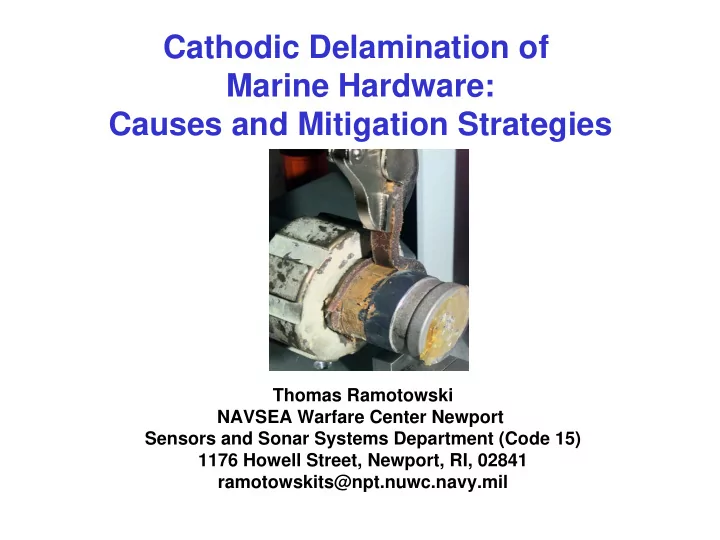
Cathodic Delamination of Marine Hardware: Causes and Mitigation Strategies
Thomas Ramotowski NAVSEA Warfare Center Newport Sensors and Sonar Systems Department (Code 15) 1176 Howell Street, Newport, RI, 02841 ramotowskits@npt.nuwc.navy.mil
SLIDE 2 Outline
- Introduction
- Cathodic Delamination
- Four requirements for corrosion
- Description and mechanism
- Accelerated Life Testing
- Theory
- How to set up an ALT
- How to measure activation energy
- Mitigation Strategies for Cathodic Delamination
- Deoxygenate water
- Non-conductive ceramic (NCC) coatings
- GRE coated connector backshells
- Thick, quick drying paints
- Nanocomposite barrier coatings
- Summary
SLIDE 3
NUWC Division Newport Location
SLIDE 4
NAVSEA Undersea Warfare Center (NUWC) Division Newport
SLIDE 5
NUWC’s Mission:
R&D, T&E, and Fleet support for submarines and submarine related systems. sonar and sensors, periscopes, antennae, torpedoes, UUVs, sub-launched weapons, systems integration. Chemistry Lab: R&D projects of naval interest and fleet support work
SLIDE 6
Cathodic Delamination: Description and Mechanism
SLIDE 7 The Four Requirements for Corrosion:
Polymer Metal Zinc sacrificial anode
Sea water Sea water
Polymer
(Seawater)
(2H2O + O2 + 4e- → 4OH-)
(Direct contact between metals)
(Zn → Zn2+ + 2e-)
SLIDE 8
Why Do We Cathodically Polarize Metals in Seawater?
> In a corrosion cell, the cathode does not mass waste or dissolve > Steel and many other metals are not electrochemically stable in seawater (they behave like anodes) > Sacrificial anodes or impressed currents protect vulnerable metals by making them behave as cathodes. Coupling two dissimilar metals together and submerging them in seawater will produce an anode/cathode couple that will cause the more active metal to dissolve (galvanic corrosion).
SLIDE 9 What Is “Cathodic Delamination”
“Cathodic Delamination” is a corrosion reaction that occurs spontaneously in seawater. It occurs on cathodically polarized surfaces (usually metal, but not always!). The reaction produces a very high pH environment at the interface between the cathodically polarized surface and the material directly above it. The high pH conditions directly
- r indirectly cause the overlying
material to delaminate from the cathodically polarized substrate.
SLIDE 10 Polymer-Metal Bonding Failures: Cathodic Delamination
At the polymer-metal interface: 2H2O + O2 + 4e- → 4OH-
Metal Zinc sacrificial anode Polymer
Sea water Sea water
At the zinc-seawater interface: Zn → Zn2+ + 2e-
The most common failure mechanism for metal-polymer bonds in a marine environment is “cathodic delamination”. Sacrificial zinc anodes on the hull cathodically polarize metal surfaces. Caustic hydroxide ions (OH-) are generated on the metal surface; this reaction weakens/destroys metal-polymer bonds.
SLIDE 11
Cathodic Delamination Theory Part I
Polymer saturated with water and dissolved oxygen Cathodically polarized metal substrate Regions of hydroxide ion formation
Once the polymer is saturated with water and dissolved oxygen, hydroxide (OH-) ions are formed at the metal/polymer interface due to a cathodic corrosion reaction.
SLIDE 12 Cathodic Delamination Theory Part II:
Polymer saturated with water and dissolved oxygen Cathodically polarized metal substrate Debonded areas “watery blisters”
As hydroxide (OH-) ions are formed at the metal/polymer interface,
- smotic pressure leads to the formation of high-pressure water
“blisters” at the bondline. Blister growth is governed by the permeability of the polymer.
SLIDE 13 Evans Diagram for Sacrificial Anodes
In a two electrode system (e.g., steel hulls and sacrificial zinc anodes) the natural corrosion potential (Ecorr) will be between the E values for the two electrodes, and the natural corrosion current (icorr) will be greater than either electrode’s original current value. The combined system wants to be at Ecorr and icorr. In all cases, the Tafel lines must be followed!
log current density potential (Volts)
zinc anodes steel & seawater cathodic reaction anodic reaction icorr Ecorr A1 C1 A2 C2
Current density is directly proportional to the reaction rate!
SLIDE 14
Results of Cathodic Delamination:
Delaminated polymer overmolds
Blistered paints and primers
SLIDE 15
Accelerated Life Testing: Theory and Practical Considerations
SLIDE 16
What is Accelerated Life Testing?
Question: How long will a given cable/connector function in the marine environment? Answer: Use accelerated life testing techniques to “speed up” the aging process - samples can be aged rapidly in the laboratory to determine the service life of a variety of hardware components
SLIDE 17 The Theoretical Basis for Accelerated Life Testing
Svante Arrhenius (1859 - 1927)
The Arrhenius Equation
kT E
Ae K
−
=
K = reaction rate constant A = constant; represents the frequency at which atoms and molecules collide in a way that leads to a reaction e = base of the natural logarithm system E = activation energy (energy required to generate the reaction transition state k = Boltzmann’s constant T = absolute temperature
The Arrhenius equation is a mathematical expression that describes the effect of temperature on the velocity of a chemical reaction.
Winner of the Nobel Prize for Chemistry in 1903
SLIDE 18 The Meaning of Activation Energy (Ea)
Activation Energy: an energy barrier
- r hurdle that must be surmounted
by the reacting molecules before a reaction can occur. Activation Energy is the most important ALT parameter; it relates temperature to time (and vice-versa). For most reactions, the Activation Energy must be determined by
- experimentation. There are few
published values in the literature
Ea R P
Reaction Coordinates Energy
SLIDE 19 The Time-Temperature Relationship
As temperature is increased, the average molecular speed also increases. Molecular energy is related to molecular speed (kinetic energy = ½mv2) Activation Energy is not affected by changes in temperature; however, at higher temperatures, more molecules have sufficient energy to engage in reactions
In many cases, degradative (aging) processes can be accelerated by raising the
- temperature. Useful service
lifetimes can be determined rapidly using ALT protocols.
Ea Ea #2
The “participation area” ratio is directly proportional to the RAF
SLIDE 20 The Basic ALT Equation:
In order to set up an accelerated life test (ALT) a parameter known as the reaction acceleration factor (RAF) must be calculated:
( ) ( )
2 1 1 2
2 1 T T R T T E
e RAF TF TF
− −
= =
E = activation energy R = gas constant T1= normal operating temperature of the item T2= temperature at which the ALT is run e = base of natural logarithm system TF1 = time to failure at temperature T1 TF2 = time to failure at temperature T2
The RAF indicates how much faster a given process will occur in the ALT
SLIDE 21 Proper Cathodic Delamination ALT Voltage:
If a sacrificial zinc anode is used, the voltage will be correct. If a battery is used, a reference electrode must be used (chemical equations are typically versus SCE), the polarization must be correct, and the “throw weight” of the zinc electrode must be factored into the set-up.
battery ANODE CATHODE
zinc sample zinc sample
SLIDE 22
Voltages and Current Density
Certain voltages and current densities are required for the proper functioning of a cathodic delamination ALT. If the voltage is not correct, the desired reactions may not occur, and other undesired reactions may occur. If the current density is not correct, then the desired reaction may be accelerated/decelerated. This will compromise a temperature-based ALT.
WHY?
SLIDE 23 Cathodic Delamination: Reactions and Voltages
At voltages lower than -0.5 V SCE: O2 + 2H2O + 2e- → HOOH + 2OH- At voltages between -0.7 V and -1.2 V SCE: HOOH + 2e- → 2OH- If hydrogen peroxide is not stable on metal surface: O2 + 2H2O + 4e- → 4OH- At voltages above -0.6 V SCE: 2H+ + 2e- → 2H → H2 All of these reactions increase the pH
contact with the surface of the metal
SLIDE 24 Effect of Potential on Reaction Rate
Potential versus SCE (Volts)
Log (current density) Activation Control OH- Formation Hydrogen Evolution Dominates Oxygen Diffusion Limited
Changes in potential may change the current (and hence, the rate)
- f the cathodic delamination reaction.
SLIDE 25 Chemical Equilibrium & Le Chatelier’s Principle Zn → Zn2+ + 2e- Anode 2H2O + O2 + 4e- → 4OH- Cathode
The solubility of oxygen drops as the temperature of water
- increases. The lower concentration
- f dissolved oxygen in hot water
may slow down the cathodic reaction. Zinc ions will build up over time in the ALT tank water. If they are not removed from time to time, the anodic reaction will slow down and perhaps even reverse!
Water temperature Dissolved
Zn Zn Zn Zn Zn Zn Zn Zn Zn Zn Zn Zn Zn Zn Zn Zn Zn Zn Zn Zn Zn Zn Zn Zn Zn Zn Zn Zn Zn Zn Zn Zn Zn Zn
Slower Faster
SLIDE 26 The Importance of Dissolved Oxygen 2H2O + O2 + 4e- → 4OH-
The cathodic delamination reaction consumes
- xygen. In an ALT test tank, oxygen must be
continually replenished or the reaction will stop.
O2 O2 O2 O2 O2
No oxygen
SLIDE 27 Maintaining Dissolved Oxygen
Bubbling pure oxygen through the ALT tank water is the best way to maintain dissolved oxygen levels. Pumping laboratory air may be more convenient, but carbon dioxide in the air can react with water to form carbonic acid and lower the pH of the ALT tank water:
OXYGEN
Air Pump
CO2 + H2O → H2CO3 Carbonic Acid
Water can hold much more dissolved carbon dioxide than dissolved
SLIDE 28 Carbonate Precipitation
At high pH values, various carbonate minerals can precipitate from seawater. As they precipitate, these carbonates form non-conductive coatings that may interfere with the primary cathodic delamination reaction.
M e t a l Polymer D e b
d e d p
y m e r
Carbonate deposits Carbonates only precipitate at high pH. Cathodically polarized metal surfaces generate hydroxide ions in ALTs. “Smoking-gun” evidence for cathodic delamination? Calcium, zinc and iron carbonates have been found on ALT samples
SLIDE 29 Activation Energy: The Critical Parameter
What is actually being accelerated in a standard ALT experiment?
H20 H20
The permeation of water into and through the polymeric
considered to be the rate-limiting step in the cathodic delamination
- process. Water is needed to make
hydroxide ions and to form the blisters that cause debonding. The activation energy used for standard ALTs is that for the permeation of water into the polymeric overmolding compound
SLIDE 30 Determination of Ea for Water Diffusion into Polymers
Calculate diffusion constants (D) at three different temperatures Plot ln(D) versus 1/T. The slope
- f the resulting line is -Ea/R
Time Mass (grams)
T(1) > T(2) > T(3) Slope =
natural log D 1/temperature (K-1)
SLIDE 31 The Effect of Ea Values on an ALT
Effect of different E values
7.5 10 15
7.5 kcals/mole 10 kcals/mole 15 kcals/mole
Because the Arrhenius Equation is exponential, small changes in Ea can have large effects on the RAF!
SLIDE 32 An ALT Myth: The 10°C = 2x Increase in the RAF for all Systems
10 20 30 40 50 60 70 20 40 60 80
ALT Temperature (C) RAF
2x per 10 Ea = 3.5 kcals/mole Ea = 8.5 kcals/mole Ea = 13 kcals/mole Plot assumes working temperature = 15°C
The RAF in an ALT depends upon both the temperature difference and the activation energy (Ea). 10°C = 2x RAF only works for an Ea ≈ 13 kcals/mole! It does not work well for other Ea values.
SLIDE 33
ALT Temperature Limitations
Room Temperature A mess! Boiling Water A boiled egg! ALT temperatures cannot be raised indefinitely. At some point, the temperature becomes high enough for “unrealistic” reactions to occur.
SLIDE 34
Some ALT Words of Wisdom
Lawrence “Yogi” Berra Catcher, NY Yankees and World-Renowed Philosopher
“Prediction is difficult… especially about the future” and “If you don’t know where you are going, you’ll wind up somewhere else.”
SLIDE 35
Cathodic Delamination: Mitigation Strategies
SLIDE 36 Deoxygenate the Surrounding Water
Dissolved oxygen is a critical requirement of the cathodic delamination
- Process. Cut off the DO, and the reaction stops!
2H2O + O2 + 4e- → 4OH-
Certain chemical species can be added to water to remove (consume) DO. Only viable if the hardware is located such that its immediate environment can be isolated from the rest of the marine environment.
SLIDE 37 Non-Conductive Ceramic (NCC) Coatings
- Plasma-sprayed ceramic coatings (≈ 10 microns thick)
- Prevents electrons from reaching the metal/polymer interface
- Used on connector backshells; other uses under consideration
- Porosity of NCC coating can be problematic for some applications
before after NCC coating
SLIDE 38 GRE-Coated Connector Backshells
- Similar to NCC coatings, but material
is glass re-enforced epoxy (GRE)
- Prevents electrons from reaching the
polymer-metal interface
- Held in place mechanically (cure-shrinkage
induced constriction and circumferential grooves
- Can be cracked/damaged if connector nut
is overtightened
- Application limited to cylindrical hardware
(need for constriction).
SLIDE 39 Thick, Quick-Drying Paints
Thick, quick-drying paints produce even thickness coatings Normal paint produces thinnest coating over sharp angles
- Most paints produce thinner coatings around sharp corners
- Thinner coatings increase the flux of permeating species and thereby
speed up the cathodic delamination process
- U.S. Navy study revealed that cathodic delamination of paint invariably
begins at sharp corners
- Paints that are designed to dry “instantly” do not flow away from sharp
corners and coat them more uniformly.
- Delays but does not prevent the cathodic delamination process
SLIDE 40 Nanocomposite Barrier Coatings
1.0 0.8 0.6 0.4 0.2 0.0 0.0 0.1 0.2 0.3 0.4
Relative Permeability (Pc/Pp) Volume Fraction of Silicate N a n
p
i t e Conventional #1 Conventional #2
- Polymer-clay nanocomposites with intercalated particulate geometry
can exhibit orders of magnitude better barrier properties than the polymer alone
- Greatly reduces the permeation of water and dissolved oxygen
- Can be added to paints and encapsulates
- Low cost and low volume fractions
SLIDE 41 Summary:
- Cathodic delamination is a corrosion reaction responsible for
a significant portion of the metal-to-polymer bond failures that
- ccur in the marine environment.
- Accelerated life testing techniques can be used to speed up
cathodic delamination in laboratory experiments to allow researchers to predict how long hardware can be expected to survive in the ocean.
- ALT tanks must maintain the proper chemical environment and
electrical potentials for cathodic delamination to occur.
- Use of the proper activation energy values in the ALT age
calculations is critical.
- Several techniques now exist for protecting hardware from
cathodic delamination – more research is needed in this area!