SLIDE 1 1
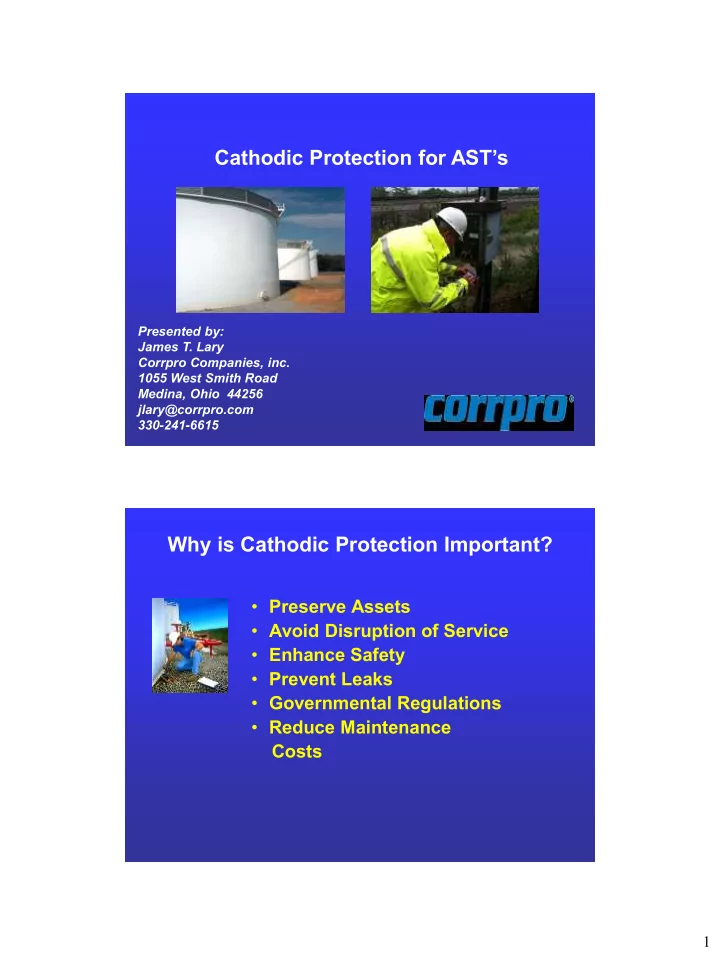
Cathodic Protection for AST’s
Presented by: James T. Lary Corrpro Companies, inc. 1055 West Smith Road Medina, Ohio 44256 jlary@corrpro.com 330-241-6615
- Preserve Assets
- Avoid Disruption of Service
- Enhance Safety
- Prevent Leaks
- Governmental Regulations
- Reduce Maintenance
Costs
Why is Cathodic Protection Important?
SLIDE 2 2
Terminal Tankage
Main Line
M
Valve OPS Inspection Meter
M
No OPS Inspection OPS Inspection Stops (Enforcement Policy) Loading Terminal
Product Tank (Terminal) Product Tank (Terminal)
Breakout Tank
M
Main Line
Valve OPS Inspection Meter
M
Product Tank (Breakout)
M
SLIDE 3 3
Charleston, WV Spill
The investigation found that two small holes ranging in size from about 0.4-inch to 0.75-inch in the bottom of the 48,000- gallon tank 396 were caused by corrosion, likely resulting from water leaking through holes in the roof and settling on the tank
- floor. Furthermore, the CSB inspection
found a similar hole penetrating the bottom of nearby tank 397, containing the same chemical at the facility, located in
- Charleston. Other tanks also showed
multiple signs of pitting and metallurgical damage, investigators said. The growing corrosion in these tanks went unnoticed until the bottom of 396 was breached and up to an estimated 10,000 gallons of product made their way through the underlying mixture of soil and gravel under the facility and into the Elk River on January 9, 2014.
- Causes of Corrosion
- Cathodic Protection Applications
- Installation & Maintenance
- Rectifier Monitoring
What we will cover….
SLIDE 4 4
Early Oil Tanks & Piping did not Employ CP
IRON OXIDE REFINING MILLING STEEL CORROSION IRON OXIDE
THE PROBLEM…..
SLIDE 5 5
Anodic Area
Cathodic Area
SAND CURRENT FLOW
External Corrosion of Tank Bottom
MFL Floor Inspection
SLIDE 6 6
SAND CURRENT FLOW
Corrosion Cell Caused by Foreign Material in Sand Cushion
CLAY
Steel Tank Floor
SLIDE 7 7
DRY SAND MOIST SAND WATER
Corrosion Caused by Poor Water Drainage
New Bottom (Anode)
CURRENT FLOW SAND SAND
New Steel Coupled to Old Steel
Old Bottom (Cathode)
SLIDE 8
8 Leak detection grove under under bottom Tank bottom required 30% floor replacement after 5 years in service
Concrete Slab
Types of Cathodic Protection
Galvanic: Current obtained from a metal with a higher energy level. Impressed Current: Requires external power source (transformer rectifier).
SLIDE 9 9
System Characteristics
Galvanic Impressed
No external power External power required Fixed driving voltage Voltage can be varied Limited current Current can be varied Small current requirements High current requirements Used in lower resistivity Used in almost any environment resistivity environment Usually negligible Must consider interference interference with other structures Above Ground Storage Tank With Galvanic Anodes
Anodes Tank Anodes
SLIDE 10 10 Above Ground Storage Tank With Galvanic Anodes Is Protection Being Achieved?
Anode Tank Uncoated Tank Bottom Tank Grounded to Other Structures
Test Box Anode Cells Tank
Galvanic Anodes
SLIDE 11 11
- With the advent of secondary containment
liners for AST’s, some oil companies initially installed galvanic (zinc or magnesium) anode cathodic protection systems. Many of these same companies have now abandoned this approach due to the inability to obtain effective levels of cathodic protection or limited system design life.
- The industry preference for cathodic protection
for large AST’s is now impressed current.
Galvanic Anode Installation on AST. Note that anode life and current output are dependent upon sand / backfill conditions. Reference cells were rarely installed to monitor performance. Galvanic Anode
(Many galvanic systems installed by tank contractor)
SLIDE 12 12
Recommended Practices
API-651 - Cathodic Protection of Aboveground Petroleum Storage Tanks: “Galvanic anodes method is not practical for protection of large bare structures.” NACE RP0193-2001 - External Cathodic Protection of On- Grade Carbon Steel Storage Tank Bottoms: “Galvanic protection systems can be applied to tank bottoms where the metallic surface area exposed to the electrolyte can be minimized through the application of a dielectric coating or the area is small due to the tank size or configuration.”
(+) (-)
Return Rectifier Anode CURRENT FLOW
Impressed Current Cathodic Protection
SLIDE 13
13
Impressed Current Cathodic Protection System Anodes Rectifier Wiring
Tanks & Piping
SLIDE 14 14 Above Ground Storage Tank Vertical Impressed Current Anodes - Existing Tanks
Sand Anodes Rectifier Negative Connection
+
Ringwall Tank Anodes Rectifier
Negative Connection Tank
SLIDE 15 15
Anodes Junction Box Rectifier
Deep Anode
Tank
(+) (-) Rectifier
Tank Tank Tank
SLIDE 16 16
Computer Guided Horizontally Bored Anode System
Tank
Rectifier (+) (-)
Anode Splice Box Anode Pipe Monitoring Pipe Anode Pipe
SLIDE 17 17
ABOVEGROUND STORAGE TANK CATHODIC PROTECTION
3” PVC 20% Exposure Anode Material Anode Tube 10’ Typical Test/Access Station Grade Aboveground Storage Tank
SLIDE 18
18
Rectifier Units
Explosion or Non Explosion Proof ? AC Input ? AC Availability ?
CP Applications for Re-bottomed or New Tanks
SLIDE 19
19
CP Installation on Rebottomed Tank
Above Ground Storage Tank Bottoms with Secondary Containment
SLIDE 20
20 Liner Floor Anode Conduit
CP Installation on Double Bottom Tank New Tank Construction with Liner
SLIDE 21
21 Anode Reference Cells Tank Impressed Current Junction Box (-) (+) Rectifier
Anode & Reference Cell Placement in High Resistance Sand
SLIDE 22
22
Installation of CP System on Lifted AST Installation of CP System on Lifted AST
SLIDE 23 23 Cathodic Protection Survey (When Tank is Full) Tank
Rim Potential Measurements
Portable Reference Cell Soil (+)
? ?
SLIDE 24
24 Soil Access Station (Thru Liner or Asphalt)
Reference Cell Placement Under Tank Bottom (Note obtain and store native readings)
SLIDE 25 25
Reference Cell Monitoring Conduit
Tank
Monitoring Conduit
Cathodic Protection Monitoring
30 days.
inspection (obtain potentials) by NACE certified individuals.
SLIDE 26
26 Hot Asphalt Tank Bottoms
Stray Current ?
SLIDE 27 27
Pipeline Integrity Inspections
Qualifications
- f the corrosion engineer
- Certified by N.A.C.E.
(National Association of Corrosion Engineers)
- Experienced in Cathodic Protection
- Experienced in Cathodic Protection of Fuel
Storage Systems
SLIDE 28 28
Internal Corrosion
Anode Cathode Water / Sediment Fuel Product
Internal Corrosion
SLIDE 29 29
Coating Anode Bolt Tank Bottom
SLIDE 30
30
Recommended Practices
API-651 - Cathodic Protection of Aboveground Petroleum Storage Tanks: NACE RP0193-2001 - External Cathodic Protection of On- Grade Carbon Steel Tank Bottoms:
Iron Water Fire Water Piping
Pitting (concentrated) corrosion attack on ductile iron pipe.
SLIDE 31
31
Questions?
Thank You
James T Lary Corrpro Companies, Inc. 1055 West Smith Road Medina, Ohio 44256 330-723-5082 email jlary@corrpro.com