SLIDE 1
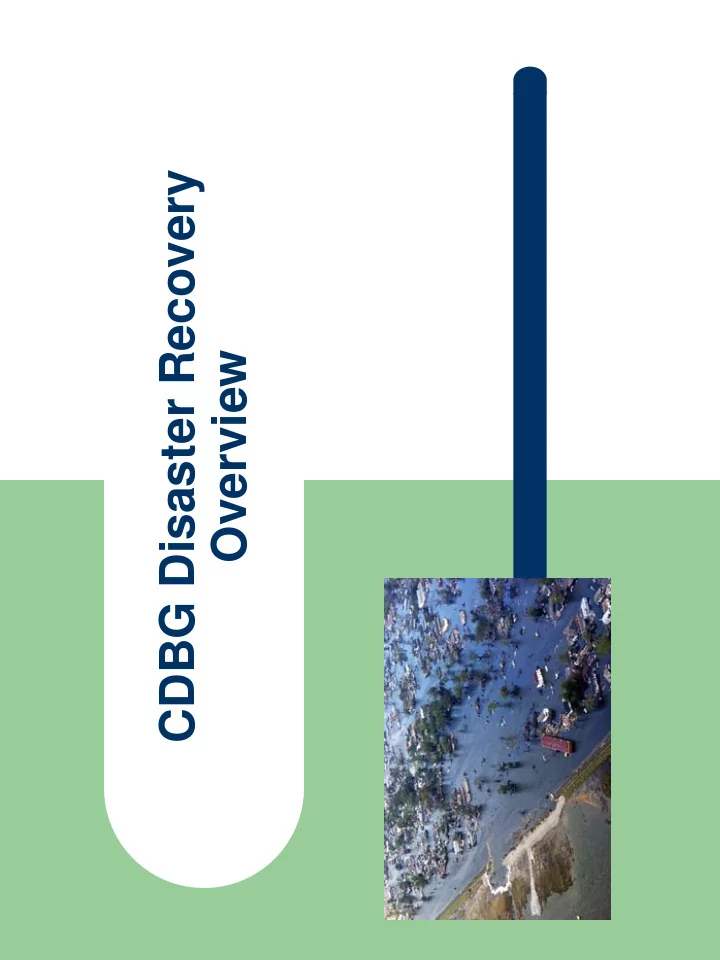
CDBG Disaster Recovery Overview
SLIDE 2
The money and the grantees
$3.483 billion for New York’s ESDC and LMDC $150 million for 10 States for 2003-2004 events $19.7 billion in CDBG for the States of Alabama, Florida, Louisiana, Mississippi, and Texas
SLIDE 3
How does the CDBG disaster recovery program work?
Congress appropriates funds for disaster recovery HUD contacts grantees to discuss recovery plans
and identify list of needed waivers
HUD publishes waivers and alternative
requirements in Notices
Grantee applies/HUD makes grant State or local government manages programs Projects may be contracted out and funds
subgranted
SLIDE 4 How does the CDBG program work?
Most State CDBG rules and principles apply:
Grantee chooses activities Grantee submits Action Plan Each activity is eligible and meets a national
Grantee designs management procedures (including
monitoring and internal audit)
Grantee draws funds from a U.S.Treasury line of
credit
HUD monitors for compliance with Action Plans and
rules
SLIDE 5
How does the CDBG program work (New York/Gulf Coast variations)?
Oversight from HUD–HQ and/or Field offices eLOCCS with budget line items DRGR Action Plans DRGR quarterly performance reports HUD monitoring and OIG audits based on risk
analysis
Substantial waivers and alternate requirements Stay consistent with “overall purpose of the Act”
SLIDE 6 Eligibility (aka Grant Activity Categories)
- All the usual CDBG-eligible activities in HCD law
–
Housing
–
Infrastructure
–
Economic Development
- Waiver for new construction of housing, public
services cap
- Other waivers based on laws, activity details, and
need
- Related to consequences of covered disaster
- Included in an Action Plan
SLIDE 7 Critical requirements?
Citizen participation Financial management
– Procurement – Document necessary and reasonable costs – Internal controls – Reconcile accounts to LOCCS & DRGR – Program income
Environment Labor (Davis-Bacon) Acquisition of real property/relocation Administration/planning cap
SLIDE 8 Critical requirements?
Eligible and related to effects of covered disaster Grantee is responsible for day-to-day management
– Subrecipient/UGLG monitoring – Contractor management – Beneficiary data – Internal audit function within grantee
Recordkeeping
– Document day-to-day management – Retain 3 years after overall Grantee-HUD closeout
Privacy FOIA
SLIDE 9
Advice (based on the regs and experience)
Put all procedures in writing. Follow them or
document why you don’t.
Build performance targets into contracts. Hone your
scopes of work.
Make the files tell the story. Build compliance into day-to-day management.
Project completion can be undone by noncompliance.
Sign your work. Catch problems early and take action. Communicate.
SLIDE 10
Web resources
www.hud.gov http://www.access.gpo.gov/davisbacon/ http://www.hud.gov/offices/cpd/communityde
velopment/programs/dri/
http://www.hud.gov/systems/other.cfm
SLIDE 11
Reference
Appropriations laws Housing and Community Development Act of 1974, as
amended
State CDBG regulations Federal Register notices Guide to Subrecipient Management LMDC GAM
SLIDE 12
Presenter
Jessie Handforth Kome, Director,
Disaster Recovery & Special Issues Division Office of Block Grant Assistance Community Planning and Development (CPD) U.S. Department of HUD jessie.handforth.kome@hud.gov