
SLIDE 1
Nukualofa, Tonga, 5th April 2017
Angela Martin, Blue Climate Solutions
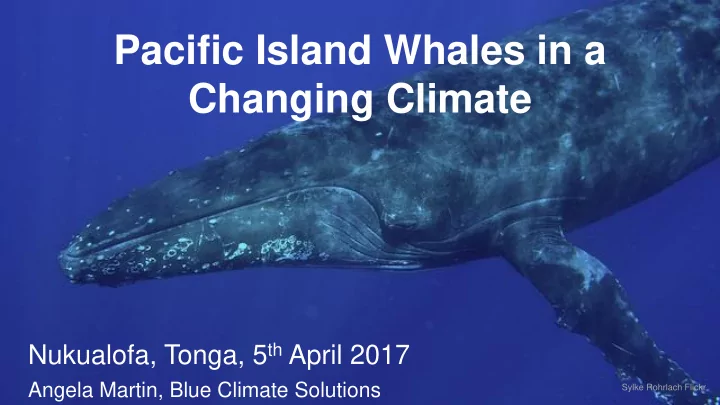
Pacific Island Whales in a Changing Climate
Sylke Rohrlach Flickr
Changing Climate Nukualofa, Tonga, 5 th April 2017 Angela Martin, - - PowerPoint PPT Presentation
Pacific Island Whales in a Changing Climate Nukualofa, Tonga, 5 th April 2017 Angela Martin, Blue Climate Solutions Sylke Rohrlach Flickr Washington D.C. Established in 2008 58 Projects To advance Blue Carbon Blue Carbon: Carbon
Sylke Rohrlach Flickr
Christopher Michel CC 2.0 Flickr
Sylke Rohrlach Flickr
Sylke Rohrlach Flickr
NOAA
Sylke Rohrlach Flickr
(Lavery et al. 2012)
(EPA greenhouse gas equivalencies calculator)
(Lavery et al. 2010)
(EPA greenhouse gas equivalencies calculator)
Tony Wu
(Pershing et al. 2010)
(EPA greenhouse gas equivalencies calculator)
Pathways – Pumps – Trophic Cascades
Lutz and Martin 2014
Donald LeRoi NOAA
Roderick Eime Flickr
Sylke Rohrlach Flickr
Sylke Rohrlach Flickr
is Angela Martin.
Government and people for welcoming us to their beautiful island, and for the great entertainment last night! I’d also like to thank all the Pacific Islands representatives who have come together to address this important issue for Pacific Island whales, culture and people, but also for the world, which would be, and indeed has been, a poorer place without these amazing creatures.
project of The Ocean Foundation, and the world’s first organisation to focus solely on blue carbon, which is carbon captured and stored by life in the ocean, and we look at both coastal ecosystems -mangroves, seagrasses, as well as the role of larger marine life, including whales! But I’ll get to that a bit later.
expected impacts on these whales, the potential role of whales in climate change mitigation, implications for the region and proactive measures.
draft report on Pacific Island whales and climate change. We have reached out to those of you active in the region to help inform this report, so thank you to all of those who have contributed insights, pointed us toward references, shared resources and given feedback so
and will be finalising the draft in the weeks after the meeting, so please come chat to us or be in touch on email
approximately one-third and continues to do so, along with most of the 0.6°C global temperature increase over the past 30 years. Although there is much to still understand, by exploring and identifying the potential direct and indirect impacts of climate change on whales, and the related consequences on whale-watching economies, we can work towards identifying solutions for humans and whales alike.
whale that use the waters around the Pacific Islands, so I’m going to jump straight in to the topic of climate change.
populations: more than half of cetaceans in Oceania, as well as globally, are classified as data deficient by the International Union for the Conservation of Nature (IUCN) while we can measure physical indicators of climate change, such as temperature rise, reduction of sea ice and rising sea levels, the responses of whales to climate change are difficult to predict.
effects on marine mammals, their populations, and their responses to climate and ecosystem variations are highly speculative.
understanding and predictive capacities. Additionally, given the geographical scope of Pacific Islands, collaborative partnerships with the many organisations and researchers addressing these issues are essential to tackling climate change issues, to guide climate mitigation and adaption strategies that benefit Pacific Island whales and their ocean habitats, and support their well-established cultural and economic roles.
are complex and can be amplified at higher trophic levels. So these are the effects of climate change and I will outline how they are expected to affect whales in Pacific Islands.
and zooplankton, and coral reef-forming organisms with calcium carbonate skeletons or
important habitat for their prey.
distribution of many whale species. Being highly mobile, many whales are expected to exhibit behavioural changes rather than physiological responses, including altering distribution as
various drivers that might not be solved through relocation, including availability of prey or suitable habitat. Likelihood of illness and disease outbreaks in marine ecosystems may be increased due to expansion of pathogen ranges, host susceptibility due to increased stress, and expansion of vectors of disease.
including humpback prey items such as krill. Krill population estimates vary greatly, and research into the impact of climate change on krill abundance is ongoing. In response to low krill availability in the North-East Pacific, humpbacks have been recorded switching to anchovy and sardines. Whales that are unable to switch between prey may be forced to use
between species whose niches were formerly separated by sea surface temperature. Species with expanding ranges, or those less constrained by water temperature, may encroach upon species with contracting ranges. Climate-forced range overlaps add complexity to established food chains and compound existing threats with increased competition, and can result in exclusion of formerly dominant species from resources. Due to the complex nature of increased competition between species that currently occupy separate spaces, it is difficult to predict the outcomes of such occurrences.
tertiary effects, are likely to result in increased encroachment of human activities upon whale habitats. Examples include human migration to coasts and relatively untouched areas that become increasingly habitable, as well as increased activities in newly-accessible ocean and polar areas, including shipping, resource extraction and fishing. This encroachment and the associated threats are expected to exacerbate the impacts of climate change on whales and their habitats.
to exhibit any direct physiological responses, they are likely to experience indirect effects, such as those on food webs, which are uncertain but likely irreversible. It is widely reported that reef-forming corals are susceptible to reduced pH, and in future, coral reef ecosystems may support less biodiversity than at present. Some Pacific Island coral reefs have adapted to naturally acidified waters, however it is unknown whether these will continue to provide suitable habitat for reef-dependent species in the event of climate-driven acidification.
without geographical barriers to movement, whales in the Pacific Islands are expected to move towards cooler waters. Models assessing ocean warming over the next 35 years indicate that the Pacific islands may experience a net reduction in the diversity of marine mammal species found in their waters. While temperature is a key driver behind range shifts, other factors also have a strong influence on whale behaviour, and whales may face ecological barriers to shifting their range.
range shifts as temperature. Many models attempt to predict marine mammal distribution in response to climate factors, however few consider the potential and likely significant effects of changing prey distribution. Most baleen whales do not feed in the Pacific Islands waters, with Antarctic krill either their principal prey, or the base of their food chain. Food availability at feeding grounds in Antarctica is dictated by ice cover and ocean fronts, both of which will shrink with warming oceans. Pacific island whales are therefore vulnerable to the impact of climate change on krill populations. Migratory whales are expected to travel an additional 3-5o latitude further South to find foraging grounds. So, migration patterns of Pacific island whales, including length and timing, may be disrupted. Krill abundance could also be reduced due to climate change, which could result in whale malnourishment and population decreases.
their prey, which can affect the success of range shifts. For Pacific Island whales, boundaries between habitats, foraging areas, and other spatial and temporal parameters that define the niche for each species are not well documented. Thus, the potential for successful range shifts, increased competition within or between species, or altered diets, is unknown.
from human activities, and so cannot be considered in isolation. Climate change is enabling human exploration and industry to expand, and to enter new regions of Antarctic waters. As a result, the potential for anthropogenic disturbance to Pacific island whales is consequently increased, including ship strikes, noise and other pollution.
change, remain a factor in whales’ responses and ability to adapt to change. Because of their life history traits, such as slow growth, whales are at higher risk of extinction. The IUCN red list classifies almost a fifth of marine mammals in Oceania as threatened. Accidental whale mortality, through entanglement in fishing gear or ship strikes, is thought to be the most prevalent threat to whales in Oceania and around the world, followed by pollution, including chemicals, plastics and sound.
to Antarctic waters are therefore likely competing for resources with these fisheries. Growing demand for krill and the development of technology that reduces the cost of krill fishing are likely to result in industry pressure for increased catch allowances. Balancing conservation and fisheries activities could diminish the principles of conservation outlined in the Convention for the Conservation of Antarctic Marine Living Resources (CCAMLR). In the absence of effective management and regulation, krill fisheries have the potential to exacerbate any negative ecological impacts of climate change on krill populations, and thus krill-dependent food chains, including humpbacks and other baleen whales.
for some good news! The contribution of whales to ecosystem function has been gaining recognition in scientific literature and support from members of the IWC and IUCN. Through the same life history traits that make them vulnerable, their unique behaviours, long life spans and large body size, whales directly contribute to the oceans ability to absorb CO2, a greenhouse gas, and store organic carbon in the ocean. Carbon captured and stored by ocean and coastal organisms, such as whales, is termed “blue carbon”. So I’m going to just show you a short video here… hopefully it works! Just a note on the claim about movement of whales being equal to wind and tides… this claim has been widely contested in the literature since this video was produced.
sperm whales in Hawaii enable 60 tonnes of carbon to be captured per year. Apparently, this is for those of you who prefer trees as a unit of measurement, this is equivalent to carbon sequestered by 208 acres of US forests in one year.
enhance the carbon capture process. For example, in the Southern Ocean, sperm whales enable as much carbon to be captured as is sequestered in 694 acres of U.S. forests per year.
deliver nutrients into their breeding grounds through shedding skin and other life processes. But this is yet to be quantified in terms of carbon benefits.
the ocean during their long lifespans, when whale carcasses sink, the carbon stored in their biomass can enter sediments. According to one study in 2010, eight species of baleen whale globally can store as much carbon as 100,000 acres of U.S. forests in one year. This is one way that carbon is effectively retired from the carbon cycle, and is unlikely to re-emerge as a greenhouse gas for hundreds to thousands of years.
animals and other life contributes to carbon capture and storage in the oceans. Steven Lutz and I identified 8 different pathways, pumps and trophic cascades in scientific literature, and have included a round up of these in the Fish Carbon report – the link isn’t that intuitive, so if you’d like me to email you a copy, please leave your business card/email address for me.
storage, and fewer still quantified, that the numbers here may seem small. However, is this just the tip of the iceberg? And what will the story be if whales were restored to their former populations? If you’re interested in answering these questions, talk to me!
the world has become more popular as tourists are increasingly seeking authentic experiences in natural habitats. As well as impacts on the whales that tourists pay to see, climate change will also have direct and indirect effects on whale-watching operations.
industry focuses on humpbacks. Like most baleen whales, humpbacks in the Pacific Islands are
range of small fish and krill species, and migrate to the Pacific Islands during winter for breeding and calving. Economies based on these whales therefore have a stake in ensuring the long-term protection of food and habitat at Antarctic feeding grounds.
migrating humpback whales. The whale season is anywhere between May and November, depending on the island State. Climate change may affect migration cycles, resulting in earlier
the season. The impact of changes to timing, particularly in the shoulder seasons (those first and last months when the whales are arriving and departing), may reduce predictability of whale occurrence, which is important for both tourist satisfaction and businesses.
restaurants, income and staff contracts may be affected. Ongoing shifts in timing and the corresponding lack of certainty may affect the desirability of the Pacific Islands as a whale- watching destination, both to tourists and businesses, during these shoulder seasons.
weather, including cyclone frequency and severity, is expected to increase. Circumstances in which boats are unable to launch, tourists are unable to view or swim with whales, or are uncomfortable, may increase. Poor weather conditions may also increase search time on the water.
abundance will correspondingly increase search time and associated costs to the whale- watching operators, as well as reduce customer satisfaction.
satisfied with species, such as humpback whales, that are “more active and gregarious”. Humpback whales breed, calve and sing in the Pacific islands, and these natural behaviours are part of the tourism draw. Whales undernourished or stressed by climate change and other human-related stressors may not exhibit desirable behaviours regularly. And climate change could affect reproductive success of humpbacks, and therefore may affect the number of mother-calf pairs. Accordingly, supporting a whale-watching economy translates to not only supporting a healthy population of whales, but also an environment which encourages natural behaviours.
activities, and may enable year-round whale-watching, potentially creating more economic stability for the industry.
as data deficient, meaning not enough is known to assign a category on their population
studied regions there are gaps in understanding the potential impacts and responses.
climate change on destination habitats and timing are hard to identify. Long term monitoring, use of satellite and remote sensing technology, traditional surveys and assessment of relationships between whales and their habitats will help identify the causes of potential range shifts, and estimate their likelihood and outcomes.
however, few studies record and quantify these services. The contribution of whales to ocean productivity, removal of carbon dioxide from the atmosphere and its storage as organic carbon in the Pacific Islands is unknown. Focused research here can enable estimates of the carbon-market value of whale conservation. Payments to protect natural carbon storage in coastal ecosystems are already a reality elsewhere in the world, and benefits shared from sale
Restoration, and a draft project to start this analysis in the Cook Islands, and are looking for funders.
marine protected areas, will need to address both climate and non-climate related threats to be successful.
help to identify key habitats and establish effective conservation and management measures therein, such as the partnership the Pacific Islands have with SPREP and the CMS. Collaboration between Governments could promote and encourage a more holistic approach to whale conservation and management throughout their range, including national territorial waters, Antarctic areas governed by CCAMLR, and areas beyond national jurisdiction, which make up half of the Pacific Islands ocean area. The development process for a UN treaty on biodiversity in areas beyond national jurisdiction is currently underway, and provides an
measures could be encouraged and formalised through customary and introduced law. Issues related to climate change, industry, ocean ecosystems and whales could be included in environmental assessment, planning and management, or other mechanisms to consider and regulate the impacts of industry. Collaborative partnerships between industry, government, research and NGOs can look together to address the issues that face each of these entities.
considering that activities that negatively impact whale populations also limit their mitigation
restore healthy whale populations for their carbon sequestration services, would have co- benefits for the whale-watching economy.
large scale processes, identify likely range shifts and other behavioural changes, and inform proactive policies and management decisions, including priority areas and actions. To supplement research, traditional knowledge could help increase understanding and protection of whale species, and insights could be gathered from researchers, fishers and boat-based tourism operators on trends and anecdotal observations on the water.
economical and comfortable option for those who are less able to enjoy boat trips, as well as an alternative land-based infrastructure to continue to provide touristic experiences to view whales in adverse weather conditions for boats.
the necessity of addressing the impacts of climate change on whales alongside other threats, and support for action, is an important step to acknowledge and prioritise these issues.
comments, insights, references for the report. There’s a draft copy of the report on the USB sticks hidden in your lanyards, so feel free to review and comment directly onto that, using track changes. And I’m happy to take questions now if you have any?