SLIDE 1
- Chap. 2. The First Law of Thermodynamics
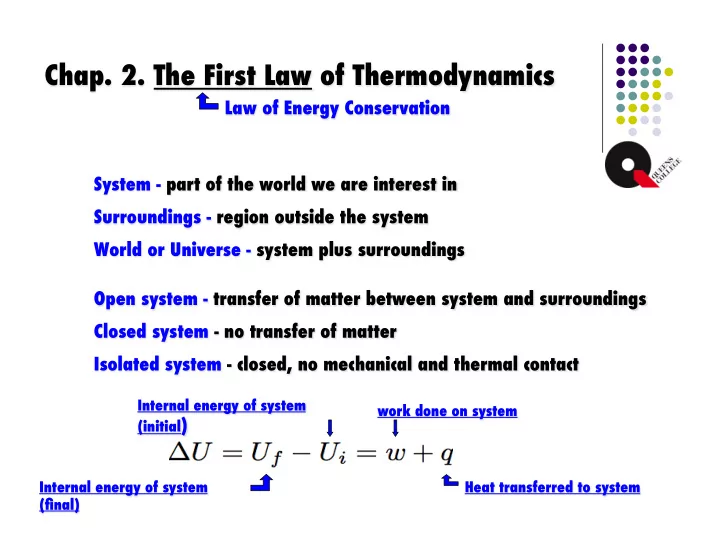
Law of Energy Conservation System - part of the world we are interest in Surroundings - region outside the system World or Universe - system plus surroundings Open system - transfer of matter between system and surroundings Closed system - no transfer of matter Isolated system - closed, no mechanical and thermal contact
Internal energy of system (initial) Internal energy of system (final) work done on system Heat transferred to system
SLIDE 2
First law holds however small the heat and work are. Infinitesimal changes:
work on system due to expansion or contraction electric or other work on system
SLIDE 3
First law holds however small the heat and work are. Infinitesimal changes:
work on system due to expansion or contraction electric or other work on system
At constant volume,
Heat capacity at constant volume - the amount of heat transferred to the system per unit increase of temperature
SLIDE 4
First law holds however small the heat and work are. Infinitesimal changes:
work due to expansion or contraction electric or other work
At constant volume,
Heat capacity at constant volume - the amount of heat transferred to the system per unit increase of temperature
SLIDE 5
Most processes occur at constant pressure. What is the relation between heat absorbed at constant pressure and the energy? Enthalpy:
heat content, a state function in the unit of energy
SLIDE 6
The heat absorbed at constant pressure is the same as enthalpy change of the system given that its pressure is the same as the external pressure. Enthalpy:
heat content, a state function in the unit of energy
SLIDE 7
Enthalpy:
heat content, a state function in the unit of energy
At constant pressure,
Heat capacity at constant pressure - the amount of heat transferred to the system per unit increase of temperature
The heat absorbed at constant pressure is the same as enthalpy change of the system given that its pressure is the same as the external pressure.
SLIDE 8
and are functions of temperature in general Molar Heat Capacities
SLIDE 9
and are functions of temperature in general Molar Heat Capacities Heat capacities can be used to determine U and H Molar energy Molar enthalpy
SLIDE 10
Example, Ideal Gas
Monoatomic Linear molecule Nonlinear molecule
SLIDE 11
Example, Ideal Gas
Monoatomic Linear molecule Nonlinear molecule
SLIDE 12
Example, Ideal Gas
Monoatomic Linear molecule Nonlinear molecule
SLIDE 13
Example, Ideal Gas
Monoatomic Linear molecule Nonlinear molecule
SLIDE 14
Example, Ideal Gas
Monoatomic Linear molecule Nonlinear molecule
SLIDE 15
General Relations Consider as a function of T and V
A state function having the unit of pressure (named as internal pressure in Atkins)
SLIDE 16
General Relations Consider as a function of T and V
A state function having the unit of pressure (named as internal pressure in Atkins)
Then, consider and as functions of T and p
(isobaric) expansion coefficient
SLIDE 17
General Relations Consider as a function of T and V
A state function having the unit of pressure (named as internal pressure in Atkins)
Then, consider and as functions of T and p
(isobaric) expansion coefficient
SLIDE 18
Another general relations Consider temperature, , as a function of H and p
SLIDE 19
Another general relations Consider temperature, , as a function of H and p (1)
Take partial derivative of (1) with respect to T while H remains fixed
(2)
SLIDE 20
Another general relations Consider temperature, , as a function of H and p (1)
Take partial derivative of (1) with respect to T while H remains fixed
(2) (2)
Joule-Thompson coefficient Take partial derivative of (1) with respect to H while T remains fixed
SLIDE 21 Joule-Thompson Effect - Cooling of gas upon lowering
- f pressure at constant enthalpy (isenthalpic process)
Consider enthalpy, , as a function of T and p
Isothermal Joule- Thompson coefficient Easier to measure
SLIDE 22
Thermochemistry Application of thermodynamics to chemical reaction. The set of reactants and the set of products are viewed as the same system at different physical and chemical conditions.
Phase, structure, etc Different molecules and complexes
Standard state Pure form at 1 bar. Defined at any temperature, but refers to 298.15 K if not stated explicitly. Standard enthalpy change Change in enthalpy for a process in which the initial and final states are in their standard states
See Table 2.4
SLIDE 23 Hess’s Law The standard enthalpy of an overall reaction is the sum of the standard enthalpies of the individual reactions into which a reaction may be divided. Direct result of enthalpy as a state function.
and then Kirchhoff’s law
Reaction heat capacity for the chemical reaction at constant pressure