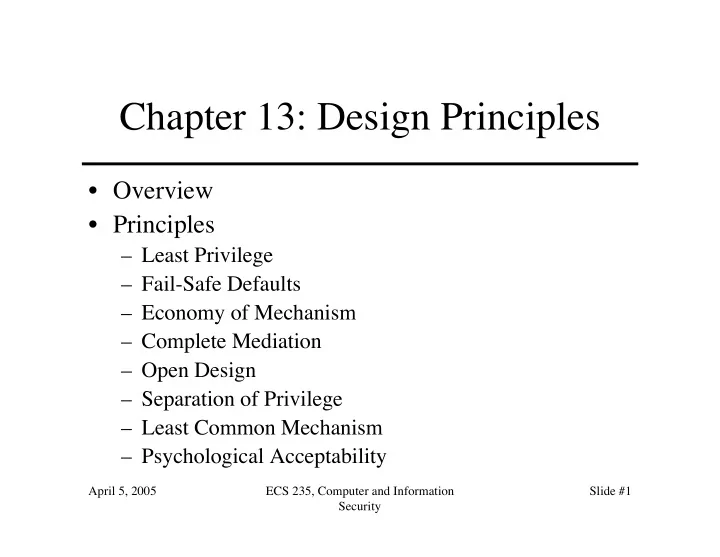
Chapter 13: Design Principles Overview Principles Least - - PowerPoint PPT Presentation

chapter 13 design principles
SMART_READER_LITE
LIVE PREVIEW

Chapter 13: Design Principles Overview Principles Least - - PowerPoint PPT Presentation

Chapter 13: Design Principles Overview Principles Least Privilege Fail-Safe Defaults Economy of Mechanism Complete Mediation Open Design Separation of Privilege Least Common Mechanism Psychological


slide-1
SLIDE 1

April 5, 2005 ECS 235, Computer and Information Security Slide #1

Chapter 13: Design Principles

  • Overview
  • Principles

– Least Privilege – Fail-Safe Defaults – Economy of Mechanism – Complete Mediation – Open Design – Separation of Privilege – Least Common Mechanism – Psychological Acceptability

slide-2
SLIDE 2

April 5, 2005 ECS 235, Computer and Information Security Slide #2

Overview

  • Simplicity

– Less to go wrong – Fewer possible inconsistencies – Easy to understand

  • Restriction

– Minimize access – Inhibit communication

slide-3
SLIDE 3

April 5, 2005 ECS 235, Computer and Information Security Slide #3

Least Privilege

  • A subject should be given only those

privileges necessary to complete its task

– Function, not identity, controls – Rights added as needed, discarded after use – Minimal protection domain

slide-4
SLIDE 4

April 5, 2005 ECS 235, Computer and Information Security Slide #4

Fail-Safe Defaults

  • Default action is to deny access
  • If action fails, system as secure as when

action began

slide-5
SLIDE 5

April 5, 2005 ECS 235, Computer and Information Security Slide #5

Economy of Mechanism

  • Keep it as simple as possible

– KISS Principle

  • Simpler means less can go wrong

– And when errors occur, they are easier to understand and fix

  • Interfaces and interactions
slide-6
SLIDE 6

April 5, 2005 ECS 235, Computer and Information Security Slide #6

Complete Mediation

  • Check every access
  • Usually done once, on first action

– UNIX: Access checked on open, not checked thereafter

  • If permissions change after, may get

unauthorized access

slide-7
SLIDE 7

April 5, 2005 ECS 235, Computer and Information Security Slide #7

Open Design

  • Security should not depend on secrecy of

design or implementation

– Popularly misunderstood to mean that source code should be public – “Security through obscurity” – Does not apply to information such as passwords or cryptographic keys

slide-8
SLIDE 8

April 5, 2005 ECS 235, Computer and Information Security Slide #8

Separation of Privilege

  • Require multiple conditions to grant

privilege

– Separation of duty – Defense in depth

slide-9
SLIDE 9

April 5, 2005 ECS 235, Computer and Information Security Slide #9

Least Common Mechanism

  • Mechanisms should not be shared

– Information can flow along shared channels – Covert channels

  • Isolation

– Virtual machines – Sandboxes

slide-10
SLIDE 10

April 5, 2005 ECS 235, Computer and Information Security Slide #10

Psychological Acceptability

  • Security mechanisms should not add to

difficulty of accessing resource

– Hide complexity introduced by security mechanisms – Ease of installation, configuration, use – Human factors critical here

slide-11
SLIDE 11

April 5, 2005 ECS 235, Computer and Information Security Slide #11

Key Points

  • Principles of secure design underlie all

security-related mechanisms

  • Require:

– Good understanding of goal of mechanism and environment in which it is to be used – Careful analysis and design – Careful implementation

slide-12
SLIDE 12

April 5, 2005 ECS 235, Computer and Information Security Slide #12

Chapter 2: Access Control Matrix

  • Overview
  • Access Control Matrix Model

– Boolean Expression Evaluation – History

  • Protection State Transitions

– Commands – Conditional Commands

  • Special Rights

– Principle of Attenuation of Privilege

slide-13
SLIDE 13

April 5, 2005 ECS 235, Computer and Information Security Slide #13

Overview

  • Protection state of system

– Describes current settings, values of system relevant to protection

  • Access control matrix

– Describes protection state precisely – Matrix describing rights of subjects – State transitions change elements of matrix

slide-14
SLIDE 14

April 5, 2005 ECS 235, Computer and Information Security Slide #14

Description

  • bjects (entities)

subjects s1 s2 … sn

  • 1 … om s1 … sn
  • Subjects S = { s1,…,sn }
  • Objects O = { o1,…,om }
  • Rights R = { r1,…,rk }
  • Entries A[si, oj] ⊆ R
  • A[si, oj] = { rx, …, ry } means

subject si has rights rx, …, ry

  • ver object oj
slide-15
SLIDE 15

April 5, 2005 ECS 235, Computer and Information Security Slide #15

Example 1

  • Processes p, q
  • Files f, g
  • Rights r, w, x, a, o

f g p q p rwo r rwxo w q a ro r rwxo

slide-16
SLIDE 16

April 5, 2005 ECS 235, Computer and Information Security Slide #16

Example 2

  • Procedures inc_ctr, dec_ctr, manage
  • Variable counter
  • Rights +, –, call

counter inc_ctr dec_ctr manage inc_ctr + dec_ctr – manage call call call

slide-17
SLIDE 17

April 5, 2005 ECS 235, Computer and Information Security Slide #17

Boolean Expression Evaluation

  • ACM controls access to database fields

– Subjects have attributes – Verbs define type of access – Rules associated with objects, verb pair

  • Subject attempts to access object

– Rule for object, verb evaluated, grants or denies access

slide-18
SLIDE 18

April 5, 2005 ECS 235, Computer and Information Security Slide #18

Example

  • Subject annie

– Attributes role (artist), groups (creative)

  • Verb paint

– Default 0 (deny unless explicitly granted)

  • Object picture

– Rule: paint: ‘artist’ in subject.role and ‘creative’ in subject.groups and time.hour >= 0 and time.hour < 5

slide-19
SLIDE 19

April 5, 2005 ECS 235, Computer and Information Security Slide #19

ACM at 3AM and 10AM

… picture … … annie … paint At 3AM, time condition met; ACM is: … picture … … annie … At 10AM, time condition not met; ACM is:

slide-20
SLIDE 20

April 5, 2005 ECS 235, Computer and Information Security Slide #20

History

Database: name position age salary Alice teacher 45 $40,000 Bob aide 20 $20,000 Cathy principal 37 $60,000 Dilbert teacher 50 $50,000 Eve teacher 33 $50,000 Queries: 1.sum(salary, “position = teacher”) = 140,000 2.sum(salary, “age > 40 & position = teacher”) should not be answered (deduce Eve’s salary)

slide-21
SLIDE 21

April 5, 2005 ECS 235, Computer and Information Security Slide #21

ACM of Database Queries

Oi = { objects referenced in query i } f(oi) = { read } for oj ∈ Oi, if |∩j = 1,…,i Oj| < 2 f(oi) = ∅ for oj ∈ Oi, otherwise 1. O1 = { Alice, Dilbert, Eve } and no previous query set, so: A[asker, Alice] = f(Alice) = { read } A[asker, Dilbert] = f(Dilbert) = { read } A[asker, Eve] = f(Eve) = { read } and query can be answered

slide-22
SLIDE 22

April 5, 2005 ECS 235, Computer and Information Security Slide #22

But Query 2

From last slide: f(oi) = { read } for oj ∈ Oi, if |∩j = 1,…,i Oj| < 2 f(oi) = ∅ for oj ∈ Oi, otherwise 2. O2 = { Alice, Dilbert } but | O2 ∩ O1 | = 2 so A[asker, Alice] = f(Alice) = ∅ A[asker, Dilbert] = f(Dilbert) = ∅ and query cannot be answered

slide-23
SLIDE 23

April 5, 2005 ECS 235, Computer and Information Security Slide #23

State Transitions

  • Change the protection state of system
  • H represents transition

– Xi Hτ Xi+1: command τ moves system from state Xi to Xi+1 – Xi H* Xi+1: a sequence of commands moves system from state Xi to Xi+1

  • Commands often called transformation

procedures

slide-24
SLIDE 24

April 5, 2005 ECS 235, Computer and Information Security Slide #24

Primitive Operations

  • create subject s; create object o

– Creates new row, column in ACM; creates new column in ACM

  • destroy subject s; destroy object o

– Deletes row, column from ACM; deletes column from ACM

  • enter r into A[s,o]

– Adds r rights for subject s over object o

  • delete r from A[s,o]

– Removes r rights from subject s over object o

slide-25
SLIDE 25

April 5, 2005 ECS 235, Computer and Information Security Slide #25

Create Subject

  • Precondition: s ∉ S
  • Primitive command: create subject s
  • Postconditions:

– S´ = S ∪{ s }, O´ = O ∪{ s } – (∀y ∈ O´)[a´[s, y] = ∅], (∀x ∈ S´)[a´[x, s] = ∅] – (∀x ∈ S)(∀y ∈ O)[a´[x, y] = a[x, y]]

slide-26
SLIDE 26

April 5, 2005 ECS 235, Computer and Information Security Slide #26

Create Object

  • Precondition: o ∉ O
  • Primitive command: create object o
  • Postconditions:

– S´ = S, O´ = O ∪ { o } – (∀x ∈ S´)[a´[x, o] = ∅] – (∀x ∈ S)(∀y ∈ O)[a´[x, y] = a[x, y]]

slide-27
SLIDE 27

April 5, 2005 ECS 235, Computer and Information Security Slide #27

Add Right

  • Precondition: s ∈ S, o ∈ O
  • Primitive command: enter r into a[s, o]
  • Postconditions:

– S´ = S, O´ = O – a´[s, o] = a[s, o] ∪ { r } – (∀x ∈ S´)(∀y ∈ O´ – { o }) [a´[x, y] = a[x, y]] – (∀x ∈ S´ – { s })(∀y ∈ O´) [a´[x, y] = a[x, y]]

slide-28
SLIDE 28

April 5, 2005 ECS 235, Computer and Information Security Slide #28

Delete Right

  • Precondition: s ∈ S, o ∈ O
  • Primitive command: delete r from a[s, o]
  • Postconditions:

– S´ = S, O´ = O – a´[s, o] = a[s, o] – { r } – (∀x ∈ S´)(∀y ∈ O´ – { o }) [a´[x, y] = a[x, y]] – (∀x ∈ S´ – { s })(∀y ∈ O´) [a´[x, y] = a[x, y]]

slide-29
SLIDE 29

April 5, 2005 ECS 235, Computer and Information Security Slide #29

Destroy Subject

  • Precondition: s ∈ S
  • Primitive command: destroy subject s
  • Postconditions:

– S´ = S – { s }, O´ = O – { s } – (∀y ∈ O´)[a´[s, y] = ∅], (∀x ∈ S´)[a´[x, s] = ∅] – (∀x ∈ S´)(∀y ∈ O´) [a´[x, y] = a[x, y]]

slide-30
SLIDE 30

April 5, 2005 ECS 235, Computer and Information Security Slide #30

Destroy Object

  • Precondition: o ∈ o
  • Primitive command: destroy object o
  • Postconditions:

– S´ = S, O´ = O – { o } – (∀x ∈ S´)[a´[x, o] = ∅] – (∀x ∈ S´)(∀y ∈ O´) [a´[x, y] = a[x, y]]

slide-31
SLIDE 31

April 5, 2005 ECS 235, Computer and Information Security Slide #31

Creating File

  • Process p creates file f with r and w

permission command create•file(p, f) create object f; enter own into A[p, f]; enter r into A[p, f]; enter w into A[p, f]; end

slide-32
SLIDE 32

April 5, 2005 ECS 235, Computer and Information Security Slide #32

Mono-Operational Commands

  • Make process p the owner of file g

command make•owner(p, g) enter own into A[p, g]; end

  • Mono-operational command

– Single primitive operation in this command

slide-33
SLIDE 33

April 5, 2005 ECS 235, Computer and Information Security Slide #33

Conditional Commands

  • Let p give q r rights over f, if p owns f

command grant•read•file•1(p, f, q) if own in A[p, f] then enter r into A[q, f]; end

  • Mono-conditional command

– Single condition in this command

slide-34
SLIDE 34

April 5, 2005 ECS 235, Computer and Information Security Slide #34

Multiple Conditions

  • Let p give q r and w rights over f, if p owns

f and p has c rights over q command grant•read•file•2(p, f, q) if own in A[p, f] and c in A[p, q] then enter r into A[q, f]; enter w into A[q, f]; end

slide-35
SLIDE 35

April 5, 2005 ECS 235, Computer and Information Security Slide #35

Copy Right

  • Allows possessor to give rights to another
  • Often attached to a right, so only applies to

that right

– r is read right that cannot be copied – rc is read right that can be copied

  • Is copy flag copied when giving r rights?

– Depends on model, instantiation of model

slide-36
SLIDE 36

April 5, 2005 ECS 235, Computer and Information Security Slide #36

Own Right

  • Usually allows possessor to change entries

in ACM column

– So owner of object can add, delete rights for

  • thers

– May depend on what system allows

  • Can’t give rights to specific (set of) users
  • Can’t pass copy flag to specific (set of) users
slide-37
SLIDE 37

April 5, 2005 ECS 235, Computer and Information Security Slide #37

Attenuation of Privilege

  • Principle says you can’t give rights you do

not possess

– Restricts addition of rights within a system – Usually ignored for owner

  • Why? Owner gives herself rights, gives them to
  • thers, deletes her rights.
slide-38
SLIDE 38

April 5, 2005 ECS 235, Computer and Information Security Slide #38

Key Points

  • Access control matrix simplest abstraction

mechanism for representing protection state

  • Transitions alter protection state
  • 6 primitive operations alter matrix

– Transitions can be expressed as commands composed of these operations and, possibly, conditions

slide-39
SLIDE 39

April 5, 2005 ECS 235, Computer and Information Security Slide #39

Chapter 3: Foundational Results

  • Overview
  • Harrison-Ruzzo-Ullman result

– Corollaries

  • Take-Grant Protection Model
  • SPM and successors
slide-40
SLIDE 40

April 5, 2005 ECS 235, Computer and Information Security Slide #40

Overview

  • Safety Question
  • HRU Model
  • Take-Grant Protection Model
  • SPM, ESPM

– Multiparent joint creation

  • Expressive power
  • Typed Access Matrix Model
slide-41
SLIDE 41

April 5, 2005 ECS 235, Computer and Information Security Slide #41

What Is “Secure”?

  • Adding a generic right r where there was

not one is “leaking”

  • If a system S, beginning in initial state s0,

cannot leak right r, it is safe with respect to the right r.

slide-42
SLIDE 42

April 5, 2005 ECS 235, Computer and Information Security Slide #42

Safety Question

  • Does there exist an algorithm for

determining whether a protection system S with initial state s0 is safe with respect to a generic right r?

– Here, “safe” = “secure” for an abstract model

slide-43
SLIDE 43

April 5, 2005 ECS 235, Computer and Information Security Slide #43

Mono-Operational Commands

  • Answer: yes
  • Sketch of proof:

Consider minimal sequence of commands c1, …, ck to leak the right. –Can omit delete, destroy –Can merge all creates into one Worst case: insert every right into every entry; with s subjects and o objects initially, and n rights, upper bound is k ≤ n(s+1)(o+1)