SLIDE 1
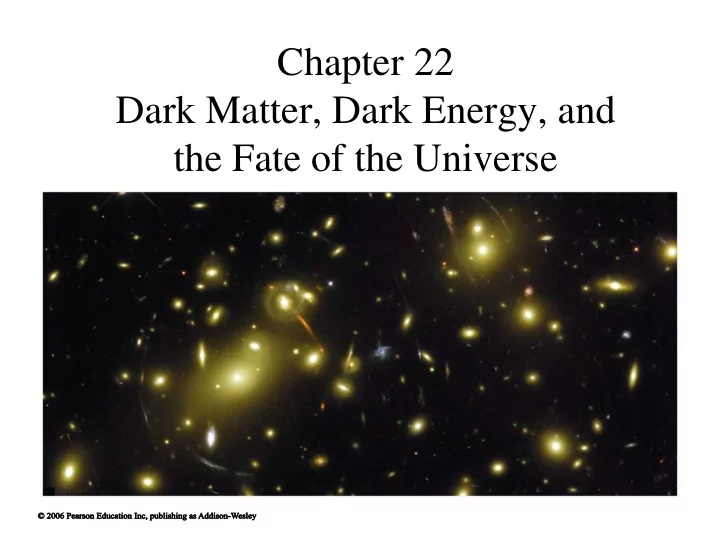
Chapter 22 Dark Matter, Dark Energy, and the Fate of the Universe
SLIDE 2 22.1 Unseen Influences in the Cosmos
- Our goals for learning
- What do we mean by dark matter and dark
energy?
SLIDE 3
What do we mean by dark matter and dark energy?
SLIDE 4
Dark Matter: An undetected form of mass that emits little or no light but whose existence we infer from its gravitational influence Dark Energy: An unknown form of energy that seems to be the source of a repulsive force causing the expansion of the universe to accelerate
Unseen Influences
SLIDE 5
~ 4.4%
– Normal Matter inside stars: ~ 0.6% – Normal Matter outside stars: ~ 3.8%
~ 25%
~ 71%
Contents of Universe
SLIDE 6 What have we learned?
- What do we mean by dark matter and dark
energy?
– “Dark matter” is the name given to the unseen mass whose gravity governs the observed motions of stars and gas clouds – “Dark energy” is the name given to whatever might be causing the expansion of the universe to accelerate
SLIDE 7 22.2 Evidence for Dark Matter
- Our goals for learning
- What is the evidence for dark matter in
galaxies?
- What is the evidence for dark matter in
clusters of galaxies?
- Does dark matter really exist?
- What might dark matter be made of?
SLIDE 8
What is the evidence for dark matter in galaxies?
SLIDE 9 We measure the mass of the solar system using the
- rbits of planets
- Orb. Period
- Avg. Distance
Or for circles:
- Orb. Velocity
- Orbital Radius
SLIDE 10 Rotation curve A plot of orbital velocity versus
Solar system’s rotation curve declines because Sun has almost all the mass
SLIDE 11
Rotation curve of merry-go- round rises with radius
SLIDE 12 Rotation curve
stays flat with distance Mass must be more spread
solar system
SLIDE 13 Mass in Milky Way is spread out
region than the stars Most of the Milky Way’s mass seems to be dark matter!
SLIDE 14 Mass within Sun’s
1.0 x 10¹¹ MSun Total mass: ~1012 MSun
SLIDE 15
The visible portion of a galaxy lies deep in the heart of a large halo of dark matter
SLIDE 16 We can measure rotation curves of
galaxies using the Doppler shift of the 21-cm line
SLIDE 17
Spiral galaxies all tend to have flat rotation curves indicating large amounts of dark matter
SLIDE 18 Broadening of spectral lines in elliptical galaxies tells us how fast the stars are
These galaxies also have dark matter
SLIDE 19
What is the evidence for dark matter in clusters of galaxies?
SLIDE 20
We can measure the velocities of galaxies in a cluster from their Doppler shifts
SLIDE 21
The mass we find from galaxy motions in a cluster is about 50 times larger than the mass in stars!
SLIDE 22
Clusters contain large amounts of X- ray emitting hot gas Temperature of hot gas (particle motions) tells us cluster mass: 85% dark matter 13% hot gas 2% stars
SLIDE 23
Gravitational lensing, the bending of light rays by gravity, can also tell us a cluster’s mass
SLIDE 24
SLIDE 25
All three methods of measuring cluster mass indicate similar amounts of dark matter
SLIDE 26
Does dark matter really exist?
SLIDE 27
Our Options
1. Dark matter really exists, and we are observing the effects of its gravitational attraction 2. Something is wrong with our understanding of gravity, causing us to mistakenly infer the existence of dark matter
SLIDE 28
Our Options
1. Dark matter really exists, and we are observing the effects of its gravitational attraction 2. Something is wrong with our understanding of gravity, causing us to mistakenly infer the existence of dark matter Because gravity is so well tested, most astronomers prefer option #1
SLIDE 29 What might dark matter be made
SLIDE 30
… not as bright as a star. How dark is it?
SLIDE 31
- Ordinary Dark Matter (MACHOS)
– Massive Compact Halo Objects: dead or failed stars in halos of galaxies
- Extraordinary Dark Matter (WIMPS)
– Weakly Interacting Massive Particles: mysterious neutrino-like particles
Two Basic Options
SLIDE 32
- Ordinary Dark Matter (MACHOS)
– Massive Compact Halo Objects: dead or failed stars in halos of galaxies
- Extraordinary Dark Matter (WIMPS)
– Weakly Interacting Massive Particles: mysterious neutrino-like particles
Two Basic Options
The Best Bet
SLIDE 33 MACHOs
make other stars appear brighter through lensing
SLIDE 34 MACHOs
make other stars appear brighter through lensing … but not enough lensing events to explain all the dark matter
SLIDE 35
- There’s not enough ordinary matter
- WIMPs could be left over from Big Bang
- Models involving WIMPs explain how galaxy
formation works
Why Believe in WIMPs?
SLIDE 36 What have we learned?
- What is the evidence for dark matter in
galaxies?
– Rotation curves of galaxies are flat, indicating that most of their matter lies outside their visible regions
- What is the evidence for dark matter in
clusters of galaxies?
– Masses measured from galaxy motions, temperature of hot gas, and gravitational lensing all indicate that the vast majority of matter in clusters is dark
SLIDE 37 What have we learned?
- Does dark matter really exist?
– Either dark matter exists or our understanding
- f our gravity must be revised
- What might dark matter be made of?
– There does not seem to be enough normal (baryonic) matter to account for all the dark matter, so most astronomers suspect that dark matter is made of (non-baryonic) particles that have not yet been discovered
SLIDE 38 22.3 Structure Formation
- Our goals for learning
- What is the role of dark matter in galaxy
formation?
- What are the largest structures in the
universe?
SLIDE 39
What is the role of dark matter in galaxy formation?
SLIDE 40
Gravity of dark matter is what caused protogalactic clouds to contract early in time ⇒
SLIDE 41
WIMPs can’t contract to center because they don’t radiate away their orbital energy
SLIDE 42 Dark matter is still pulling things together After correcting for Hubble’s Law, we can see that galaxies are flowing toward the densest regions
SLIDE 43
What are the largest structures in the universe?
SLIDE 44
Maps of galaxy positions reveal extremely large structures: superclusters and voids
SLIDE 45
Models show that gravity of dark matter pulls mass into denser regions – universe grows lumpier with time
Time in billions of years 0.5 2.2 5.9 8.6 13.7 Size of expanding box in millions of lt-yrs 13 35 70 93 140
SLIDE 46
Models show that gravity of dark matter pulls mass into denser regions – universe grows lumpier with time
SLIDE 47
Structures in galaxy maps look very similar to the ones found in models in which dark matter is WIMPs
SLIDE 48 What have we learned?
- What is the role of dark matter in galaxy
formation?
– The gravity of dark matter seems to be what drew gas together into protogalactic clouds, initiating the process of galaxy formation
- What are the largest structures in the
universe?
– Galaxies appear to be distributed in gigantic chains and sheets that surround great voids
SLIDE 49 22.4 The Fate of the Universe
- Our goals for learning
- Will the universe continue expanding
forever?
- Is the expansion of the universe
accelerating?
SLIDE 50
Will the universe continue expanding forever?
SLIDE 51 Does the universe have enough kinetic energy to escape its
gravitational pull?
SLIDE 52 Critical density of matter Not enough dark matter Fate of universe depends
amount
matter Lots of dark matter
SLIDE 53
Amount of dark matter is ~25% of the critical density suggesting fate is eternal expansion Not enough dark matter
SLIDE 54
But expansion appears to be speeding up! Not enough dark matter Dark Energy?
SLIDE 55 Estimated age depends on both dark matter and dark energy
SLIDE 56
Is the expansion of the universe accelerating?
SLIDE 57
Brightness of distant white-dwarf supernovae tells us how much universe has expanded since they exploded
SLIDE 58
Accelerating universe is best fit to supernova data
SLIDE 59 What have we learned?
- Will the universe continue expanding
forever?
– Current measurements indicate that there is not enough dark matter to prevent the universe from expanding forever
- Is the expansion of the universe
accelerating?
– An accelerating universe is the best explanation for the distances we measure when using white dwarf supernovae as standard candles