Chapter 6: Selection Statements boolean expressions constants: true - - PowerPoint PPT Presentation

chapter 6 selection statements boolean expressions
SMART_READER_LITE
LIVE PREVIEW

Chapter 6: Selection Statements boolean expressions constants: true - - PowerPoint PPT Presentation

Chapter 6: Selection Statements boolean expressions constants: true and false method return values: if a method returns true or false , then sending the message counts as a boolean expression relational operators: > , > =,


slide-1
SLIDE 1

Chapter 6: Selection Statements

  • boolean expressions

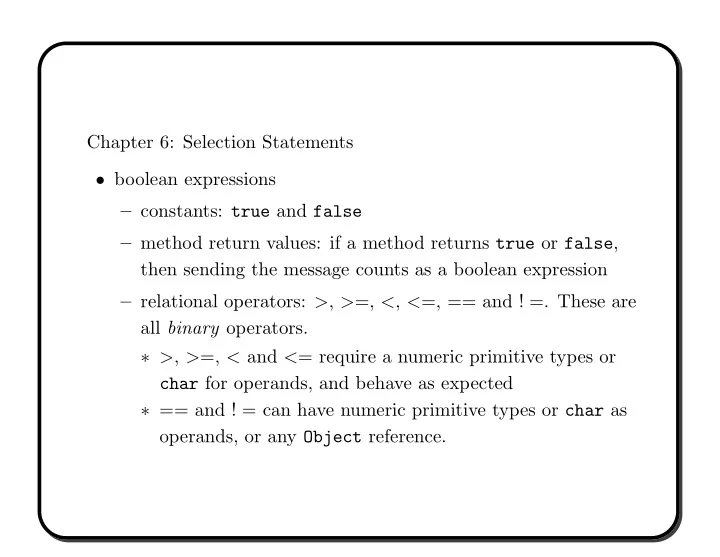
– constants: true and false – method return values: if a method returns true or false, then sending the message counts as a boolean expression – relational operators: >, >=, <, <=, == and ! =. These are all binary operators. ∗ >, >=, < and <= require a numeric primitive types or char for operands, and behave as expected ∗ == and ! = can have numeric primitive types or char as

  • perands, or any Object reference.
slide-2
SLIDE 2

– boolean operators: && (AND), (OR), !(NOT). These may be applied to boolean expressions to yield another boolean expression. ∗ && and both take two boolean expressions as operands. ∗ ! takes one boolean expression as an operand.

  • if statments

– format: if (<boolean expression>) { // ‘‘true’’ code } else { // ‘‘false’’ code } – ‘‘false’’ code optional – braces are optional if code body is only one command – see the Style Guide for rules about indentation! – any boolean expression is allowed, so may be quite complex using boolan operators!

slide-3
SLIDE 3
  • switch statements

– format: switch(<numeric type>) { case <value>: ...; default: ... } – may have multiple case <value> statements – note that <value> is not a boolean expression, but rather a constant! – default statement is optional – break; statement needed between case statements if you want code to skip to end of switch block. – see the Style Guide for rules about indentation!

slide-4
SLIDE 4

ListBox from Javabook

  • used to offer discrete choices for user to select from
  • constructor requires a MainWindow object as an argument, just

like InputBox and OutputBox

  • method addItem(String) adds a choice to the ListBox
  • method getSelectedIndex() makes the ListBox appear, and

waits until the user selects an item

  • a zero-based index is returned from getSelectedIndex(), so

switch is a good way to handle the response

  • two class constants are defined:

– ListBox.NO SELECTION - when the user closes the ListBox window without selecting anything (using the X at the top) – ListBox.CANCEL - when the user clicks the CANCEL button rather than the OK button in the window