Chapter Twelve Protein Synthesis: Translation of the Genetic - - PDF document

chapter twelve protein synthesis translation of the
SMART_READER_LITE
LIVE PREVIEW

Chapter Twelve Protein Synthesis: Translation of the Genetic - - PDF document

Mary K. Campbell Shawn O. Farrell Chapter Twelve Protein Synthesis: Translation of the Genetic Message Paul D. Adams University of Arkansas 1 Translating the


slide-1
SLIDE 1

Mary K. Campbell Shawn O. Farrell

  • Chapter Twelve

Protein Synthesis: Translation of the Genetic Message

Paul D. Adams • University of Arkansas

1

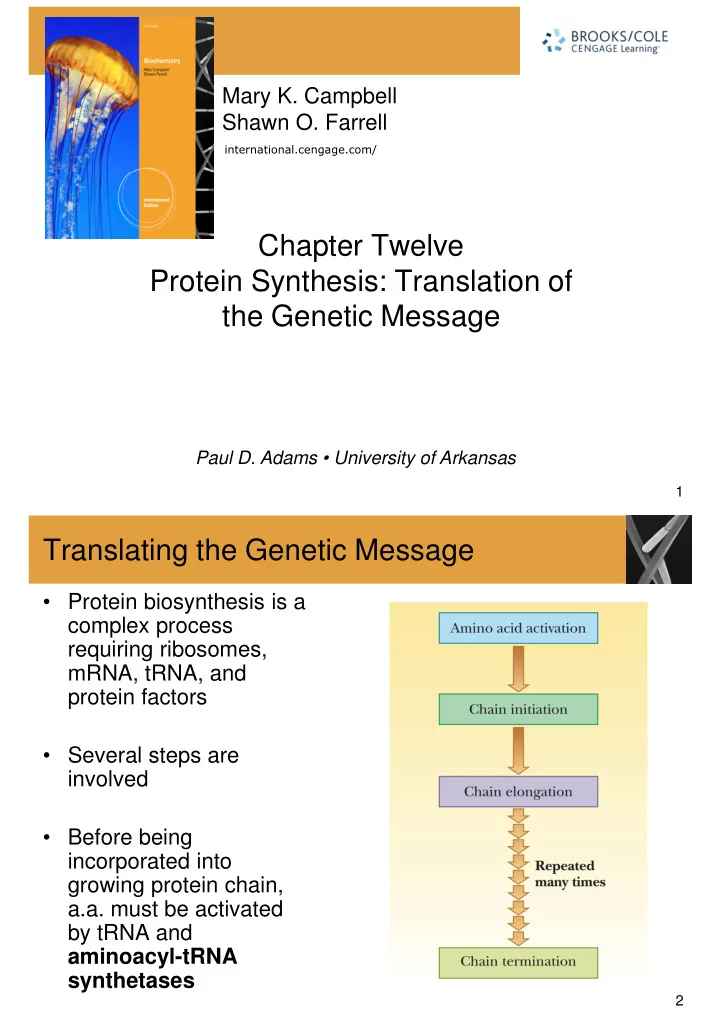
Translating the Genetic Message

  • Protein biosynthesis is a

complex process requiring ribosomes, mRNA, tRNA, and mRNA, tRNA, and protein factors

  • Several steps are

involved

  • Before being
  • Before being

incorporated into growing protein chain, a.a. must be activated by tRNA and aminoacyl-tRNA synthetases

2

slide-2
SLIDE 2

The Genetic Code

  • Salient features of the genetic code
  • triplet:

triplet: a sequence of three bases (a codon) is needed to specify one amino acid needed to specify one amino acid

  • nonoverlapping:

nonoverlapping: no bases are shared between consecutive codons

  • commaless:

commaless: no intervening bases between codons

  • degenerate:

degenerate: more than one triplet can code for the same amino acid; Leu, Ser, and Arg, for example, are each coded for by six triplets

  • universal:

universal: the same in viruses, prokaryotes, and eukaryotes; the only exceptions are some codons in mitochondria

3

The Genetic Code (Cont’d)

  • The ribosome moves

along the mRNA three bases at a time rather bases at a time rather than one or two at a time

  • Theoretically possible

genetic codes are genetic codes are shown in figure 12.2

4

slide-3
SLIDE 3

The Genetic Code (Cont’d)

  • All 64 codons have assigned meanings
  • 61 code for amino acids
  • 3 (UAA, UAG, and UGA) serve as termination signals
  • only Trp and Met have one codon each
  • the third base is irrelevant for Leu, Val, Ser, Pro, Thr,

Ala, Gly, and Arg

  • the second base is important for the type of amino

acid; for example, if the second base is U, the amino acids coded for are hydrophobic acids coded for are hydrophobic

  • for the 15 amino acids coded for by 2, 3, or 4 triplets,

it is only the third letter of the codon that varies. Gly, for example, is coded for by GGA, GGG, GGC, and GGU

5

The Genetic Code (Cont’d)

6

slide-4
SLIDE 4

7

The Genetic Code (Cont’d)

  • Assignments of triplets in genetic code based on

several different experiments

  • synthetic mRNA:

synthetic mRNA: if mRNA is polyU, polyPhe is

  • synthetic mRNA:

synthetic mRNA: if mRNA is polyU, polyPhe is formed; if mRNA is poly --- ACACACACACACACACACACA---, poly(Thr-His) is formed

  • binding assay:

binding assay: aminoacyl-tRNAs bind to ribosomes in the presence of trinucleotides

synthesize trinucleotides by chemical means

  • synthesize trinucleotides by chemical means
  • carry out a binding assay for each type of

trinucleotide

  • aminoacyl-tRNAs are tested for their ability to bind

in the presence of a given trinucleotide

8

slide-5
SLIDE 5

9

tRNA Structure – simple

10

https://wikispaces.psu.edu/display/Bio110nk/From+Gene+to+Protein#FromGenetoProtein-GeneToProtein%3ATheCentralDogma

slide-6
SLIDE 6

The Filter-Binding Assay Helps Elucidate the Genetic Code

11

Wobble Base Pairing

  • Some tRNAs bond to one

codon exclusively, but many tRNAs can recognize many tRNAs can recognize more than one codon because of variations in allowed patterns of hydrogen bonding

  • the variation is called

“wobble” “wobble”

  • wobble is in the first base
  • f the anticodon

12

slide-7
SLIDE 7

Base Pairing Combination in the Wobble Scheme

3’ 13

Wobble Base Pairing Alternatives

14

slide-8
SLIDE 8

Wobble Base Pairing Hypothesis

  • The wobble hypothesis provides insight into some

aspects of the degeneracy of the code

  • in many cases, the degenerate codons for a given
  • in many cases, the degenerate codons for a given

amino acid differ only in the third base; therefore fewer different tRNAs are needed because a given tRNA can base-pair with several codons

  • the existence of wobble minimizes the damage that

can be caused by a misreading of the code; for example, if the Leu codon CUU were misread CUC or example, if the Leu codon CUU were misread CUC or CUA or CUG during transcription of mRNA, the codon would still be translated as Leu during protein synthesis

15

Amino Acid Activation

  • Amino acid activation and formation of the

aminoacyl-tRNA take place in two separate steps aminoacyl-tRNA take place in two separate steps

  • Both catalyzed by amionacyl-tRNA synthetase
  • Free energy of hydrolysis of ATP provides energy

for bond formation

16

slide-9
SLIDE 9

Amino Acid Activation (Cont’d)

  • This two-stage reaction allows selectivity at two

levels

  • the amino acid:

the amino acid: the aminoacyl-AMP remains bound

  • the amino acid:

the amino acid: the aminoacyl-AMP remains bound to the enzyme and binding of the correct amino acid is verified by an editing site in the tRNA synthetase

  • tRNA

tRNA: there are specific binding sites on tRNAs that are recognized by aminoacyl-tRNA synthetases.

17

Amino Acid Activation (Cont’d)

18

slide-10
SLIDE 10

19

https://wikispaces.psu.edu/display/Bio110nk/From+Gene+to+Protein#FromGenetoProtein-GeneToProtein%3ATheCentralDogma 20

slide-11
SLIDE 11

tRNA Tertiary Structure

  • There are several recognition sites for various amino

acids on the tRNA

21

The Ribosome - summary

22

https://wikispaces.psu.edu/display/Bio110nk/From+Gene+to+Protein#FromGenetoProtein-GeneToProtein%3ATheCentralDogma

slide-12
SLIDE 12

Chain Initiation

  • In all organisms, synthesis of polypeptide chain

starts at the N-terminal end, and grows from N- terminus to C-terminus terminus to C-terminus

  • Initiation requires:
  • tRNAfmet
  • initiation codon (AUG) of mRNA
  • 30S ribosomal subunit
  • 50S ribosomal subunit
  • 50S ribosomal subunit
  • initiation factors IF-1, IF-2, and IF-3
  • GTP, Mg2+
  • Forms the initiation complex

23

The Initiation Complex

24

slide-13
SLIDE 13

The Initiation Complex - simplified

25

https://wikispaces.psu.edu/display/Bio110nk/From+Gene+to+Protein#FromGenetoProtein-GeneToProtein%3ATheCentralDogma

Chain Initiation

  • tRNAmet and tRNAfmet contain the triplet 3’-UAC-5’
  • Triplet base pairs with 5’-AUG-3’ in mRNA
  • 3’-UAC-5’ triplet on tRNAfmet recognizes the AUG

triplet (the start signal) when it occurs at the beginning

  • f the mRNA sequence that directs polypeptide

synthesis

  • 3’-UAC-5’ triplet on tRNAmet recognizes the AUG

triplet when it is found in an internal position in the mRNA sequence

  • Start signal is preceded by a Shine-Dalgarno purine-

rich leader segment, 5’-GGAGGU-3’, which usually lies about 10 nucleotides upstream of the AUG start signal and acts as a ribosomal binding site

26

slide-14
SLIDE 14

Chain Elongation

  • Uses three binding sites for tRNA present on the

50S subunit of the 70S ribosome: P (peptidyl) site, A (aminoacyl) site, E (exit) site. (aminoacyl) site, E (exit) site.

  • Requires
  • 70S ribosome
  • codons of mRNA
  • aminoacyl-tRNAs
  • elongation factors EF-Tu (Elongation factor
  • elongation factors EF-Tu (Elongation factor

temperature-unstable), EF-Ts (Elongation factor temperature-stable), and EF-G (Elongation factor- GTP)

  • GTP, and Mg2+

27

Shine-Dalgarno Sequence Recognized by

  • E. Coli Ribosomes

28

slide-15
SLIDE 15

Elongation Steps

  • Step 1
  • an aminoacyl-tRNA is bound to the A site
  • the P site is already occupied
  • 2nd amino acid bound to 70S initiation complex. Defined by the

mRNA

  • Step 2
  • EF-Tu is released in a reaction requiring EF-Ts
  • Step 3
  • the peptide bond is formed, the P site is uncharged
  • the peptide bond is formed, the P site is uncharged
  • Step 4
  • the uncharged tRNA is released
  • the peptidyl-tRNA is translocated to the P site
  • EF-G and GTP are required
  • the next aminoacyl-tRNA occupies the empty A site

29

Chain Elongation

30

slide-16
SLIDE 16

Peptide bond formation

31

Chain Termination

  • Chain termination requires
  • stop codons (UAA, UAG, or UGA) of mRNA
  • RF-1 (Release factor-1) which binds to UAA and
  • RF-1 (Release factor-1) which binds to UAA and

UAG or RF-2 (Release factor-2) which binds to UAA and UGA

  • RF-3 which does not bind to any termination codon,

but facilitates the binding of RF-1 and RF-2

  • GTP which is bound to RF-3
  • The entire complex dissociates setting free the

completed polypeptide, the release factors, tRNA, mRNA, and the 30S and 50S ribosomal subunits

32

slide-17
SLIDE 17

Chain Termination

33

Translation – overview

34

https://wikispaces.psu.edu/display/Bio110nk/From+Gene+to+Protein#FromGenetoProtein-GeneToProtein%3ATheCentralDogma

slide-18
SLIDE 18

Translation – simple summary

3’

tRNA with amino acid attached

35 5’ 3’

https://wikispaces.psu.edu/display/Bio110nk/From+Gene+to+Protein#FromGenetoProtein-GeneToProtein%3ATheCentralDogma

Components of Protein Synthesis

36

slide-19
SLIDE 19

Protein Synthesis

  • In prokaryotes, translation begins very soon after

mRNA transcription

  • It is possible to have several molecules of RNA
  • It is possible to have several molecules of RNA

polymerase bound to a single DNA gene, each in a different stage of transcription

  • It is also possible to have several ribosomes bound to

a single mRNA, each in a different stage of translation

  • Polysome:

Polysome: mRNA bound to several ribosomes

  • Polysome:

Polysome: mRNA bound to several ribosomes

  • Coupled translation:

Coupled translation: the process in which a prokaryotic gene is being simultaneously transcribed and translated

37

Simultaneous Protein Synthesis on Polysomes

  • A single mRNA molecule is translated by several

ribosomes simultaneously

  • Each ribosome produces a copy of the polypeptide

chain specified by the mRNA

  • When protein has been completed, the ribosome

dissociates into subunits that are used again in dissociates into subunits that are used again in protein synthesis

38

slide-20
SLIDE 20

Simultaneous Protein Synthesis on Polysomes (Cont’d)

39 40

slide-21
SLIDE 21

41

Eukaryotic Translation

  • Chain Initiation:
  • the most different from process in prokaryotes
  • 13 more initiation factors are given the designation eIF

(eukaryotic initiation factor) (Table 12.4) (eukaryotic initiation factor) (Table 12.4)

42

slide-22
SLIDE 22

Eukaryotic Translation (Cont’d)

  • Chain elongation
  • uses the same mechanism of peptidyl transferase and

ribosome translocation as prokaryotes

  • there is no E site on eukaryotic ribosomes, only A and

P sites

  • there are two elongation factors, eEF-1 and eEF-2
  • eEF2 is the counterpart to EF-G, which causes

translocation

  • Chain termination
  • Chain termination
  • stop codons are the same: UAG, UAA, and UGA
  • only one release factor that binds to all three stop

codons

43

Posttranslational Modification

  • Newly synthesized polypeptides are frequently modified

before they reach their final form where they exhibit biological activity

  • N-formylmethionine in prokaryotes is cleaved
  • N-formylmethionine in prokaryotes is cleaved
  • specific bonds in precursors are cleaved, as for example,

preproinsulin to proinsulin to insulin

  • leader sequences are removed by specific proteases of the

endoplasmic reticulum; the Golgi apparatus then directs the finished protein to its final destination

  • factors such as heme groups may be attached
  • factors such as heme groups may be attached
  • disulfide bonds may be formed
  • amino acids may be modified, as for example, conversion of

proline to hydroxyproline

  • other covalent modifications; e.g., addition of carbohydrates

44

slide-23
SLIDE 23

Examples of Posttranslational Modification

45

Protein Degradation

  • Proteins are in a dynamic state and are often turned
  • ver
  • Degradative pathways are restricted to
  • subcellular organelles such as lysosomes
  • macromolecular structures called proteosomes
  • In eukaryotes, ubiquitinylation (becoming bonded

to ubiquitin) targets a protein for destruction

  • protein must have an N-terminus
  • those with an N-terminus of Met, Ser, Ala, Thr, Val,
  • those with an N-terminus of Met, Ser, Ala, Thr, Val,

Gly, and Cys are resistant

  • those with an N-terminus of Arg, Lys, His, Phe, Tyr,

Trp, Leu, Asn, Gln, Asp, Glu have short half-lives

46

slide-24
SLIDE 24

Ubiquitin-Proteosome Degradation

47

Acidic N-termini Induced Protein Degradation

48