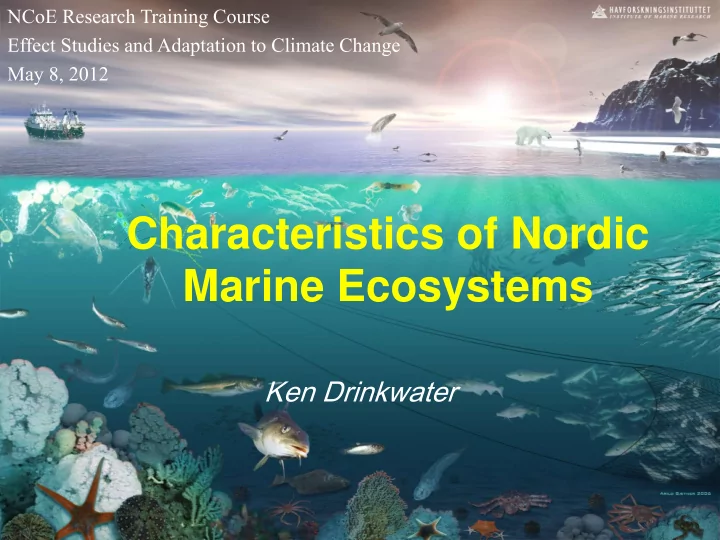
SLIDE 1 Characteristics of Nordic Marine Ecosystems
Ken Drinkwater
NCoE Research Training Course Effect Studies and Adaptation to Climate Change May 8, 2012
SLIDE 2
SLIDE 3 Barents Sea: 1.4x10⁶ km2, Mean depth 230 m
Lofoten Basin Norwegian Basin
Norwegian Sea: 1.1x10⁶ km2 Mean depth 1800 m
Barents Sea
SLIDE 4
Mean Conditions: Physical Oceanography
SLIDE 5
Circulation
Atlantic Inflow to the Barents Sea is on average approximately 40% that of the flow in Norwegian Sea.
SLIDE 6
SLIDE 7 Rey & Mork, Toktrapport, HI, 2003
Salinity Temperature Extended Gimsøy Section - May/June 2003
Hydrographic Transect Across Norwegian Sea
SLIDE 8 400 m Salinity 0 m 40 km
Norwegian Sea Arctic Front
Density Compensating (Passive) Fronts
June 2007 CTD data T S σθ Strong T,S contrast Weak density contrast
Drinkwater et al., in prep.
SLIDE 9 Red represents Atlantic Water inflow, blue the Arctic Waters and green is the extension of the Norwegian Coastal Current and is shelf water of lower
between Atlantic and Arctic Waters is the Polar Front.
Barents Sea Circulation
Arctic/Polar Waters Coastal Waters Barents Sea Waters Atlantic Waters
SLIDE 10
Mean at 100 m
Barents Sea Temperatures
SLIDE 11
The Fugloya- Bjørnoya Section has had seasonal hydrographic sections taken since the 1970s while current meters have been moored for over 10 years and are continuing.
Barents Sea Opening (BSO)
SLIDE 12 Weak Surface T contrast Polar Front (50-150 m)
- Strong T, S, contrast
- Weak density contrast
- Evidence of interleaving
90 km
Strong Surface S Front T S σθ
Density Compensating (Passive) Fronts
Barents Sea Polar Front
August 2007 CTD data Storbanken
Våge et al., 2012
SLIDE 13 Ice coverage in different months
70°N 75°N 80°N 10°E 2 ° E 30°E 40°E 50°E 60°E 7 ° E
Ocean Data View
II IV VI X XII IX XI
Sea Ice
SLIDE 14
Mean Conditions: Biology
SLIDE 15
Annual production: Barents Sea ~90-150 g C m-2, Atlantic 2-3x Arctic Norwegian Sea ~80-180 g C m-2
Primary Production
SLIDE 16 Norwegian Sea June 2007 Barents Sea August 2007
Phytoplankton Biomass
Arctic Front Atlantic Atlantic Front Arctic
South North West East
Norwegian Sea Iceland Sea Jan Mayen
Jan Mayen Ridge
There is no increased phytoplankton biomass or production at the fronts.
Erga et al., submitted Basedow, pers. com.
SLIDE 17 Norwegian Sea Norwegian Shelf/Barents Sea Ocean circulation and climate
Modified after M. Heath
Zooplankton – Calanus finmarchicus
SLIDE 18 Main Zooplankton Species
- C. finmarchicus, 1-yr
- C. glacialis, 2-yr
Temperature at 50 m
SLIDE 19 Hamre 1999
Major Fish Species
SLIDE 20 Capelin Herring
Hamre 1999
SLIDE 21
Atlantic Cod
SLIDE 22
Polar Cod
SLIDE 23 Estimated annual biomass, production and consumption of different trophic levels.
Loeng & Drinkwater 2007
SLIDE 24
Interannual Variability
SLIDE 25 Air Temperature Variability
Significant warming has occurred twice in the past 100+ years in Northern Hemisphere: 1920-1950s and 1990s to present.
Johannesen et al., 2004
SLIDE 26 Inter-annual variations in Atlantic water
- trend since 1970s
- inter-annual variations
- anomalies trough the
system, in general not dampened.
Skagseth et al. 2008
SLIDE 27 Volume flux
Fugløya-Bear Island Vardø-N
Temperature anomalies
Observations in BSO
SLIDE 28
0.05 0.15 1965 1975 1985 1995 2005
Salinity Anomaly Sea Surface Salinties Western Barents Sea
Salinity increases due to transport from the south providing further evidence of importance of advection.
Salinity Anomaly Time Series and Trends
SLIDE 29 Positive Phase of NAO
- deeper Low over Iceland, stronger
High over the Azores
- more northerly storm track
- Warmer, wetter in northern Europe
Negative Phase of NAO
- weaker Low over Iceland, weaker High
- ver the Azores
- weaker storms, move southerly
- Colder dryer in northern Europe
North Atlantic Oscillation (NAO)
- M. Visbeck, CLIVAR Website
SLIDE 30 Effects of the NAO
0,00 2,00 4,00 1958 1963 1968 1973 1978 1983 1988 1993 1998 Year, longitude of 35 PSU
NAO winter index
2 4 6 1960 1965 1970 1975 1980 1985 1990 1995 2000 Year, NAO
Longitude NAO 6S
Winter NAO index (Hurrell. 1995) and the westerly penetration of Atlantic water along 65o45´N. From Blindheim et al. (2000).
Blindheim et al. (2001)
High NAO Low NAO
SLIDE 31 Atlantic Multidecadal Oscillation (AMO)
Sutton and Hodson, 2005
SLIDE 32 Barents Sea (Kola Section) Temperatures
2.5 3.0 3.5 4.0 4.5 5.0 5.5 1890 1940 1990 Temperature (°C) Annual Mean Decadal Multidecadal
Data kindly provided by PINRO
SLIDE 33 Month
1900 1920 1940 1960 1980 2000
Jan Mar May Jul Sep Nov
Barents Sea (Atlantic sector) Barents Sea (Arctic sector)
Jan Mar May Jul Sep
1900 1920 1940 1960 1980 2000
Jan Mar May Jul Sep Nov
anomalies 1900-2006
Heat in the Barents Sea due mostly to advection rather than air-sea heat exchange.
SLIDE 34 R2 = 0.24 1900-2001 2.5 3.0 3.5 4.0 4.5 5.0
5 10 15 20 25 30 35 40
NAO Temperature (°C)
0.1 0.2 0.3 0.4 0.5 0.6 0.7 0.8 1920 1930 1940 1950 1960 1970 1980 1990 2000 2010 Last year of 30-year Period Correlation Coefficient
Kola-NAO Correlations
General positive relationship The strength of the relationship has changed over time and during the 2000s is near its maximum.
SLIDE 35
10 20 1982 1983 1984 1985 1986 1987 1988 1989 1990 1991 1992 1993 1994 1995 1996 1997 1998 1999 2000 2001 2002 2003 2004 2005 2006 2007
Year Sea Ice coverage anomaly, %
Sea Ice Cover Anomalies
Barents Sea (1982-2006) Decadal scale variability determined by advection of heat forced by storms coming across Atlantic. Short time scale variability determined by storms crossing the Arctic that advect ice into the Barents Sea.
SLIDE 36
- Standardized anomalies based on 40 time series of
meteorological, sea-ice and oceanographic conditions
- Up to late 1990s out of phase relationship which are
now in phase. This is related to changing atmospheric patterns.
Drinkwater et al., submitted NORCAN
SLIDE 37 Effect of Warming on primary production, 1998-2006
2 4 6 8 10 200 300 400 500
Annual mean SST (°C)
Total annual net primary production (gC m-2)
Barents Sea (P = 0.093) Norwegian Sea (n.s.) Bering Sea (P = 0.039) Gulf of Maine / Georges Bank (P < 0.001) Gulf of Alaska (n.s.)
Mueter et al. 2009
SLIDE 38
NW Barents Sea
Krill Abundance Indices
Southern Barents Sea
SLIDE 39
Norwegian Sea Zooplankton, g/m2
2000 2009
SLIDE 40 Norwegian Sea Fish Catches
Barents Sea
Sea Around Us Project
SLIDE 41 Development of stocks in the Norwegian Sea
2 4 6 8 10 12 14 16 18 20 5 10 15 20 25 1988 1989 1990 1991 1992 1993 1994 1995 1996 1997 1998 1999 2000 2001 2002 2003 2004 2005 2006 2007 2008 2009
Plankton, g /m2 Pelagic fish, million tonnes
Mackerel Herring Blue whiting Plankton
SLIDE 42
Blue Whiting Growth
SLIDE 43 Barents Sea Fish Catches
Barents Sea
Sea Around Us Project
SLIDE 44
Variation in fish populations
SLIDE 45 0-group fish (1980-2006)
Eastward shift in distribution
Coast Aug Kola Aug FB Aug FB Mar cod capelin herring haddock
SLIDE 46 1987 2004 cod herring capelin
0-group fish
- 1987 was a cold year
- 2004 was a warm year
- More and further east/north
PS 2006 (also warm)
haddock
SLIDE 47 2003 2006 2005 2004
Invasive Species
Snake Pipefish
SLIDE 48
Seabirds
SLIDE 49
Future Changes?
SLIDE 50 Ice algae
- With the reduction
- f sea ice, ice
algae will decline in abundance and those animals feeding on ice algae will also
change the structure and functioning of Arctic ecosystems.
SLIDE 51 Future zooplankton production -Barents Sea
2045-2054 1995-2004
Production increases in Atlantic Waters
Ellingsen et al. (2008)
Production decreases in Arctic Waters
SLIDE 52 Highly likely to be a general northward movement in response to climate changes (already
Shifts in Fish Distribution
SLIDE 53 Capelin Spawning in Response to Climate Change
Huse and Ellingsen, 2008
Present Spawning Future Spawning Direction of distributional shift of adult feeding migration
SLIDE 54 Year 1 Year 30 Year 20 Year 10
Likely Polar cod retreats from subarctic into the Arctic
Chung et al., 2008, UBC Report
SLIDE 55 Cod Recruitment and Temperature
Mean Annual Bottom Temperature
11 10 9 8 7 6 4 3 2
Temp Warm Temperatures decreases Recruitment Warm Temperatures increases Recruitment Recruits
Planque and Fredou (1999)
SLIDE 56 R2 = 0.75
0.5 1 1.5 2 2 4 6 8 10 12 Bottom Temperature d(Recruitment)/dT
If BT < 5° and T warms stock recruitment generally increase If BT between 5° and 8.5°C little change in recruitment If BT >8.5°C recruitment generally decreases If BT 12°C we do not see any cod stocks GB
SLIDE 57
Effect on abundance of 1°C increase
Increase No change Decrease Collapse ?
SLIDE 58
1 to 2°C Temperature Increase
Increase No change Decrease Collapse ?
SLIDE 59
2-3°C Temperature Increase
Increase No change Decrease Collapse ?
SLIDE 60
3-4°C Temperature Increase
Increase No change Decrease Collapse ?
SLIDE 61 Ice-Dependent Marine Mammals
Polar Bear Minke Whales
- Highly likely polar bear abundances will decrease
and distribution will follow the ice out of the Barents
- Whale abundance and distribution (especially Minke
whales) will likely increase.
SLIDE 62 Food web in Atlantic water Food web in Arctic water
Changes in ecosystem function (Barents)
The food web changes may be far more dramatic for the higher compared to the lower trophic levels
Falk-Petersen et al. 2007
SLIDE 63
There is the possibility that boreal species from the Arctic and Pacific will move into the Arctic and may start to mix.
SLIDE 64 Summary
- Strong warming primarily due to advective
heat fluxes
- Traditional NAO forcing less important
- Zooplankton increasing slightly in Barents,
declining in Norwegian Sea
- Cod and haddock in Barents doing very well,
capelin variable but presently increasing
- Norwegian Sea, pelagics have been at very
high abundance but appear to be decreasing in recent years, perhaps due to reduced zooplankton.
SLIDE 65
Thank you for your attention!
SLIDE 66
Comparision between BSO and Svinøy section
SLIDE 67
SLIDE 68
Blue Whiting in Norwegian Sea
SLIDE 69 Blue whiting stock-recruitment relationship
0e+00 2e+06 4e+06 6e+06 8e+06 0e+00 2e+07 4e+07 6e+07 SSB (tonnes) Recruitment (000s of individuals)
81 82 83 84 85 86 87 88 89 90 91 92 93 94 95 96 97 98 99 00 01 02 03 04 05 06 07
SLIDE 70 Role of Subpolar Gyre
(Hatun et al. 2009)
Hátún et al., 2009 Strong gyre, colder
(RP), lower recruitment Weak gyre, warmer
(RP), higher recruitment
SLIDE 71
Variations in predation by mackerel on eggs and larvae
Blue Whiting distribution during cold years Blue Whiting distribution during warm years
SLIDE 72 Development of stocks in the Norwegian Sea
2 4 6 8 10 12 14 16 18 20 5 10 15 20 25 1988 1989 1990 1991 1992 1993 1994 1995 1996 1997 1998 1999 2000 2001 2002 2003 2004 2005 2006 2007 2008 2009
Plankton, g /m2 Pelagic fish, million tonnes
Mackerel Herring Blue whiting Plankton