CHE Alaska Webinar April 8 th 2015 Bjorn Beeler ! - - PowerPoint PPT Presentation

che alaska webinar april 8 th 2015 bjorn beeler ipen
SMART_READER_LITE
LIVE PREVIEW

CHE Alaska Webinar April 8 th 2015 Bjorn Beeler ! - - PowerPoint PPT Presentation

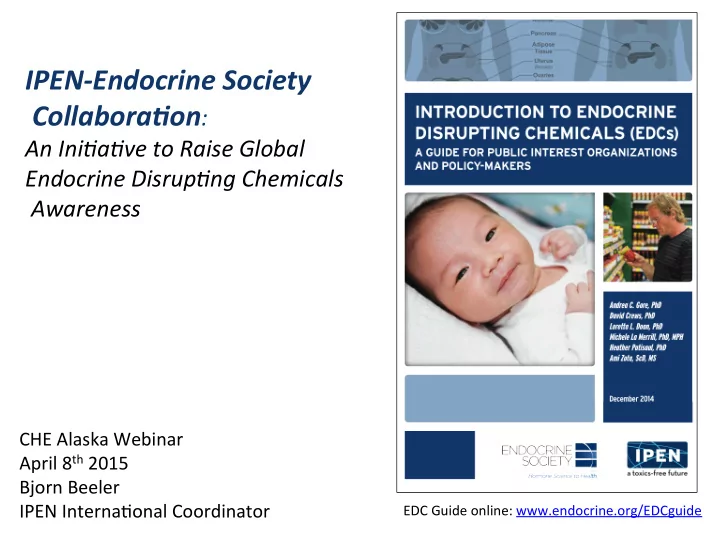
IPEN-Endocrine Society Collabora5on : An Ini'a've to Raise Global Endocrine Disrup'ng Chemicals Awareness CHE Alaska Webinar April 8 th 2015


slide-1
SLIDE 1

¡

CHE ¡Alaska ¡Webinar ¡ April ¡8th ¡2015 ¡ Bjorn ¡Beeler ¡ ¡ IPEN ¡Interna>onal ¡Coordinator ¡

¡

¡

IPEN-­‑Endocrine ¡Society ¡ ¡Collabora5on: ¡

An ¡Ini'a've ¡to ¡Raise ¡Global ¡ ¡ Endocrine ¡Disrup'ng ¡Chemicals ¡ ¡Awareness ¡

!

EDC ¡Guide ¡online: ¡www.endocrine.org/EDCguide ¡ ¡

slide-2
SLIDE 2

IPEN ¡Overview: ¡ ¡Mission ¡ A ¡TOXIC’S ¡FREE ¡FUTURE ¡FOR ¡EVERYONE ¡

¡

A ¡world ¡in ¡which ¡chemicals ¡are ¡no ¡longer ¡produced ¡or ¡ used ¡in ¡ways ¡that ¡harm ¡human ¡health ¡and ¡the ¡ environment ¡

slide-3
SLIDE 3

IPEN ¡Overview: ¡Global ¡Network ¡ ¡

700+ IPEN Participating Organizations in 116 countries 8 Regional Hubs Offices 2 International Offices (Sweden & US) alance

slide-4
SLIDE 4

IPEN ¡Overview: ¡Local ¡Chemical ¡Issues ¡& ¡PrioriGes ¡

PesGcides ¡ Waste ¡ Contaminated ¡Sites ¡ ¡ ¡ ¡ ¡ ¡ ¡(Industrial ¡PolluGon) ¡

slide-5
SLIDE 5

IPEN ¡Leadership ¡

Africa ¡ ¡ ¡ ¡ ¡ ¡ ¡Arab ¡ ¡ ¡ ¡ ¡ ¡ ¡ ¡ ¡Asia-­‑Pacific ¡ ¡ ¡ ¡ ¡ ¡ ¡ ¡C/E ¡Europe ¡ ¡ ¡LaGn ¡America ¡ ¡ ¡ ¡ ¡ ¡ ¡US ¡ ¡ ¡ ¡ ¡ ¡ ¡ ¡ ¡ ¡ ¡ ¡ ¡ ¡ ¡W. ¡Europe ¡ Cameroon ¡ Ethiopia ¡ Tanzania ¡ ¡ ¡ ¡ Lebanon ¡ Tunisia ¡ Alaska ¡ California ¡ ¡ Czech ¡Rep. ¡ France ¡ Germany ¡ Switzerland ¡ Sweden ¡ Chile ¡ Mexico ¡ Bangladesh ¡ Cook ¡Islands ¡ India ¡ Indonesia ¡ Philippines ¡ ¡ ¡ Belarus ¡ Russia ¡ Co-­‑Chairs ¡ Execu>ve ¡CommiWee ¡ Steering ¡CommiWee ¡ Regional ¡Hubs ¡ Secretariat ¡ Thema>c ¡Working ¡Group ¡Coordinators ¡

slide-6
SLIDE 6

Global: ¡Increased ¡Chemical ¡Produc>on ¡& ¡Use ¡

Global ¡Chemical ¡Sales: ¡$17 ¡Billion ¡USD ¡(1970s) ¡à ¡ ¡$4.1 ¡Trillion ¡(2010) ¡ ¡ Rapid ¡Expansion ¡in ¡Developing ¡Countries: ¡limited ¡regula>on ¡& ¡capacity ¡

¡ ¡(ex: ¡China’s ¡chemical ¡produc>on ¡forecasted ¡to ¡grow ¡by ¡66% ¡within ¡the ¡2012-­‑2020 ¡period) ¡

slide-7
SLIDE 7

IPEN’s ¡Theory ¡of ¡Change: ¡Local-­‑Global-­‑Local ¡ Globalize Local Priorities

Linking local priorities to global policies

Localize ¡Global ¡Policies ¡

Leveraging ¡global ¡policies ¡and ¡resources ¡for ¡

  • n-­‑the-­‑ground ¡ac>on ¡and ¡change ¡

¡ ¡

slide-8
SLIDE 8

IPEN: ¡Areas ¡of ¡work ¡ ¡

EliminaGng ¡the ¡World’s ¡Most ¡Hazardous ¡ Chemicals: ¡Making ¡Interna>onal ¡Trea>es ¡Work ¡ PromoGng ¡Stronger ¡InternaGonal ¡Chemicals: ¡A ¡ Strategic ¡Approach ¡to ¡Interna>onal ¡Chemicals ¡ Management ¡(SAICM) ¡ HalGng ¡the ¡Spread ¡of ¡Toxic ¡Metals: ¡Mercury ¡ Treaty ¡and ¡Lead ¡Paint ¡Elimina>on ¡ Capacity ¡Building ¡& ¡Expansion ¡of ¡Global ¡ Toxics-­‑Free ¡Movement ¡

slide-9
SLIDE 9

Global ¡Policy: ¡Local ¡Voice ¡to ¡the ¡Global ¡Arena ¡

Global ¡Chemical ¡Policy ¡Arenas: ¡

  • Stockholm, ¡Basel, ¡RoWerdam ¡& ¡Minamata ¡Conven>ons ¡
  • SAICM: ¡Strategic ¡Approach ¡to ¡Interna>onal ¡Chemicals ¡Management ¡
slide-10
SLIDE 10

EDCs ¡on ¡the ¡Global ¡Chemical ¡Policy ¡Agenda ¡

Global ¡Community ¡recognize ¡EDCs ¡as ¡an ¡Emerging ¡Issues, ¡ ¡ via ¡adopGon ¡of ¡the ¡ ¡2012 ¡SAICM ¡ResoluGon ¡on ¡EDCs ¡

“…poten'al ¡adverse ¡effects ¡of ¡endocrine ¡disruptors ¡on ¡human ¡health ¡and ¡the ¡ environment” ¡and ¡“…the ¡need ¡to ¡protect ¡humans, ¡and ¡ecosystems ¡and ¡their ¡ cons'tuent ¡parts ¡that ¡are ¡especially ¡vulnerable.” ¡ ¡ Adopted* ¡by ¡reps ¡from: ¡ 122 ¡Government ¡ ¡ 19 ¡Int’l ¡Organiza>ons ¡ 79 ¡NGOs ¡ ¡ * ¡Non-­‑legally ¡binding ¡ ¡

slide-11
SLIDE 11

EDCs ¡in ¡the ¡Global ¡Chemical ¡Policy ¡Arena ¡

The ¡SAICM ¡ac5ons ¡recommended ¡for ¡the ¡5me ¡period ¡from ¡2012 ¡– ¡2015 ¡ include ¡the ¡following: ¡

¡

  • ¡ ¡ ¡ ¡ ¡ ¡Provide ¡up-­‑to-­‑date ¡informa>on ¡and ¡scien>fic ¡expert ¡advice ¡to ¡relevant ¡

stakeholders ¡for ¡the ¡purpose ¡of ¡iden>fying ¡or ¡recommending ¡poten>al ¡measures ¡ that ¡could ¡contribute ¡to ¡reduc>ons ¡in ¡exposures ¡to ¡or ¡the ¡effects ¡of ¡endocrine-­‑ disrup>ng ¡chemicals, ¡in ¡par>cular ¡among ¡vulnerable ¡popula>ons; ¡ ¡

  • ¡ ¡ ¡ ¡ ¡ ¡Raise ¡awareness ¡at ¡all ¡levels; ¡

¡

  • ¡ ¡ ¡ ¡ ¡ ¡Provide ¡interna>onal ¡support ¡for ¡ac>vi>es ¡to ¡build ¡capaci>es ¡in ¡countries, ¡in ¡

par>cular ¡developing ¡countries ¡and ¡countries ¡with ¡economies ¡in ¡transi>on, ¡for ¡ genera>ng ¡informa>on ¡and ¡for ¡assessing ¡issues ¡related ¡to ¡endocrine-­‑disrup>ng ¡ chemicals ¡in ¡order ¡to ¡support ¡decision-­‑making, ¡including ¡the ¡priori>za>on ¡of ¡ ac>ons ¡to ¡reduce ¡risks; ¡and ¡ ¡

  • ¡ ¡ ¡ ¡ ¡ ¡The ¡development ¡of ¡case ¡studies ¡and ¡advice ¡on ¡transla>on ¡of ¡research ¡

results ¡into ¡control ¡ac>on ¡

slide-12
SLIDE 12

SAICM ¡EDC ¡ResoluGon: ¡Framework ¡for ¡AcGon ¡

Outreach ¡to ¡EDC ¡Science ¡Leaders: ¡the ¡Endocrine ¡Society ¡

¡

Localize ¡Global ¡Policies ¡ Leveraging ¡global ¡policies ¡and ¡ ¡resources ¡for ¡on-­‑the-­‑ground ¡ac>on ¡ ¡ and ¡change ¡(capacity/knowledge ¡building) ¡ ¡

¡ ¡

slide-13
SLIDE 13

1) ES-­‑IPEN ¡EDC ¡IniGaGve ¡

¡

2) ¡ES-­‑IPEN ¡EDC ¡Guide ¡ ES-­‑IPEN ¡IniGaGve: ¡Global ¡EDC ¡Awareness ¡

  • Target ¡Audience: ¡NGOs ¡& ¡Policy ¡Makers ¡

¡ ¡ ¡ ¡ ¡ ¡ ¡ ¡ ¡ ¡ ¡in ¡Developing/Transi>onal ¡Countries ¡

  • Scope: ¡Science ¡from ¡ES ¡ ¡

¡ ¡ ¡ ¡ ¡ ¡ ¡ ¡ ¡ES ¡Scien>fic ¡Statement ¡ ¡ ¡ ¡ ¡ ¡ ¡ ¡ ¡ ¡WHO-­‑UNEP ¡State ¡of ¡the ¡Science ¡Report ¡

  • Roles/ ¡ES ¡& ¡IPEN ¡Teams ¡

> ¡ES= ¡Science ¡& ¡Health ¡Authors ¡ > ¡IPEN= ¡SAICM ¡& ¡Global ¡South ¡relevance ¡

  • Joint ¡ProducGon/Release: ¡ ¡

¡Global ¡distribu>on ¡ ¡ ¡(transla>ons/webinars) ¡

!

slide-14
SLIDE 14

EDC ¡Guide: ¡Chapters ¡

1-­‑ ¡Major ¡Health ¡Ins>tu>ons ¡ 2-­‑ ¡Endo ¡System ¡ 3-­‑ ¡Impacts ¡of ¡EDCs ¡(diseases) ¡ 4-­‑ ¡Need ¡for ¡New ¡Paradigm ¡

¡ ¡ ¡(low ¡dose ¡effects/the ¡concept ¡of ¡no ¡safe ¡dose) ¡

5-­‑ ¡Exposure ¡Examples ¡

!

slide-15
SLIDE 15

EDC ¡Guide: ¡Key ¡Points ¡

à ¡

!

Introduction to EDCs (December 2014)

11

BLANK PAGE FOR ILLUSTRATION OF TYPES OF EDCS

WHERE YOU CAN FIND EDCs

PESTICIDES FOOD CONTACT MATERIALS ELECTRONICS AND BUILDING MATERIALS CHILDREN’S PRODUCTS
slide-16
SLIDE 16

EDC ¡Guide: ¡CommunicaGon ¡& ¡Messaging ¡

  • There is good reason to suspect that increasing chemical

production and use is related to the growing incidence of endocrine-associated pediatric disorders over the past 20 years, including male reproductive problems (cryptorchidism, hypospadias, testicular cancer), early female puberty, leukemia, brain cancer, and neurobehavioral disorders.

slide-17
SLIDE 17

EDC ¡Guide: ¡CommunicaGon ¡& ¡Messaging ¡

The American Chemical Society issued a 2012-2015 policy statement on testing for endocrine disruption, recommending expanded education and research, updated testing protocols, and the development of safer alternatives to EDCs.

slide-18
SLIDE 18

EDC ¡Guide: ¡CommunicaGon ¡& ¡Messaging ¡

  • Category/Use

Example EDCs

Pesticides DDT, chlorpyrifos, atrazine, 2,4-D, glyphosate Children’s products Lead, phthalates, cadmium Food contact materials BPA, phthalates, phenol Electronics and Building materials Brominated flame retardants, PCBs Personal care products, medical tubing Phthalates Antibacterials Triclosan Textiles, clothing Perfluorochemicals

Abbreviations: BPA: bisphenol A; 2,4-D: 2,4-dichlorophenoxyacetic acid; DDT: dichlorodiphenyltrichlo- roethane; PCBs: polychlorinated biphenyls

Introduction to EDCs (December 2014)

11

BLANK PAGE FOR ILLUSTRATION OF TYPES OF EDCS

WHERE YOU CAN FIND EDCs

PESTICIDES FOOD CONTACT MATERIALS ELECTRONICS AND BUILDING MATERIALS CHILDREN’S PRODUCTS

slide-19
SLIDE 19

EDC ¡Guide: ¡CommunicaGon ¡& ¡Messaging ¡

When humans are tested for the presence of EDCs in their blood, fat, urine, and other tissues, the results consistently demonstrate a variety of EDCs in all individuals worldwide.

slide-20
SLIDE 20

EDC ¡Guide: ¡CommunicaGon ¡& ¡Messaging ¡

Chemicals referred to as “obesogens” are thought to enhance weight gain by altering or reprogramming key parts of the endocrine system governing metabolism, energy balance, and appetite, resulting in obesity and its related adverse health outcomes.

slide-21
SLIDE 21

EDC ¡Guide: ¡CommunicaGon ¡& ¡Messaging ¡

Considering how many cancers involve hormones, such as prostate, breast, uterine, and other reproductive tissues, it may not be surprising that estrogenic and other hormone- active chemicals such as BPA, phthalates and some pesticides, are thought to contribute to carcinogenic risk.

slide-22
SLIDE 22

EDC ¡Guide: ¡CommunicaGon ¡& ¡Messaging ¡

ARE INADEQUATE TO DETERMINE ENDOCRINE-DISRUPTING ACTIVITY. Traditional Approach to Chemical Testing: ‘The Dose is the Poison’ Why this approach is insufficient for Endocrine-Disrupting Chemicals

Tests individual chemicals one at a time Every person in the world now carries a body burden of chemicals that did not exist before 1940. Many more are being produced and released into the environ- ment each year. Testing chemicals one at a time can’t keep pace with exposure and doesn’t take into account how combina- tions of chemicals within the body are impacting human development or health. Assumes individual chemicals have a “safe or acceptable” level of exposure below which there are no adverse effects The endocrine system regulates virtu- ally every aspect of human health from development in the womb, to growth, to reproduction, and overall health. Recent science shows that even very small amounts of these chemicals or mixtures

  • f these chemicals disrupt the endocrine

system, reducing intelligence, disrupting reproductive systems, and causing other health problems. There may, in fact, be no safe level, especially when individuals have hundreds of these chemicals in their bodies. Tests are focused on adult animals Hormones regulate body systems begin- ning in the womb and throughout life. Tests conducted only on adult animals can’t capture the impact of chemicals

  • n the endocrine system throughout the

body’s life cycle. Presumes doses below the amounts which cause test animals to die or develop a target disease (usually cancer) are ‘safe’ Endocrine-disrupting chemicals have many impacts beyond death or disease.

slide-23
SLIDE 23

EDC ¡Guide: ¡CommunicaGon ¡& ¡Messaging ¡

We now know that direct exposures of an individual to EDCs cause a range of behavioral, endocrine, and neurobiological problems. This requires a paradigm shift in how to conduct risk assessment.

slide-24
SLIDE 24

EDC ¡Guide: ¡CommunicaGon ¡& ¡Messaging ¡

Exposure to EDCs may also be in the form of pesticides, algicides, and other chemicals designed to kill unwanted

  • rganisms. Spraying of homes, agricultural crops, and

ponds releases airborne and sedimented chemicals that are inhaled, get on skin, and are ingested from sprayed

  • food. It is not surprising that some of these chemicals

are EDCs.

slide-25
SLIDE 25

EDC ¡Guide: ¡CommunicaGon ¡& ¡Messaging ¡

There is some evidence that chlorpyrifos can accumulate up the food chain in certain species, and it has been measured in fish in the Arctic as a result of global transport.

slide-26
SLIDE 26

EDC ¡Guide: ¡Next ¡Step ¡

TranslaGon ¡& ¡ProducGon: ¡ ¡In ¡Review: ¡Spanish ¡& ¡French ¡ ¡ Poten>al: ¡ ¡Arabic, ¡Chinese, ¡Portuguese ¡and ¡Russian ¡

¡

Webinars: ¡ Regional ¡Webinars ¡for ¡NGOs ¡and ¡country ¡delegates ¡

¡

Global ¡Monitoring: ¡ Long-­‑term ¡(IPEN) ¡Plan ¡ ¡

Download ¡the ¡EDC ¡Guide ¡at: ¡ ¡www.endocrine.org/EDCguide ¡ ¡

!
slide-27
SLIDE 27

Thank ¡you ¡for ¡your ¡a`enGon ¡ ¡

¡

www.ipen.org ¡ ¡| ¡ ¡www.ipen-­‑china.org ¡ ¡ ¡| ¡ipen@ipen.org ¡ ¡| ¡@ToxicsFree ¡ ¡ ¡