
SLIDE 1
China: A Short History Matthew Chun Disclaimer/Motivation I am - - PowerPoint PPT Presentation
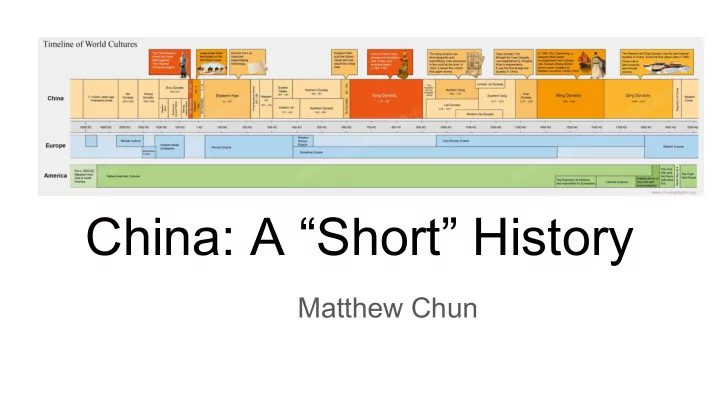
China: A Short History Matthew Chun Disclaimer/Motivation I am not Chinese Fascinated with Chinese history, especially interplay with other cultures Excuse to finally get a sense of Chinese history with this presentation
○ China: 1.389,344,089 -> 18.47% of world population ○ Canada: 36,690,165 -> 0.49% of world population ○ China population density -> 148 people per Km squared ○ Canada population density -> 4 people per Km squared ○ China country size: 9.597 million km squared ○ Canada country size: 9.985 million km squared
Paeleolithic
Neolithic
○ Polygamous marriage to monogamy marriage
○ Peiligang (7000 to 5000 BC): Yellow River in Henan Province (Central China), practiced agriculture and livestock, hunting, fishing -> distinct residential and burial areas, earliest to use pottery ○ Cishan (5400 to 5100 BC): North China Hebel Province, agriculture in millet, also pottery ○ Yangshao (5000 to 3000 BC): Gashu to Hainan Province (along Yellow River), rice and millet agriculture, cattles, pigs, horses -> black pottery art using facial and animal designs
The Bronze Age
The Three Wise Kings and Five August Emperors ○ Gave people the knowledge of fire, house building, farming, silk, medicine, calendar, and early script writing ... sounds familiar right? ○ Particularly famous -> The Yellow Emperor (ancestor of Chinese tribes) -> usage of yellow as motif for symbol of emperors
(“Summer” Dynasty) Yellow Emperor Mausoleum
○ Who were the “Xia”? Maybe the Erlitu located people ■ Artifacts dated via radiocarbon indicates similar timeline (2000 and 1500 BC) ■ Records in form of pottery ... not hard writing -> later accounts of such a dynasty written much later in Chinese history (in 109 and 91 BC)
○ Xia clan head, Shun first to pass down rule to his son Yu the Great ○ Yu supposedly united tribes through conquest, and later flood prevention works (Yu’s Doorway)
○ Later heads of Xia switched to worship of supernatural beings, no longer ancestors ○ Last Xia emperor Jie was extravagant, loved to drink, didn’t listen to advisors, etc ○ Other clans stopped supporting Xia, Shang Clan led a rebellion and won (headed by King Tang) Yu the Great Deified as Water God
○ Historical record via inscriptions on oracle bones and bronze objects
Dynasties)
○ Human sacrifice in religion common
tribute
○ Just like the Xia Emperor ○ Another tribe called the Zhou took over (Zhou Wu) Oracle Bones
○ Split into different periods -> due to moving of capitals, alliances, and invasions ■ Western Zhou (1046 BC to 771 BC) ■ Eastern Zhou (770 BC to 256 BC)
diversity of language, thoughts grew -> Hundred Schools of Thought ○ Daoism -> accordance with nature ○ Confucianism -> social order ○ Spring and Autumn Period
○ Rich merchants, great thinkers competed for court roles, etc.
○ Overtime, the expanding city-states grew less associated, more independent ○ Increasing barbarian attacks ○ Qin state, main guardian of Zhou rulers gained great control/influence, other city states grew larger (Jin, Qi, Chu)
Laozi - Founder of Daoism
independence, then them fighting each other
Zhao, Wei, Han, Yan, and Qi) ○ Several smaller city-states arose from ashes of “Jin” mentioned before (Zhao, Wei, Han) after battle of Jinyang
○ Ruthless, powerful economically and military -> Irrigated via Zhengguo Canal over 227,000 sq km of fertile land to feed the army and peasants ○ King Zheng of Qin, how did he do it? Get the easy states
○ Great Wall ○ Terracotta warriors ○ Centralization of power via two-tier admin system -> adherence to the law (legalism) ■ State over individual -> obedience ... see “flavours” of it today ■ Controlled records such as history except Qin curated version ○ Writing system, money, and measurements were standardized, road system ○ But literacy and scholarship was denied -> only for elite, books were banned for the commoners ○ Still brutal in his rule, one time buried alive 460 scholars who displeased him
○ “Elixir of Life” killed him ... ironically, died on a trip to find it ○ Emperor wished to live forever, stop gap medicine of mercury pills .... probably did it ○ Power play among his sons, faked wills, made some sons commit suicide forcibly
○
The long standing heavy taxation, forced labour of projects such as mausoleum and palace ... led to more rebellions
Terracotta Warriors
Bang
trade ○ Silk Road
courts (exam system)
southern Manchuria, Korea by Emperor Wu
○ Rich were ... richer and educated ○ But opening of opportunities eg. unbanning of books ○ High taxes for merchants, lowered for peasants but still tough
Hanfu
○ Death of Emperor Wu left a power gap, government official named Wang Man usurped and made a new sub-dynasty called “Xin” or “new” (9 to 23 AD) ○ Some modern ideas -> abolished slavery ○ More power to the people via redistribution of land (attempted) ○ Xin dynasty still problematic due to natural disasters and subsequent peasant revolts -> led to his decapitation ○ Descendant of Liu Bang re-established Han dynasty (Eastern
Guangwu -> defeated enemies eg. Xiongnu tribes and Goguryeo Korean Kingdom attacks
○ Series of emperors dying young, power control over young relatives ○ Empire plagued with locusts, floods -> sign of the “end” ○ Corruption of court led to more peasant revolts -> “Yellow Turban Rebellion” ○ A general named Cao Cao reigned in last Han emperor’s name, consolidated power and went to war with dissendenting regions -> Three Kingdoms Period
Yellow Turban Rebels
○ Cao Pi of Wei, Liu Bei of Shu, Sun Quan of Wu
forced remnants of Han family to concede power, renamed controlled region to Wei
Jing of Han dynasty era, led a poor life selling straw mats and sandals ○ Friendly with famous individuals, in particular general Zhuge Liang, and Quan Yu (later deified) ○ Eventual surrender to Wei kingdom in 263
○ Internal power struggles , Wei family members sold
forced Wei family to abdicate
Jin Dynasty
who rebelled
past Yangtze river (natural barrier)
tribes
advantage and took the throne (Southern/Northern Dynasties)
Xiongnu Depiction
South China
○ Liu Song ■ Killed prior Jin emperor (Liu Yu), crowned himself emperor Wu ■ Emperor Wu had little interest in ruling, gave positions of court to family, fearful of being killed, eventually abdicated in favour of his sons to rule ■ Successors killed in various ways by “loyal” men, and family -> Yu family seemed to be “immoral” ■ Eventually other court players took over -> Xiao Daocheng established himself as Emperor Gao of Southern Qi (479 to 502 AD) ○ Southern Qi ■ Made peace with Northern China via a treaty (Yongming Administration) ■ But again ... cruelty of ruling family led to its downfall (rebellions)
Liang Dynasty
○ 502 - 557 AD ○ Emperor Wu (Xiao Yan) was diligent in government affairs, cared for the common folk, devout Buddhist ○ Nearly half of population become monks as they were exempt from taxes -> led to poor economy ○ War with the north (North Wei) continued ○ Poor decisions that angered certain Liang supporter generals, led to rebellions and betrayals (work with the North) ○ Eventually ... can you guess it? Another court member took control -> Chen Baxian
○ 557 - 589 AD ○ Basically more internal power struggles ○ Wasteful awful rulers that took over, which allowed northern armies to burn farmlands of Chen dynasty ○ Eventually the North captured the last Chen emperor
North Wei, North Qi, North Zhou
○ 386 - 557 AD ○ The Tuoba family ○ Adopted Sinicization for political reasons eg. adopt Chinese surname, using Han language ■ Improved military ○ Eventually internal strife (again) split this dynasty into East and West Wei ○ West Wei had policy of introducing Fubing (local militia system) that would be adopted by later dynasties as well ○ East Wei eventually won after a political power struggle involving attacking the southern Liang dynasty, consolidated West Wei troops ... but you know betrayals of generals and all ... led to...
○ Events took place from 557 - 581 AD ○ Qi side conquered other tribes such as the Kumoxi, Qidan, Rouran, Shanhu ○ The Qi favoured Xianbei nobility over Han houses -> strife ○ Old story, terrible rulers causing internal chaos allowed Zhou to conquer North Qi eventually ○ Zhou rule ended when again ... awful emperor killed by a noble (Yang Jian) who established the Sui Dynasty
Xianbei Archer
Religion
via simplified ritual processes
development of several statues, murals
○ Thousand Buddha Caves
Art
styles (western art influence)
Longman Grottoes
○ 581 - 618 AD ○ China was reunited after Yang Jian (crowned as Emperor Wen) conquered Chen (South China) dynasty in 589 ○ Projects ■ Grand Canal -> World’s Longest Canal and Artificial River
■ Rebuilding of the Great Wall ■ War on Vietnam (Captured Hanoi), 3 attempted invasions on Korea (Goguryeo) ■ Further spread of Buddhism ■ Resurgence of Confucian bureaucrats ■ Demise -> heavy taxes, military losses, forced labour led to revolts which allowed northern government official Li Yuan to establish Tang Dynasty
Grand Canal
○ Poetry ○ Painting ○ Tricolored glazed pottery ○ Woodblock printing
○ External attacks -> Muslim Arab Empire attacked in 751 at Battle of Talas, Nanzhao Empire (West of China) attacked in 751/754, Tibetan Empire attacked in 763 ○ Civil war erupted (An Lushan Rebellion) from a general, later peasant rebellion due to famine and drought in 873 (Huang Chao Rebellion) ■ Led to a general Zhu Wen taking control which led to the start of the Five Dynasties and 10 Kingdoms (907 to 960 AD)
kingdom (Northern Zhou) had a general that rebelled against his king, took over as Song dynasty which then conquered the other dynasties and kingdoms
○ Population estimated to be around 100 million ○ Increased foreign trade with India and Arabia ○ Rice became the major food crop of choice after new techniques developed ○ Movable Type Printing -> improve literacy and cultural development ○ Gunpowder -> used as landmines later against Mongol invasions ○ Less emphasis on religion -> Neo-Confucianism ○ Ordinary citizens could more easily become government officials through exam revisions (Keju examination)
○ Some rival empires popped up (Jin Empire) from which the Song Empire decided to team up with the Mongols ... they were successful but then the Mongols had 1 enemy left (1279 AD)
○ Established base of power by defeating peripheral Western Xia people, conquered Central Asia, Mongolia, Hexi Corridor (which contained Silk Road) ○ Died before able to lead campaign against Song ○ His son, Ogedei was the one who started war with Song dynasty
○ Ruled from 1260 to 1294 AD ○ Some power struggles with Mongol Khanate -> made Dadu (modern day Beijing) the capital ○ Defeated the Song Dynasty in 1279 AD
○ Switched to paper currency as main currency, world first ○ Marco Polo visited, brought back ideas from China back to the West ○ Major novels and theater used everyday language (mainstream)
Demise
foreigners, ethnic Chinese received lower priority ○ Side effect: Islam established as minority religion
○ To finance wars of empire
droughts, floods ○ Red Turban Rebellions from common folk -> Zhu Yuanzhang, a beggar turned monk commanded the rebellion and won, making the Mongol court flee back to Mongolia which established the Ming Dynasty (1368 AD)
○ Limitation of Eunuch powers -> they had to be illiterate, could not engage in court affairs ■ Replaced with new officials that passed the Imperial exam, more reliant on court for their needs ○ Pro Peasant policies -> land distribution to peasants, looser taxes ■ Many peasants sold produce to cities for profit ○ Anti-merchant policies -> high taxation for merchants
○ Construction of the Forbidden City (1406 to 1420) ○ Capital officially Beijing ○ Further development of Grand Canal towards the North ○ Age of exploration -> Zheng He expeditions, definitely went to Arabia, disputed for Africa, maybe North America ...???? Probably not ○ Increased foreign demand for porcelain and silk ○ Jesuit influence on court, attempted to bring western science
Demise
trading port ○ Several more earthquakes (1621 to 1627) above 7.0
○ Ming assisted Korea in repelling Japanese invasions twice, but at high financial cost (26 million ounces of silver)
○ Japan reduced foreign imports in 1639 as part of isolationist policy ○ Inflation of silver prices as result meant paying taxes was more difficult for farmers ○ Deficits made soldiers abandon their roles
○ Financial strains and epidemics caused another rebellion, where
... (1644)
○ Originally Jurchen tribes (ruled China in 265 to 420 AD) ○ Merged with Mongols and former Ming supporters
○ “Hairstyle Massacre” -> Men had to adopt traditional shaved hairstyle called the “queue” ■ Used to identify Ming men dissenters (against Confucian ideal not to cut your hair) ■ Those who resisted were killed ■ Eventually become the norm ○ Isolationist and Traditionalists ■ Focus on the ancient studies, not modern knowledge ■ Restricted foreign trade, possibly to limit port cities from accumulating wealth
○ 2nd largest empire next to Yuan, Tibet and Mongolia part of it ○ Many literary works made in this time
Demise
○ Quality of imports much better due to new tech ○ Loss of jobs as a result
○ 1800 to 1912 -> Evangelical Christianity converted and taught western medicine ○ Lost trading ports to Europeans -> Opium Wars with British in 1854, Qing lost Hong Kong ○ Modernized Japan took over Taiwan and the original Manchuria homeland
○ Many many rebellions caused power loss -> ethnicity and religion based ○ Taiping Rebellion (1851-1864) -> quasi-Christian movement caused 25 million deaths, Qing won with assistance from Britain and France ○ Natural disasters (1907 Famine killed 25 million) ○ Boxer Rebellion (1900) -> Empress Cixi secretly supported the Boxers, anti-foreign fighters, but Qing/Boxers lost against foreign military alliances -> carved up China Empress Cixi secretly supported Boxers (a
○ After all of these events, the last emperor, Puyi, was really just a figurehead while China began to become a series of republic states (around 1911)
○ WWI and WWII ○ Communism