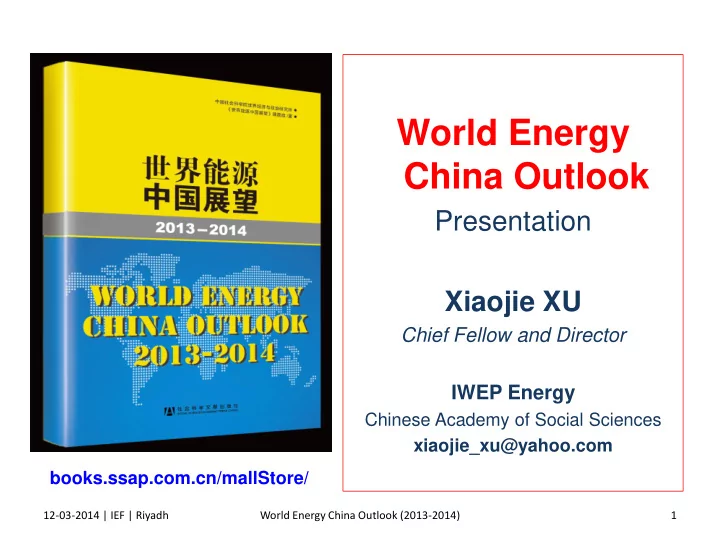
World Energy China Outlook
Presentation Xiaojie XU
Chief Fellow and Director IWEP Energy
Chinese Academy of Social Sciences xiaojie_xu@yahoo.com
12-03-2014 | IEF | Riyadh 1
books.ssap.com.cn/mallStore/
World Energy China Outlook (2013-2014)
China Outlook Presentation Xiaojie XU Chief Fellow and Director - - PowerPoint PPT Presentation
World Energy China Outlook Presentation Xiaojie XU Chief Fellow and Director IWEP Energy Chinese Academy of Social Sciences xiaojie_xu@yahoo.com books.ssap.com.cn/mallStore/ 12-03-2014 | IEF | Riyadh World Energy China Outlook (2013-2014)
Chief Fellow and Director IWEP Energy
Chinese Academy of Social Sciences xiaojie_xu@yahoo.com
12-03-2014 | IEF | Riyadh 1
books.ssap.com.cn/mallStore/
World Energy China Outlook (2013-2014)
reflecting our insights, findings and methodology along with our database.
Institute of World Economics and Politics (IWEP) at Chinese Academy of Social Sciences (CASS).
best understanding and availability of sources. Not necessarily accurate and complete.
CASS or any other parties with which we have worked, official or unofficial.
2 World Energy China Outlook (2013-2014) 12-03-2014 | IEF | Riyadh
Executive Summary (English version is available on request) An Introduction – Nature, Approach, Assumptions, Database Part One: World Energy Trends: A Chinese Perspective Chapter One: Global Energy Trends and Impacts Chapter Two: Neo-Energy Revolution and Its Implications Chapter Three: China’s Eco-Friendly Energy Strategic Approach Chapter Four: Regional Natural Gas Markets and China’s Role Chapter Five: Non-Fossil Fuels and China Options Part Two: Energy Security: A Multidimensional Investigation Chapter Six: Neo-Energy Security: Perspectives and Situations Chapter Seven: Bilateral Energy Security: The Case of Sino-Russian Hydrocarbon Nexus Chapter Eight: Multilateral Mechanisms and Capability Building Appendix: IWEP Energy Outlook Database Framework (2014 Edition will be publicly available by the year end)
12-03-2014 | IEF | Riyadh 3 World Energy China Outlook (2013-2014)
The Report Title:
explain the country as a black swan My Thoughts:
interesting times when we deal with demand/supply, im/exports, manufacturing, CO2 emission, and climate changes.
12-03-2014 | IEF | Riyadh 4 World Energy China Outlook (2013-2014)
Our Approach
developments with a set of assumptions on population, economics, market competition and technology innovations.
IEA’s New Policy Scenario is its central scenario. However, its NPS on China is not fully developed yet. Therefore, we decided to develop our own central policy scenario to back up our research and outlook within the same outlook period (2011-2035).
coined our own policy scenario as Eco-friendly Energy Strategy in the report.
revisit and review energy policy in China in little bit details.
12-03-2014 | IEF | Riyadh 5 World Energy China Outlook (2013-2014)
Current Policy Scenario, IEA Eco-Energy Strategy Scenario, IWEP
Global GDP growth rate 3.6% in 2011-2035 while China GDP 8.1% in 2011-2020, 5.7% in 5.7% in 2011-2035
China GDP growth rate 7.2% in 2011- 2020 (7.5% in 2013, 7.3% in 2014), 5-6% in 2020-2035
Worldwide: 7-8.7 billion from 2012 to 2035 with annual growth rate at 0.9%
China: 1.354 bn in 2012, projected to be 1.44 bn with annual growth rate 0.77%. 1.47 bn in 2030 with annual rate 0.21%
Oil: imported at $113/bbl in 2020 and $128/bbl in 2035. Gas price gap narrowed. Coal price remain lower than oil.
China: oil product prices will be
reformed upward as benchmarking in Asia by 2018.
12-03-2014 | IEF | Riyadh 6 World Energy China Outlook (2013-2014)
Current Policy Scenario, IEA Eco-Energy Strategy Scenario, IWEP
Fossil fuel subsidies will be diminished in at least 10 years Such subsidies will be maintained, esp. for new renewables, agriculture sector.
Global: CO2 emission will increase 34% by 2035 from 8% in 2012. If carbon marketing initiated in all sector, carbon price could $30 per ton in 2035 from $10/ton in 2020. In China, carbon emission will be reduced by reducing coal and smart use before 2020; Chinese target 45% reduction of emission is subject to energy efficiency and CCS after 2020. carbon tax could be optional and net benefited than carbon marketing.
Technology in use or under development will be cost effective in association of energy supply and demand Technology innovation presents huge potential in China, esp. clean coal, energy efficiency and CCS will be expanded wider afterwards. Therefore, outcome of energy saving and emission will outstrip those envisioned by the IEA.
12-03-2014 | IEF | Riyadh 7 World Energy China Outlook (2013-2014)
12-03-2014 | IEF | Riyadh 8
IEA NPS IWEP EES
2011-2015 2011-2035
2011-15 2011-35
GDP Growth 3.6% 4%
7.4% 5.7%
GDP per capita 2.2% 2.2%
7%以上 5.4%
Population 1.1% 0.9%
0.72% 0.4%-0.45%
Urbanization 51%(2012年) 61%(2035年)
55% 65%-70%
World Energy China Outlook (2013-2014)
12-03-2014 | IEF | Riyadh 9
2012 2020 IEA 2035 IEA 2020 IWEP 2035 IWEP Oil $/bbl 100+ 113 128
120 130
Gas NA, $/MMBTU 2-3 5 7
5 7
Gas EU, $/MMBTU 12 12 13
12 13
Japan LNG,$/MMBTU 17 16 15
15 14
China LNG,$/MMBTU 4 8 12
10 13
Coal, $/ton 99 106 110
106 110
Carbon, $/ton 10 33 40
World Energy China Outlook (2013-2014)
Energy efficiency, energy productivity, wastes generation, trading and investments are fully calculated.
12-03-2014 | IEF | Riyadh 10
Global China Forward Looking Clean Coal Coal chemical and coal power integration Clean coal tech spread around 2020, coal2gas under development Cost reduction and water solutions to be explored Unconventional Drilling US, Poland, Australia, etc. Development approach toward tight gas, CBM and shale. Unconventional rate will be upward to 67% in 2020 Comprehensive solutions dealing with uncertainties in geology, technology, infrastructure and regulations Deep Water Deep and ultra-deep water E&P activities and produce 200 Mt in 2020 Moving to deep water for production 50 Mt in 2020 Further openness and technology & equipment innovation Renewable electricity Solar PV capacity grow at 42% while wind capacity grow at 27% Solar and wind power sector are under restructuring for higher increases Cost effectiveness and policy supports are required。 Nuclear Nuclear plants are under review and re-start. 15-20 nuclear plants could be restored, Nuclear power could account for 15%. Currently, 17 nuclear plants under
planned. Benchmarking pricing and safety & security, plus public awareness CCS 13 large CCS pilot projects are under operation or construction CCS is listed into state 5-year energy Hi-tech planning Enhance financing and policy supports, increase pilot projects in line with carbon marketing campaign Bio energy Enhance policy supports and further investment dealing with
Promoting bio energy diversification (fuel, power, gas) fitting local requirements Provide policy incentives to build up confidence and promote R&D while promote international cooperation HEV/EV HEV/EV sale increase sharply for better future Working on HEV technical routes and standards and promote in major cities in 2015 Further reduce battery life and costs, plus logistics。 Energy Efficiency Majority of consumers released incentive and policy Efficiency is developed in details Diminishing obstacles Environmental Release further development energy saving and environmental protection proposals in August 2013 Take energy saving as a new life style by launching “new energy, new life” campaign
World Energy China Outlook (2013-2014)
12-03-2014 | IEF | Riyadh 11
IEA’s NPS IWEP’s EES
Energy sector trends Further development in the energy sector will be witnessed by 2025 and then slow down for structural balancing Structural reform is gaining momentum in the late 12th Five Year Plan. Gas and renewables will be stressed while pushing internationalization Policy priorities CO2 reduced 40-45% by the end
Energy policy will be adjusted to target demand growth and environmental concerns and good governance at home and abroad Public Policy dimensions No discussion Public interests are calculated in principle.
growing expectations for clean and green energy, safety and health.
policy execution. A type of “social license” is badly needed to all energy projects.
World Energy China Outlook (2013-2014)
1. Polycentric Energy Supplies against Eastbound Demand Persist 2. Natural Gas and Renewables Are Stars of Neo-Energy Revolution 3. Eco-friendly Energy Strategy Repositions Energy Policy 4. China Enters the Age of Unconventional Gas 5. Renewables Are Subject to Market Competition and Technology Innovation 6. China’s Energy Demand Is the Largest Variable of the World 7. Advanced Energy Mix in China Contributes to Curbing Global Climate Change Greatly 8. Enhanced Energy Efficiency is A Key to Softening China’s Demand Growth 9. China Has to Build Up Global Energy Trading and Investment Systems
Responsibilities and Obligations to Good Governance
12-03-2014 | IEF | Riyadh 12 World Energy China Outlook (2013-2014)
12-03-2014 | IEF | Riyadh 13 World Energy China Outlook (2013-2014)
energy transformation is in need and has revealed brand new prospects: – (1) conventional patterns of energy utilization are about to be terminated; – (2) hydrocarbon fuels (coal, oil, gas) could co-exist instead of being replaced by one another continuously, being developed in favor of ecological and environmental protection and utilized in cleaner, more efficient, globally competitive manners; – (3) natural gas and renewable energy sources will be joining these forces to grow on the stage reflecting higher human expectations and environmental requirements around the world.
12-03-2014 | IEF | Riyadh 14 World Energy China Outlook (2013-2014)
unprecedented industrial innovation and transformations in thoughts, technology, and management and trigger a new round of de-carbonization
development pattern through industrial innovation and systematic reforms.
management system in the coming decade, launching a new round of Four Drives with wider and deeper implications at home and abroad.
12-03-2014 | IEF | Riyadh 15 World Energy China Outlook (2013-2014)
towards the Eastern Hemisphere amid an economic slowdown in such emerging economies as China, India, the Middle East and African countries.
repositioning the growing importance of energy supply in North America, multiple sources from multiple supplying centers gain polycentric momentums in the energy world, such as, oil renaissance in Iraq, oil and gas exports from the Caspian Sea/Central Asia, gas discovery in East Africa, and upward production in the deep waters around the world in addition to the New Middle East. The landscape of world energy is featured by polycentric supplies against eastern bound movement in demand. Such a trend will continue for years to come.
12-03-2014 | IEF | Riyadh 16 World Energy China Outlook (2013-2014)
World Energy Demand by Region World in Net Increase in Energy Demand, 2011-2035
Change in Fossil Energy, 2011-2035
Coal Oil Natural Gas
200 400 600 800 1000 1200 1400 1600 0% 10% 20% 30% 40% 50% 60% 70% 80% 90% 100% 2011 2035
Source: IEA
Mtoe
12-03-2014 | IEF | Riyadh 17
Others
38%
China
36%
India
17% Middle East 9%
World Energy China Outlook (2013-2014)
500 1000 1500 2000 2500 3000 3500 4000 4500 2010 2015 2020 2030 2035
Energy Demand Outlook (NPS/IEA & EES/IWEP)
Mtoe
Sources: IEA, IWEP. China (IWEP) China(IEA) Middle East (IEA) India (IEA) Brazil (IEA) U.S. (IEA) OECD Europe (IEA)
12-03-2014 | IEF | Riyadh 18 World Energy China Outlook (2013-2014)
1.90%
2.23%
0% 10% 20% 30% 40% 50% 60% 70% 80% 90% 100% 110% 5 10 15 20 25 30 1950 1955 1960 1965 1970 1975 1980 1985 1990 1995 2000 2003 2006 2009 2012
Energy Self-Sufficiency Rate and Oil & Gas Production in U.S.
Oil Production Natural Gas Production Energy Self-Sufficiency Rate
Unit: Quadrillion Btu; Source: EIA
12-03-2014 | IEF | Riyadh 20 World Energy China Outlook (2013-2014)
12-03-2014 | IEF | Riyadh 21
2 4 6 8 Other Regions U.S. Brazil Middle East Mb/d 2013-2025 2025-2035
Trend of Oil Supply by Regions, IEA
Oil production in U.S. (mainly tight oil) and Brazil (Deep-water) will increase until
Source: IEA World Energy China Outlook (2013-2014)
500 1000 1500 2000 2500 3000 3500 2011 2020 2025 2030 2035
12-03-2014 | IEF | Riyadh 22
5 10 15 20 25 30 35 40 45 50 2012 2020 2025 2030 2035
Middle East New Middle East Other Countries
Source: IEA World Energy China Outlook (2013-2014)
“New Middle East” Middle East Outside of Middle East Outside of Middle East Outside of Middle East
2018 2018 2018
Asia Pacific
Russia
percent under its new policy scenario (CPS)
IEA’s growth rate of 1.4 percent.
energy growth, both in demand and supply at large. A greater impact on the world energy industry, world economy, and geopolitics will be widely felt onward worldwide, esp. in the course of its new four drives mentioned above.
been collectively re-drawing the world energy system and landscape.
12-03-2014 | IEF | Riyadh 25 World Energy China Outlook (2013-2014)
1000 2000 3000 4000 5000 2020 2030 2035 1000 2000 3000 4000 5000 2020 2030 2035
Eco-Energy Strategy Scenario
Energy demand in China
500 1000 1500 2000 2500 3000 3500 4000 4500 2020 2030 2035 1000 2000 3000 4000 5000 2020 2030 2035 0% 10% 20% 30% 40% 50% 60% 70% 80% 90% 100% 2011 2035
Share of China energy demand in Eco-Energy Strategy Unit: Mtoe Sources: IEA; IWEP 10-03-2014 | KAPSARC | Riyadh 26 New Policies Scenario Current Policies Scenario 450 Scenario World Energy China Outlook (2013-2014)
2000 4000 6000 8000 10000 12000 14000 16000 2020 2030 2035
Unit: TWh Sources: IEA; IWEP
0% 10% 20% 30% 40% 50% 60% 70% 80% 90% 100% 2011 2035
Share of China power in Eco-Energy Strategy
2000 4000 6000 8000 10000 12000 2020 2030 2035 2000 4000 6000 8000 10000 12000 2020 2030 2035 2000 4000 6000 8000 10000 12000 2020 2030 2035
10-03-2014 | KAPSARC | Riyadh 27 New Policies Scenario Current Policies Scenario 450 Scenario Eco-Energy Strategy Scenario World Energy China Outlook (2013-2014)
1000 2000 3000 4000 5000 6000 2010 2020 2035 1000 2000 3000 4000 5000 6000 2010 2020 2035
Golden Rules Case
1,000 2,000 3,000 4,000 5,000 6,000 2010 2020 2035
New Policies Scenario
Natural Gas Demand
Golden Rules Case New Policies Scenario
Natural Gas Supply
1,000 2,000 3,000 4,000 5,000 6,000 2010 2020 2035
bcm
12-03-2014 | IEF | Riyadh 28 Source: IEA World Energy China Outlook (2013-2014)
bcm) under EES rather than 455 MTOE under IEA’s NPS
in the years after 2020, 2025 through 2035 featured by rapid increase in
gas will be an engine of the increase in gas production into 2035 while conventional gas has reached its peak output in 2015-2020 and will witness its decline thereafter in our outlook period.
hydrocarbon industry policy makers and could be an issue for its upcoming industrial reform, accordingly.
12-03-2014 | IEF | Riyadh 29 World Energy China Outlook (2013-2014)
0% 10% 20% 30% 40% 50% 60% 70% 80% 90% 100% 100 200 300 400 500 600 700 2010 2020 2035
The Golden Rules Case, IEA Eco-Energy Strategy Scenario, IWEP
0% 10% 20% 30% 40% 50% 60% 70% 80% 90% 100% 100 200 300 400 500 600 700 2011 2020 2035
12-03-2014 | IEF | Riyadh 30
bcm
Source: IEA, IWEP World Energy China Outlook (2013-2014)
larger resources potential than that in the U.S. statistically. It is less possible to reach its said output targets 60-100 bcm by 2020 in China.
gas and coal bed methane would take lead based on their sizable production combined and ever-enhanced technologies employed.
development pattern for the sub-sector, policy issues and environmental concerns over the possible unconventional gas boom.
12-03-2014 | IEF | Riyadh 31 World Energy China Outlook (2013-2014)
12-03-2014 | IEF | Riyadh 32
Renewable Energy Demand Growth by Region and Scenario, IEA
100 200 300 400 500 600 700 800 900 1000 U.S. Europe Japan Russia China India Middle East Africa Brizal Other Regions
2010 The New Polices Scenario The Current Policies Scenario The 450 Scenario Source: IEA World Energy China Outlook (2013-2014)
to 15 percent in 2020 and 24.5 percent (higher than that of oil) in 2035 from current below 10 percent.
its momentum under strictest safety circumstances.
fastest growth momentum above 100 percent, as their current capacity at home remains small in its entirety.
Plan in 2012 and four plans in details. Policy incentives are designed and applied.
taking into account of A Plan for Actions against Atmosphere Pollution in 2013.
12-03-2014 | IEF | Riyadh 33 World Energy China Outlook (2013-2014)
500 1000 1500 2000 2500 3000 2020 2030 2035
New Policies Scenario Current Policies Scenario
500 1000 1500 2000 2500 3000 2020 2030 2035 500 1000 1500 2000 2500 3000 3500 4000 4500 5000 2020 2030 2035 0% 10% 20% 30% 40% 50% 60% 70% 80% 90% 100% 2011 2035 1000 2000 3000 4000 2020 2030 2035
450 Scenario
12-03-2014 | IEF | Riyadh 34
Eco-Energy Strategy Scenario
Outlook of power generated by renewables in China
Renewables Electricity Mix in EES Scenario Unit: TWh Sources: IEA; IWEP World Energy China Outlook (2013-2014)
carbon emission on the eco-system and global warming.
increase within 2 °C while its NPS and CPS will come with results 3.6 °C and 5.3 °C temperature increase.
in our outlook period will be negative 0.4 percent, at much lower rate than IEA NPS in both 2030 and 2035. As a result, Chinese contribution under the EES will obviously improve the environment and global warming concern within 2-4 °C by 2050.
12-03-2014 | IEF | Riyadh 35 World Energy China Outlook (2013-2014)
2000 4000 6000 8000 10000 12000 14000
2011 2015 2020 2025 2030 2035
EES NPS CPS 450
Unit: Ton
12-03-2014 | IEF | Riyadh 36
0% 10% 20% 30% 40% 50% 60% 70% 80% 90% 100% 2011 2035
Coal Oil Gas
Source: WECO-13, IWEP World Energy China Outlook (2013-2014)
0.00% 20.00% 40.00% 60.00% 80.00% 100.00% 120.00% 140.00% (5000.000) 0.000 5000.000 10000.000 15000.000 20000.000 25000.000 30000.000 35000.000 40000.000 1978198019851990199119921993199419951996199719981999200020012002200320042005200620072008200920102011
Oil net import National gas net import Energy self-sufficiency rate Oil self-sufficiency rate National gas self-efficiency rate
12-03-2014 | IEF | Riyadh 37 ten thousand standard coal Source: National Bureau of Statistics, PRC World Energy China Outlook (2013-2014)
stabilized thereafter and possibly decline to 15 percent in 2035.
foreign natural gas dependency will be 35 percent in 2015, 40 percent in 2020 before declining to 24 percent in 2035.
and globally, and bilateral and multilateral.
and productivity
entitled Land Silk Road and Marine Silk Road
win-win but for best practices and better governance.
and globally in terms of supply and demand management, investments and trading, risk management, and global issues such as climate changes
12-03-2014 | IEF | Riyadh 38 World Energy China Outlook (2013-2014)
covering security of (1) demand, (2) supply and (3) cooperation at both regional level and global one.
taking Sino-Russian hydrocarbon ties as an example. A multilateral level review was done by examining Chinese attitudes towards the regional and global energy governance.
12-03-2014 | IEF | Riyadh 39 World Energy China Outlook (2013-2014)
Energy consumers: stable supply and price
Security of supply & demand for producers and consumers
Conventional Wisdom New Concept
12-03-2014 | IEF | Riyadh 40 World Energy China Outlook (2013-2014)
country will play its bigger role in APEC Meeting in Beijing.
Road are endorsed by the new leadership.
infrastructural and logistic settings such as required institutions, staffing, rules education, and information sharing
12-03-2014 | IEF | Riyadh 41 World Energy China Outlook (2013-2014)
China
in our energy landscape including fundamental profile, energy mix, trade pattern, etc.
energy sources: coal reduced sharply down to 48% in 2035, gas increased to the similar percentage to oil around 14, renewables 24%.
10-03-2014 | KAPSARC | Riyadh 42 World Energy China Outlook (2013-2014)
12-03-2014 | IEF | Riyadh 43 World Energy China Outlook (2013-2014)
Curb energy consumption by energy efficiency for sustainability
1. Curb energy demand growth in 2014: 3.88 billion standard tones for energy (3.2% upward) and could peak at 4.1 bn by 2020, electricity generation 572 TWh (7%), 3.8 billion tone for coal (1.6%), 510 MT for oil (1.8%), 193 bcm for gas (14.5%). 2. Increasing energy efficiency: energy use per GDP unit down to 0.71 standard tones. Energy consumption elasticity: 0.43 while power consumption elasticity: 0.93. 3. Enhancing energy-saving and efficiency by a set of policy incentives and technology innovations covering wastes utilization, embedded energy.
12-03-2014 | IEF | Riyadh 44 World Energy China Outlook (2013-2014)
Optimize energy mix for emission reduction
1. Reduce coal share down to 65% in 2014 while promoting efficient and clean utilization: IGCC vs. USPG; Coal2Gas, Coal2Oil 2. Shift from co-development “both oil and gas sector” to the one “increasing gas while stabilizing oil” with intent to increase gas share up to 6.5% in 2014. 3. Ultra-high Voltage Transmission and smarter grid 4. Promote the development of renewable energy including wind and solar energy based on market mechanisms instead of interference with intent to increase share up to over 10%.
12-03-2014 | IEF | Riyadh 45 World Energy China Outlook (2013-2014)
Enhance energy security system at home and abroad
1. Increase domestic supplies remain its priorities: unconventional, deep-water, and deep exploration on land 2. Domestic responsibility: public policy dimensions, social responsibility 3. International expansion: trade, investment, cooperation mechanisms 4. International cooperation on global agendas (governance, security, sustainability and climate) 5. Compatible Infrastructure (rules, educations, institutions, data sharing, local supports)
12-03-2014 | IEF | Riyadh 46 World Energy China Outlook (2013-2014)
Energy Division (since 2009 April) at Institute of World Economics and Politics, Chinese Academy of Social Sciences in Beijing; a Member of the World Economic Forum Global Agenda Council on Energy Security, an Editorial Board member of the Journal
petroleum economics sub-committee of China Petroleum Society
and was the Director of Institute of Overseas Investment Research, CNPC (2000-2009), has been advising the National Energy Administration on oil and gas policy and international energy policy, and CNPC, CNOOC and some other state owned energy companies on global expansion specializing in geopolitical, economical, commercial, regulatory, and contractual review and business development and risk management
European Press, 2002) and Energy Black Swan: Global Games for Hydrocarbon Resources and Chinese Options (in Chinese, 2011) along with numerous writing and speeches on energy investment, corporate strategy and governance, and geopolitics of energy in both Chinese and English.
12-03-2014 | IEF | Riyadh 47 World Energy China Outlook (2013-2014)