Chinese Dinner Constraint Network Variations Must be Hot&Sour - - PDF document

chinese dinner constraint network
SMART_READER_LITE
LIVE PREVIEW

Chinese Dinner Constraint Network Variations Must be Hot&Sour - - PDF document

Search Algorithms Guessing versus Inference Backtrack Search All the search algorithms weve seen so far are 1. DFS variations of guessing and backtracking 2. BFS / Dijkstras Algorithm But we can reduce the amount of guesswork by 3.


slide-1
SLIDE 1

1 Search Algorithms

Backtrack Search 1. DFS 2. BFS / Dijkstra’s Algorithm 3. Iterative Deepening 4. Best-first search 5. A* Constraint Propagation 1. Forward Checking 2. k-Consistency 3. DPLL & Resolution Local Search 1. Hillclimbing 2. Simulated annealing 3. Walksat

Guessing versus Inference

All the search algorithms we’ve seen so far are variations of guessing and backtracking But we can reduce the amount of guesswork by doing more reasoning about the consequences of past choices

  • Example: planning a trip

Idea:

  • Problem solving as constraint

satisfaction

  • As choices (guesses) are made,

propagate constraints

Map Coloring CSP

  • V is a set of variables v1, v2, …, vn
  • D is a set of finite domains D1, D2, …, Dn
  • C is a set of constraints C1, C2, …, Cm

Each constraint specifies a restriction over joint values of a subset of the variables

E.g.: v1 is Spain, v2 is France, v3 is Germany, … Di = { Red, Blue, Green} for all i For each adjacent vi, vj there is a constraint Ck (vi,vj) ∈

∈ ∈ ∈ { (R,G), (R,B), (G,R), (G,B), (B,R), (B,G) }

Variations

  • Find a solution that satisfies all constraints
  • Find all solutions
  • Find a “tightest form” for each constraint

(v1,v2) ∈

∈ ∈ ∈ { (R,G), (R,B), (G,R), (G,B), (B,R), (B,G) }

! (v1,v2) ∈

∈ ∈ ∈ { (R,G), (R,B), (B,G) }

  • Find a solution that minimizes some

additional objective function

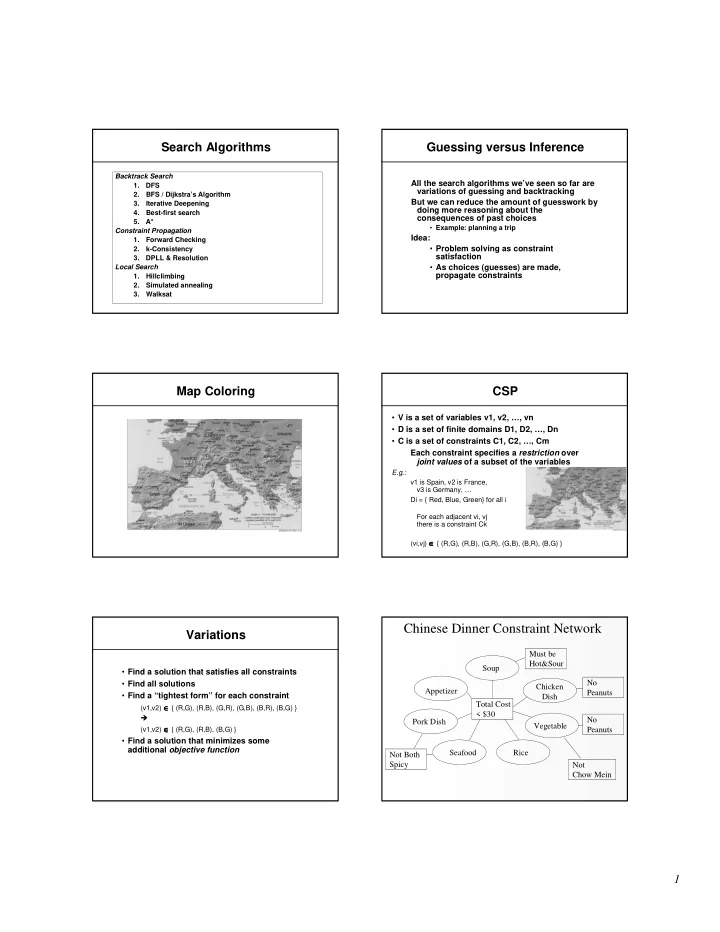
Chinese Dinner Constraint Network

Soup Total Cost < $30 Chicken Dish Vegetable Rice Seafood Pork Dish Appetizer Must be Hot&Sour No Peanuts No Peanuts Not Chow Mein Not Both Spicy

slide-2
SLIDE 2

2 Exploiting CSP Structure

Interleave inference and guessing

  • At each internal node:
  • Select unassigned variable
  • Select a value in domain
  • Backtracking: try another value

– Branching factor?

  • At each node:
  • Propagate Constraints

Running Example: 4 Queens

Variables:

Q1 ∈ ∈ ∈ ∈ {1,2,3,4} Q2 ∈ ∈ ∈ ∈ {1,2,3,4} Q3 ∈ ∈ ∈ ∈ {1,2,3,4} Q3 ∈ ∈ ∈ ∈ {1,2,3,4} Q Q Q Q 2 4 1 4 1 3 3 1 4 2 4 1 Q2 Q1

Constraints:

Constraint Checking

Q x Q x Q x x Q x x x Q x x Q x x Q x x Q Q x x Q x x x Q x Q x x x x Q

Takes 5 guesses to determine first guess was wrong

Forward Checking

x x x Q x x x x x x Q x x x x x Q x x x x x Q x x x x x x Q x x x Q x Q x x x x x x Q

Takes 3 guesses to determine first guess was wrong

When variable is set, immediately remove inconsistent values from domains of other variables

Arc Consistency

x x x Q x x x x x x Q x x x x x Q x x x x x x Q x x x x x x Iterate forward checking Propagations: 1. Q3=3 inconsistent with Q4 ∈

∈ ∈ ∈ {2,3,4}

2. Q2=1 and Q2=2 inconsistent with Q3 ∈

∈ ∈ ∈ {1} Inference alone determines first guess was wrong!

Huffman-Clowes Labeling

+ + + + + +

slide-3
SLIDE 3

3 Waltz’s Filtering: Arc- Consistency

  • Lines: variables
  • Conjunctions: constraints
  • Initially Di = {+,-, "

" " ", # # # # )

  • Repeat until no changes:

Choose edge (variable) Delete labels on edge not consistent with both endpoints

No labeling! Path Consistency

Path consistency (3-consistency):

  • Check every triple of variables
  • More expensive!
  • k-consistency:
  • n-consistency: backtrack-free search

1

| | k-tuples to check Worst case: each iteration eliminates 1 choice | || | iterations | || | steps! (But usually not this bad)

k k

V D V D V

+

Variable and Value Selection

  • Select variable with smallest domain

– Minimize branching factor – Most likely to propagate: most constrained variable heuristic

  • Which values to try first?

– Most likely value for solution – Least propagation! Least constrained value

  • Why different?

– Every constraint must be eventually satisfied – Not every value must be assigned to a variable!

  • Tie breaking?

– In general randomized tie breaking best – less likely to get stuck on same bad pattern of choices

CSPs in the real world

  • Scheduling Space Shuttle Repair
  • Transportation Planning
  • Computer Configuration

– AT&T CLASSIC Configurator

  • #5ESS Switching System
  • Configuring new orders: 2 months # 2 hours

CPGomes - AAAI00

Quasigroup Completion Problem (QCP)

Given a partial assignment of colors (10 colors in this case), can the partial quasigroup (latin square) be completed so we obtain a full quasigroup? Example:

32% preassignment

(Gomes & Selman 97)

slide-4
SLIDE 4

4

CPGomes - AAAI00

QCP Example Use: Routers in Fiber Optic Networks

Dynamic wavelength routing in Fiber Optic Networks can be directly mapped into the Quasigroup Completion Problem.

(Barry and Humblet 93, Cheung et al. 90, Green 92, Kumar et al. 99)

  • each channel cannot be repeated in the same input port

(row constraints);

  • each channel cannot be repeated in the same output

port (column constraints);

CONFLICT FREE LATIN ROUTER Input ports Output ports

3 1 2 4

Input Port Output Port

1 2 4 3

CPGomes - AAAI00

QCP as a CSP

  • Variables -
  • Constraints -

} ..., , 2 , 1 { , n j i x ∈ . ..., , 2 , 1 , ; , , n j i j i cell

  • f

color j i x = . ..., , 2 , 1 ); , ,..., 2 , , 1 , ( n i n i x i x i x alldiff = . ..., , 2 , 1 ); , ,..., , 2 , , 1 ( n j j n x j x j x alldiff = ) 2 (n O ) (n O

row column

Hill Climbing

  • Idea

– Always choose best child, no backtracking

  • Evaluation

– Complete? – Space Complexity? – Complexity of random restart hillclimbing, with success probability P

Simulated Annealing / Random Walk

  • Objective: avoid local minima
  • Technique:

– For the most part use hill climbing – Occasionally take non-optimal step – Annealing: Reduce probability (non-optimal) over time

  • Comparison to Hill Climbing

– Completeness? – Speed? – Space Complexity?

Time # # # #

Temperature Objective

Backtracking with Randomized Restarts

  • Idea:

– If backtracking algorithm does not find solution quickly, it is like to be stuck in the wrong part of the search space

  • Early decisions were bad!

– So kill the run after T seconds, and restart

  • Requires randomized heuristic, so choices not always the same

– Why does it often work?

  • Many problems have a small set of “backdoor” variables – guess them on a

restart, and your are done! (Andrew, Selman, Gomes 2003)

– Completeness?

Demos!

  • N-Queens

Backtracking vs. Local Search

  • Quasigroup Completion

Randomized Restarts

  • Travelling Salesman

Simulated Annealing

slide-5
SLIDE 5

5 Exercise

Peer interviews: Real-world constraint satisfaction problems

  • 1. Break into pairs
  • 2. 7 minute interview – example of needing to

solve a CSP type problem (work or life). Interviewer takes notes:

  • Describe problem
  • What techniques actually used
  • Any techniques from class that could have been used?
  • 3. Switch roles
  • 4. A few teams present now
  • 5. Hand in notes (MSR – have someone collect

and mail to me at dept)

Planning as CSP

  • Phase 1 - Convert planning problem in a CSP
  • Choose a fixed plan length
  • Boolean variables

– Action executed at a specific time point – Proposition holds at a specific time point

  • Constraints

– Initial conditions true in first state, goals true in final state – Actions do not interfere – Relation between action, preconditions, effects

  • Phase 2 - Solution Extraction
  • Solve the CSP

27

Planning Graph Representation of CSP

Proposition Init State Action Time 1 Proposition Time 1 Action Time 2

Precondition constraints Effect constraints

Constructing the planning graph…

  • Initial proposition layer

– Just the initial conditions

  • Action layer i

– If all of an action’s preconditionss are in i-1 – Then add action to layer I

  • Proposition layer i+1

– For each action at layer i – Add all its effects at layer i+1

29

Mutual Exclusion

  • Actions A,B exclusive (at a level) if

– A deletes B’s precondition, or – B deletes A’s precondition, or – A & B have inconsistent preconditions

  • Propositions P,Q inconsistent (at a level) if

– All ways to achieve P exclude all ways to achieve Q

  • Constraint propagation (arc consistency)

– Can force variables to become true or false – Can create new mutexes

30

Solution Extraction

  • For each goal G at last time slice N:
  • Solve( G, N )
  • Solve( G, t ):

CHOOSE action A making G true @t that is not mutex with a previously chosen action If no such action, backtrack to last choice point For each precondition P of A:

Solve(P, t-1)

slide-6
SLIDE 6

6

31

Graphplan

  • Create level 0 in planning graph
  • Loop

– If goal ⊆ contents of highest level (nonmutex) – Then search graph for solution

  • If find a solution then return and terminate

– Else Extend graph one more level

A kind of double search: forward direction checks necessary (but insufficient) conditions for a solution, ... Backward search verifies...

Dinner Date

Initial Conditions: (:and (cleanHands) (quiet)) Goal: (:and (noGarbage) (dinner) (present)) Actions: (:operator carry :precondition :effect (:and (noGarbage) (:not (cleanHands))) (:operator fire :precondition :effect (:and (noGarbage) (:not (paper))) (:operator cook :precondition (cleanHands) :effect (dinner)) (:operator wrap :precondition (paper) :effect (present))

Planning Graph

noGarb cleanH paper dinner present carry fire cook wrap cleanH paper 0 Prop 1 Action 2 Prop 3 Action 4 Prop

Are there any exclusions?

noGarb cleanH paper dinner present carry noop fire noop cook wrap cleanH paper 0 Prop 1 Action 2 Prop 3 Action 4 Prop

Do we have a solution?

noGarb cleanH paper dinner present cleanH paper 0 Prop 1 Action 2 Prop 3 Action 4 Prop carry noop fire noop cook wrap

Extend the Planning Graph

noGarb cleanH paper dinner present noop carry noop fire noop cook noop wrap noop cleanH paper noGarb cleanH paper dinner present 0 Prop 1 Action 2 Prop 3 Action 4 Prop carry noop fire noop cook wrap

slide-7
SLIDE 7

7

One (of 4) Solutions

noGarb cleanH paper dinner present noop carry noop fire noop cook noop wrap noop cleanH paper noGarb cleanH paper dinner present 0 Prop 1 Action 2 Prop 3 Action 4 Prop carry noop fire noop cook wrap

Search Algorithms

Backtrack Search 1. DFS 2. BFS / Dijkstra’s Algorithm 3. Iterative Deepening 4. Best-first search 5. A* Constraint Propagation 1. Forward Checking 2. k-Consistency 3. DPLL & Resolution Local Search 1. Hillclimbing 2. Simulated annealing 3. Walksat

Representing Knowledge in Propositional Logic

R&N Chapter 7

Basic Idea of Logic

By starting with true assumptions, you can deduce true conclusions.

Truth

Francis Bacon (1561-1626) No pleasure is comparable to the standing upon the vantage-ground of truth. Thomas Henry Huxley (1825- 1895) Irrationally held truths may be more harmful than reasoned errors. John Keats (1795-1821) Beauty is truth, truth beauty; that is all Ye know on earth, and all ye need to know. Blaise Pascal (1623-1662) We know the truth, not only by the reason, but also by the heart. François Rabelais (c. 1490- 1553) Speak the truth and shame the Devil. Daniel Webster (1782-1852) There is nothing so powerful as truth, and often nothing so strange.

Propositional Logic

Ingredients of a sentence:

  • 1. Propositions (variables)
  • 2. Logical Connectives ¬

¬ ¬ ¬, ∧ ∧ ∧ ∧, ∨ ∨ ∨ ∨, ⊃ ⊃ ⊃ ⊃ literal = a variable or a negated variable

  • A possible world assigns every proposition the

value true or false

  • A truth value for a sentence can be derived from

the truth value of its propositions by using the truth tables of the connectives

  • The meaning of a sentence is the set of possible

worlds in which it is true

slide-8
SLIDE 8

8 Truth Tables for Connectives

1 1 1 1 1 1 1 1 1 1 1 1 1

⊃ ⊃ ⊃ ⊃ ∨ ∨ ∨ ∨ ¬ ¬ ¬ ¬ ∧ ∧ ∧ ∧

Special Syntactic Forms

  • General PL:

((q∧¬ ∧¬ ∧¬ ∧¬ r) ⊃ ⊃ ⊃ ⊃ s)) ∧ ∧ ∧ ∧ ¬ ¬ ¬ ¬ (s ∧ ∧ ∧ ∧ t)

  • Conjunction Normal Form (CNF)

(¬ ¬ ¬ ¬ q ∨ ∨ ∨ ∨ r ∨ ∨ ∨ ∨ s ) ∧ ∧ ∧ ∧ (¬ ¬ ¬ ¬ s ∨ ∨ ∨ ∨ ¬ ¬ ¬ ¬ t) Set notation: { (¬ ¬ ¬ ¬ q, r, s ), (¬ ¬ ¬ ¬ s, ¬ ¬ ¬ ¬ t) } empty clause () = false

  • Binary clauses: 1 or 2 literals per clause

(¬ ¬ ¬ ¬ q ∨ ∨ ∨ ∨ r) (¬ ¬ ¬ ¬ s ∨ ∨ ∨ ∨ ¬ ¬ ¬ ¬ t)

  • Horn clauses: 0 or 1 positive literal per clause

(¬ ¬ ¬ ¬ q ∨ ∨ ∨ ∨ ¬ ¬ ¬ ¬ r ∨ ∨ ∨ ∨ s ) (¬ ¬ ¬ ¬ s ∨ ∨ ∨ ∨ ¬ ¬ ¬ ¬ t) (q∧ ∧ ∧ ∧r) ⊃ ⊃ ⊃ ⊃ s (s∧ ∧ ∧ ∧t) ⊃ ⊃ ⊃ ⊃ false

Satisfiability, Validity, & Entailment

  • S is satisfiable if it is true in some world
  • Example:
  • S is unsatisfiable if it is false all worlds
  • S is valid if it is true in all worlds
  • S1 entails S2 if wherever S1 is true S2 is true

Reasoning Tasks

  • Model finding

KB = background knowledge S = description of problem Show (KB ∧ ∧ ∧ ∧ S) is satisfiable A kind of constraint satisfaction

  • Deduction

S = question Prove that KB S Two approaches:

  • 1. Rules to derive new formulas from old (inference)
  • 2. Show (KB ∧

∧ ∧ ∧ ¬ ¬ ¬ ¬ S) is unsatisfiable

Inference

  • Mechanical process for computing new

sentences

  • Resolution

{ (p ∨ ∨ ∨ ∨ α α α α), (¬ ¬ ¬ ¬ p ∨ ∨ ∨ ∨ β β β β) }

R (α

α α α ∨ ∨ ∨ ∨ β β β β)

  • Correctness

If S1

R S2 then S1

S2

  • Refutation Completeness:

If S is unsatisfiable then S

R ()

Resolution

(¬ ¬ ¬ ¬ A ∨ ∨ ∨ ∨ H) (M ∨ ∨ ∨ ∨ A) (¬ ¬ ¬ ¬ H) (¬ ¬ ¬ ¬I ∨ ∨ ∨ ∨ H) (¬ ¬ ¬ ¬ M) (¬ ¬ ¬ ¬ M ∨ ∨ ∨ ∨ I) (¬ ¬ ¬ ¬I) (¬ ¬ ¬ ¬A) (M) ()

If the unicorn is mythical, then it is immortal, but if it is not mythical, it is a mammal. If the unicorn is either immortal or a mammal, then it is horned. Prove: the unicorn is horned. M = mythical I = immortal A = mammal H = horned

slide-9
SLIDE 9

9 New Variable Trick

Putting a formula in clausal form may increase its size exponentially But can avoid this by introducing dummy variables (a∧b∧c)∨(d∧e∧f) ⇒{(a∨d),(a∨e),(a∨f), (b∨d),(b∨e),(b∨f), (c∨d),(c∨e),(c∨f) } (a∧b∧c)∨(d∧e∧f) ⇒ {(g∨h), (¬ ¬ ¬ ¬a∨¬ ¬ ¬ ¬b∨¬ ¬ ¬ ¬c∨g),(¬ ¬ ¬ ¬g∨a),(¬ ¬ ¬ ¬g∨b),(¬ ¬ ¬ ¬g∨c), (¬d∨¬e∨¬f∨h),(¬ ¬ ¬ ¬h∨d),(¬ ¬ ¬ ¬h∨e),(¬ ¬ ¬ ¬h∨f)} Dummy variables don’t change satisfiability!

DPLL Davis Putnam Loveland Logmann

  • Model finding: Backtrack search over space
  • f partial truth assignments

DPLL( wff ): Simplify wff: for each unit clause (Y) Remove clauses containing Y if no clause left then return true (satisfiable) Shorten clauses contain ¬ ¬ ¬ ¬ Y if empty clause then return false Choose a variable Choose a value (0/1) – yields literal X if DPLL( wff, X ) return true (satisfiable) else return DPLL(wff, ¬ ¬ ¬ ¬ X)

DPLL Davis Putnam Loveland Logemann

  • Backtrack search over space of partial truth

assignments

DPLL( wff ): Simplify wff: for each unit clause (Y) Remove clauses containing Y if no clause left then return true (satisfiable) Shorten clauses contain ¬ ¬ ¬ ¬ Y if empty clause then return false Choose a variable Choose a value (0/1) – yields literal X if DPLL( wff, X ) return true (satisfiable) else return DPLL(wff, ¬ ¬ ¬ ¬ X)

unit propagation = arc consistency

Horn Theories

Recall the special case of Horn clauses: { (¬ ¬ ¬ ¬ q ∨ ∨ ∨ ∨ ¬ ¬ ¬ ¬ r ∨ ∨ ∨ ∨ s ), (¬ ¬ ¬ ¬ s ∨ ∨ ∨ ∨ ¬ ¬ ¬ ¬ t) } { ((q∧ ∧ ∧ ∧r) ⊃ ⊃ ⊃ ⊃ s ), ((s∧ ∧ ∧ ∧t) ⊃ ⊃ ⊃ ⊃ false) } Many problems naturally take the form of such if/then rules

  • If (fever) AND (vomiting) then FLU

Unit propagation is refutation complete for Horn theories

  • Good implementation – linear time!

CPGomes - AAAI00

DPLL

  • Developed 1962 – still the best complete algorithm for

propositional reasoning

  • State of the art solvers use:

Smart variable choice heuristics “Clause learning” – at backtrack points, determine minimum set of choices that caused inconsistency, add new clause

Limited resolution (Agarwal, Kautz, Beame 2002)

Randomized tie breaking & restarts

  • Chaff – fastest complete SAT solver

Created by 2 Princeton undergrads, for a summer project! Superscaler processor verification AI planning - Blackbox

CPGomes - AAAI00

Exercise

  • How could we represent the Quasigroup

Completion Problem as a Boolean formula in CNF form? (take 10 minutes to sketch solution)

slide-10
SLIDE 10

10

CPGomes - AAAI00

WalkSat

Local search over space of complete truth assignments With probability P: flip any variable in any unsat clause With probability (1-P): flip best variable in any unsat clause

Like fixed-temperature simulated annealing

  • SAT encodings of QCP, N-Queens, scheduling
  • Best algorithm for random K-SAT

Best DPLL: 700 variables Walksat: 100,000 variables

Random 3-SAT

$ Random 3-SAT

%sample uniformly from space of all possible 3- clauses %n variables, l clauses

$ Which are the hard instances?

%around l/n = 4.3

Random 3-SAT

$ Varying problem size, n $ Complexity peak appears to be largely invariant of algorithm

%backtracking algorithms like Davis-Putnam %local search procedures like GSAT

$ What’s so special about 4.3?

Random 3-SAT

$ Complexity peak coincides with solubility transition

%l/n < 4.3 problems under- constrained and SAT %l/n > 4.3 problems over- constrained and UNSAT %l/n=4.3, problems on “knife-edge” between SAT and UNSAT

Real-World Phase Transition Phenomena

$Many NP-hard problem distributions show phase transitions -

%job shop scheduling problems %TSP instances from TSPLib %exam timetables @ Edinburgh %Boolean circuit synthesis %Latin squares (alias sports scheduling)

$Hot research topic: predicting hardness of a given instance, & using hardness to control search strategy (Horvitz, Kautz, Ruan 2001-3)

Logical Reasoning about Time & Change AKA Planning as Satisfiability

Salvidor Dali, Persistance of Memory

slide-11
SLIDE 11

11 Actions

We want to relate changes in the world over time to actions associated with those changes How are actions represented?

  • 1. As functions from one state to another
  • 2. As predicates that are true in the state

in which they (begin to) occur

Actions as Functions: “Situation Calculus”

On(cat, mat, S0) Happy(cat, S0) ¬ On(cat, mat, kick(S0)) ¬ Happy(cat, kick(S0)) Happy(cat, pet(kick(S0))) Branching time:

kick pet kick kick pet pet

S0

Actions as Predicates: “Action Calculus”

On(cat, mat, S0) ∧ Happy(S0) Kick(cat, S0) ¬ On(cat, mat, S1) ∧ ¬Happy(CAT99, S1) Pet(CAT99, S1) ¬ On(CAT99, MAT37, S2) ∧ Happy(CAT99, S2) Linear time:

kick pet

S0 S1 S2

Relating Actions to Preconditions & Effects

Strips notation:

Action: Fly( plane, start, dest ) Precondition: Airplane(plane), City(start), City(dest), At(plane, start) Effect: At(plane, dest), ¬ At(plane, start) Pure strips: no negative preconditions!

Need to represent logically:

  • An action requires it’s predications
  • An action causes it’s effects
  • Interfering actions do not co-occur
  • Changes in the world are the result of actions.

Preconditions & Effects

∀ plane, start, dest, s . Fly(plane, start, dest, s) ⊃ [ At(plane, start, s) ∧ Airplane(plane,s) ∧ City(start) ∧ City(dest) ]

  • Note: state indexes on predicates that never change

not necessary. ∀ plane, start, dest, s . Fly(plane, start, dest, s) ⊃ At(plane, dest, s+1)

  • In action calculus, the logical representation of

“requires” and “causes” is the same!

  • Not a full blown theory of causation, but good

enough…

Interfering Actions

Want to rule out: Fly( PLANE32, NYC, DETROIT, S4) ∧ Fly( PLANE32, NYC, DETROIT, S4) Actions interfere if one changes a precondition or effect

  • f the other

They are mutually exclusive – “mutex” ∀ p, c1, c2, c3, c4, s . [Fly(p, c1, c2, s) ∧ (c1 ≠ c3 ∨ c2 ≠ c4) ] ⊃ ¬ Fly(p, c3, c4, s) (Similar for any other actions Fly is mutex with)

slide-12
SLIDE 12

12 Explanatory Axioms

  • Don’t want world to change “by magic” – only

actions change things

  • If a proposition changes from true to false (or

vice-versa), then some action that can change it must have occurred ∀ plane, start, s . [ Airplane(plane) ∧ City(start) At(plane,start,s) ∧ ¬At(plane,city,s+1) ] ⊃ ∃ dest . [ City(dest) ∧ Fly(plane, start, dest, s) ] ∀ plane, dest, s . [ Airplane(plane) ∧ City(start) ¬At(plane,dest,s) ∧ At(plane,dest,s+1) ] ⊃ ∃ start . [ City(start) ∧ Fly(plane, start, dest, s) ]

The Frame Problem

General form of explanatory axioms: [ p(s) ∧ ∧ ∧ ∧ ¬ ¬ ¬ ¬p(s+1) ] ⊃ ⊃ ⊃ ⊃ [ A1(s) ∨ ∨ ∨ ∨ A2(s) ∨ ∨ ∨ ∨ … ∨ ∨ ∨ ∨ An(s) ] As a logical consequence, if none of these actions

  • ccurs, the proposition does not change

[¬ ¬ ¬ ¬A1(s) ∧ ∧ ∧ ∧ ¬ ¬ ¬ ¬A2(s) ∧ ∧ ∧ ∧ … ∧ ∧ ∧ ∧ ¬ ¬ ¬ ¬An(s) ] ⊃ ⊃ ⊃ ⊃ [ p(s) ⊃ ⊃ ⊃ ⊃ p(s+1) ] This solves the “frame problem” – being able to deduce what does not change when an action

  • ccurs

Frame Problem in AI

  • Frame problem identified by

McCarthy in his first paper on the situation calculus (1969)

667 papers in researchindex !

  • Lead to a (misguided?) 20 year effort

to develop non-standard logics where no frame axioms are required (“non-monotonic”)

7039 papers!

  • 1990 - Haas and Schubert

independently pointed out that explanatory axioms are pretty easy to write down

Planning as Satisfiability

  • Idea: in action calculus assert that initial state holds at

time 0 and goal holds at some time (in the future):

  • Axioms ∧

∧ ∧ ∧ Initial ∧ ∧ ∧ ∧ ∃ ∃ ∃ ∃ s . Goal(s)

  • Any model that satisfies these assertions and the

axioms for actions corresponds to a plan

  • Bounded model finding, i.e. satisfiability testing:

1. Assert goal holds at a particular time K 2. Ground out (instantiate) the theory up to time K 3. Try to find a model; if so, done! 4. Otherwise, increment K and repeat

Reachability Analysis

  • Problem: many irrelevant propositions, large

formulas

  • Reachability analysis: what propositions

actually connect to initial state or goal in K steps?

  • Graphplan’s plan graph computes reachable

set!

  • Blackbox (Kautz & Selman 1999)
  • Run graphplan to generate plan graph
  • Translate plan graph to CNF formula
  • Run any SAT solver

Translation of Plan Graph

Fact ⊃ ⊃ ⊃ ⊃ Act1 ∨ ∨ ∨ ∨ Act2 Act1 ⊃ ⊃ ⊃ ⊃ Pre1 ∧ ∧ ∧ ∧ Pre2 ¬Act1 ∨ ∨ ∨ ∨ ¬Act2

Act1 Act2 Fact Pre1 Pre2

slide-13
SLIDE 13

13 Improved Encodings

Translations of Logistics.a: STRIPS → → → → Axiom Schemas → → → → SAT

  • 3,510 variables, 16,168 clauses
  • 24 hours to solve

STRIPS → → → → Plan Graph → → → → SAT

(Blackbox)

  • 2,709 variables, 27,522 clauses
  • 5 seconds to solve!

Model-Based Diagnosis

Idea:

  • Create a logical model
  • f the correct

functioning of a device

  • When device is broken,
  • bservations + model is

inconsistent

  • Create diagnosis by

restoring consistency

Simplified KB

Knowledge Base: SignalValueA ∧ ValveAok ⊃ ValveAopen SignalValueB ∧ ValveBok ⊃ ValveBopen SignalValueC ∧ ValveCok ⊃ ValveCopen ValveAopen∧ ⊃ EngineHasFuel ValveBopen∧ ⊃ EngineHasFuel ValveCopen ⊃ EngineHasOxy EngineHasFuel ∧ EngineHasOxy ⊃ EngineFires Normal Assumptions: ValveAok, ValveBok, ValveCok Direct Actions (cannot fail): SignalValveA, SignalValveB, SignalValveC Observed: ¬ ¬ ¬ ¬ EngineFires

Diagnosis: 1

Knowledge Base: SignalValueA ∧ ValveAok ⊃ ValveAopen SignalValueB ∧ ValveBok ⊃ ValveBopen SignalValueC ∧ ValveCok ⊃ ValveCopen ValveAopen∧ ⊃ EngineHasFuel ValveBopen∧ ⊃ EngineHasFuel ValveCopen ⊃ EngineHasOxy EngineHasFuel ∧ EngineHasOxy ⊃ EngineFires Normal Assumptions: ValveAok, ValveBok, ValveCok Direct Actions (cannot fail): SignalValveA, SignalValveB, SignalValveC Observed: ¬ ¬ ¬ ¬ EngineFires

Inconsistent by Unit Propagation

Diagnosis: 2

Knowledge Base: SignalValueA ∧ ValveAok ⊃ ValveAopen SignalValueB ∧ ValveBok ⊃ ValveBopen SignalValueC ∧ ValveCok ⊃ ValveCopen ValveAopen∧ ⊃ EngineHasFuel ValveBopen∧ ⊃ EngineHasFuel ValveCopen ⊃ EngineHasOxy EngineHasFuel ∧ EngineHasOxy ⊃ EngineFires Normal Assumptions: ValveAok, ValveBok, ValveCok Direct Actions (cannot fail): SignalValveA, SignalValveB, SignalValveC Observed: ¬ ¬ ¬ ¬ EngineFires

Still Inconsistent

Diagnosis: 3

Knowledge Base: SignalValueA ∧ ValveAok ⊃ ValveAopen SignalValueB ∧ ValveBok ⊃ ValveBopen SignalValueC ∧ ValveCok ⊃ ValveCopen ValveAopen∧ ⊃ EngineHasFuel ValveBopen∧ ⊃ EngineHasFuel ValveCopen ⊃ EngineHasOxy EngineHasFuel ∧ EngineHasOxy ⊃ EngineFires Normal Assumptions: ValveAok, ValveBok, ValveCok Direct Actions (cannot fail): SignalValveA, SignalValveB, SignalValveC Observed: ¬ ¬ ¬ ¬ EngineFires

Consistency Restored! Diagnosis: Valve A and Valve B broken (double fault)

slide-14
SLIDE 14

14 Diagnosis: 4

Knowledge Base: SignalValueA ∧ ValveAok ⊃ ValveAopen SignalValueB ∧ ValveBok ⊃ ValveBopen SignalValueC ∧ ValveCok ⊃ ValveCopen ValveAopen∧ ⊃ EngineHasFuel ValveBopen∧ ⊃ EngineHasFuel ValveCopen ⊃ EngineHasOxy EngineHasFuel ∧ EngineHasOxy ⊃ EngineFires Normal Assumptions: ValveAok, ValveBok, ValveCok Direct Actions (cannot fail): SignalValveA, SignalValveB, SignalValveC Observed: ¬ ¬ ¬ ¬ EngineFires

A different way to restore consistency Diagnosis: Valve C broken (single fault) Diagnostic Engine for NASA’s Deep Space One

  • 2,000 variable CNF formula
  • Real-time planning and diagnosis

Beyond Logic

  • Often you want most likely diagnosis rather

than all possible diagnoses

  • Can assign probabilities to sets of fault, and

search for most likely way to restore consistency

  • But suppose observations and model of the

device are also uncertain?

  • Next: Probabilistic Reasoning in Bayesian

Networks