Data types and data structures Book definition An abstract data - - PowerPoint PPT Presentation

data types and data structures book definition
SMART_READER_LITE
LIVE PREVIEW

Data types and data structures Book definition An abstract data - - PowerPoint PPT Presentation

CS206 CS206 Data types and data structures Book definition An abstract data type is a programmer-defined data type that A data type (also called abstract data type or ADT) defines specifies a set of data values and a collection of well-defined


slide-1
SLIDE 1

CS206

Data types and data structures

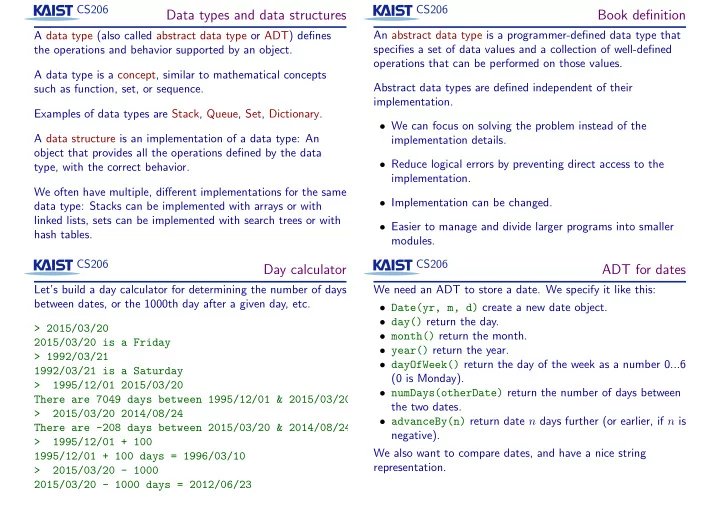
A data type (also called abstract data type or ADT) defines the operations and behavior supported by an object. A data type is a concept, similar to mathematical concepts such as function, set, or sequence. A data structure is an implementation of a data type: An

  • bject that provides all the operations defined by the data

type, with the correct behavior. We often have multiple, different implementations for the same data type: Stacks can be implemented with arrays or with linked lists, sets can be implemented with search trees or with hash tables. Examples of data types are Stack, Queue, Set, Dictionary. CS206

Book definition

An abstract data type is a programmer-defined data type that specifies a set of data values and a collection of well-defined

  • perations that can be performed on those values.

Abstract data types are defined independent of their implementation.

  • We can focus on solving the problem instead of the

implementation details.

  • Reduce logical errors by preventing direct access to the

implementation.

  • Implementation can be changed.
  • Easier to manage and divide larger programs into smaller

modules. CS206

Day calculator

Let’s build a day calculator for determining the number of days between dates, or the 1000th day after a given day, etc. > 2015/03/20 2015/03/20 is a Friday > 1992/03/21 1992/03/21 is a Saturday > 1995/12/01 2015/03/20 There are 7049 days between 1995/12/01 & 2015/03/20 > 2015/03/20 2014/08/24 There are -208 days between 2015/03/20 & 2014/08/24 > 1995/12/01 + 100 1995/12/01 + 100 days = 1996/03/10 > 2015/03/20 - 1000 2015/03/20 - 1000 days = 2012/06/23 CS206

ADT for dates

We need an ADT to store a date. We specify it like this:

  • Date(yr, m, d) create a new date object.
  • day() return the day.
  • month() return the month.
  • year() return the year.
  • dayOfWeek() return the day of the week as a number 0...6

(0 is Monday).

  • numDays(otherDate) return the number of days between

the two dates.

  • advanceBy(n) return date n days further (or earlier, if n is

negative). We also want to compare dates, and have a nice string representation.

slide-2
SLIDE 2

CS206

Client code

Since we have a fully specified Date ADT, we can start by writing the client code. >>> from date import Date >>> a = Date(1996, 9, 3) >>> b = Date(2015, 9, 8) >>> a.numDays(b) 6944 >>> print(a.advanceBy(7000)) 2015/11/03 CS206

Implementing the Date class

class Date(): def __init__(self, year, month, day): self._year = year self._month = month self._day = day For the dayOfWeek, numDays, and advanceBy methods we need to convert to and from Julian day number. def dayOfWeek(self): jday = self._toJulianDay() return jday % 7 def numDays(self, otherDate): return otherDate._toJulianDay() - self._toJulianDay() CS206

Another implementation?

Imagine an application, where we need to store millions of Date objects. We should make Date as small as possible—ideally store only a single number. class Date(): def __init__(self, year, month, day): self._jday = _toJulianDay(year, month, day) The methods year, month, day get harder now, but numDays and dayOfWeek get easier. . . def dayOfWeek(self): return self._jday % 7 def numDays(self, otherDate): return otherDate._jday - self._jday CS206

Equality and Ordering

We want to compare dates using all the standard operators: ==, <, <=, >=, >, !=. def __eq__(self, rhs): return self._jday == rhs._jday def __lt__(self, rhs): return self._jday < rhs._jday def __le__(self, rhs): return self._jday <= rhs._jday

slide-3
SLIDE 3

CS206

Invalid dates

Our class does not recognize invalid dates: > 2015/02/29 2015/02/29 is a Sunday > 2015/09/31 2015/09/31 is a Thursday > 2015/13/00 2015/13/00 is a Thursday > 2015/13/01 - 1 2015/13/01 - 1 days = 2015/12/31 > 2015/12/00 + 1 2015/12/00 + 1 days = 2015/12/01 > 2015/02/29 2015/03/01 There are 0 days between 2015/02/29 and 2015/03/01 CS206

Handling invalid dates

Recognizing invalid dates is easy: convert to day number and back—if it’s not equal, it’s invalid. But how to report the error? The __init__ method must return a Date object! Solution: raise an exception def __init__(self, year, month, day): jday = _toJulianDay(year, month, day) y, m, d = _jdayToYMD(jday) if y != year or m != month or d != day: raise ValueError("Invalid Gregorian date") self._jday = jday But now the program crashes when we use an invalid date. . . CS206

Catching exceptions

We need to catch the exception and report the error to the user: s = input("> ") f = s.split() try: if len(f) == 0: return elif len(f) == 1: show_weekday(f[0]) elif len(f) == 2: show_difference(f[0], f[1]) # omitted except ValueError as e: print(e) CS206

Exceptions simplify our error handling

We can now also handle the incorrect date formats using exceptions. This simplifies the entire days program: We no longer need to check the result of get_date every time we call it. def show_weekday(s): day = get_date(s) print(day, "is a", dayNames[day.dayOfWeek()]) def show_difference(s1, s2): day1 = get_date(s1) day2 = get_date(s2) print("There are", day1.numDays(day2), "days between", day1, "and", day2)