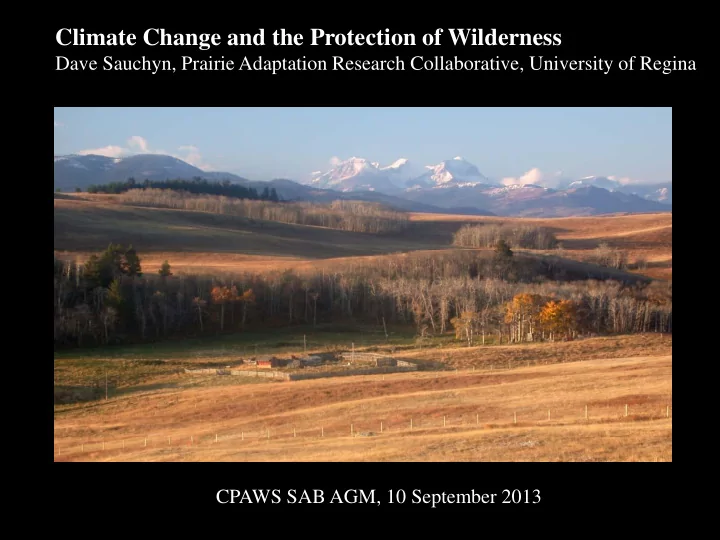
SLIDE 1
Climate Change and the Protection of Wilderness
Dave Sauchyn, Prairie Adaptation Research Collaborative, University of Regina CPAWS SAB AGM, 10 September 2013
SLIDE 2
SLIDE 3
University of Regina PARC Tree-Ring Lab Network
SLIDE 4
SLIDE 5
SLIDE 6
SLIDE 7
SLIDE 8
SLIDE 9
SLIDE 10
SLIDE 11
Mean annual flow (m3/s), Bow River at Calgary, 1107-2007
SLIDE 12
Cycles in the tree rings
SLIDE 13
Mean Annual Flow (m3 sec-1), Bow River at Calgary 1911-2010
SLIDE 14
We are losing the advantage of a cold winter
SLIDE 15
Brown et al. 2003; www.ccin.ca/cms/en/socc/snow/snowAtlas.aspx
Mean Snow Depth, 1979-96
SLIDE 16
July 2013 was the 341st consecutive month (more than 28 years) with a global temperature above the 20th century average.
Every month has been warmer than average since May, 1985.
SLIDE 17
Mean Annual Temperature (° C), Calgary, 1885-2010
SLIDE 18
SLIDE 19 Climate is the statistics
Therefore climate change is a shift in the statistics: the average and/or the variability
Source: IPCC
past future
SLIDE 20
Hogg and Hurdle, 1995
SLIDE 21
SLIDE 22
Munich Reinsurance (2012) Severe weather in North America
SLIDE 23 Vulnerabilidad y Adaptación a los Extremos Climáticos en las Américas
Principal Investigators:
- Dr. Dave Sauchyn, University of Regina, Canada
- Dr. Fernando Santibañez, Universidad de Chile, Santiago
Vulnerability and Adaptation to Climate Extremes in the Americas (VACEA)
Los investigadores principales
www.parc.ca/vacea/
SLIDE 24
Source: Kienzle 2011
SLIDE 25
Research Sites (Watersheds)
SLIDE 26
Study “Communities”
SLIDE 27
Community Vulnerability Assessment – 170 Interviews
SLIDE 28
The overall objective is to improve the understanding of the vulnerability of rural agricultural and indigenous communities to shifts in climate variability and to the frequency and intensity of extreme climate events, and to engage governance institutions in Canada, Argentina, Brazil, Chile and Colombia in enhancing their adaptive capacity to reduce rural community vulnerability.
VACEA - Objective
SLIDE 29
SLIDE 30
SLIDE 31
B U Y I N G T I M E : A User’s Manual for Building Resistance and Resilience to Climate Change in Natural Systems (WWF 2003)
Increasing the resilience of natural systems is a standard goal of conservation; intact ecosystems have more resources for withstanding stresses.
SLIDE 32
- 1. PROTECT ADEQUATE AND APPROPRIATE SPACE
Ecosystems with high biodiversity and those that maintain crucial structural components are thought to recover more easily from climatic disturbances. Traditional conservation methods such as creating protected areas will thus have another justification in the next several decades. … Planning reserves will now require an eye for potentially dramatic future changes in protected areas; thinking about not only current but future configurations of habitats, communities, and ecosystems.
- 2. LIMIT ALL NON-CLIMATE STRESSES
To support ecosystem resilience you must reduce the number of simultaneous insults faced by that ecosystem. [Climate change tends to amplify adverse impacts of other stressors.]
SLIDE 33
- 3. USE ACTIVE ADAPTIVE MANAGEMENT AND STRATEGY
TESTING
Given uncertainty about the exact nature of ecosystem impacts of and responses to climate change, effective management will require a responsive and flexible approach. … In instances where impacts are relatively clear, active intervention to increase adaptive capacity coupled with monitoring is necessary. Such intervention may include assisted migration or reintroduction
- f species, non-chemical control of pest or disease outbreaks,
prescribed burning or other fire management strategies, … controlling invasive species and decreasing nutrient-enhanced run-off …
OR … Let Nature Take its Course?
SLIDE 34 Does the Anthropocene deserve formal recognition as a subdivision
Alexander Wolfe, Professor of Earth and Atmospheric Sciences, University
CANQUA Biennial Conference, August 22, 2013, Edmonton Abstract: A strong case can be made that the Anthropocene concept … deserves formal recognition as a new subdivision of geological time within the Quaternary. While globally expressed stratigraphic fingerprints of the Anthropocene begin to appear in the geological record soon after the Industrial Revolution, they accelerate markedly in the latter half of the 20th century. This is precisely when humanity’s collective influence becomes prominent through enhancement of the greenhouse effect, and other key biogeochemical cycles, become more firmly modulated by humans than the sum of natural processes.
SLIDE 35
Holtgrieve et al. (2011) A Coherent Signature of Anthropogenic Nitrogen Deposition to Remote Watersheds of the Northern Hemisphere
SLIDE 36
Atmospheric Carbon Dioxide
Source: NASA <climate.nasa.gov/evidence>
SLIDE 37
The level of the most important heat-trapping gas in the atmosphere, carbon dioxide, has passed a long-feared milestone, scientists reported Friday, reaching a concentration not seen on the Earth for millions of years. Scientific monitors reported that the gas had reached an average daily level that surpassed 400 parts per million – just an odometer moment in one sense, but also a sobering reminder that decades of efforts to bring human- produced emissions under control are faltering.
SLIDE 38
Major ecological changes are expected