Climate Change is for Real IPCC F IPCC Fourth Assessment Report: - - PDF document

climate change is for real
SMART_READER_LITE
LIVE PREVIEW

Climate Change is for Real IPCC F IPCC Fourth Assessment Report: - - PDF document

CLIMATE CHANGE IN BHUTAN : CLIMATE CHANGE IN BHUTAN : ADAPTATION AND MITIGATION South Asia Climate Change Focal Points and Experts Consultation Meeting N November 16-17, 2011 b 16 17 2011 Dil Bahadur Rahut, South Asian University Climate


slide-1
SLIDE 1

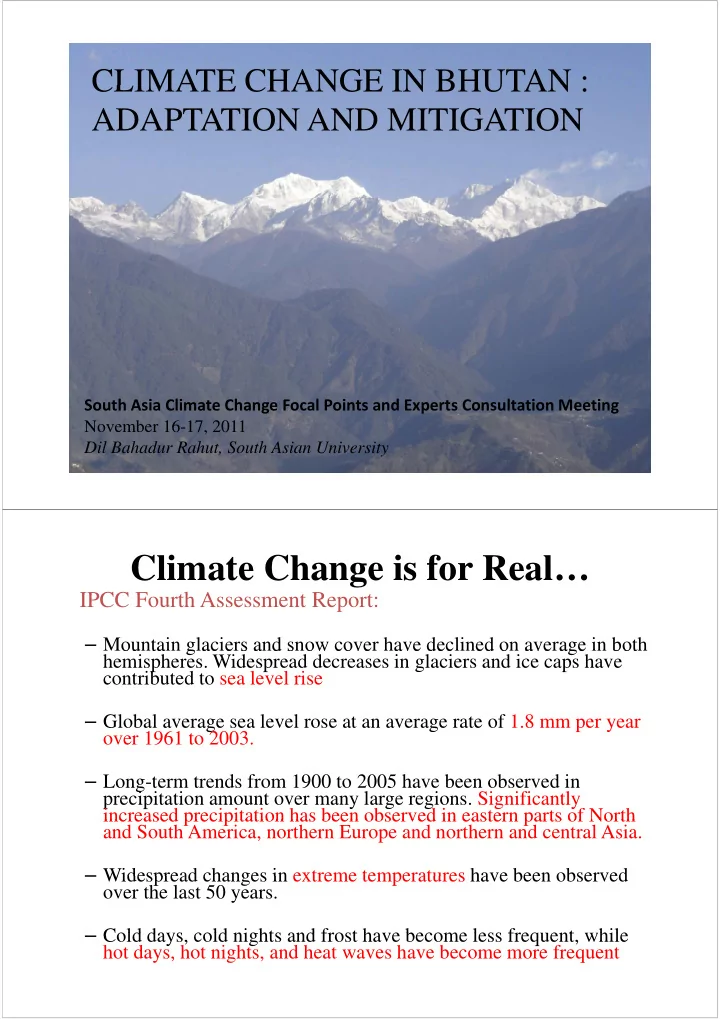
CLIMATE CHANGE IN BHUTAN : CLIMATE CHANGE IN BHUTAN : ADAPTATION AND MITIGATION

South Asia Climate Change Focal Points and Experts Consultation Meeting N b 16 17 2011 November 16-17, 2011 Dil Bahadur Rahut, South Asian University

Climate Change is for Real…

IPCC F th A t R t IPCC Fourth Assessment Report:

– Mountain glaciers and snow cover have declined on average in both

  • u ta

g ac e s a d s ow cove ave dec ed o ave age bot

  • hemispheres. Widespread decreases in glaciers and ice caps have

contributed to sea level rise – Global average sea level rose at an average rate of 1.8 mm per year

  • ver 1961 to 2003.

– Long-term trends from 1900 to 2005 have been observed in precipitation amount over many large regions. Significantly increased precipitation has been observed in eastern parts of North increased precipitation has been observed in eastern parts of North and South America, northern Europe and northern and central Asia. – Widespread changes in extreme temperatures have been observed – Widespread changes in extreme temperatures have been observed

  • ver the last 50 years.

Cold da s cold nights and frost ha e become less freq ent hile – Cold days, cold nights and frost have become less frequent, while hot days, hot nights, and heat waves have become more frequent

slide-2
SLIDE 2

From An Economic Perspective Climate Change is a Unique “Externality” is a Unique Externality

  • Th

i i f h i t th th t

  • The emission of greenhouse gases imposes costs on others that

are not borne by the emitter.

  • Reducing GHGs is a global public good

If one country reduces, all countries benefit Individual countries have an incentive to “free ride” Whil Bh t i th t t f GHG it i hi hl

  • While Bhutan is the net sequesterer of GHG, it is highly

vulnerable to the impact of climate change. (GHG Inventory 2000 provides that in 1994 the forests and land (GHG Inventory 2000 provides that, in 1994, the forests and land use system sequestered 3,549.52 gigagram (Gg) of CO2 annually, while total CO2 emissions were only 228.46 Gg.

From An Economic Perspective Climate Change is a U i “E t lit ” Unique “Externality”

  • The costs will be felt over a long time period and
  • ver the entire world.
  • But, the exact nature of costs is uncertain: they will

be shaped by policies market mechanisms & other be shaped by policies, market mechanisms, & other events.

  • Those most affected—future generations– cannot

speak up for their interests

slide-3
SLIDE 3

Bhutan and Climate Change

  • Bhutan is a responsible nation and is committed to
  • Bhutan is a responsible nation and is committed to

growth with environmental responsibility. GROSS NATIONAL HAPINESS NATIONAL HAPINESS

  • Bhutan declared to remain Carbon Neutral during

g the COP at Copenhagen

  • Maintenance of forest coverage

Maintenance of forest coverage

  • Bhutan signed UNFCCC at Rio de Janeiro in 1992

Bhutan and Climate Change

  • Signatory to Kyoto Protocol/ratified Kyoto Protocol
  • Signatory to Kyoto Protocol/ratified Kyoto Protocol

in 2002

  • Submitted the Initial National Communication at the

6th Conference of Parties on November, 2000 ,

  • Completed first National Inventory on Greenhouse

Gas Emission 2000 Gas Emission 2000.

  • National Adaptation Program of Action (NAPA)

completed-2006

slide-4
SLIDE 4

Impact of Climate Change in Bhutan

  • Reduced agricultural productivity

(productivity of farms, forests, & fisheries)

Biodiversity & Forest

(p y , , )

  • Threaten food security
  • Decrease the ability to fight against poverty

& Forest l

  • Heightened water insecurity

(Water: Supply & Demand)

  • Increased exposure to extreme weather events

Agriculture

  • Increased exposure to extreme weather events
  • Collapse of ecosystems

(distribution & abundance of species)

Water

( p )

  • Increased health risks

(geography of disease)

Natural Disaster

  • Economic loss from hydropower (direct/indirect)
  • Damages from storms, floods, droughts, wildfires
  • Tourism

Health

  • Tourism
  • Property and human life lose from GLOF

Impacts on Agriculture

  • Rural Livelihood: Over 70 percent of Bhutanese population

dependent in agriculture. C t ib t t b t 14% f GDP d it i i t

  • Contributes to about 14% of GDP and its is growing at

decreasing rate

  • High dependency on rainfed irrigation combined with high
  • High dependency on rainfed irrigation combined with high

variability in precipitation and changes in the timing of rainfall

  • Could benefit from increased

growing season at high latitudes g g g

  • Increased minimum temperature

(crop growth and pest/pathogen (crop growth and pest/pathogen effects)

slide-5
SLIDE 5

Impact on Biodiversity p y

  • Bhutan is rich in biodiversity
  • Biodiversity resources also

y contributes significantly to the livelihood of rural poor

  • Millennium Ecosystem Assessment
  • Millennium Ecosystem Assessment

(Climate change is the second greatest threat to biodiversity) Climate change is changing species through: shifting habitat

Forest Fire

shifting habitat changing life cycles the development of new h i l t it physical traits Loss of habitat for humans and animals

Royal Bengal Tiger:4200m in JDNP

Health impacts

– Malaria

VECTOR-BORNE DI SEASE

– Malnutrition – Heat Stroke, floods

slide-6
SLIDE 6

Impact on the Hydro-power Sectors

  • Large source of export earning

from India

  • Substantial contribution to

t fi l b d t government fiscal budget

  • Forest conservation and rural

Forest conservation and rural electrification cyclical affects

  • Wide variation in the water

level changes the hydropower generation Affect energy pricing and t

Water Resources

impacts on hydropower due to

government revenue

– impacts on hydropower due to fluctuations in flow (30,000 MW potential)

Impact on Business

  • Vulnerability of inputs such as energy and

agricultural products agricultural products

– Agro based industries – Power intensive industries – Decrease on Indian rupee earning could hamper the p g p imports from India for business

  • This will also have impact on employment

This will also have impact on employment

  • Challenges to the Sustainable Development of the

Tourism Industry Tourism Industry

slide-7
SLIDE 7

IMPACT ON MGDs IMPACT ON MGDs

Bhutan: Impacts of Climate Change (GLOF

l Glacier Retreat

– Total of 2,794 glacial lakes – 25 potentially dangerous

Phochhu Sub basin 9 Mochhu Sub basin 5 Ch kh hh S b b i 3 Chamkhar chhu Sub basin 3 Kurichhu Sub basin 1 Mangde Chhu Sub basin 7

slide-8
SLIDE 8

1994 Glacier Lake Outburst Flood

Lugge Tsho Raphstreng Tsho

F

Thorthromi Tsho

What Should We Do? What Should We Do?

  • Face the challenge in two ways:

– Mitigation = reduce GHG emissions & concentration in atmosphere – Adaptation = prepare for impact of climate change

  • We need to prepare now for the inevitable effects of climate

change, such as heat waves and wildfires change, such as heat waves and wildfires “Neither adaptation nor mitigation alone can avoid all climate p g change impacts; however, they can complement each

  • ther and together can significantly reduce the risks of

climate change” (Key findings of the IPCC Fourth

16

g ( y g Assessment Report)

slide-9
SLIDE 9

Mitigation and Adaptation Diagram from SRES

CLIMATE CHANGE

I l di V i bilit

Human Interface

Including Variability

Human Interface Exposure

Vulnerabil mpacts Initial Impacts or Effects

Autonomous MITIGATION

Of Climate Change via GHG Sources and Sinks ities Im

Autonomous Adaptations Residual or Net

GHG Sources and Sinks

Planned Impacts ADAPTATION

to the Impacts and Vulnerabilities

Policy Responses

Adopted from David D. Houghton 17

Places of adaptation in the climate change issue.

Adaptation Adaptation

  • As per Bhutan’s National Adaptation Programme of

Action (NAPA) 2006, 45 adaptation activities were identified.

  • These adaptation activities were further fine tuned

p into addressing climate hazards impacting vulnerable and vital components of the Bhutanese society.

  • The framework of climate induced hazards and

adaptation activities then constituted the basis for adaptation activities then constituted the basis for projects.

slide-10
SLIDE 10

Adaptation Options/Strategies [Based on Hazard]

GLOF (D t t t i ) GLOF (Due to temperature rise)

  • Early warning systems
  • Artificial lowering of Glacier Lake

Artificial lowering of Glacier Lake

  • Assessment of GLOF threats for hydropower projects
  • Awareness to the population in high risk zone

p p g Decreases/Fluctuation in river water

  • Diversification in to other sources of renewable energy like:

– Wind – Solar – Solar

  • Forecasting the climate changes and its impact on river water

Adaptation Options/Strategies

Landslide (due to weather pattern) p )

  • Soil Conservation and Land

Management g

  • National database
  • Relocation the population from

p p high risk zone

  • River bank protection

p

  • Small stream catchment

protection p

  • Slope stabilization-

terraces/canals/afforestation

slide-11
SLIDE 11

Adaptation Options/Strategies

Flash flood (due to GLOF/weather pattern)

  • Early warning systems
  • Relocation the population from high risk zone
  • Watershed Catchment Management integrated

ith L d M t/S il with Land Management/Soil

  • Conservation
  • Weather and climate forecasting

Weather and climate forecasting

  • Promote forest management and afforestation

projects

  • Protect water treatment plants to ensure safe

drinking water C t l th d f i i d

  • Control the spread of impervious ground

cover that impedes the recharging of ground water resources water resources Drought (due to temperature rise/weather pattern) p )

  • Promote forest management and

afforestation projects

  • Protecting water sources
  • Irrigation water supply, etc
  • Weather and climate forecasting
  • Weather and climate forecasting
  • Water use efficiency,
  • Resistant crop varieties,

p ,

  • Water harvesting

Rural Livelihood

  • Diversification of livelihood

activities,

  • Adjustments in farming operations;
  • Adjustments in farming operations;
  • Income-generation projects;
  • Move towards off- or non-farm

livelihood incomes.

slide-12
SLIDE 12

Policies/Institutions Policies/Institutions

  • Support to institutional building and implementing

Support to institutional building and implementing agencies

  • Coordination

Coordination

  • Mainstreaming adaptation process in the five year

plans: Adaptation to be integrated into the plans: Adaptation to be integrated into the development projects in general. St k h ld i l t

  • Stakeholder involvement
  • Awareness and outreach programs
  • Capacity building
  • Climate Change Data base

g

Mitigation g

Th UN d fi iti ti i th t t f The UN defines mitigation in the context of climate change, as a human intervention to g , reduce the sources or enhance the sinks of greenhouse gases greenhouse gases.

slide-13
SLIDE 13

Mitigation Strategy

  • Carbon sequestration

through forest management g g

  • Conservation
  • Afforestation
  • Ban on exports of timber
  • Rural electrification
  • Renewable energy: Solar
  • Renewable energy: Solar

Mitigation Strategy

Transportation: Emission testing Fuel efficiency Hybrids Hybrids Road to rail Public transport L d l i Land-use planning Buildings

Day-lighting Energ efficienc Energy efficiency Promoting alternatives to timber for housing G b ildi Green building Improved cook stoves (to reduce fuelwood) Solar heating & cooling Fuel Switching (replacement by LPG)

slide-14
SLIDE 14

Mitigation Strategy

Agriculture

Crop & land management Li t k & Livestock & manure management Improved N fertilizer Improved N fertilizer use

Industry

Energy efficiency e gy e c e cy Heat & power recovery

Mitigation Strategy

A areness Awareness

slide-15
SLIDE 15

THANK YOU THANK YOU AND AND TASHI DELEK TASHI DELEK