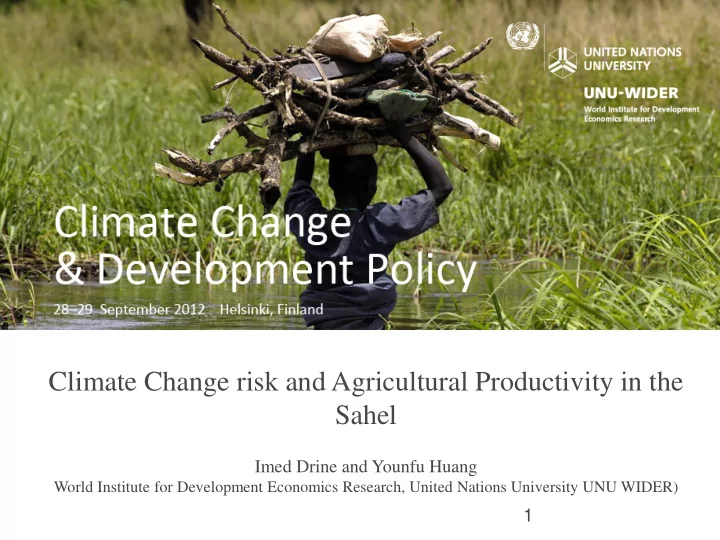
Climate Change risk and Agricultural Productivity in the Sahel Imed - - PowerPoint PPT Presentation

climate change risk and agricultural productivity in the
SMART_READER_LITE
LIVE PREVIEW

Climate Change risk and Agricultural Productivity in the Sahel Imed - - PowerPoint PPT Presentation

Climate Change risk and Agricultural Productivity in the Sahel Imed Drine and Younfu Huang World Institute for Development Economics Research, United Nations University UNU WIDER) 1 The Sahel is extremely vulnerable to climate change due to its


slide-1
SLIDE 1

Climate Change risk and Agricultural Productivity in the Sahel

Imed Drine and Younfu Huang

World Institute for Development Economics Research, United Nations University UNU WIDER)

1

slide-2
SLIDE 2

The Sahel is extremely vulnerable to climate change due to its geographical location

2

slide-3
SLIDE 3

“ The combined threat of drought, high food prises, displacement and chronic poverty is affecting millions of

people in 2012 as n new food crisis emerge across the Sahel region. Food insecurity and malnutrition are recurrent in the region with more than 16 million people directly at risk this year.” FAO

3

Source : Aljazeera net

slide-4
SLIDE 4

Recurrent droughts caused important losses of agricultural production and livestock

4

Source : Aljazeera net

slide-5
SLIDE 5

Climate in the Sahel

  • According to many experts rainfall in the region has

become less reliable and growing seasons are shorter.

  • The Sahel is characterised by irregular rainfall that ranges

between 200 mm and 600 mm with coefficients of variation ranging from 15 to 30 percent (Fox and Rockström, 2003;CILSS, 2004)

  • Harvests of major food crops are highly uncertain due to

recurrent droughts (two out of every five years).

5

slide-6
SLIDE 6

The Observed and Projected 5-Year Mean Rainfall in Sahel

6 Source: Held et al. (2005). According to the IPCC, a rainfall decrease of 29-49% was observed in the 1968- 1997 period compared to the 1931-60 baseline period

slide-7
SLIDE 7

Agriculture in the Sahel : Poor performance

  • Agriculture in the Sahelian countries is underdeveloped

and almost totally dependent on rainfall.

  • Agriculture is characterized by the low use of improved

seeds and fertilizers, the absence of mechanization, and poor linkage to markets.

  • Mendelsohn et al. (2000): 3 African countries will

virtually lose their entire rainfed agriculture by 2100 and two of them are Sahelien countries: Chad and Niger

7

slide-8
SLIDE 8

Agriculture in the Sahel: Important for food security in the Sahel

8

0.89 0.89 0.89 0.89 0.90 0.88 0.89 0.88 0.88 0.85 0.82 0.76 0.69 0.74 0.82 0.79 0.76 0.77 0.75 0.75 0.78 0.70 0.68 0.66 0.72 0.78 0.79 0.79 0.81 0.77 0.75 0.77 0.78 0.82 0.81 0.78 0.74 0.72 0.76 0.76 0.73 0.70 0.76 0.73 0.73 0.73 0.71 0.75 0.74

0.00 0.10 0.20 0.30 0.40 0.50 0.60 0.70 0.80 0.90 1.00 1961 1962 1963 1964 1965 1966 1967 1968 1969 1970 1971 1972 1973 1974 1975 1976 1977 1978 1979 1980 1981 1982 1983 1984 1985 1986 1987 1988 1989 1990 1991 1992 1993 1994 1995 1996 1997 1998 1999 2000 2001 2002 2003 2004 2005 2006 2007 2008 2009 50 100 150 200 250 300 350 1961 1962 1963 1964 1965 1966 1967 1968 1969 1970 1971 1972 1973 1974 1975 1976 1977 1978 1979 1980 1981 1982 1983 1984 1985 1986 1987 1988 1989 1990 1991 1992 1993 1994 1995 1996 1997 1998 1999 2000 2001 2002 2003 2004 2005 2006 2007 2008 2009 Domestic supply per capita Production per capita

Share of Domestic Production in total supply

slide-9
SLIDE 9

Investment in agriculture in the Sahel

  • Highly risks of crop failure
  • Low value of major cereal crops
  • Poor road infrastructures and Poor access to

market  Investing in new production technologies (new seeds, fertilizers, ….) to improve productivity is not profitable

9

slide-10
SLIDE 10

Fox and Rockström (2003): “Supplement irrigation for dry-spell mitigation of rainfed agriculture in the Sahel”, Agriculture and Water Management, 61.

1998 1999 2000 1998-2000 Mean (kg/ha) S.D. (kg/ha) Mean (kg/ha) S.D. (kg/ha) Mean (kg/ha) S.D. (kg/ha) Mean (kg/ha) S.D. (kg/ha) Control Treatment (farmer’s normal practice) 666 154 238 25 460 222 455 232 Irrigation application 961 237 388 182 787 230 712 320 Fertilise application 1470 254 647 55 807 176 975 404 Irrigation and Fertilisers 1747 215 972 87 1489 123 1403 367

10 1998 (571 mm) 1999 (667 mm) 2000 (418 mm)

Control Treatment (farmer’s normal practice)

1.16 0.36 1.10

Irrigation application

1.51 0.53 1.54

Fertilise application

2.55 0.97 1.93

Irrigation and Fertilisers

2.75 1.34 2.93 Rain water use efficiency for mean grain yield per hectare (kg/mm/ha)

Observed average grain yields

slide-11
SLIDE 11

Empirical Analysis

Objective of this work: How does drought risk affect agricultural productivity in the Sahel?

  • Test the impact of weather risk on agricultural productivity
  • 6 Countries : Burkina Faso, Chad, Mali, Mauritania, Niger, and Senegal.

We proceed in 6 steps : 1. We use the Standardized Precipitation Index ( SPI ) to identify drought episodes

  • ver the period 1901-2000.
  • 2. Estimate crop losses associated with drought shock relative to the nearest normal

growing season. (main crops) 3. Probability distribution of crop losses 4. The Drought Risk is defined as crop losses times the probability of occurrence

  • f drought shock

5. Estimate agricultural technical efficiency using the stochastic frontier approach 6. Test the impact of the drought risk on the agricultural technical efficiency

11

slide-12
SLIDE 12

The impact of drought risk on farmer’s decision

States of nature Technologies Normal year Dry year Standard technology (low cost (Cn), normal production (Yn)) (low cost (Cn), low production (Yd)) Drought- resilient technology (high cost (Ch), high production (Yh)) (high cost (Ch), normal production (Yn))

12 Let P denotes the probability associated with the drought shock:

  • Using the standard technology : Profit (S): P*(Yd-Cn)+(1-P)*(Yn-Cn)
  • Using the Drought- resilient technology : Profit (H) : P*(Yn-Ch)+(1-P)*(Yh-Ch)

The farmer prefers the Drought- resilient technology only if : P*(Yn -Yd) > ( (Ch-Cn) – (1-P)*(Yh-Yn)) Drought- resilient technology : Using fertilizers + new seed varieties

slide-13
SLIDE 13

SPI for the Sahel: Growing Season (June-October)

13

  • 4
  • 3
  • 2
  • 1

1 2 3

1901 1904 1907 1910 1913 1916 1919 1922 1925 1928 1931 1934 1937 1940 1943 1946 1949 1952 1955 1958 1961 1964 1967 1970 1973 1976 1979 1982 1985 1988 1991 1994 1997 2000

SPI_Sahel

slide-14
SLIDE 14

Drought Damages: Crop losses (%)

Burkina Faso Chad Mali Mauritania Niger Senegal 1972 26% 37% 21% 48% 31% 45% 1973 30% 30% 23% 47% 47% 25% 1977 15% 31% 31% 27% 23% 27% 1980 9% 29% 33% 28% 24% 33% 1982 9% 5% 27% 26% 33% 26% 1983 18% 26% 22% 28% 58% 39% 1984 6% 28% 35% 19% 30% 34% 1985 11% 31% 10% 1986 17% 46% 17% 1987 21% 5% 21% 8% 1990 4% 24% 33% 19% 40% 15% 1991 17% 4% 35% 51% 11% 1992 1% 34% 19% 52% 16% 1993 31% 31% 17% 42% 9% 1996 19% 3% 14% 56% 18% 1997 21% 6% 28% 35% 26%

Average 15% 25% 25% 30% 35% 30%

14

slide-15
SLIDE 15

LEP curve for the Sahel

15 Exceedance probability Production loss (%)

0.05 0.1 0.15 0.2 0.25 0.3 0.35 0.1 0.2 0.3 0.4 0.5 0.6 0.7

slide-16
SLIDE 16

Technical Efficiency

16

0.02 0.04 0.06 0.08 0.1 0.12 0.14 0.16 0.18 0.2 1970 1971 1972 1973 1974 1975 1976 1977 1978 1979 1980 1981 1982 1983 1984 1985 1986 1987 1988 1989 1990 1991 1992 1993 1994 1995 1996 1997 1998 1999 2000 2001 2002 2003 2004 2005 2006 2007 2008 Burkina Faso Chad Mali Mauritania Niger Senegal

slide-17
SLIDE 17

Regression results

17

  • An increase of climate risk by 1% results in a decrease in technical efficiency by 0.66%
  • Openness to trade and private investment may help to weather the negative impact of

climate risk on agricultural productivity

slide-18
SLIDE 18

Long-run versus Short-run effects

Variables Long-run Effects Risk

  • 0.22***

Risk_2 0.21*** Precipitation 0.39*** Precipitation_2

  • 0.043***

Fertlizer Use 0.01*** Consumer Price

  • 0.01***

18 Countries Short-run effects Risk Risk_2 Burkina Faso 0.07***

  • 0.06***

Mauritania 0.12***

  • 0.13***

Niger 0.05*

  • 0.11*
slide-19
SLIDE 19

Conclusion

  • The Sahel is extremely vulnerable to climate change
  • Drought frequency, severity and damages are increasing
  • Risk related to climate change has a negative impact on

agricultural productivity

  • Higher investment and more openness to trade reduce the

impact of climate uncertainty on agricultural productivity

19

slide-20
SLIDE 20

Diagnostic plots for GEV fit to the crop losses

Threshold σ ξ LR Test (P-value) 20% 0.17

  • 0.41

0.0078 20

Maximum likelihood estimates for excess

Diagnostic plots for GPD fit to the crop losses

slide-21
SLIDE 21

www.wider.unu.edu

Helsinki, Finland