SLIDE 1 Energieinstitut Vorarlberg
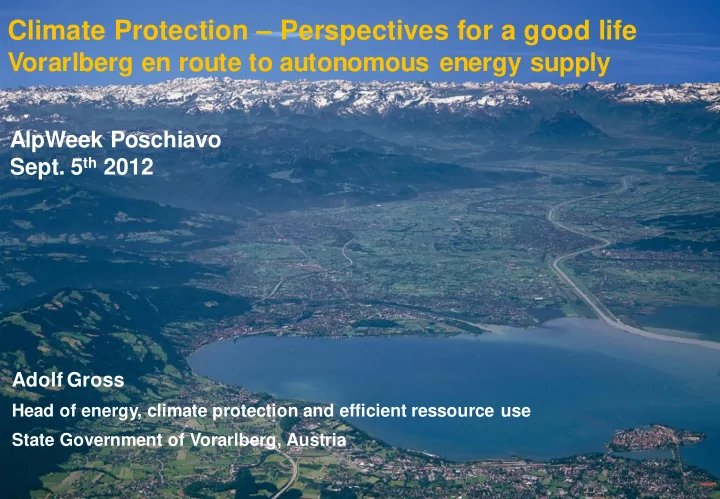
Climate Protection – Perspectives for a good life
Vorarlberg en route to autonomous energy supply
AlpWeek Poschiavo
Adolf Gross
Head of energy, climate protection and efficient ressource use State Government of Vorarlberg, Austria
SLIDE 2
- Share of biomass for heating purposes: about 25%
- We run more than hundred biomass district heating systems
- Area of solar thermal panels in Vorarlberg is 0,65 m² per inhabitant, 0,7 m² PV
- Hydropower covers about 80% of total electricity consumption
- Share of bicycle traffic is 17%
- Quality und density of public transport is similar to big cities
- We run one of the European largest implementation programme for electric
mobility
- Approximately one fourth of all families claimed an energy consulting
- One third of all communities take part in the programme for energy efficient
communities
Examples where we are (I)
SLIDE 3
- In the communities passive house quality is common standard
- You only get a building subsidy if you use renewable energy
- More or less all of the new build buildings are in low energy standard
at least
- We have the worldwide highest density of passive houses (almost 30% of all
new build dwellings are in passive house standard)
- Years ago we broadly developed and introduced a comprehensive building
certification system
- Last year we reached a renovation rate of 3%
Examples where we are (II)
SLIDE 4
Why thinking foresighted
→ climate protection – cutting down CO2 emissions until 2050 by 90% → peak oil, resource shortages → dependency and security of supply → risk reduction → development and peacekeeping → ensuring flourishing of future generations
SLIDE 5
- Is a sustainable energy supply possible and in which time scales?
- Which level of improvement in efficiency is possible based on current
knowledge?
- Which potentials of renewable energy sources are still deducible?
- What are the basic principles of action in all relevant areas?
- What are the most important recommended actions?
- How does a concrete implementation program until 2020 look like?
- How do we guarantee the widest possible participation and acceptance?
The „Energy Future Vorarlberg“ process – key questions
SLIDE 6 Use of renewable energy sources
1000 2000 3000 4000 5000 6000 2005 2020 2030 2050 [GWh] geothermal energy solar heat photovoltaics biogas biomass hydropower
SLIDE 7 Realization of efficiency potentials
2000 4000 6000 8000 10000 12000 2005 2020 2030 2050 [GWh] production mobility buildings
SLIDE 8 2000 4000 6000 8000 10000 12000 2005 2020 2030 2050
[GWh]
The goal – autonomy in energy
need for energy energy from renewables
SLIDE 9
step by step to energy autonomy 101 grandchild suitable measures
SLIDE 10 CO2 emissions per day and the sustainable one day limit
- ne day electricity (household)
- ne vegetable dish
- ne wiener schnitzel with fries
- ne day heating oil demand
(sing. fam. house)
car 50 km
SLIDE 11
SLIDE 12
How do we live?
What do I really need to fulfill my requriments of accomodation and to feel comfortable? area and equipment, flat our own house, distance to work, energy consumption, ..
Some important questions
How are we mobile?
Where I want to go, is it really important for me to be there? means of transport, using or possessing, travelling or consuming, …
What do we eat?
What is really good for me and how do I want my food is produced? vegetarian, organic, fair trade
What do we consume?
Does it make me happier having that stuff as well? how much, live span, reparability, common use instead of possessing
SLIDE 13
2/3 of all distances travelled by car are shorter than 10 km
distances by car
SLIDE 14
Change of technology?
SLIDE 15 But:
- It is no solution if we think it is simply an other
technology of individual transport without changing mobility basically.
- We can‘t produce and run 3 billion e-cars
ecologically and social sustainable.
- It is crucial to discuss technologies in a
significantly wider social context Of course, e-cars are better in a direct comparison (if power is renewable)
Change of technology – example e-cars
SLIDE 16
no business as usual anymore
Please note that climate protection isn‘t primarily a technological debate, but rather a cultural task. Basic questions like how we deal with other peoples, how do we live and last but not least how do we treat our blue marble, arise. Do we foster the options of future generations? Do we hamper or even destroy them? Finally it is about the question what life we want to live.
SLIDE 17
SLIDE 18 The big transformation process
Transformation applies to a good part of living and economic areas. This task affects the society as a whole and is not delegable. It can only be overcome by involving those who are concerned, just everybody. At the end of this process are the citizens who not bring to the surrender, but cause and support – through cultural participation – a society which they consider to be good.
(Harald Welzer “Das Ende der Welt wie wir sie kannten”)
SLIDE 19
I would immediately do something for the climate. But I am just a poster.
Reference: WWF
SLIDE 20 S
imaging ….
climate protection is a spring for wellbeing
SLIDE 21
... pay your heating bill with your pocket money ... you live in a flat with high comfort, bright and warm and, of course, fresh air all along
SLIDE 22
… when you leave the house it is silent, you breath salubrios air
SLIDE 23
… the building surfaces produce energy mute and emission-free
SLIDE 24 … there are no more coal and nuclear plants -
- ffshore wind turbines rotate peaceful
SLIDE 25
… sun power delivers energy reliable and for free
SLIDE 26
… daily needs are available around the corner
SLIDE 27
… streets are venues
SLIDE 28
… bikes are the most important vehicles for short distances
SLIDE 29
… public transportation picks you up nearby
SLIDE 30
… cities are connected with comfortable high speed trains
SLIDE 31
… the very few cars we still need run electrically
SLIDE 32
… food is farmed organically
SLIDE 33
… industry produces emission-free and is part of circular economy
SLIDE 34
step by step to energy autonomy step by step to a better life it is up to you (and me of course)
SLIDE 35
Contact
adolf.gross@vorarlberg.at