Clinical News and Innovation in Type 1 Diabetes and Technology - - PowerPoint PPT Presentation

clinical news and innovation in
SMART_READER_LITE
LIVE PREVIEW

Clinical News and Innovation in Type 1 Diabetes and Technology - - PowerPoint PPT Presentation

Clinical News and Innovation in Type 1 Diabetes and Technology Parth Narendran University Hospitals Birmingham Adjunctive therapy to insulin Accurate diagnosis of T1D Early intensive treatment Technology Glucose sensing


slide-1
SLIDE 1

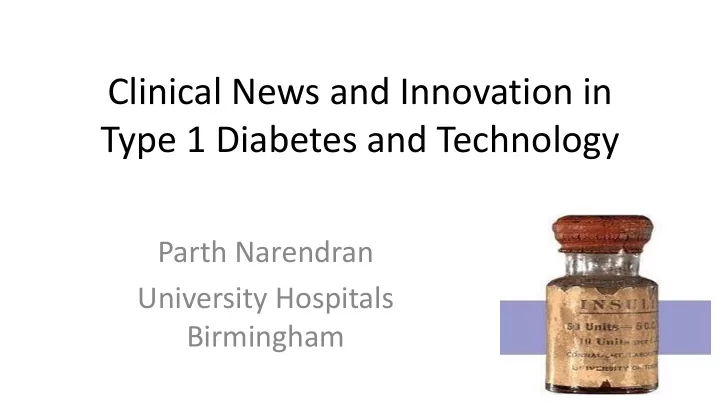
Clinical News and Innovation in Type 1 Diabetes and Technology

Parth Narendran University Hospitals Birmingham

slide-2
SLIDE 2
  • Adjunctive therapy to insulin
  • Accurate diagnosis of T1D
  • Early intensive treatment
  • Technology

– Glucose sensing – Insulin delivery with sensor augmentation – Artificial pancreas

  • The post code lottery that is T1D care in the UK
  • Suggested way forward
slide-3
SLIDE 3

Adjunctive therapy to insulin

slide-4
SLIDE 4

Getting to target in T1D?

National Diabetes Audit

slide-5
SLIDE 5

Lind 2014

slide-6
SLIDE 6

Options for glucose lowering agents (other than insulin) in T1D

Currently licensed Not licensed but promising Not licensed but potential in selected patients Exercise Metformin Pramlintide (not licensed in UK) SGLT inhibitors GLP1 agonists Pioglitazone Acarbose Bariatric surgery DPP IV inhibitors

slide-7
SLIDE 7

Tahrani et al 2013

slide-8
SLIDE 8

Effect of 10mg Dapagliflozin in a T1D patient

Pre - DAPA During DAPA Range 2.2 - 18.8 mmol/L 2.2 – 16.1 % High 12% 2% % Low 7% 2% Num high periods 17 4 Num low periods 25 14 CGM Std Dev 3.2 mmol/L 2.2 mmol/L Insulin TDD 43.6 U 33.9 U

slide-9
SLIDE 9

DEPICT 1 (Dapagliflozin)

HbA1c reduction: 0.4-0.5% Daily insulin: 10% Body weight: 3Kg SBP 3-6 SH – NS DKA - NS GU infection 4x

Global inTandem3 (Sotagliflozin)

HbA1c reduction: 0.5% Daily insulin: 9% Body weight: 3Kg SBP 3.5 SH – NS DKA 5x GU infection 3x Dapa T2D HbA1c: 0.5% Weight: 2Kg SBP: 4mmHg DBP: 2mmHg

slide-10
SLIDE 10

European and Israeli inTandem2

782 participants, DKA 2-3%

slide-11
SLIDE 11

If licensed

Who prescribes? The importance and practicalities

  • f education

DKA risk subgroups: females? CSII? DKA risk does not decline with therapy duration

Current state of play

AZ Dapagliflozin for T1D

EMEA decision late 2018? NICE decision mid 2019?

Sanofi Sotagliflozin for T1D

EMEA decision late 2018?

slide-12
SLIDE 12

Accurate diagnosis of T1D

slide-13
SLIDE 13

Differentiating between T1D and T2D is challenging

– 86% accurate in white European – 70% accurate in south Asian

Hope 2016, Thomas 2018

slide-14
SLIDE 14

NICE guidelines NG17

Do not measure C-peptide and/or diabetes-specific autoantibody titres routinely to confirm type 1 diabetes in adults. Consider further investigation in adults that involves measurement of C-peptide and/or diabetes-specific autoantibody titres if: type 1 diabetes is suspected but the clinical presentation includes some atypical features

  • r

type 1 diabetes has been diagnosed and treatment started but there is a clinical suspicion that the person may have a monogenic form of diabetes

  • r

classification is uncertain, and confirming type 1 diabetes would have implications for availability

  • f therapy
slide-15
SLIDE 15

Clinical cases can be challenging

  • 20yr old South Asian
  • Strong family history of T2D
  • Diagnosed with ‘T1D’ whilst on holiday in Pakistan
  • Ab negative
  • C peptide high
  • Not taking insulin for 3 weeks: glucose 7-12mmol/L without ketones
  • T1D in Honeymoon?
  • T2D?
slide-16
SLIDE 16

StartRight

Getting The Right Classification And Treatment From Diagnosis Of Diabetes

Primary objective

  • To establish diagnostic performance of biomarkers including islet autoantibodies, C-peptide and a genetic

risk score in identifying patients with rapid requirement for insulin, alone and in combination with clinical features.

Secondary objectives

  • To prospectively validate a clinical prediction model developed from cross sectional datasets in predicting

rapid insulin requirement in young onset diabetes.

  • To integrate discriminative and additive biomarkers into the clinical prediction model.
  • To establish a bio resource for future biomarkers discovery and assessment.
slide-17
SLIDE 17

Early intensive treatment for T1D

slide-18
SLIDE 18

Glycaemic tracking and importance of early intensive treatment

(4,500 incident cases of UK T1D)

Krishnarajah et al 2018

slide-19
SLIDE 19

Exploratory plots - stratified by sex and age

1-10 years 20-30 years 10-20 years 30-40 years Males Female s

Krishnarajah et al 2018

slide-20
SLIDE 20
  • 8
  • 6
  • 4
  • 2

2 1 2 3 4 5 6 7 8 9 Duration(years)

Krishnarajah et al 2018

slide-21
SLIDE 21

Conclusions

  • Individuals with type 1 diabetes, glycaemic control measured by HbA1c

settles onto a long-term ‘track’

  • Tracking occurs on average at 4-5 years following diagnosis
  • Age at diagnosis modifies both the rate at which individuals settle into

their track and the absolute HbA1c tracking level

  • Early targeted intervention may impact on long term outcomes

Krishnarajah et al 2018

slide-22
SLIDE 22

Technology

slide-23
SLIDE 23

Emerging recognition of the value of continuous glucose feedback in the day to day management of glucose

  • Flash glucose sensing
  • Continuous glucose monitoring
slide-24
SLIDE 24

Freestyle Libre

slide-25
SLIDE 25

Impact on decision making

….very different to….

  • Response to this….
slide-26
SLIDE 26

Example of how continuous feedback can help

Libre started

Courtesy of Emma Wilmot

slide-27
SLIDE 27

Real world Libre data

  • 51K readers,

worldwide

  • Average 16

scans/day

  • T. Dunn, Y. Xu, G. Hayter, Abbott Diabetes Care, ATTD 2017
slide-28
SLIDE 28

CGM is useful in people on MDI (as well as pumps)

Lind 2017

slide-29
SLIDE 29

Lancet 2017

  • HbA1c improved by 0.19%
  • TIR increased from 61% to 68%
  • Significant improvement in neonatal outcomes

– Large for gestational age – 69 to 53% – Neonatal hypoglycaemia requiring IV dextrose – 28 to 15% – Need for ICU – 43 to 27% – 1 day less in hospital

slide-30
SLIDE 30

Glucose sensing/monitoring

  • Libre – Libre like
  • Real time CGM: Dexcom G6, Enlite 3, Medrum
  • Implantable sensors: Senseonics
slide-31
SLIDE 31

Low Glucose Suspend

The dynamic suspend feature is based on certain criteria: sensor glucose must be within 3.9mmol/L of the low limit and predicted to be 1.1mmol/L above the low limit within 30 minutes AND the pump must not be in the refractory period. The dynamic resume feature is based on certain preset criteria: sensor glucose must be 1.1mmol/L above the preset low limit and predicted to be 2.2mmol/L above within 30 minutes AND insulin must have been suspended for at least 30 minutes.

slide-32
SLIDE 32

Other low glucose suspend systems

Tandem pump and Dexcom sensor

slide-33
SLIDE 33

US release March 2017 UK release planned Autumn 2018 Real world data from ADA Lower mean BG Increased time in range

slide-34
SLIDE 34

Other potential hybrid closed loops

  • What is a hybrid closed loop?
  • Omnipod Insulet hybrid closed loop
  • Diabeloop DBLG1
  • Dual hormone (insulin and glucagon)
slide-35
SLIDE 35

A way forward

slide-36
SLIDE 36

The post code lottery that is T1D care in the UK

  • Flash Glucose sensing
  • CGM
  • Psychology
  • Emerging technology
slide-37
SLIDE 37

Keeping up with emerging technology

slide-38
SLIDE 38

A way forward?

  • Offer participation in research
  • Structured education
  • Glucose download facilities
  • Transition service
  • Pregnancy care
  • Flash
  • Insulin pumps
  • CSII
  • Sensor augmented pumps
  • Closed loop pumps
  • Other approaches to insulin delivery (IP)
  • Beta cell replacement

All T1D centres

Regional T1D Hubs

slide-39
SLIDE 39
  • KPI
  • Referral centre for the more

complicated patient

  • Responsibilities for teaching and

training local centres

  • Hubs would meet to discuss more

difficult patients