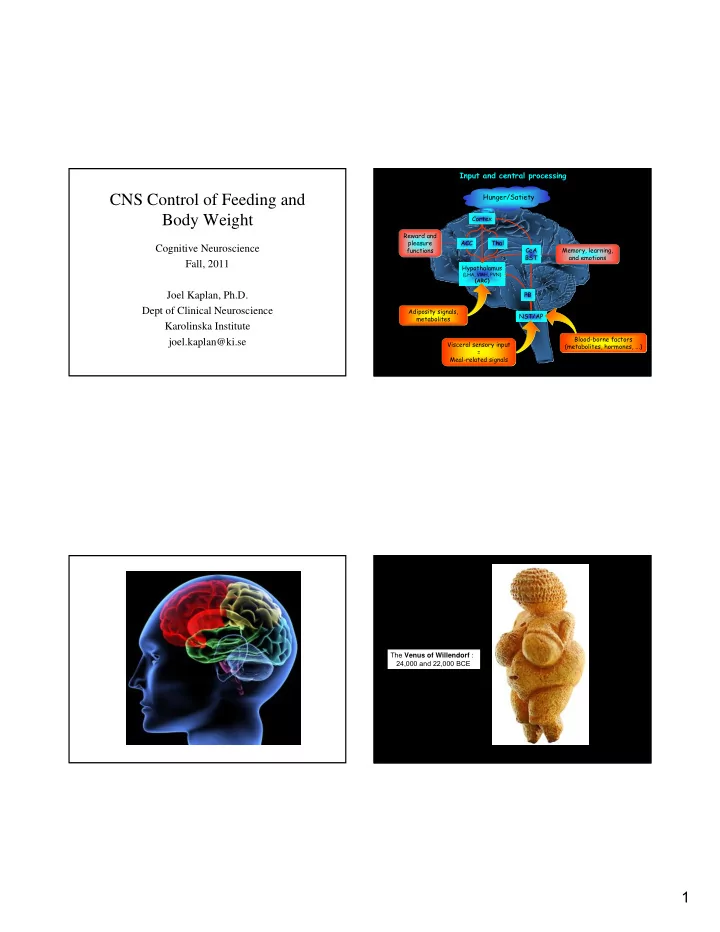
CNS Control of Feeding and Body Weight Cortex Reward and pleasure - - PDF document

cns control of feeding and body weight
SMART_READER_LITE
LIVE PREVIEW

CNS Control of Feeding and Body Weight Cortex Reward and pleasure - - PDF document

Input and central processing Hunger/Satiety CNS Control of Feeding and Body Weight Cortex Reward and pleasure ACC Thal Cognitive Neuroscience CeA Memory, learning, functions BST and emotions Fall, 2011 Hypothalamus (LHA, VMH, PVN)


slide-1
SLIDE 1

1

CNS Control of Feeding and Body Weight

Cognitive Neuroscience Fall, 2011 Joel Kaplan, Ph.D. Dept of Clinical Neuroscience Karolinska Institute joel.kaplan@ki.se

CeA BST Hypothalamus

(LHA, VMH, PVN)

(ARC)

PB Thal ACC Cortex

Hunger/Satiety

Visceral sensory input = Meal-related signals Blood-borne factors (metabolites, hormones, ...) NST/AP Adiposity signals, metabolites Reward and pleasure functions Memory, learning, and emotions

Input and central processing

The Venus of Willendorf : 24,000 and 22,000 BCE

slide-2
SLIDE 2

2

From short- to long-term control of food intake and body weight. Perspective: “The Obesity Epidemic” Body Mass Index: BMI = weight (kg) / height (m)2

class III obesity ≥ 40.0 class II obesity 35.0–39.9 class I obesity 30.0–34.9

  • verweight

25.0–29.9 normal weight 18.5–24.9 underweight < 18.5 Classification BMI

Silhouettes and waist circumferences representing normal, overweight, and obese

2 0 0 0

Obesity Trends* Am ong U.S. Adults BRFSS, 1 9 9 0 , 2 0 0 0 , 2 0 1 0

( * BMI 3 0, or about 30 lbs. overw eight for 5’4” person) 2 0 1 0 1 9 9 0 No Data <10% 10%–14% 15%–19% 20%–24% 25%–29% ≥30%

Neovius M, Teixeira‐Pinto A, Rasmussen F. Shift in the Composition of Obesity in Young Adults between 1969 and 2005. Int J Obes (Lond) 2007;Epub ahead of print (PMID: 18087264 ).

slide-3
SLIDE 3

3

Losing Weight is Difficult

slide-4
SLIDE 4

4

Genetics Play a Big Part

Identical Twins Fraternal Twins

slide-5
SLIDE 5

5

Evidence for a physiological Evidence for a physiological control of body weight: control of body weight:

 The body weight of adult individuals remains

surprisingly constant over long periods of time

 If body weight in adult individuals (and thus

body fat) is forced away from its normal level, compensatory changes in food intake and energy expenditure are induced

slide-6
SLIDE 6

6

Recovery of rats‘ body weight after a period of caloric restriction

(Keesey and Hirvonen, J. Nutr. 127:1875S-1883S, 1997)

slide-7
SLIDE 7

7

Energy intake Energy expenditure

=

Caloric homeostasis

CNS Effectors of Energy Balance

slide-8
SLIDE 8

8

A comparison of a mouse unable to produce leptin thus resulting in obesity (left) and a normal mouse (right)

Human Obesity: Leptin Protein & MC4-R Mutations Human Obesity: Leptin Protein & MC4-R Mutations

slide-9
SLIDE 9

9

Energy Balance is Achieved Through Controls on Energy Intake [Feeding] and Energy Expenditure

Bachman et al. 2002 Schwartz et al. 2002

break

Enhancement of the direct inhibitory controls of meal size by adiposity signals  Small meal

Eating Leptin Insulin

Direct controls

  • f meal size (e.g. CCK)

Adipose tissue

slide-10
SLIDE 10

10

Indirect Controls of Meal Size

Definition: Everything that is not a direct control Categories Examples .

Metabolic Changes in status of fat mass (Leptin and Insulin signaling) Rhythmic Diurnal Thermal Environmental and fever Ecologic Relative densities of predators and foods Conditioned Preferences, Aversions Cognitive Social, and in humans, cultural and esthetic

”Direct Controls” of Meal Size:

Adequate stimuli act directly on preabsorptive mucosa along the surface of the GI tract, from mouth through the small intestine Taste (Excitatory) Gut : Satiety Signals (postingestive inhibition from gastric and post-gastric sources; e.g., Vagal afferents signaling stomach stretch, CCK Two Categories:

Next 3 slides: Modeling how direct controls (excitatory and inhibitory) interact to determine progress of individual meals, and cumulative intake (= meal size

Feedback intensity Eating time

Meal

Positive feedback Negative feedback

slide-11
SLIDE 11

11

“Sham Feeding” paradigm: nutritive fluid meal taken by rats with gastric fistulas. Large meals are taken when fluid drips out of the stomach (i.e., when post-ingestive inhibitory feedback is eliminated.) A+B = high palatability, C+D = intermediate palatability, E+F = low palatability Pairs (A,B; C,D; E,F) are substances of same palatability but differ in rate of clearance from intestine

Each curve is a substance of different palatability

Pre- and Post-Prandial Correlations

(skipped in class, but briefly FYI… ) Part of a conversation about how mechanisms controlling intake over short Term (i.e. meal size controls) carry over to influence intermediate-term intake (i.e., meal patterning; daily intake). Data from freely feeding rat: Graph to right shows that size of one meal influences when the next meal will be initiated; Not shown, data from schedule-fed rats indicate that the size of a given meal correlates negatively with amount consumed during the next meal (e.g., big breakfast  smaller lunch).

slide-12
SLIDE 12

12

A Behavioral Strategy for Meal Size Control

  • 1. Eat very slowly
  • 2. Take small bites of food
  • 4. Pause often during the meal (put down the fork)
  • 3. Chew a lot

Assumptions

  • 1. Obese individuals eat at a higher rate than do

their lean counterparts.

  • 3. Prospects for a ’normalization’ of meal size

would be improved if ingestion rate were treated as a target behavior in a clasic behavior-modification approach to obesity

  • 2. The obese take excessively large meals.

Questions

  • 1. Does eating slowly really affect meal size

in obese or normal-weight people, or in lab rats?

  • 2. What are the physiological implications of

the hypothesis linking ingestion rate and meal size?

  • 3. Can competing hypothesis be framed in

physiological terms?

slide-13
SLIDE 13

13

“Your body has an internal satiety (fullness) mechanism. When you have eaten enough, the mechanism sends out signals saying ‘Enough is enough!’ We think this takes about 20 minutes, although this is a very complex process involving the stomach, hormones in the small intestine, and other factors.”

Competing Hypotheses

Meals end as a function of elapsed feeding time. Meals end simply as a function of the amount consumed (i.e., meal size is a ”regulated” parameter). Friendly to a Postgastric theory of satiety Friendlier to a Gastric Model

Size = 5 gram Size = 15 gram S #07 S #11

slide-14
SLIDE 14

14

5 10 15 20 25

g/min Bite size (g)

5 10 15

Ingestion rate

5 10 15 20 25

Bite size (g)

5 10 15

min

Meal duration

50 100 150 200 250 300 350

Bite size (g)

5 10 15

grams

Meal size

10 20 30 40 50 60

5 10 15

Bite size (g) number

Number of bites

Possible outcomes:

1) The total number of licks emitted remains constant Meal size is halved. 2) Meal size remains constant across sessions the number of licks emitted is doubled. 3) Neither of these two outcomes applies. (Not possible for both outcomes to be correct.)

LICK COUNT 1000 2000 3000 4000 5000 INTAKE (ml) 5 10 15 20 25 30 MEAL DURATION (sec) 200 400 600 800 1000 1200 4 8

A B C

Lick volume (l)

4 8 4 8

Intake (ml) Lick Count Meal Duration (sec) Lick volume ul) 4 8 8 8 4 4

slide-15
SLIDE 15

15

Generalization

Examples:

’Drop Size’ Challenge: Different sugars at different concentrations Deprivation Preload Pharmacological treatments Other Challenges: Meal Interruption Constraints on burst/pause pattern

Conclusions:

  • 1. For a given set of background conditions (food, physiological

status, history, etc.), the meal ends as a function of the amount consumed, and not in relation to elapsed feeding time.

  • 2. Meal termination cannot be anticipated by following

behavioral or ingestion-rate trajectories. Ingestive behavior is flexible, and can vary broadly in service of the meal-size goal.

  • 3. Meal termination reflects highly accurate monitoring of

cumulative intake.

  • 4. Rat and human data indicate that eating glowly, by whatever

contortion, isn’t likely to reduce intake. -- ”Myth Busted.”