Collateral Protection for Collateral Protection for Financial Assets: - - PowerPoint PPT Presentation

collateral protection for collateral protection for
SMART_READER_LITE
LIVE PREVIEW

Collateral Protection for Collateral Protection for Financial Assets: - - PowerPoint PPT Presentation

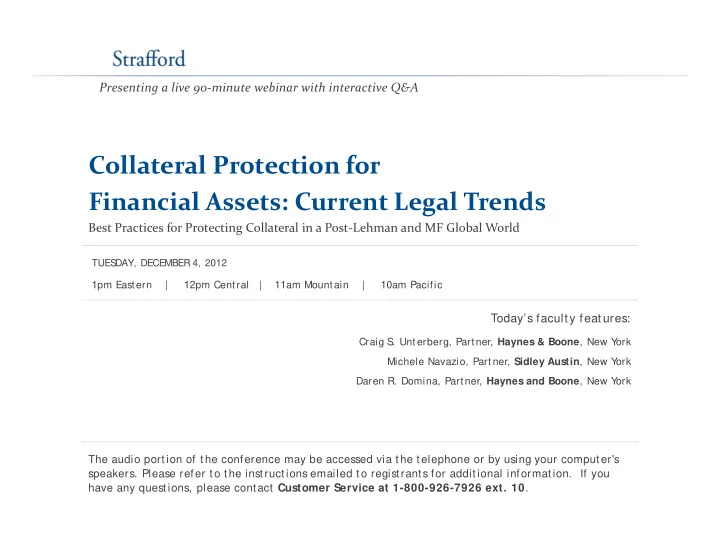
Presenting a live 90 minute webinar with interactive Q&A Collateral Protection for Collateral Protection for Financial Assets: Current Legal Trends Best Practices for Protecting Collateral in a Post Lehman and MF Global World TUES DAY,


slide-1
SLIDE 1

Presenting a live 90‐minute webinar with interactive Q&A

Collateral Protection for Collateral Protection for Financial Assets: Current Legal Trends

Best Practices for Protecting Collateral in a Post‐Lehman and MF Global World

T d ’ f l f

1pm Eastern | 12pm Central | 11am Mountain | 10am Pacific TUES DAY, DECEMBER 4, 2012

Today’s faculty features:

Craig S . Unterberg, Partner, Haynes & Boone, New Y

  • rk

Michele Navazio, Partner, Sidley Austin, New Y

  • rk

Daren R. Domina, Partner, Haynes and Boone, New Y

  • rk

Daren R. Domina, Partner, Haynes and Boone, New Y

  • rk

The audio portion of the conference may be accessed via the telephone or by using your computer's

  • speakers. Please refer to the instructions emailed to registrants for additional information. If you

have any questions, please contact Customer Service at 1-800-926-7926 ext. 10.

slide-2
SLIDE 2

Tips for Optimal Quality

S d Q lit S

  • und Quality

If you are listening via your computer speakers, please note that the quality of your sound will vary depending on the speed and quality of your internet connection. If the sound quality is not satisfactory and you are listening via your computer speakers, you may listen via the phone: dial 1-888-450-9970 and enter your PIN when prompted Otherwise please send us a chat or e mail when prompted. Otherwise, please send us a chat or e-mail sound@ straffordpub.com immediately so we can address the problem. If you dialed in and have any difficulties during the call, press *0 for assistance.

Viewing Qualit y

To maximize your screen, press the F11 key on your keyboard. To exit full screen, press the F11 key again press the F11 key again.

slide-3
SLIDE 3

Continuing Education Credits

FOR LIVE EVENT ONLY

For CLE purposes, please let us know how many people are listening at your location by completing each of the following steps:

  • In the chat box, type (1) your company name and (2) the number of

attendees at your location attendees at your location

  • Click the S

END button beside the box

slide-4
SLIDE 4

Program Materials

If you have not printed the conference materials for this program, please complete the following steps:

  • Click on the + sign next to “ Conference Materials” in the middle of the left-

hand column on your screen hand column on your screen.

  • Click on the tab labeled “ Handouts” that appears, and there you will see a

PDF of the slides for today's program.

  • Double click on the PDF and a separate page will open.

Double click on the PDF and a separate page will open.

  • Print the slides by clicking on the printer icon.
slide-5
SLIDE 5

Collateral Protection P t L h & MF Gl b l Post-Lehman & MF Global

December 4, 2012

Craig Unterberg, Haynes and Boone, LLP

craig.unterberg@haynesboone.com | 212.659.4987

Miki Navazio, Sidley Austin LLP Miki Navazio, Sidley Austin LLP

mnavazio@sidley.com | 212.839.5310

Daren R. Domina, Haynes and Boone, LLP

d d i @h b | 212 6 9 4963

5

daren.domina@haynesboone.com | 212.659.4963

slide-6
SLIDE 6

OVERVIEW

  • 1. Legal Framework of Collateral Protection
  • 2. Financial Institution Insolvency
  • 3. Applicability to Swap Dealers
  • 4. Case Studies: Lehman & MF Global

5 Collateral Protection Trends

  • 5. Collateral Protection Trends
  • 6. Dodd-Frank

6

slide-7
SLIDE 7

Legal Framework: Article 8

  • Our focus will be on the indirect holding system

Applicable to securities intermediaries

  • Applicable to securities intermediaries
  • A person that maintains securities accounts for
  • thers is a “securities intermediary”
  • thers is a securities intermediary
  • Obligations on securities intermediaries are set

forth in Article 8 forth in Article 8

7

slide-8
SLIDE 8

Legal Framework: Article 8

  • §8-504 requires securities intermediaries to

maintain a quantity of financial assets equal to maintain a quantity of financial assets equal to all securities entitlements it has established

  • Compliance with §8-504 contains exceptions to

Compliance with §8 504 contains exceptions to the “perfect match” rule

  • Example: a temporary shortfall due to failure to

Example: a temporary shortfall due to failure to deliver by a counterparty in trade settlement

8

slide-9
SLIDE 9

Legal Framework: Regulation & Legal Framework: Regulation & Oversight g

  • Broker-dealers / FCMs

Article 8 – Article 8 – Federal statutes – SEC and SRO oversight SEC and SRO oversight

  • Banks (Custodians)

– Article 8 – Federal and State statutes – FDIC oversight

9

slide-10
SLIDE 10

Legal Framework: Broker-Dealers

  • Rule 15c3-3 limits broker-dealer’s use of

customer’s securities customer s securities

  • Cap on a broker-dealer’s rehypothecation

T f th t t

  • Terms of the account agreement can

impact applicability of the customer t ti l protection rules

– Rehypothecation

10

– Cross-collateralization

slide-11
SLIDE 11

Legal Framework: FCMs

  • FCMs must segregate customer funds pursuant to CEA § 4d(a)(2)

– FCM may not grant any lien on customer collateral (other than to DCOs)

  • FCMs may invest customer collateral in “permitted investments”

under CFTC rule 1.25 and retain gains

– Since MF Global, CFTC has revised rule 1.25 to limit list of permitted investments investments

  • LSOC (for cleared swaps)

– collateral legally segregated, but commingled in one account mitigates “fellow customer” risk – mitigates fellow customer risk

  • FCM not permitted to use one customer’s collateral to satisfy another

customer’s obligations or the FCMs obligations – balances benefits and costs in protecting market participants and the public

11

slide-12
SLIDE 12

Legal Framework: B/D and FCM Regulatory Compliance Regulatory Compliance

  • The regulatory oversight for customer

t d t ti i h dl d th h assets and protections is handled through a combination of:

– audits (internal and external); – regulatory examinations; and – reporting requirements.

12

slide-13
SLIDE 13

Legal Framework: Bank Legal Framework: Bank Regulatory Compliance g y p

  • Periodic FDIC regulatory examinations of

trust departments trust departments

  • Examine policies and account

administration to prevent liabilities or loss to the bank’s capital

13

slide-14
SLIDE 14

Insolvency of Financial Insolvency of Financial Institutions

  • Broker-Dealers

C t P t ti R l – Customer Protection Rule – SIPC and SIPA

  • Custodians/Banks

– FDIC – Trust/fiduciary accounts – Assets inside/outside the estate

14

slide-15
SLIDE 15

Insolvency: Broker Dealers & Insolvency: Broker-Dealers & SIPA

  • Federal court appoints a SIPA trustee
  • Trustee tasked to return customer assets

(in whole or pro rata based on net equity)

  • Net equity fixed as of SIPC filing date
  • SIPC Protections

S C

  • tect o s

– $500,000 insurance cap – $250 000 insurance cap on cash (inclusive)

15

$250,000 insurance cap on cash (inclusive)

slide-16
SLIDE 16

Insolvency Risks: Broker-Dealer

  • Net equity claim in excess of pro rata

share of customer assets and SIPA share of customer assets and SIPA insured amounts ff ff

  • Assets moved to offshore affiliates
  • Failure of broker-dealer to abide by

customer protection rule

16

slide-17
SLIDE 17

Insolvency: Bank/Custodian and Insolvency: Bank/Custodian and FDIC

  • Assets held in trust, fiduciary or custodial

accounts should not be assets of the bank accounts should not be assets of the bank

  • FDIC will attempt to transfer accounts to a

successor institution

  • Cash is typically held in deposit accounts

subject to certain levels of FDIC insurance

17

slide-18
SLIDE 18

Insolvency Risks: Insolvency Risks: Bank/Custodian and FDIC

  • Assets intended to be held in trust, fiduciary or

custodial accounts are open to certain risks custodial accounts are open to certain risks

– Determination that assets are not held in appropriate account – Inability to trace the assets

  • If assets are not held in appropriate account or

non-traceable, then upon failure the customer is subject to FDIC receivership / conservatorship

18

slide-19
SLIDE 19

Applicability to Swap Dealers

  • Swap collateral is posted under the CSA
  • Need to determine applicability of laws to

swap dealer

  • Self-help remedies may be limited
  • Collateral subject to regulatory/bankruptcy

Co ate a subject to egu ato y/ba uptcy regime that overlays the counterparty

19

slide-20
SLIDE 20

Case Study: Lehman Brothers

  • In the insolvency of Lehman Brothers Inc.

(“LBI”), SIPA and the SEC moved customer ( ) assets out of the failed brokerage

  • Pre-insolvency, LBI followed the segregation

and reserve requirements

  • Customers were made whole and no advances

from the SIPC Fund have been made

20

from the SIPC Fund have been made

slide-21
SLIDE 21

C St d L h B th Case Study: Lehman Brothers (UK) (U )

  • Results for clients of Lehman Brothers

International (Europe) (“LBIE”) were vastly International (Europe) ( LBIE ) were vastly different

  • Customers of LBIE became general unsecured

creditors and their assets were frozen in the insolvency proceeding. insolvency proceeding.

  • Untangling customers’ assets from those of

LBIE

21

LBIE

slide-22
SLIDE 22

C St d L h B th Case Study: Lehman Brothers (swap affiliates) (s ap a a es)

  • Counterparties of LBSF and similar US affiliates

general unsecured creditors – general unsecured creditors – assets subject to insolvency proceeding (albeit under US bankruptcy law).

  • Competing claims over customer assets had to

be resolved (LBIE and other Lehman affiliates, be resolved (LBIE and other Lehman affiliates, bondholder claims, etc.) V l ti di t

22

  • Valuation disputes
slide-23
SLIDE 23

Case Study: MF Global

  • MF Global Inc. had a deficiency in its

segregated accounts for certain customers segregated accounts for certain customers

  • As stated in a February release by SIPC

As stated in a February release by SIPC,

“Nearly all securities customers have received 60% or more of th i t l d l d 194 f f MF Gl b l I their account value and already 194 of former MF Global Inc. securities customers have received the entirety of their account balances because of a Securities Investor Protection Corporation guarantee.”

23

slide-24
SLIDE 24

Collateral Protection Trends

  • Segregate IA collateral in connection with swap

transactions

Assets held by custodians subject to tri party – Assets held by custodians subject to tri-party arrangements

  • Utilize cash sweeps to limit cash deposits

Move excess collateral to third party accounts in

  • Move excess collateral to third party accounts in

non-swap transactions

24

slide-25
SLIDE 25

Collateral Protection Trends Collateral Protection Trends (cont’d) ( )

  • Diversify relationships with financial

institutions institutions

  • Concentration limits

Concentration limits

  • Limit offshore transactions to avoid

t o s o e t a sact o s to a o d unfamiliar bankruptcy law

25

slide-26
SLIDE 26

Collateral Protection Trends: Segregation

  • Segregation issues for financial institution

P f ti d A ti l 9 – Perfection under Article 9 – Customer access to collateral – withdrawals d b tit ti and substitutions – Competing liens, including custodian’s claims C fli ti i t ti – Conflicting instructions – Fraudulent acts by customer

26

– Reporting on account collateral

slide-27
SLIDE 27

Collateral Protection Trends: Segregation

  • Segregation issues for customers

Ti d f – Time and expense of process – Credit risk of the custodian – Ability to make withdrawals/substitutions – Ability to access collateral post-default – Release of excess collateral

27

slide-28
SLIDE 28

Collateral Protection Trends: Collateral Protection Trends: Rehypothecation yp

  • §8-504 prohibits rehypothecation without

authorization and Rule 15c3 3 limits authorization and Rule 15c3-3 limits rehypo by broker dealers f

  • Authorization is typically found in the

customer agreement

  • Limiting rehypo increases borrowing costs
  • Is the risk worth the cost?

28

slide-29
SLIDE 29

Collateral Protection Trends: Collateral Protection Trends: Rehypothecation with B/D yp

  • A customer’s net equity claim is equal to the

value of its long positions (including cash) minus value of its long positions (including cash) minus the value of its obligations

  • Applies whether or not the customer’s assets

Applies whether or not the customer s assets have been rehypothecated.

  • A customer whose assets have been

A customer whose assets have been rehypothecated stands in the same position/priority as a person whose assets have

29

not been.

slide-30
SLIDE 30

Collateral Protection Trends: Dodd Collateral Protection Trends: Dodd-

Frank

  • Mandate to offer IM for uncleared swaps segregated with

custodian custodian

  • Limits on type of permitted collateral

– CFTC prosed rule makes type of collateral dependent upon type of t t counterparty – Prudential regulators proposed rule contains fewer types, but not dependent on counterparty

Fi l l t b bli h d b CFTC d d ti l l t

  • Final rule to be published by CFTC and prudential regulators
  • ISDA working group – dealers & buy-side – to address CSA

and tri-party agreement with adjustments following publication

30

  • f final rule.