COMP 431 The Transport Layer Internet Services & Protocols - - PowerPoint PPT Presentation

comp 431 the transport layer internet services protocols
SMART_READER_LITE
LIVE PREVIEW

COMP 431 The Transport Layer Internet Services & Protocols - - PowerPoint PPT Presentation

COMP 431 The Transport Layer Internet Services & Protocols Transport services and protocols application Transport protocols: transport Provide logical communication The Transport Layer network between application processes data


slide-1
SLIDE 1

1

COMP 431 Internet Services & Protocols The Transport Layer

Multiplexing, Error Detection, & UDP Jasleen Kaur

February 18, 2020

2

The Transport Layer

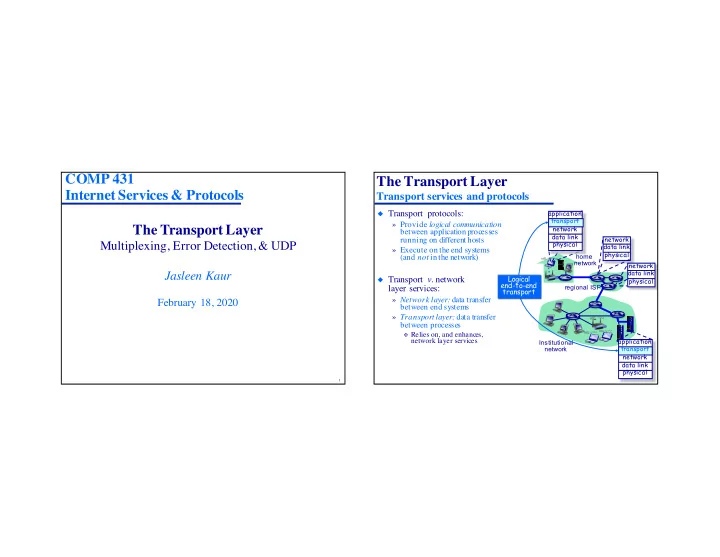
Transport services and protocols

◆ Transport protocols:

» Provide logical communication between application processes running on different hosts » Execute on the end systems (and not in the network)

◆ Transport v. network

layer services:

» Network layer: data transfer between end systems » Transport layer: data transfer between processes

❖ Relies on, and enhances,

network layer services

network data link physical regional ISP home network Institutional network application transport network data link physical application transport network data link physical network data link physical

Logical end-to-end transport

slide-2
SLIDE 2

3

Transport Layer Protocols

Internet transport services

◆ TCP: Reliable, in-order, unicast

delivery

» Congestion control » Flow control » Connection setup

◆ UDP: Unreliable, unordered

(“best-effort”), unicast or multicast delivery

» (Minimal) error detection

◆ Services not available:

» Performance guarantees

❖ No guarantees of available bandwidth ❖ No guarantees of end-to-end delay

» Other (non-unicast) delivery models

❖ Multicast (reliable v. unreliable) ❖ Anycast

network data link physical regional ISP home network Institutional network application transport network data link physical application transport network data link physical network data link physical

Logical end-to-end transport

4

Transport Layer Protocols & Services

Outline

◆ Fundamental transport layer

services

» Multiplexing/Demultiplexing » Error detection » Reliable data delivery » Pipelining » Flow control » Congestion control

◆ Service implementation in

Internet transport protocols

» UDP » TCP

network data link physical regional ISP home network Institutional network application transport network data link physical application transport network data link physical network data link physical

Logical end-to-end transport

slide-3
SLIDE 3

5

Fundamental Transport Layer Services

Multiplexing/Demultiplexing

◆ Each end-system has a single protocol “stack”

» The stack is shared between all applications using the network

application transport network ◆ Multiplexing is the process of

allowing multiple applications to use the network simultaneously

» (T

  • send data into the network

concurrently)

M1 M2

Process 1 Process 2

M1 M2 ◆ Demultiplexing is the process of

delivering received data to the appropriate application

6

Multiplexing/Demultiplexing

Review: Protocol layering in the Internet

◆ At the sender, each layer takes data from above

» May subdivide into multiple data units at sending layer » Adds header information to create new data unit » Passes new data unit to layer below

◆ The process is reversed at the receiver

application transport network link physical

Source Destination

Message Segment Datagram Frame Hlink Htrans Hnet M Htrans Hnet Hlink M Hnet Htrans M Htrans M M Htrans Hnet M Htrans M M application transport network link physical

slide-4
SLIDE 4

7

Multiplexing/Demultiplexing

Multiplexing

◆ Gathering data from multiple

application processes, enveloping data with header (later used for demultiplexing)

◆ Based on IP addresses and sender

and receiver port numbers

» Source and destination port numbers carried in each segment » (Recall: well-known port numbers for specific applications)

32 bits

application data (message “payload”) TCP/UDP segment format protocol specific header fields

source port #

  • dest. port #

8

M application transport network application transport network application transport network M P2

Multiplexing/Demultiplexing

Demultiplexing

◆ Demultiplexing is the process of delivering received segments

to the correct application-layer process

» IP address (in network-layer datagram header) identifies the receiving machine » Port number (in transport-layer segment header) identifies the receiving process Receiver

Segment P1 P3 P4

Segment header (has port #) Application-layer data

Sender 1 Sender 2

M M Hnet segment Htrans M Datagram

Datagram header (has IP addr)

slide-5
SLIDE 5

9

Multiplexing/Demultiplexing

Transport protocol specific demultiplexing

◆ Demultiplexing actions depend on whether the transport layer is

connectionless (UDP) or connection-oriented (TCP)

◆ UDP demultiplexes segments to the socket

» UDP uses 2-tuple

<destination IP addr, destination port nbr>

to identify the socket » Socket is “owned” by some process (allocated by OS).

◆ TCP demultiplexes segments to the connection

» TCP uses 4-tuple

<source IP addr, source port nbr, destination IP addr, destination port nbr>

to the identify connection » Connection (and its socket) is owned by some process

10

Multiplexing/Demultiplexing

Examples

Web client Host A Web Server B

Web server port use (TCP)

source IP: A dest IP: B source port: x

  • dest. port: 80

Web client Host C

source IP: C dest IP: B source port: y

  • dest. port: 80

source IP: C dest IP: B source port: x

  • dest. port: 80

Host A DNS Server B

DNS server port use (UDP)

  • dest. IP: B
  • dest. port: 53
  • dest. IP: A
  • dest. port: x
slide-6
SLIDE 6

11

Fundamental Transport Layer Services

“Best Effort” Delivery

◆ Goal: Provide error detection and multiplexing but no delivery

guarantees

» The characteristics of the underlying network layer will determine the reliability of data delivery

Sending Process Receiving Process Unreliable Channel

data data

Application Layer Transport Layer Network Layer

segment segment

UDP protocol (Sending Side) UDP protocol (Receiving Side) Unreliable Channel

12

Internet Transport Protocols

User Datagram Protocol (UDP) [RFC 768]

◆ No frills, “bare bones” Internet

transport protocol

◆ Best effort service — UDP

segments may be:

» Lost » Delivered out of order to the application » Delivered multiple times to the application

◆ “Connectionless”

» No handshaking between UDP sender, receiver » Each UDP segment handled independently of others

32 bits

application data (message payload) UDP segment format

Length field is length in bytes, of UDP segment (including header)

length checksum

source port #

  • dest. port #
slide-7
SLIDE 7

13

User Datagram Protocol (UDP)

Is unreliable, unordered communications useful?

◆ Who uses UDP?

» Often used for streaming multimedia applications » Loss tolerant » Rate sensitive

◆ Other UDP uses (why?):

» DNS » SNMP » Routing protocols

Why use UDP?

◆ No connection establishment

(which can add delay)

◆ Simple: no connection state at

sender, receiver

◆ Small segment header ◆ No congestion control: UDP

can blast away as fast as desired

◆ Reliable transfer over UDP still possible

» Reliability can always be added at the application layer » (Application-specific error recovery)

14

User Datagram Protocol (UDP)

Checksum computation

◆ The UDP checksum allows the

receiver to detect errors in transmitted segment

» Errors are “flipped” bits

◆ Sender computation:

» Treat segment contents as a sequence

  • f 16-bit integers

» Sum the segment’s contents, place the 1’s complement of the sum into the checksum field

32 bits

application data (message payload) UDP segment format length checksum

source port #

  • dest. port #

◆ Example:

» Sum of segment = 1010101110011011 » Checksum = 0101010001100100 “Theorem:” segment sum + checksum = 1111111111111111

slide-8
SLIDE 8

15

User Datagram Protocol (UDP)

Checksum computation

◆ Receiver computation:

» Compute checksum of received segment (including received checksum) » Compare value to all 1’s » If equal — No error detected, segment “OK” » If not equal —Error detected, now what?!

32 bits

application data (message payload) UDP segment format length checksum

source port #

  • dest. port #

“Theorem:” segment sum + checksum = 1111111111111111

❖ Retransmit? ❖ Discard? ❖ Deliver?