COMP 431 Transport Layer Protocols & Services Internet Services - - PowerPoint PPT Presentation

comp 431 transport layer protocols services internet
SMART_READER_LITE
LIVE PREVIEW

COMP 431 Transport Layer Protocols & Services Internet Services - - PowerPoint PPT Presentation

COMP 431 Transport Layer Protocols & Services Internet Services & Protocols Performance issues application transport How does congestion control network impact the latency of TCP The Transport Layer data link network


slide-1
SLIDE 1

1

COMP 431 Internet Services & Protocols The Transport Layer

TCP Fairness & Performance Jasleen Kaur

March 26, 2020

2

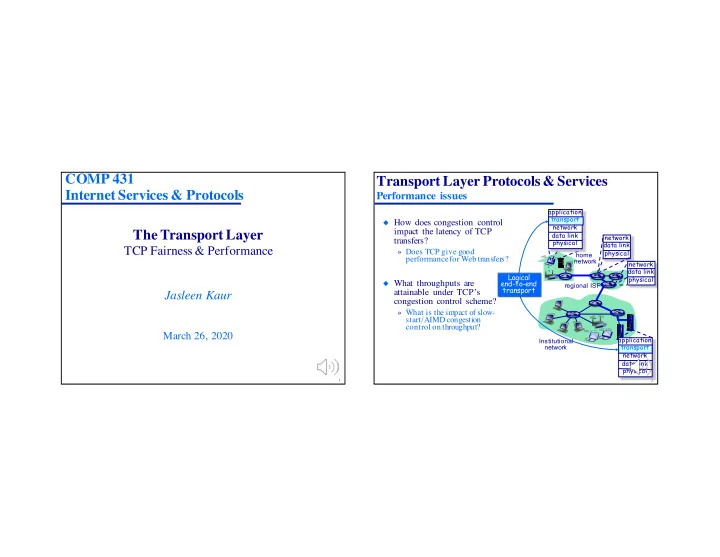
Transport Layer Protocols & Services

Performance issues

◆ How does congestion control

impact the latency of TCP transfers?

» Does TCP give good performance for Web transfers?

◆ What throughputs are

attainable under TCP’s congestion control scheme?

» What is the impact of slow- start/AIMD congestion control on throughput?

network data link physical regional ISP home network Institutional network application transport network data link physical application transport network data link physical network data link physical

Logical end-to-end transport

slide-2
SLIDE 2

3

TCP Performance

Latency for TCP transfers

◆ How long does it take to

receive an object from a Web server?

» TCP connection establishment

  • verhead

» Data transfer delay

❖ Slow start ❖ Congestion avoidance

Client Server

Time Connection establishment Object transfer ◆ Assume one link between

client and server with transmission speed R

» Fixed congestion window of w segments » S = segment size » O = object size » No loss/retransmissions » SYN & ACK transmission times negligible

4

TCP Latency Analysis

Fixed-sized congestion window of w segments

◆ Assume no congestion or flow

control

» Receiver has large window

Client Server

Time S/R RTT wS/R O/R 2RTT ◆ Case 1: RTT + S/R < wS/R ◆ latency = 2RTT + O/R

» Here ACKs return before the server completes the transmission

  • f a window

» (Hence the size of the congestion window does not effect performance) » Is it possible to do better?

slide-3
SLIDE 3

5

TCP Latency Analysis

Fixed-sized congestion window of w segments

Client Server

Time S/R RTT wS/R ◆ Case 2: RTT + S/R > wS/R

» total stall time = (k–1)(S/R + RTT – wS/R)

stall ◆ The object requires

k = O/wS windows to transmit

» Now the server “stalls” waiting for ACKs to return » latency = 2RTT + O/R + total stall time » stall time per window= (S/R + RTT) – wS/R

6

TCP Latency Analysis

Adding in the effect of slow-start

◆ Assume the window grows

according to slow start

» k = Number of windows required to transmit the object » q = Number of windows transmitted before the server no longer stalls » Actual number of stalls is P = MIN{q, k–1}

◆ latency = min_latency +

stall time

» min_latency = 2RTT + O/R » stall time = P(...)

Client Server

Time 1st window 2nd window 3rd window 4th window

slide-4
SLIDE 4

7

TCP Latency Analysis

Adding in the effect of slow-start

◆ min_latency = 2RTT + O/R ◆ stall time for the ith window =

Client Server

Time 2S/R S/R 1st window 8S/R 4S/R 2nd window 3rd window 4th window ◆ total stall time = ...

= P + RTT – (2P–1) S R S R + RTT – 2i–1 S R S R

Σ

i=1 P

=

time for the return

  • f the ACK for the

first segment in the ith window time to transm it the ith window

= 0 or – + RTT – 2i–1 S R S R = 0 or

8

TCP Latency Analysis

Summary

◆ Latency with a fixed-size

window w:

» 2RTT + O/R +

+ RTT – w S R S R (k–1)

k = Number of windows required to transmit the object P= Number of TCP server stalls = MIN{q, k–1}

P + RTT – (2P–1) S R S R

◆ Latency under slow start:

» 2RTT + O/R +

Client Server

Time S/R 4S/R 2S/R 1st window 8S/R 2nd window 3rd window 4th window

slide-5
SLIDE 5

9

TCP Latency Analysis

Finding q and k

◆ k is the number of windows

required to transmit the object

◆ q is the number of windows

required for the sender to fully consume the bandwidth on the link k = MIN i: 20+21+22+…+2i–1 ≥ O S = MIN i: 2i–1 ≥ O S = MIN i: i ≥ log2 O S +1 = ceil(log2 ) O S +1 q = MAX i: RTT + ≥ 2i–1 S R S R = MAX i: 2i–1 ≤ 1 + RTT S/R = MAX i: i ≤ log2 1 + +1 RTT S/R = floor(log2 1 + + 1) RTT S/R

20

Congestion Control

How to Define Fairness?

◆ If nk connections share a congested link k with capacity Rk, each

connection should receive r = Rk/nk bandwidth

◆ But what if a connection can’t consume R/n bandwidth?

» MAX-MIN fairness:

❖ If a connection receives less bandwidth than it requires, then it receives

the same amount of bandwidth as all other unsatisfied connection

... ...

k k+1 k–1 Rk–1 Rk

slide-6
SLIDE 6

22

◆ Simple fairness

» If n TCP sessions share a bottleneck link, each should get 1/n of link capacity

◆ When a connection slows down, by how much should it slow

down?

Connection 1 Bottleneck router Connection 2

TCP Performance

Is TCP throughput fairly realized?

23

TCP Throughput

Is TCP fair?

◆ Consider two competing connections with same MSS and RTT

R R Equal bandwidth share

Connection 1’s throughput Loss: decrease window by factor of 2 Congestion avoidance: additive increase Loss: decrease window by factor of 2 Congestion avoidance: additive increase

» Additive increase gives slope of 1, as throughout increases » Multiplicative decrease decreases throughput proportionally Throughput goal

slide-7
SLIDE 7

25

Transport Layer Protocols & Services

Summary

◆ Fundamental transport layer

services

» Multiplexing/Demultiplexing » Error detection » Reliable data delivery » Flow control » Congestion control

◆ Internet transport protocols

» UDP » TCP

network data link physical

... ... ... ...

network data link physical application transport network data link physical application transport network data link physical

Logical end-to-end transport ◆ Up next: Leaving the network “edge” and

diving into the network “core”