
SLIDE 1
Comparison for spent fuel behavior of PWR and SMRs
Gyujae Nam1, Jong-Dae Hong2, Youho Lee1*,
1Seoul National University, 1 Gwanak-ro, Gwanak-gu, Seoul 08826, Republic of Korea 2Korea Atomic Energy Research Institute, 989-111 Daedeokdae-Ro, Yuseong-Gu, Daejeon 34057, Republic of
Korea leeyouho@snu.ac.kr
- 1. Introduction
While most of fuel simulation studies are conducted to investigate steady-state and accident behavior, relatively small attention has been given to the spent fuel behavior of existing PWRs. A limited number of studies addressed the pre-disposal spent fuel behavior
- f existing LWRs [3]. It can be inferred from these
studies that the behavior of spent fuels is largely affected by its steady-state operation history, including fission gas generation, and cladding embrittlement such as oxidation, and hydrogen pick
- up. This would naturally mean that there exists a
substantial difference of spent fuel behavior between existing LWRs and SMRs. Yet, no study, to the authors’ knowledge, has been conducted to address the spent fuel behavior difference, hence resulting management strategies and implications, of existing LWRs and SMRs. This study aims at exploring the pre-disposed spent fuel behavior
- f
existing PWRs and some representative SMR designs, in order to illuminate the potential difference in their management strategies based on key safety threatening conditions. Fuel rod simulations that integrates steady-state, wet storage in spent fuel pool, and dry-storage were conducted using modified FRAPCON-4.0. The FRAPCON-4.0 has been modified in this study to properly capture key behavior unique to spent fuel. Comparisons were made among the existing PWR and selected SMRs, and the key differences that may affect the spent fuel failure modes are highlighted.
- 2. Methods
Spent fuel behavior can be simulated mostly as an extension of steady-state fuel modeling. Yet, there are a few fuel behavior models that need to be modified for spent fuel simulation. These are (A) fission gas release, (B) cladding creep rate, and (C) pellet swelling due to self-radiation [3]. FRAPCON-4.0, by default, provides an option for dry storage simulation. However, it only accounts for the cladding creep rate among the aforementioned three required modifications for proper dry-storage fuel simulation. Hence, it is decided in this study to update FRPACON-4.0 with modifications and assumptions necessary for spent fuel simulation. They are:
- 1. Fission gas release
A past investigation conducted by U.S NRC clearly demonstrates that no appreciable fission gas release takes place in spent fuel pellet at temperatures below 1000K [1]. Therefore, the modified code suppresses any fission gas release from spent fuel pellets at temperatures below 1000K.
- 2. Pellet swelling rate
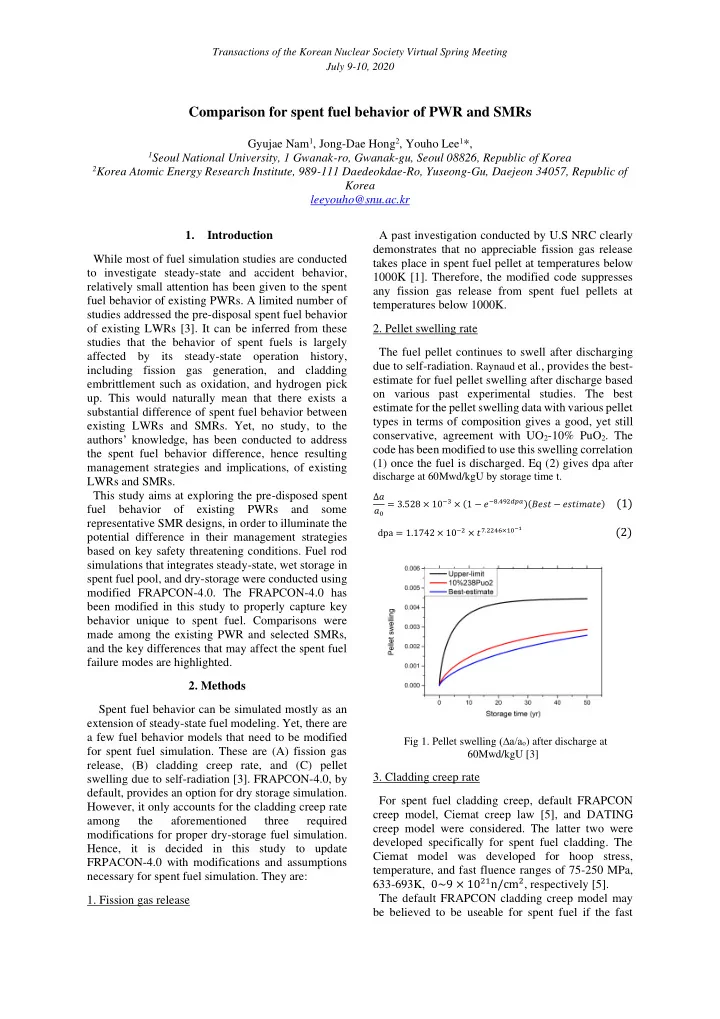
The fuel pellet continues to swell after discharging due to self-radiation. Raynaud et al., provides the best- estimate for fuel pellet swelling after discharge based
- n various past experimental studies. The best
estimate for the pellet swelling data with various pellet types in terms of composition gives a good, yet still conservative, agreement with UO2-10% PuO2. The code has been modified to use this swelling correlation (1) once the fuel is discharged. Eq (2) gives dpa after
discharge at 60Mwd/kgU by storage time t.
∆𝑏 𝑏0 = 3.528 × 10−3 × (1 − 𝑓−8.492𝑒𝑞𝑏)(𝐶𝑓𝑡𝑢 − 𝑓𝑡𝑢𝑗𝑛𝑏𝑢𝑓) (1) dpa = 1.1742 × 10⁻² × 𝑢7.2246×10⁻¹ (2)
Fig 1. Pellet swelling (∆a/ao) after discharge at 60Mwd/kgU [3]
- 3. Cladding creep rate