Completeness of Resolution 5ai We will show by construction: - - PowerPoint PPT Presentation

completeness of resolution
SMART_READER_LITE
LIVE PREVIEW

Completeness of Resolution 5ai We will show by construction: - - PowerPoint PPT Presentation

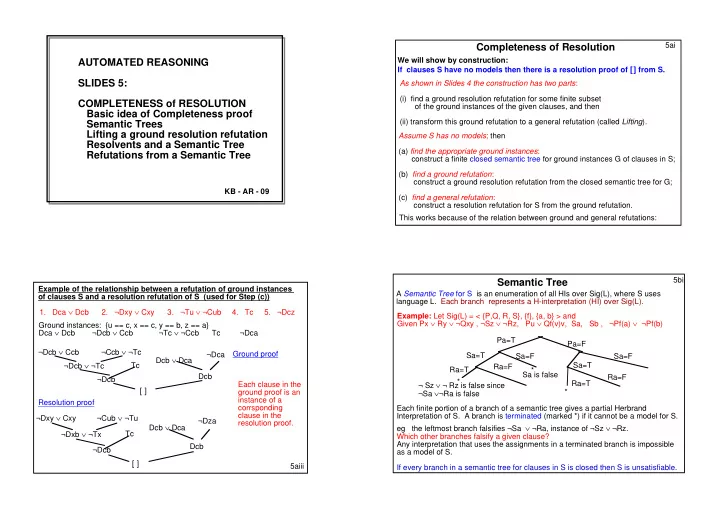
Completeness of Resolution 5ai We will show by construction: AUTOMATED REASONING If clauses S have no models then there is a resolution proof of [] from S . As shown in Slides 4 the construction has two parts : SLIDES 5: (i) find a ground


slide-1
SLIDE 1

AUTOMATED REASONING SLIDES 5: COMPLETENESS of RESOLUTION Basic idea of Completeness proof Semantic Trees Lifting a ground resolution refutation Resolvents and a Semantic Tree Refutations from a Semantic Tree

KB - AR - 09 As shown in Slides 4 the construction has two parts: (i) find a ground resolution refutation for some finite subset

  • f the ground instances of the given clauses, and then

(ii) transform this ground refutation to a general refutation (called Lifting). 5ai We will show by construction: If clauses S have no models then there is a resolution proof of [] from S.

Completeness of Resolution

Assume S has no models; then (a) find the appropriate ground instances: construct a finite closed semantic tree for ground instances G of clauses in S; (b) find a ground refutation: construct a ground resolution refutation from the closed semantic tree for G; (c) find a general refutation: construct a resolution refutation for S from the ground refutation. This works because of the relation between ground and general refutations: Example of the relationship between a refutation of ground instances

  • f clauses S and a resolution refutation of S (used for Step (c))
  • 1. Dca ∨ Dcb 2. ¬Dxy ∨ Cxy 3. ¬Tu ∨ ¬Cub 4. Tc 5. ¬Dcz

Ground instances: {u == c, x == c, y == b, z == a} Dca ∨ Dcb ¬Dcb ∨ Ccb ¬Tc ∨ ¬Ccb Tc ¬Dca 5aiii Each clause in the ground proof is an instance of a corrsponding clause in the resolution proof. ¬Dcb ∨ Ccb ¬Ccb ∨ ¬Tc ¬Dcb ∨ ¬Tc Tc ¬Dcb Dcb ∨ Dca ¬Dca Dcb Ground proof [ ] ¬Dxy ∨ Cxy ¬Cub ∨ ¬Tu ¬Dxb ∨ ¬Tx Tc ¬Dcb Dcb ∨ Dca ¬Dza Dcb Resolution proof [ ] 5bi A Semantic Tree for S is an enumeration of all HIs over Sig(L), where S uses language L. Each branch represents a H-interpretation (HI) over Sig(L). Pa=T Pa=F Sa=T Sa=F Sa=T Sa=F Ra=T Ra=F Ra=T Ra=F * * ¬ Sz ∨ ¬ Rz is false since ¬Sa ∨¬Ra is false Sa is false *

Semantic Tree

Example: Let Sig(L) = < {P,Q, R, S}, {f}, {a, b} > and Given Px ∨ Ry ∨ ¬Qxy , ¬Sz ∨ ¬Rz, Pu ∨ Qf(v)v, Sa, Sb , ¬Pf(a) ∨ ¬Pf(b) Each finite portion of a branch of a semantic tree gives a partial Herbrand Interpretation of S. A branch is terminated (marked *) if it cannot be a model for S. eg the leftmost branch falsifies ¬Sa ∨ ¬Ra, instance of ¬Sz ∨ ¬Rz. Which other branches falsify a given clause? Any interpretation that uses the assignments in a terminated branch is impossible as a model of S. If every branch in a semantic tree for clauses in S is closed then S is unsatisfiable.

slide-2
SLIDE 2
  • If S has no Hmodels then each H-interpretation must falsify a clause in S;
  • To make a clause C false it is sufficient to make 1 ground instance of C false.
  • Since clauses in S are finite, the falsifying part of the interpretation is found

after consideration of a finite number of atoms. BUT: Can we be sure there are a finite number of ground instances of S sufficient to be falsified by all the H-interpretations over the signature of S? 5bii We can show: If S is unsatisfiable then there is a finite closed semantic tree for S (Called compactness.)

  • The “Umbrella” Property says we can!

Each dot is an H-interpretation Each circle is a ground instance of S (one of the finite number) falsified by a number of H-interpretations Assume S has no models:

  • If the Semantic tree for S were

infinite, then there would be an infinite

  • branch. (Konig’s Lemma)
  • We claim such an infinite branch

would yield a model because:

  • Assume for contradiction the

branch did not give a model.

  • Then the branch could have

been finite (by above observations)

The “Umbrella” Property

5biii Any interpretation that assigns T to a1 and a3 will falsify instance C3'. Thus all branches of the tree through node A (called a closure node) can be terminated at A. Node B is called a Failure Node. Notice that the two children are both closure nodes and that the ground instances C2’ and C1’ resolve with each other. Let the Herbrand Base be {a1,a2,a3,a4,a5,...} Let Givens include clauses C1, C2, C3, ....which have as instances C3’= ¬a1 ∨ ¬a3, C2’=a1 ∨ ¬a3, C1’ = a1 ∨ a3, .... The semantic tree yields an unsatisfiable finite set of ground instances of S.

Illustrating Compactness in a Semantic Tree

a1=T a1=F a2=T a2=F a3=T a3=F falsifies instance C2' (say) C2'= a1 ∨ ¬a3 falsifies C1 because falsifies instance C1' =a1 ∨ a3 a3=T (Node A) falsifies instance C3' =¬a1 ∨ ¬a3 (Node B) 5biv R=F Q=F S=F P=F P=T eg falsifies P ∨ Q ∨ R eg falsifies ¬P ∨ S makes P true and S false Note2: the false clause must include ¬P falsifies resolvent Q ∨ R ∨ S called a failure node Note1: the false clause must include P

How to find a resolvent from a semantic tree.

The two children of a failure node will resolve by Nodes 1 and 2. If atom A is tested, then the clause falsified by the A=F branch will contain A and the clause falsified by the A=T branch will contain ¬A. The resolvent willl be false at the failure node. WHY? Therefore, the resolvent cannot be a tautology. Why? The resolvent can be added to the falsifying ground instances and will allow a smaller tree to be

  • btained, since the failure node

will now become a closure node. How to obtain a ground refutation from a completed semantic tree.

  • 1. Dca ∨

∨ ∨ ∨ Dcb 2. ¬ Dxy ∨ ∨ ∨ ∨ Cxy 3. ¬Tx ∨ ∨ ∨ ∨ ¬ Cxb 4. Tc 5. ¬ Dcz A semantic tree: Resolution steps - process nodes in order. (1): (left) 5g; (right) 1g; => Dcb (6g and is false) (2): (left) 2g; (right) 6g => Ccb (7g and is false) (3): (left) 3g; (right) 7g => ¬ Tc (8g and is false) (4): (left) 8g; (right) 4g => [] Check that at each failure node to be processed false clauses can be resolved and that if atom A is tested, then left clause contains ¬A and right clause contains A. (Assumes left branch of test makes A=T, right branch makes A = F.) Also check that the resolvent is false at the processed node. 5bv Tc = F x 4 Tc =T Ccb =F Ccb = T x 3 Dcb = F Dcb = T Dca= T Dca = F x 1 x 5 x 2 (1) (2) (3) (4) i.e. falsifies clause 1 Ground instances found from tree:

  • 1g. Dca ∨

∨ ∨ ∨ Dcb 2g. ¬ Dcb ∨ ∨ ∨ ∨ Ccb 3g. ¬Tc ∨ ∨ ∨ ∨ ¬ Ccb 4g. Tc 5g. ¬ Dca

slide-3
SLIDE 3

Suppose a fully closed semantic tree has been generated using clauses in T. Let T' be the used ground instances (i.e. the ground instances falsified at the leaves). If the resolvent, eg QRS (ie Q∨R∨S) of Slide 5biv, is added by resolution to T' then T can be contracted since QRS is falsified at the failure node, which is higher than the two parent clauses. This gives rise to a new closure node which can be used to derive a resolvent and hence a smaller semantic tree. Eventually , since there were only a finite number of closure nodes at the start and each step removes at least one, a tree of the form on the right is derived, from which [] is deduced. P=T P=F falsifies ¬P falsifies P falsifies [] 5ci Sometimes a resolvent falsifies a node higher than the failure node at which it was formed - enables the tree to contract more quickly. P=T P=F Q=T Q=F falsifies ¬Q falsifies Q resolvent (Q,¬Q) =[] which is falsified at A A

Properties of the Semantic Tree method (1):

5cii

  • Each tree gives rise to a ground resolution proof (refutation) using instances of

the given clauses.

  • Can derive a full resolution refutation from a semantic tree proof by LIFTING (see

below and slide 5cv) because of the following invariant property:

  • Each failed clause instance is either an instance of a given clause, or an instance
  • f the resolvent of the involved clauses at the leaves (ie the closure nodes).

Properties of the Semantic Tree method (2):

Rb=T Rb=F ¬Rb ∨ ¬Sb is an instance of ¬Rz ∨ ¬Sz =C1 Pf(b) ∨ Rb ∨ ¬Qf(b)b is an instance

  • f Px ∨ Ry ∨ ¬Qxy = C2

Resolve instances of C1 and C2 to give ¬Sb ∨ Pf(b) ∨ ¬Qf(b)b which is an instance of ¬Sz ∨ Px ∨ ¬Qxz, the resolvent of C1 and C2 LIFTING LEMMA (Example) 5ciii Sometimes a factoring step is required: It’s indicated if the ground instance has fewer literals than the general clause. Recall that at ground level, factoring is just merging of identical literals, whereas in general it requires a substitution to make 2 or more literals identical.

  • In slide 5civ at (Z) the new ground clause {¬ Sb, Pf(b)} is obtained:
  • by resolution of ¬Sb ∨ Pf(b) ∨ ¬Qf(b)b and Pf(b) ∨ Qf(b)b to give ¬Sb ∨ Pf(b) ∨ Pf(b)
  • then by merging to give ¬Sb ∨ Pf(b)
  • The general resolvent clause is formed from ¬Sz ∨ Px ∨ ¬Qxz and Pu ∨ Qf(v)v,

giving ¬Sz ∨ Pf(z) ∨ Pu which factors to ¬Sz ∨ Pf(z) with binding {u==f(z)}.

  • Q. What is the problem with using the semantic tree method for showing

unsatisfiability? What feature of resolution makes resolution better? (The proof of the Lifting Lemma outlined on Slide 5cv also covers the case when the ground resolvent has a merge applied and the general resolvent factors. As an exercise you might like to see why this is so.)

Properties of the Semantic Tree method (3):

S = Px ∨ Ry ∨ ¬Qxy, ¬Sz ∨ ¬Rz, Pu ∨ Qf(v)v, Sa, Sb , ¬Pf(a) ∨ ¬Pf(b) 5civ ¬Pf(a) ∨ ¬Pf(b) Pf(a)=F Pf(a)=T Pf(b)=T Pf(b)=F Sb=F Sb=T Sb Pf(b) ∨ Qf(b)b Qf(b)b=F Qf(b)b=T Rb=T Rb=F Pf(b) ∨ Rb ∨ ¬Qf(b)b ? ¬Rb ∨ ¬Sb ¬ Rz ∨ ¬Sz ¬Sb ∨ Pf(b) ∨ ¬Qf(b)b ¬Sz ∨ Px ∨ ¬Qxz Pu ∨ Qf(v)v ¬Sz ∨ Pf(z) (Z): ¬Sb ∨ Pf(b) ? ? ? ? Exercise: Fill in the missing ground clauses and resolvents at places marked ?.

slide-4
SLIDE 4

σ and λ apply to different variables so are unaffected when combined (or composed) in σλ. Eσλ= Fσλ = Eσ = Fλ so σλ unifies E and F (so θ exists). So (D∨G)θρ =(D∨G)σλ (defn of mgu ) for some substitution ρ and R' is a ground instance of (D ∨ G)θ. C1 = E∨D, C2 = ¬ F∨G D and G clauses E, F unify, θ=mgu(E,F) 5cv C1'=C1σ = (E∨D)σ C2'=C2λ =(¬F∨G)λ, Eσ = Fλ C1,C2 resolve and maybe factor take ground instances resolve R=(D∨G}θ R' = Dσ ∨ Gλ = (D∨G)σλ take ground instance You can follow the diagram in two different ways: C1,C2 have ground instances C1', C2' that resolve to R' (used by semantic tree) C1, C2 resolve to R that has ground instance R' (used by resolution)

The Lifting Lemma (General Case)

Given C1 and C2 that resolve to give R and C1’, C2’, instances of C1 and C2, that resolve to give R’, then R’ is an instance of R (or of a factor of R). The Lifting Lemma: The lifting lemma, illustrated on Slide 5civ and proved in outline on 5cv, shows how the ground resolution obtained by the semantic tree method can be transformed into a full resolution proof. Each ground resolution step, working up the tree, yields a general resolution step. An illustration

  • f such a step is shown on 5cii. The property, also illustrated in general, is that:

if C1 and C2 resolve (possibly after factoring) to give resolvent R, and ground instances C1' and C2', respectively, of C1 and C2, resolve to give resolvent R', then R' is a ground instance of R (or

  • f a factor of R).

This property is then used to guarantee the fact, given on 5cii, that each clause labelling a failure node is an instance of a given clause or of a resolvent derived from the given clauses. Each step of the ground resolution proof (deriving R' from C1' and C2' by resolution and/or factoring) gives rise to a step between C1 and C2 deriving R and such that R' is a ground instance of R (or of a factor of R). When carrying out the procedure by hand you can either: find the ground refutation and then

  • btain the general one by lifting, or add to the semantic tree the general resolvents and derive the

refutation by resolving the clauses at each pair of leaf nodes. A different completeness proof for ground resolution (ie not using semantic trees) uses induction on the number of different atoms occurring in the given set of clauses. (As identical literals in a clause are merged, each literal in a clause occurs only once.) You can assume also that there are no tautologies as such clauses can be removed without affecting satisfiability (or, as noted on Slide 5biv, no tautologies are needed), so all literals in a clause involve different atoms. The base case (for one atom A) is easy - all clauses must be unit clauses of the form A or ¬A. If S is unsatisfiable it must contain both kinds and a refutation can easily be found by resolving clauses such as A and ¬A. 5cvi The induction step (for k>0 atoms) assumes as Ind. Hyp. that a refutation can be

  • btained for an unsatisfiable set of ground clauses S with <k atoms. Now, there must be

at least 1 atom (say B) that occurs both positively and negatively in different clauses (if not S can't be unsatisfiable - why?). Form two sets of unsatisfiable clauses, S' and S", as follows: First construct S1/S2 = {C | C in S and C does not contain B/¬B} and then delete any occurrences of ¬B/B from clauses in S1/S2 to give S'/S". (Exercise: show S' and S'' must be unsatisfiable - this is the crucial step.) Hence by the Ind. Hyp. there is a resolution refutation of S' and of S'', as all occurrences of B have been removed from S' and S'', so they have <k atoms occurring. Now replace the removed literals ¬B/B into the refutations. That of S' will derive ¬B (or still be a refutation) and that of S'' will derive B or still be a refutation. In case both ¬B and B are derived a refutation can be found by resolving them. In all cases a refutation is found for S. e.g. for the ground clauses on slide 5bv, choose Dcb as B and form S1' = {Ccb, ¬Ccb∨ ¬Tc, Tc, ¬Dca} and S1"= {Dca, ¬Ccb∨ ¬Tc, Tc, ¬Dca}. For S1', repeat the step (say choosing Ccb) and eventually you will obtain the refutation ¬Ccb∨ ¬Tc + Tc ==> ¬Ccb, Ccb + ¬Ccb ==>[] . S1" is obviously unsatisfiable, Dca+¬Dca ==>[] . Putting back ¬Dcb into the first refutation will now yield ¬Dcb, and putting back Dcb into the second refutation gives Dcb. Then resolve these to give [] . (e.g. Putting back Dcb into the second refutation gives Dca∨Dcb + ¬Dca ==> Dcb.) Induction proofs are often used when resolution is restricted in some way - we will see some more examples later. 5cvii

slide-5
SLIDE 5

5di

Summary of Slides 5

  • 1. Completeness of resolution can be shown in several ways. Most proofs

demonstrate completeness using two steps. First a refutation is found using ground instances of the given clauses. This ground refuation is then lifted, to use the original clauses.

  • 2. There is a close relationship between the ground refutation and the lifted

refutation.

  • 3. A Semantic Tree formed from a set of unsatisfiable clauses will be finite.

Each branch in the tree will falsify some ground instance of one of the given clauses.

  • 4. A failure node A in a semantic tree is a node such that both descendants of

A, formed by considering some atom D=T or D=F, are leaves and the falsifying ground instance of the leaf which considered D=T contains the literal ¬D and the falsifying instance for the other leaf contains the atom D. The resolvent of the two falsifying instances falsifies the branch ending at A. 5dii

  • 5. A semantic tree can be used to obtain a ground refutation of ground

instances of given clauses and also to find the corresponding refutation.

  • 6. The refutation obtained from a semantic tree indicates where

factoring is needed. The refutation never derives a tautology.

  • 7. Semantic Trees could be used to show unsatisfiability of a set of

clauses S. But it is not a very practical method in general, since if a “bad” order of atoms is selected the tree could be very large. For this purpose, there is no need to form resolvents, of course, it is enough to know that every branch in the tree falsifies some ground instance of S.

  • 8. Inductive proofs can also be used to show the completeness of

ground resolution.

Question for next week:

5diii Suppose resolvents are restricted, in that only certain literals in a clause can be resolved upon. Consider the restriction that forces literals in a clause to be selected in alphabetical order. (e.g. R(...) would be resolved before S(...).) How can the Semantic Tree proof be modified to show completeness for this case?