Computer Graphics Course Subdivision 2005 The process of creating - - PDF document

computer graphics course subdivision 2005
SMART_READER_LITE
LIVE PREVIEW

Computer Graphics Course Subdivision 2005 The process of creating - - PDF document

Computer Graphics Course Subdivision 2005 The process of creating a smooth (curve) surface by an (infinite) number of iterations. Input : polygonal control point Introduction to Subdivision Surfaces Process : repeated refinements


slide-1
SLIDE 1

Computer Graphics Course 2005

Introduction to Subdivision Surfaces

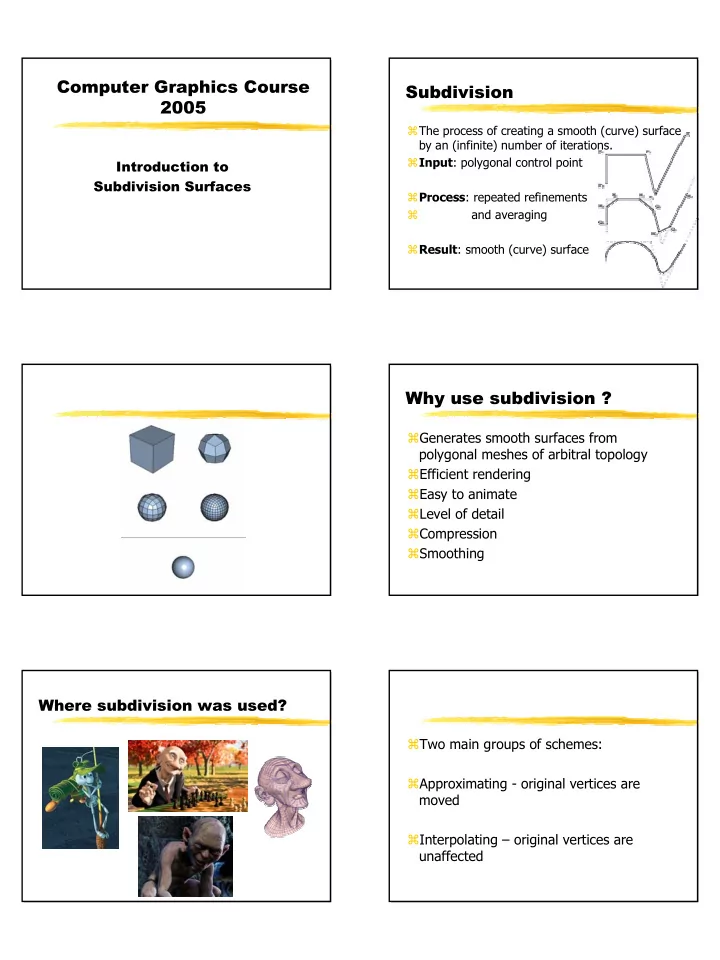
Subdivision

The process of creating a smooth (curve) surface by an (infinite) number of iterations. Input: polygonal control point Process: repeated refinements

  • and averaging

Result: smooth (curve) surface

Why use subdivision ?

Generates smooth surfaces from polygonal meshes of arbitral topology Efficient rendering Easy to animate Level of detail Compression Smoothing

Where subdivision was used?

Two main groups of schemes: Approximating - original vertices are moved Interpolating – original vertices are unaffected

slide-2
SLIDE 2

Corner Cutting Corner Cutting

1 : 3 3 : 1

Corner Cutting Corner Cutting Corner Cutting Corner Cutting

slide-3
SLIDE 3

Corner Cutting Corner Cutting Corner Cutting

The control polygon The limit curve

A control point

The 4-point scheme The 4-point scheme The 4-point scheme

1 : 1 1 : 1

slide-4
SLIDE 4

The 4-point scheme

1 : 8

The 4-point scheme The 4-point scheme The 4-point scheme The 4-point scheme The 4-point scheme

slide-5
SLIDE 5

The 4-point scheme The 4-point scheme The 4-point scheme The 4-point scheme The 4-point scheme The 4-point scheme

slide-6
SLIDE 6

The 4-point scheme

The control polygon The limit curve

A control point

Subdivision curves

Non interpolatory subdivision schemes

  • Corner Cutting

Interpolatory subdivision schemes

  • The 4-point scheme

Curve Subdivision

Given a control polygon, a subdivision curve is generated by repeatedly applying a subdivision operator to it. The central theoretical questions:

Convergence: Given a subdivision operator and a control polygon, does the subdivision process converge? Smoothness: Does the subdivision process converge to a smooth curve?

Surface Subdivision

Given a control net (polygonal mesh consisting

  • f vertices, faces and edges)

A sudivision surface is geterated by repeatedly

Refining the control net – increasing #vertices by factor ~4 Applying rules to find position of both new and old vertices

Subdivision Schemes

In the limit (after ∞ iterations) the control mesh converges to a limit surface Usually 2-3 good enough for CG Subdivision schemes characterized by

Topological refinement rules Rules for calculating position of new vertices

Triangular subdivision

Works only for control nets whose faces are triangular.

Every face is replaced by 4 new triangular faces. The are two kinds of new vertices:

  • Green vertices are associated with old edges
  • Red vertices are associated with old vertices.

Old vertices New vertices

slide-7
SLIDE 7

Loop’s scheme

3 3 1 1 1 1 1 1 1 ( ) ( )

n n n wn − + − =

2

2 cos 2 3 40 64 π

n - the vertex valency

A rule for new red vertices A rule for new green vertices Every new vertex is a weighted average of the old vertices. The list of weights is called the subdivision mask or the stencil.

n

w

The original control net After 1st iteration After 2nd iteration After 3rd iteration The limit surface

The limit surfaces of Loop’s subdivision have continuous curvature almost everywhere.

slide-8
SLIDE 8

The Butterfly scheme

This is an interpolatory scheme. The new red vertices inherit the location of the old vertices. The new green vertices are calculated by the following stencil:

  • 1
  • 1
  • 1
  • 1

8 8 2 2

The original control net After 1st iteration After 2nd iteration After 3rd iteration The limit surface

The limit surfaces of the Butterfly subdivision are smooth but are nowhere twice differentiable.

slide-9
SLIDE 9

Quadrilateral subdivision

Works for control nets of arbitrary topology. After one iteration, all the faces are quadrilateral.

Every face is replaced by quadrilateral faces. The are three kinds of new vertices:

  • Blue

Blue vertices are associated with old faces faces

  • Green vertices are associated with old edges
  • Red vertices are associated with old vertices.

Old vertices New vertices Old edge Old face

Catmull Clark’s scheme

1 1 1 1 1

First, all the yellow vertices are calculated

Step 1 1 1 1 1

Then the green vertices are calculated using the values

  • f the yellow vertices

Step 2

1 1 1 1 1 1 1 1 1

Finally, the red vertices are calculated using the values

  • f the yellow vertices

Step 3

) 2 ( − = n n wn n - the vertex valency 1

n

w

The original control net After 1st iteration After 2nd iteration After 3rd iteration
slide-10
SLIDE 10

The limit surface

The limit surfaces of Catmull-Clarks’s subdivision have continuous curvature almost everywhere.