Computer Vision Computer Vision How does vision work? What is - - PDF document

computer vision
SMART_READER_LITE
LIVE PREVIEW

Computer Vision Computer Vision How does vision work? What is - - PDF document

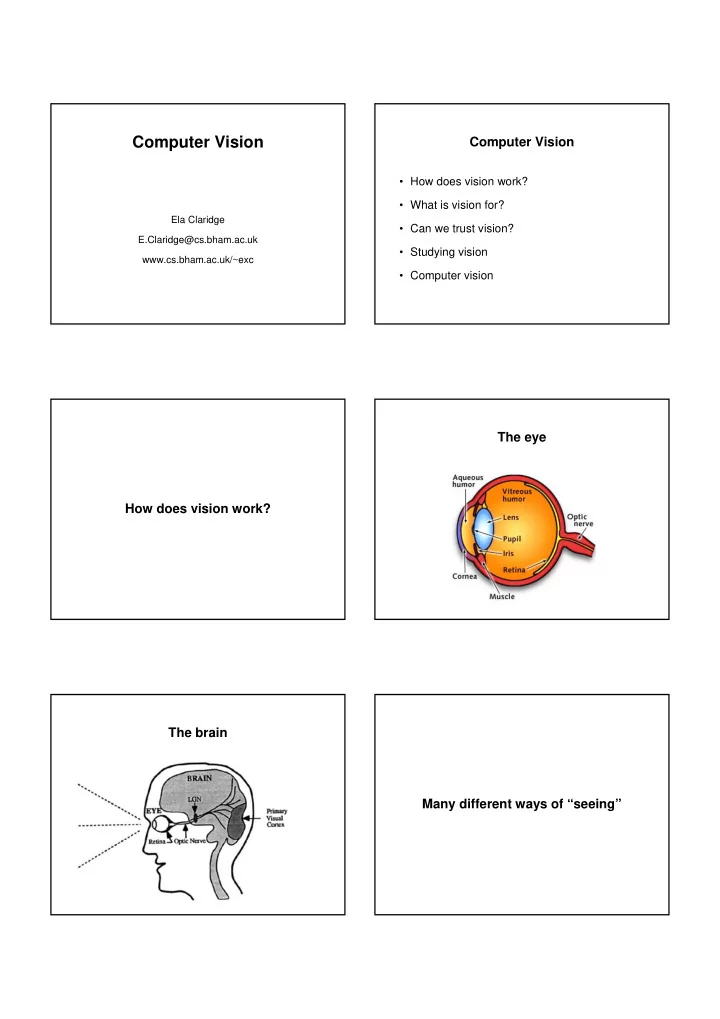
Computer Vision Computer Vision How does vision work? What is vision for? Ela Claridge Can we trust vision? E.Claridge@cs.bham.ac.uk Studying vision www.cs.bham.ac.uk/~exc Computer vision The eye How does vision work?


slide-1
SLIDE 1

Computer Vision

Ela Claridge E.Claridge@cs.bham.ac.uk www.cs.bham.ac.uk/~exc

Computer Vision

  • How does vision work?
  • What is vision for?
  • Can we trust vision?
  • Studying vision
  • Computer vision

How does vision work? The eye The brain Many different ways of “seeing”

slide-2
SLIDE 2

Perception?

How does vision work?

  • The eye

sensor based on light

  • Making use of the sensed data

interpretation internal representation

What is vision for?

slide-3
SLIDE 3

What is vision for?

  • for perceiving world of meaningful objects

and events

  • for tracking the objects and events
  • for gaining accurate spatial information for

moving about in the world and for manipulating it

slide-4
SLIDE 4

... also ...

  • for communicating
  • for conveying ideas
  • for perceiving moods
  • for achieving aesthetic satisfaction
  • .............

Can we trust vision?

slide-5
SLIDE 5

Can we trust vision?

Senses may deceive us

Can we trust vision?

Not all the knowledge comes from the image

Can computer vision help?

  • Solutions
  • Measure things
  • Develop image interpretation methods
slide-6
SLIDE 6

Sensor Internal representation Interpretation Action

Vision in action Vision as an intelligent process

  • To function in the world requires

– means of sensing of the external world to respond to changing environment and internal needs – means of interpretation of the sensed signal (goal oriented) – internal representation of the world, to aid the interpretation and goal formation

  • Sensor, internal representation, interpretation and

action are the generic components of any intelligent system, including an AI system

  • Vision has all the hallmarks of an intelligent process

Fischler & Firschein (1987) “Intelligence: The Eye, the Brain and the Computer”

Touch Taste Hearing Smell Etc ...

Visual sub- systems of various kinds Several databases Descriptions

  • f many

different kinds Cognition Control Memory

Aaron Sloman

Labyrinthine model of vision

What is vision?

“Vision is the extraction and analysis of information from an optical image in preparation for, and execution of, behaviour within the scene.”

R.Watt (1991) “Understanding Vision”: AP

Studying vision Studying vision

  • Neurophysiology (“wetware”)
  • Neurophysiology (relationships between “wetware”

and “software”)

  • Psychophysics / Cognitive Science(“software”)
  • Computer Science / Artificial Intelligence
slide-7
SLIDE 7

Studying vision

Neurophysiology

  • examines how visual processes are implemented in

the brain

  • helps to find how a particular function may be

implemented in the brain

Studying vision

Neuropsychology

  • tries to understand the visual impairments caused by

damage to specific areas of the brain

  • helps to identify functional units & interconnections

Studying vision

Psychophysics

  • investigation how different visual stimuli affect

performance

  • measuring the limits of the perception
  • helps to determine whether or not the algorithm is

used by the visual system

Studying vision

Cognitive Science & Computer vision

  • theories of vision may be explicitly formulated and

rigorously tested using computer models

Studying vision

Computer Science / Artificial Intelligence

  • Image processing (sensing)
  • Image analysis (interpretation)
  • Computer vision (sensing / interpretation / action)
  • Interdisciplinary work on vision modelling

– theories of vision may be explicitly formulated and rigorously tested using computer models

204 163 163 163 204 204 234 234 234 204 204 204 204 204 163 163 163 204 204 234 234 234 234 234 234 234 204 163 163 204 204 204 234 234 234 234 234 234 234 204 204 204 204 234 234 234 234 234 234 234 234 248 204 204 204 204 234 234 234 204 204 163 163 204 204 234 234 234 234 234 234 234 204 163 134 134 134 163 234 204 163 134 134 119 112 102 98 94 94 98 102 234 163 119 112 106 98 90 84 77 69 69 77 84 163 112 102 94 87 80 69 77 60 54 54 60 65 134 102 90 80 65 60 54 39 31 31 31 39 47 112 94 80 65 54 47 39 31 31 31 31 39 47 106 87 65 54 39 31 31 31 31 31 31 39 47 94 77 60 39 21 21 31 31 31 31 31 31 39

Digital image

Image processing

slide-8
SLIDE 8

Image processing

  • Basic image representation in a computer

2D array of pixels: Image[X, Y] Image value corresponds to image brightness: Image[x,y]=0 (dark) Image[x,y]=255 (bright) Arithmetic and logical operations on image pixels: New_image[x,y]=Image[x,y]-Image[x-1,y]

Image processing

  • Image enhancement
  • Finding boundaries of image objects
  • Shape outlining
  • Labelling of image objects
  • ...

Image interpretation

  • Object detection
  • Abnormality detection
  • Object tracking
  • Recognition
slide-9
SLIDE 9

Abnormality detection Object detection and tracking Speech recognition Gait recognition / object tracking

Computer vision

  • Navigation
  • Autonomous terrain exploration
  • Human – computer communication
  • Intelligent behaviour
  • Teamwork
  • . . .

2005 DARPA Grand Challenge After no vehicle could complete the DARPA 2004 autonomous vehicle race, the agency ran the race again, with a $2 million prize up for grabs. Twenty vehicles guided by GPS, lidar, radar, and cameras attempted the 132-mile desert course on October 8, 2005. Five made it to the finish line, proving the concept of a self-driving car.

http://news-service.stanford.edu/news/2005/october12/stanleyfinish-100905.html

slide-10
SLIDE 10

Autonomous vehicle navigation (Mars, 2004)

http://marsrovers.jpl.nasa.gov/gallery/video/animation.html

Kismet – an emotional robot

http://www.ai.mit.edu/projects/sociable/videos.html

Aibo

communicating and learning robot

Robot soccer

Many flavours of computer vision Many flavours of computer vision

  • Empirical

Finding out facts about natural systems

  • Explanatory

Trying to explain underlying mechanisms

slide-11
SLIDE 11

Many flavours of computer vision

  • Whole visual system

Autonomous motion Understanding text

  • Parts or partial

functions

Detecting edges Static images

Many flavours of computer vision

  • Fixed abilities
  • Modelling human

abilities

  • Algorithmic approaches
  • Learning
  • Going beyond human

abilities

  • Neural and symbolic

approaches

Further reading

  • Gregory LR (1997) “Eye and Brain”: OUP
  • Marr D (1982) “Vision”: Freeman
  • Fishler MA, Firschein O (1987) “Intelligence: the Eye, the Brain

and the Computer”: Addison Wesley

  • Bruce V, Green PR, Georgeson MA (2003) “Visual Perception:

Physiolgy, Psychology and Ecology”: PP

  • Sonka M, Hlavac V, Boyle R (1998) “Image Processing,

Analysis and Machine Vision” Chapman & Hall

http://homepages.inf.ed.ac.uk/rbf/CVonline/