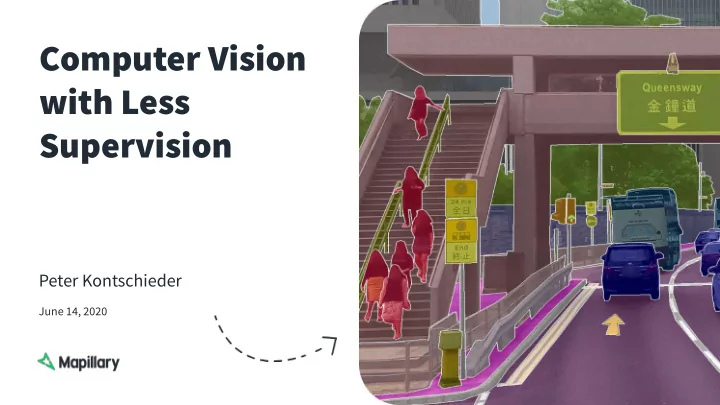
SLIDE 1 Computer Vision with Less Supervision
Peter Kontschieder
June 14, 2020
SLIDE 2
Mapillary is the street-level imagery platform that scales and automates mapping
SLIDE 3
Mapillary is a data platform!
SLIDE 4 Phone Action cam Dash Cam Pro Rig Vehicle Sensor
1b+ images, >10 million road km mapped
Anyone with Any Camera, Anywhere
SLIDE 5
Map data at scale from street-level imagery
SLIDE 6
The Mapillary Ecosystem
SLIDE 7 Schematic Data Lifecycle
3D RECONSTRUCTION OBJECT RECOGNITION MAP FEATURES CONTRIBUTOR NETWORK IMAGES
SLIDE 8
Strong Dependence on Recognition Algorithms
SLIDE 9
Research @ Mapillary
SLIDE 10
Meet the Team!
Peter Lorenzo Samuel Aleksander Andrea Arno Markus Manuel
SLIDE 11
Mapillary Data Playground
SLIDE 12
SLIDE 13
SLIDE 14
Selected projects in this talk: Single Image Depth Estimation Multi-Object Tracking and Segmentation
1.
SLIDE 15
Mapillary Planet Scale Depth Dataset (MPSD)
SLIDE 16
MPSD in a nutshell
A scalable way to create metrically accurate depth training data, suitable for real-world applications, and that is ➜ larger, more complex and has diverse environments from around the world ➜ comprising many camera types, focal lengths and distortion characteristics ➜ containing diverse data for weather, time of day, viewpoint, motion blur, ...
SLIDE 17
MPSD Data Selection Constraints
➜ Dense sampling available (at most 5m and <30° camera turning angle between frames) ➜ Cumulative trajectory of >70° for better constraining focal length ➜ Camera parameters are determined by iteratively running OpenSfM per sequence ➜ Same camera make, model, resolution and focal length data are assigned same parameters ➜ 10 reconstructions per camera before final set is hand-picked >70°
SLIDE 18
Geographic data distribution
➜ Sampling from regular grid (156 km²) ➜ 250 camera models in final dataset ➜ 750k images with depth training data
SLIDE 19 Obtaining metric scale and dense depth
➜ Cost term proportional to squared distance between (noisy) GPS and estimated camera positions removes scale ambiguity ➜ Remove outliers due to short sequences and compact reconstructions by filtering (two most distant, resulting camera positions ⩾ 20m) ➜ Run patch-match multi-view stereo [Shen, 2013], i.e. a winner-takes-all approach based on normalized cross-correlation on depth & normals for corresponding pixels in adjacent images
⩾ 20m
SLIDE 20 Filtering dense depth
➜ Patch-match stereo algorithm may contain spurious results ➜ Cleanup based on consistency checks among three neighboring images
Candidate image PatchMatch result Covisibility Final, cleaned depth
SLIDE 21 Dataset overview
Distributions of volume-normalized depth (m) for several datasets Comparison of available depth datasets with MPSD
SLIDE 22 Training with multiple cameras
➜ Learning to predict absolute depth from a highly heterogeneous set of cameras negatively affects performance and impacts generalization ➜ Focal length normalization with per-pixel consideration
focal length
- bject size in image plane [pix]
real object size [m]
SLIDE 23 We apply canonical camera model normalization and resize images by imposing
- Fixed focal length
- Square pixel sensor
- No radial distortion
Example: At a focal length of 720px, a real-world object with height 2m, the estimated depth is inversely proportional to the object size in the image. Network “only” needs to learn real-world sizes of objects!
Camera normalization
SLIDE 24 Experimental setup
➜ UNet architecture (ResNet-50 based) ➜ Dilation rates (1,1,2,4) and output stride x16 ➜ InPlace-ABN to reduce training memory footprint ➜ DeepLabV3 head (12, 24, 36 dilation rates) + global feature
- Upsampling to original input resolution in 3 stages
- Concatenated with size-matching features from encoder
- Skip-module (CONV+ACT)
➜ Final bilinear x2 upsampling ➜ Input size always fixed to 1216x352 @ batch size 64 (8 x V100, 32GB) ➜ Predicting log of focal-length normalized depth using Eigen-Loss
SLIDE 25
Experimental results
SLIDE 26 Prediction results on dynamic objects
Network trained on MPSD and tested on (previously unseen) KITTI data RMSE on KITTI validation
SLIDE 27
KITTI Depth prediction results
State-of-the-art on KITTI test data for 7 months!
SLIDE 28 Metric depth accuracy validation
Estimated least-square scale correction to describe depth scale bias for network exclusively trained on MPSD and tested on Cityscapes, KITTI, Make3D
1.03 1.01 0.89
SLIDE 29
Depth estimation in the wild
SLIDE 30
Learning Multi-Object Tracking and Segmentation from Automatic Annotations [CVPR 2020]
SLIDE 31
Overview
Joining multi-object tracking and instance segmentation brings mutual benefits, but ground truth data is rare and expensive to annotate Main contributions: ➜ Completely automated generation of multi-object tracking and segmentation (MOTS) annotations from street-level videos ➜ MOTSNet: a multi-object tracking and segmentation network using a novel “Mask-Pooling” layer to achieve SOTA results on multiple benchmarks
SLIDE 32 Automatic generation of MOTS annotations
➜ A Panoptic Segmentation network trained on Mapillary Vistas extracts object segmentations from the input videos ➜ An optical flow network trained on SfM-generated annotations predicts
- ptical flow on the input videos
➜ Detected objects are matched across frames by tracking their motion based
- n the predicted optical flow
No human intervention needed!
SLIDE 33
Why trust machine-generated segmentations
SLIDE 34
Optical Flow - Introduction
Camera and objects can move Apparent 2D motion of pixels in image pair
SLIDE 35
Comparison to Structure-from-Motion
Optical Flow ➜ Works with static cameras ➜ Establishes dense point-wise correspondences ➜ Usually from two consecutive images in a video (while there exist multi-frame methods) ➜ Can handle dynamic objects in scenes up to certain extent SfM ➜ Requires moving cameras ➜ Establishes sparse point-wise correspondences ➜ Usually based on multiple images ➜ Usually gets distracted by dynamic objects in scene
Complementary use cases!
SLIDE 36
Single-Slide Recap of Optical Flow
PWC-Net HD³ (Hierarchical Discrete Distribution Decomposition) FlowNet: Conventional Encoder + Decoder Stage
SLIDE 37
Training data for optical flow networks?
Cleaned covisibility maps can also be used to generate optical flow training data, i.e. we can exploit feature correspondences from multiple views to derive (sparse) flow data. Leads to pairs of images with sparse flow information from matched points!
SLIDE 38
Training data for tracking task?
Inductive generation of tracklets per object segment in frame segment in frame Payoff for linear assignment: Encodes additional constraints like matching of segment class labels, minimal overlap checks, IoU differences for largest and second-largest segments, etc.
SLIDE 39
MOTSNet
➜ Mask R-CNN based architecture with an additional Tracking Head (TH) ➜ The TH maps detected objects to a learned embedding space for tracking
SLIDE 40
Tracking Head and Mask Pooling
➜ Pool features under the instance segmentation masks ➜ Process with FC layers to compute embedding vectors ➜ Compare embedding vectors across frames to match objects
SLIDE 41
Training and Inference
➜ Tracking-head optimization based on hard triplet loss [Hermans et al., 2017], learning to generate object-specific embedding vectors that are similar for matching and dissimilar for non-matching objects. ➜ Inference based on embeddings, but similar to training tracklet generation
SLIDE 42 Experimental Setup
Evaluation on KITTI MOTS, MOTSChallenge (MOTS ground truth available)
[Voigtländer et al., CVPR 2019] and BDD100k tracking data (bounding box tracking
information available) ResNet-50 backbone in all our experiments Evaluation on KITTI MOTS:
- Quality assessment of dataset generation (KITTI Synth)
- MOTSNet ablation and evaluation
SLIDE 43 KITTI Synth Experiments
Generated training data from KITTI Raw (142 sequences, excluding validation set
- f KITTI MOTS), yields 1.25M object segments in ~44k images
SLIDE 44
Results on KITTI MOTS validation data
SLIDE 45
Results on MOTSChallenge
SLIDE 46
Results on KITTI MOTS / BDD100k
SLIDE 47
More Results
SLIDE 48 Drop by our virtual presentation at Poster Session 2.2 for more information!
Date: Wednesday, June 17 & Thursday, June 18 2020 Q&A Time: 1200–1400 and 0000–0200 Session: Poster 2.2 — Face, Gesture, and Body Pose; Motion and Tracking; Representation Learning Presentation times 12:00 and 00:00 (Pacific Time Zone [Seattle time]) ID 5452
SLIDE 49 Summary
➜ Using less supervision, we obtain state-of-the-art results for
- Single-Image depth estimation
- Multi-object tracking and segmentation
➜ Mapillary-scale data for learning single-image depth estimation, extracted from multiple cameras and all around the globe, using SfM ➜ SOTA recognition algorithms for automatically mining training data is beneficial for MOTS. Even possible to outperform methods based on manually annotated data
SLIDE 50
Let’s create something amazing together!
@mapillary