Consistency The syntactic counterpart of satisfiability is - - PowerPoint PPT Presentation

consistency
SMART_READER_LITE
LIVE PREVIEW

Consistency The syntactic counterpart of satisfiability is - - PowerPoint PPT Presentation

Computational Logic, Spring 2006 Pete Manolios Consistency The syntactic counterpart of satisfiability is consistency. Definition 1 is consistent, written Con , iff there is no formula such that and . is


slide-1
SLIDE 1

Computational Logic, Spring 2006 Pete Manolios

Consistency

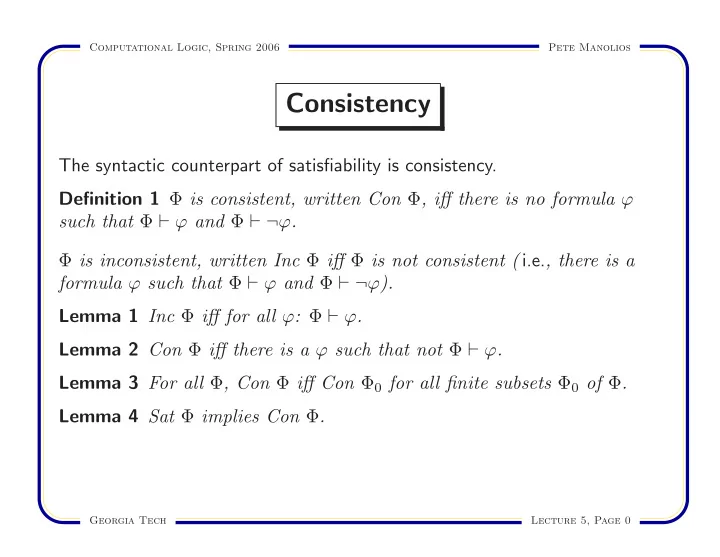
The syntactic counterpart of satisfiability is consistency. Definition 1 Φ is consistent, written Con Φ, iff there is no formula ϕ such that Φ ⊢ ϕ and Φ ⊢ ¬ϕ. Φ is inconsistent, written Inc Φ iff Φ is not consistent ( i.e., there is a formula ϕ such that Φ ⊢ ϕ and Φ ⊢ ¬ϕ). Lemma 1 Inc Φ iff for all ϕ: Φ ⊢ ϕ. Lemma 2 Con Φ iff there is a ϕ such that not Φ ⊢ ϕ. Lemma 3 For all Φ, Con Φ iff Con Φ0 for all finite subsets Φ0 of Φ. Lemma 4 Sat Φ implies Con Φ.

Georgia Tech Lecture 5, Page 0

slide-2
SLIDE 2

Computational Logic, Spring 2006 Pete Manolios

Consistency

Lemma 5 For all Φ and ϕ the following holds:

  • 1. Φ ⊢ ϕ iff Inc Φ ∪ {¬ϕ}.
  • 2. Φ ⊢ ¬ϕ iff Inc Φ ∪ {ϕ}.
  • 3. If Con Φ, then Con Φ ∪ {ϕ} or Con Φ ∪ {¬ϕ}.

We have assumed a fixed symbol set S. When we need to consider several symbol sets simultaneously, we will use Φ ⊢S ϕ to indicate that that there is a derivation with underlying symbol set S. Similarly ConS Φ denotes Con Φ with underlying symbol set S. Lemma 6 For all i ∈ ω, Si is a symbol set and Si ⊆ Si+1. Similarly for all i ∈ ω, Φi is a set of Si-formulas such that ConSi Φi and Φi ⊆ Φi+1. Let S = ∪i∈ωSi and Φ = ∪i∈ωΦi. Then ConS Φ.

Georgia Tech Lecture 5, Page 1

slide-3
SLIDE 3

Computational Logic, Spring 2006 Pete Manolios

Completeness Theorem

To show: For all Φ and ϕ: If Φ | = ϕ then Φ ⊢ ϕ. We will instead show: Every consistent set of formulas is satisfiable. Proof not Φ ⊢ ϕ implies not Φ | = ϕ ≡ { Lemma 5 } Con Φ ∪ {¬ϕ} implies Sat Φ ∪ {¬ϕ} ⇐ { Instance of } Con Ψ implies Sat Ψ

Georgia Tech Lecture 5, Page 2

slide-4
SLIDE 4

Computational Logic, Spring 2006 Pete Manolios

The Idea of Henkin’s Theorem

If Φ is consistent, then we use the syntactical info that this provides to find a model J = U, β of Φ. If A is T S and β(vi) = vi, f U(t) = ft, ..., then for variable x we have J (fx) = f U(β.x) = fx, so J (fv0) = J (fv1), but what if fv0 ≡ fv1 ∈ Φ? To overcome this, we define an equivalence relation

  • n terms.

First, we define an equivalence relation on T S: t1 ∼ t2 iff Φ ⊢ t1 ≡ t2. Lemma 7

  • 1. ∼ is an equivalence relation.
  • 2. If t1 ∼ t′

1, . . . , tn ∼ t′ n then for n-ary f ∈ S: ft1 . . . tn ∼ ft′ 1 . . . t′ n

and for n-ary R ∈ S: Φ ⊢ Rt1 . . . tn iff Φ ⊢ Rt′

1 . . . t′ n.

Let t = {t′ ∈ T S : t ∼ t′}, i.e., t is the equivalence class of t.

Georgia Tech Lecture 5, Page 3

slide-5
SLIDE 5

Computational Logic, Spring 2006 Pete Manolios

Term Structure

Let T Φ be the set of equivalence classes: T Φ = {t : t ∈ T S}. Note that T Φ is not empty. We now define the term structure over T Φ, T Φ as follows.

  • 1. cT Φ = c
  • 2. f T Φ(t1, . . . , tn) = ft1 . . . tn
  • 3. RT Φt1 . . . tn iff Φ ⊢ Rt1 . . . tn

Note that by Lemma 7, the definitions of f T Φ and RT Φ make sense.

Georgia Tech Lecture 5, Page 4

slide-6
SLIDE 6

Computational Logic, Spring 2006 Pete Manolios

Term Interpretation

We define the term interpretation associated with Φ to be J Φ = T Φ, βΦ, where βΦ(x) = x. Lemma 8

  • 1. For all t, J Φ(t) = t.
  • 2. For every atomic formula ϕ, J Φ |

= ϕ iff Φ ⊢ ϕ.

  • 3. For every formula ϕ and pairwise disjoint variables x1, . . . , xn

(a) J ϕ | = ∃x1 . . . ∃xnϕ iff there are t1, . . . , tn ∈ T S s.t. J Φ | = ϕ t1...tn

x1...xn.

(b) J ϕ | = ∀x1 . . . ∀xnϕ iff for all t1, . . . , tn ∈ T S we have J Φ | = ϕ t1...tn

x1...xn.

By the previous lemma J Φ is a model of the atomic formulas in Φ, but we do not know that it is a model of all formulas in Φ. In fact, it isn’t. Why?

Georgia Tech Lecture 5, Page 5

slide-7
SLIDE 7

Computational Logic, Spring 2006 Pete Manolios

Closure Conditions

Definition 2 Φ is negation complete iff for every formula ϕ, Φ ⊢ ϕ or Φ ⊢ ¬ϕ. Φ contains witnesses iff for every formula of the form ∃xϕ, there is a term t such that Φ ⊢ (∃xϕ → ϕ t

x).

Lemma 9 If Φ is consistent, negation complete, and contains witnesses, then for all ϕ and ψ.

  • 1. Φ ⊢ ¬ϕ iff not Φ ⊢ ϕ
  • 2. Φ ⊢ (ϕ ∨ ψ) iff Φ ⊢ ϕ or Φ ⊢ ψ
  • 3. Φ ⊢ ∃xϕ iff there is a term t s.t. Φ ⊢ ϕ t

x

Georgia Tech Lecture 5, Page 6

slide-8
SLIDE 8

Computational Logic, Spring 2006 Pete Manolios

Henkin’s Theorem

Theorem 1 (Henkin’s Theorem) If Φ is consistent, negation complete, and contains witnesses, then for all ϕ, J Φ | = ϕ iff Φ ⊢ ϕ. What we can do now is to show that and consistent set of formulas can be extended to one that is consistent, negation complete, and contains

  • witnesses. Then, from Henkin’s theorem we get the completeness theorem.

Theorem 2 (a) Φ | = ϕ iff there is a finite Φ0 ⊆ Φ such that Φ0 | = ϕ. (b) Sat Φ iff for all finite Φ0 ⊆ Φ, Sat Φ0. In addition, given that the term interpretation is a model of a set of formulas and that the size of the term interpretation is bound by the size of T S, we have the L¨

  • wenheim-Skolem theorem.

Theorem 3 Every satisfiable and at most countable set of formulas is satisfiable over a domain which is at most countable.

Georgia Tech Lecture 5, Page 7