Context Awareness for Internet of Things (CA4IOT) Charith Perera, - - PowerPoint PPT Presentation

context awareness for internet of things ca4iot
SMART_READER_LITE
LIVE PREVIEW

Context Awareness for Internet of Things (CA4IOT) Charith Perera, - - PowerPoint PPT Presentation

Context Awareness for Internet of Things (CA4IOT) Charith Perera, Arkady Zaslavsky, Peter Christen, Dimitrios Georgakopoulos November 2012 SEMANTIC DATA MANAGEMENT / INFORMATION ENGINEERING LAB Agenda Background Research Challenges and


slide-1
SLIDE 1

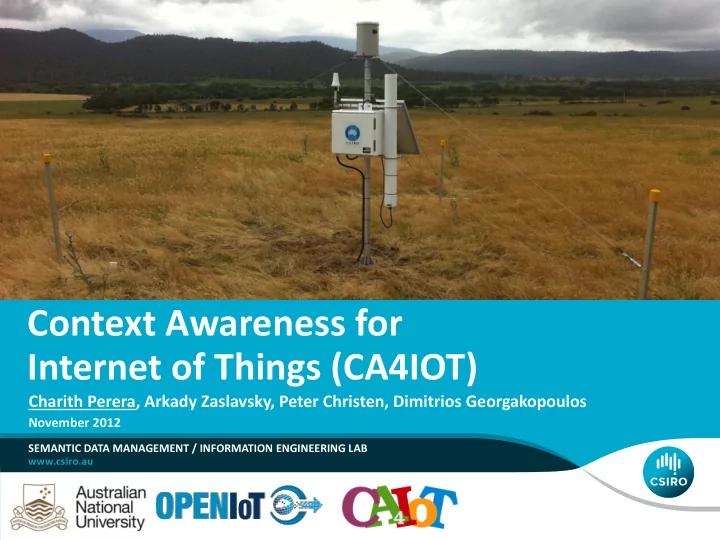
Context Awareness for Internet of Things (CA4IOT)

SEMANTIC DATA MANAGEMENT / INFORMATION ENGINEERING LAB

Charith Perera, Arkady Zaslavsky, Peter Christen, Dimitrios Georgakopoulos

November 2012
slide-2
SLIDE 2

Agenda

  • Background
  • Research Challenges and Motivations
  • Our Objectives and Functional Requirements
  • Proposed Solution: CA4IOT Architecture
  • Real world Scenario
  • Future Work and Research Directions
slide-3
SLIDE 3

Statistics and Predictions

  • n Internet of Things
slide-4
SLIDE 4

2020 2015 2010 2003 By 2020 there will be 50 billion things During 2008, the number of things connected to the Internet exceeds the number of people on earth

  • 1.5 billion Internet-enabled PCs and over 1 billion Internet-

enabled mobile phones today.

  • By 2020, there will be 50 to 100 billion devices (i.e. things, sensors,

smart objects) connected to the Internet (Source: [1])

  • The global market for sensors was around $56.3 billion in 2010,

$62.8 billion in 2011, expected to increase to $91.5 billion by 2016, at a compound annual growth rate of 7.8%. (Source:[5])

(Source: [2])

Slide 4 of 23

slide-5
SLIDE 5

Conclusions based on Statistics and Predictions

  • Massive amount of data will be generated by sensors.
  • Big Data = Volume + Velocity + Variety (Source: [6])
  • It is not be feasible to collect and process all the sensor

data generated by the sensors

  • Resource limitations: processing, storage,

communication

  • Cost involvement: related to resources and related

data ownership

  • We should collect data only from selected number of

sensors that will help us to achieve our objectives

Slide 5 of 23

slide-6
SLIDE 6
  • Select appropriate sensors when large number of

sensors are available to …

  • Decide what information to consider when selecting

the appropriate sensors; Context matters…

  • Cannot make assumptions during the development

time in IoT paradigm. Dynamic, configurable at runtime is a must…

Main Challenges

Slide 6 of 23

slide-7
SLIDE 7

Trends in IoT Middleware and Context Awareness

slide-8
SLIDE 8
  • More and more sensor network/IoT middleware

solutions are available

  • OpenIoT (next generation of GSN + Aspire) [http://www.openiot.eu/]
  • SenseMA (improved functionalities on top of the OpenIoT and GSN)
  • Context awareness is lacking in most IoT middleware
  • Lack of dynamic configuration, semantic Interactions,

scalable fusion capabilities

  • Critical functionalities (EU recommendation):
  • Adaptation of sensor ontologies
  • Distributed registries
  • Sensor searching and discovery
  • Reasoning and knowledge

discovery

  • Context aware data processing
  • Automated sensor configuration

Slide 8 of 23

slide-9
SLIDE 9
  • Two main Categories: Conceptual and Operational
  • Operational categorization schemes allow us to

understand the issues and challenges in data acquisition techniques, as well as quality and cost factors related to context.

  • Conceptual categorization allows an understanding of

the conceptual relationships between context

  • We need to capture and model context comprehensively

by in cooperating all different aspects mentioned above

Conclusions based on Literature Review

Slide 9 of 23

slide-10
SLIDE 10

The Research challenges and Motivations

slide-11
SLIDE 11
  • How to help the users to select appropriate sensors when large

number of sensors are available to use…?

  • How to reduce the gap between what user needs and what low

level sensors can provide by understanding the user requirements /problems?

  • How context (information) can help to

select the sensors…? Specially when alternative sensors (e.g. multiple sensors

produce same kind of data) with different

characteristics (e.g. energy consumption,

accuracy, quality) are available…

  • How to connect and configure sensors

and programming components dynamically on demand…?

Slide 11 of 23

slide-12
SLIDE 12

Our Objective and Functional Requirements

Slide 12 of 23

slide-13
SLIDE 13
  • Our objective is not to introduce another middleware Our objective

is to explore the possibilities of embedding (applying) context-aware functionalities into IoT middleware solutions

  • Our goal is to design an solution to help users to automating the

task of selecting the sensors according to the problems at hand.

  • We DO NOT answer user queries
slide-14
SLIDE 14
  • Connect and configure sensors to an IoT middleware

easily, dynamically and on demand.

  • Capture context and understand the user requirement
  • Reduce the gap between high-level user requirements

and low-level sensors capabilities.

  • Model and maintain context (information) about

sensors

  • Model and maintain context (information) about

processing components

Functional Requirements

Slide 14 of 23

slide-15
SLIDE 15

Real World Scenario

The Australian Plant Phenomics Facility

slide-16
SLIDE 16

Australian Agriculture

  • Agricultural research obtains $AUS1.2 billion per annum
  • Fourth largest wheat and barley exporter after US, Canada

and EU

  • BUT has to deal with scarcity of resources:
  • Water quality and quantity
  • Low soil fertility

Slide 16 of 23

slide-17
SLIDE 17
  • Grains Research and Development Corporation (GRDC)

trials plant varieties in very many 10m x 10m plots across Australia.

  • Every year, Australian grain breeders plant up to 1 million

plots across the country to find the best high yielding

  • Information sources about plant variety performance:
  • Site visits
  • Australian Bureau of Meteorology
  • Issues in current practices:
  • Site visits are expensive and time-consuming (e.g., 400km away)
  • Lack of accurate information limits the quality of results

Slide 17 of 23

slide-18
SLIDE 18

Why context knowledge matters?

  • Monitoring/Sensing strategies (data collection frequency, real-

time event detection, data archiving for pattern recognition, etc.) need

to be changed depending on the time of the day, time of the year, phase of the growing plant, type of the crop, energy efficiency and availability, sensor data accuracy, etc…

Need to be considered in developing a solution:

  • Agricultural/biological scientists and engineers do not know

much about computer science.

  • Users focus on what they want
  • Learning curve, usability, processing time, dynamicity of

sensors…

Slide 18 of 23

slide-19
SLIDE 19

Phenonet: A Distributed Sensor Network for Phenomics

  • Aim is to Improve yield by improving crop selection process. How?
  • Sensor-based monitoring and Sophisticated data analysis
  • Combined research effort from CSIRO’s ICT Centre and High

Resolution Plant Phenomics Centre

Slide 19 of 23

slide-20
SLIDE 20

Use case

  • Let’s consider a scenario: John, a plant scientist, who is looking after

a experimental crops growing facility, wants to know whether the crops are infected by Phytophtora disease.

  • Phytophtora [8] is a fungal disease which can enter a field through a

variety of sources. Humidity plays a major role in the development

  • f Phytophtora. Both temperature and whether or not the leaves

are wet are also important indicators to monitor Phytophtora.

The values used for demonstration purposes only

Slide 20 of 23

slide-21
SLIDE 21

Animated Figure

“…I want to know whether experimental plants in Canberra have infected with Phytophtora disease…”

Phytophtora disease airTemperature airHumidity leafWetness airStress

S1 S2 S3 S4 S5 Sn

Slide 21 of 23

slide-22
SLIDE 22

Future Work and Research Directions

slide-23
SLIDE 23
  • Understand user requirements
  • Extract knowledge from large knowledge bases and build simple context

registries that maps sensor measurements into context

  • Sensor description modelling, storage and reasoning (e.g. SSNO)
  • Efficient and scalable mapping between context and sensor

measurements

  • Context discovery by data fusion
  • Developing models that allows to describe programming components
  • Plugin architecture to different data fusion operations and context

discovery

  • Adaptation of OSGi component based model
  • Sensor selection based on characteristics
  • Probabilistic Vs. Semantic

Slide 23 of 23

slide-24
SLIDE 24

CSIRO ICT Center Information Engineering Laboratory Charith Perera PhD Student t +61 2 6216 7135 e Charith.Perera@csiro.au w www.csiro.au/charith.perera

SEMANTIC DATA MANAGEMENT / INFORMATION ENGINEERING LAB

Thank You!

slide-25
SLIDE 25

1.

  • H. Sundmaeker, P. Guillemin, P. Friess, and S. Woelffle, “Vision and challenges for realising the internet
  • f things,” European Commission Information Society and Media, Tech. Rep., March 2010,

http://www.internet-of-things-research.eu/pdf/IoT Clusterbook March 2010.pdf 2. International Data Corporation (IDC) Corporate USA, “Worldwide smart connected device shipments,” March 2012, http://www.idc.com/getdoc.jsp?containerId=prUS23398412 [Accessed on: 2012-08-01]. 3.

  • J. Gantz, “The embedded internet: Methodology and findings,” IDC Corporate, Tech. Rep., September

2009, http://download.intel.com/embedded/15billion/applications/pdf/322202.pdf [Accessed on: 2012-03-08]. 4.

  • J. Manyika, M. Chui, B. Brown, J. Bughin, R. Dobbs, C. Roxburgh, and A. H. Byers, “Big data: The next

frontier for innovation, competition, and productivity,” McKinsey Global Institute, Tech. Rep., May 2011, http://www.mckinsey.com/Insights/MGI/Research/Technology_and_Innovation/Big_data_The_next_fr

  • ntier_for_innovation [Accessed on: 2012-06-08].

5. BCC Research, “Sensors: Technologies and global markets,” BCC Research, Market Forecasting, March 2011, http://www.bccresearch.com/report/sensors-technologies-markets-ias006d.html [Accessed

  • n:2012-01-05].

6.

  • A. Zaslavsky, C. Perera, and D. Georgakopoulos, “Sensing as a service and big data,” in International

Conference on Advances in Cloud Computing (ACC-2012), Bangalore, India, July 2012. 7.

  • S. Bandyopadhyay, M. Sengupta, S. Maiti, and S. Dutta, “Role of middleware for internet of things: A

study,” International Journal of Computer Science and Engineering Survey, vol. 2, pp. 94–105, 2011. [Online]. Available: http://airccse.org/journal/ijcses/papers/0811cses07.pdf 8.

  • A. Baggio, “Wireless sensor networks in precision agriculture,” Delft University of Technology The

Netherlands, Tech. Rep., 2009, http://www.sics.se/realwsn05/papers/baggio05wireless.pdf [Accessed

  • n: 2012-05-10].

References

slide-26
SLIDE 26

Appendix

slide-27
SLIDE 27

2020 2015 2010 2003 By 2020 there will be 50 billion things During 2008, the number of things connected to the Internet exceeds the number of people on earth

(Source: [2]) (Source: [3]) (Source: [4])

slide-28
SLIDE 28

Non Animated Figure