
SLIDE 1
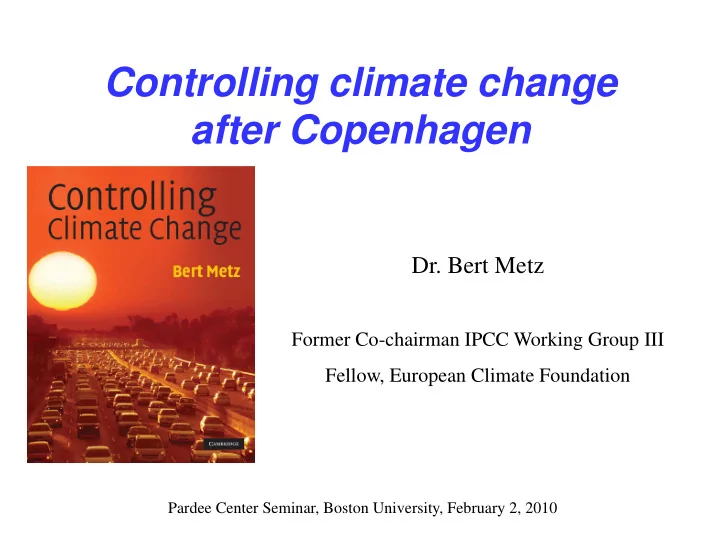
Controlling climate change after Copenhagen
- Dr. Bert Metz
Former Co-chairman IPCC Working Group III Fellow, European Climate Foundation
Pardee Center Seminar, Boston University, February 2, 2010
Controlling climate change after Copenhagen Dr. Bert Metz Former - - PowerPoint PPT Presentation
Controlling climate change after Copenhagen Dr. Bert Metz Former Co-chairman IPCC Working Group III Fellow, European Climate Foundation Pardee Center Seminar, Boston University, February 2, 2010 Copenhagen Inability to conclude 2 year
Former Co-chairman IPCC Working Group III Fellow, European Climate Foundation
Pardee Center Seminar, Boston University, February 2, 2010
Controlling Climate Change 2
3
In But Consequence Recognising 2 degree limit
commitments to get there;
get in far below top end We are on track to 3-4 degrees; chances of staying below 2 degrees virtually zero Review in 2015 with option to tighten global limit to 1.5 degrees No strengthening of 2020 reduction commitments This is lip service to vulnerable countries; has no practical impact; does not increase chance to stay below 2 degrees Annex I countries to list their 2020 targets and non-Annex-I PART of their actions by Feb 1, 2010
“developing”(as in Bali Action Plan) disappeared;
uniform; nothing about surplus AAU;
much they do
countries” impossible;
targets;
reductions
Controlling Climate Change
4
In But Consequence Stressing importance of adaptation and provide about half of $30 billion in support 2010-2012 Money likely to be at least partly relabelled ODA Vulnerable countries are getting financial support, while climate change impacts are getting much worse “we support the goal to mobilise $100 billion by 2020 “; public and private money
deliver this money;
generate funding;
to manage effective disbursement Unclear if there ever will be significant money Copenhagen Climate Fund established
fund
(only Panel to study resources) Unclear if fund will ever be
5
In But Consequence Establish a REDD + mechanism” Nothing established and no process to establish it; no rules Fast start money will partly flow to countries to avoid deforestation; rest unclear Establish a technology mechanism No details Negotiations aiming at administrative approach No effective mechanism to promote technology transfer Develop market approaches Nothing about reforming carbon market No hard caps> no market? No agreement on CDM reform International carbon market uncertain “provide incentives to developing countries to continue on a low emissions path” Nothing about Low Carbon Growth Plans No impact on producing low carbon development plans
6
In But Consequence
Decision to continue AWG-LCA and request to deliver outcome by COP16 No statement on legally binding outcome; no process decisions; vague paragapah on Mexico mandate Totally unclear if there will be serious negotiating process (also in light of acrymoneous debates in CPH) Decision to continue AWG-KP and request to deliver outcome at COP16 Demands of EU, Japan, Russia , Australia to have legally binding
from LCA ignored; vague paragapah on Mexico mandate Kyoto Annex B countries may never agree with KP amendment or never ratify
Controlling Climate Change
Controlling Climate Change 7
From Schneider, S., Nature, vol 458, April 30 2009, p 1104-1105
8 Controlling Climate Change
From Schneider, S., Nature, vol 458, April 30 2009, p 1104-1105
9 Controlling Climate Change
00
Equilibrium global mean temperature increase over preindustrial (°C) GHG concentration stabilization level (ppmv CO2-eq)
00
Equilibrium global mean temperature increase over preindustrial (°C) GHG concentration stabilization level (ppmv CO2-eq)
5 10 15 20 25 30 35
2000 2010 2020 2030 2040 2050 2060 2070 2080 2090 2100
Wold CO2 Emissions (GtC)
E: 850-1130 ppm CO2-eq D: 710-850 ppm CO2-eq C: 590-710 ppm CO2-eq B: 535-590 ppm CO2-eq A2: 490-535 ppm CO2-eq A1: 445-490 ppm CO2-eq
Stabilization targets: Post-SRES (max) Post-SRES (min)
5 10 15 20 25 30 35
2000 2010 2020 2030 2040 2050 2060 2070 2080 2090 2100
Wold CO2 Emissions (GtC)
E: 850-1130 ppm CO2-eq D: 710-850 ppm CO2-eq C: 590-710 ppm CO2-eq B: 535-590 ppm CO2-eq A2: 490-535 ppm CO2-eq A1: 445-490 ppm CO2-eq
Stabilization targets: Post-SRES (max) Post-SRES (min)
Stababilization level (ppm CO2-eq) Global Mean temperature increase at equilibrium (ºC) Year global CO2 needs to peak Year global CO2 emissions back at 2000 level Reduction in 2050 global CO2 emissions compared to 2000
445 – 490 2.0 – 2.4 2000 - 2015 2000- 2030
490 – 535 2.4 – 2.8 2000 - 2020 2000- 2040
535 – 590 2.8 – 3.2 2010 - 2030 2020- 2060
590 – 710 3.2 – 4.0 2020 - 2060 2050- 2100 +10 to +60 710 – 855 4.0 – 4.9 2050 - 2080 +25 to +85 855 – 1130 4.9 – 6.1 2060 - 2090 +90 to +140
55 50 45 40 10 65 60 44 61
Global GHG emissions Gt CO2e per year
Reference path-way "Business as Usual" 450 ppm pathway (with overshoot) Low case of current proposals* High case of current proposals*
54 49
* E.g., 20% vs. 30% below 1990 emissions in the EU – taking into account the effect of the recession and lower expected emissions from deforestation and peat Source: McKinsey Global GHG Abatement Cost Curve v2.0; Houghton; IEA; US EPA; den Elzen, van Vuuren; Project Catalyst analysis
12
Expected temperature increase
3.0˚C 2.0˚C 1.8˚C
Probability
temperature increase under 2˚C
15-30% 40-60% 70-85%
Source: IPCC WG3 AR4; den Elzen, van Vuuren; Meinshausen; McKinsey Global GHG Abatement Cost Curve v2.0; Project Catalyst analysis
Global GHG emissions and pathways for GHG stability Gt CO2e, 2020
Peak at 550 ppm, long-term stabilization 550 ppm Peak at 510 ppm, long-term stabilization 450 ppm Peak at 480 ppm, long-term stabilization 400 ppm
13
Scenario category Region 2020 2050 A-450 ppm CO2 –eq2) Annex I
Non-Annex I 15-30% deviation from baseline in Latin America, Middle East, East Asia Substantial deviation from baseline in all regions B-550 ppm CO2 -eq Annex I
Non-Annex I Deviation from baseline in Latin America and Middle East, East Asia Deviation from baseline in most regions, especially in Latin America and Middle East C-650 ppm CO2 -eq Annex I 0% to -25%
Non-Annex I Baseline Deviation from baseline in Latin America and Middle East, East Asia
IPCC, AR4, den Elzen and Hoehne, 2008
14 Controlling Climate Change
Controlling Climate Change 15
16 Controlling Climate Change
Development path with HIGH base emissions Development path with LOW emissions
17 Controlling Climate Change
Climate- compatible development Climate- resilient development
for eradicating poverty
undermine development
resilient development (“climate compatible development”) as the answer
Source: Project Catalyst
18 Controlling Climate Change
19 Controlling Climate Change
20 Controlling Climate Change
21 Controlling Climate Change
– Renewable Energy Law and the Tenth Five-Year Plan: reduce electricity sector emissions by 5 % below BAU in 2020 – Medium and Long Term Energy Conservation Plan:
– Fuel efficiency standards for passenger cars, SUVs, and multi-purpose vans: reduce transportation sector emissions by 5% below BAU levels in 2020
– Program for Incentive of Alternative Electric Energy Sources (PROINFA): reduce electricity sector emissions by 14 % below BAU levels in 2020 – Brazil’s ethanol program (flex fuel vehicles and cost competitive ethanol): reduce transportation emissions by 18 % below BAU levels in 2020 – No net forest cover loss by 2015 – GHG emissions 20% below 2005 by 2020
Source: CCAP, 2006
22 Controlling Climate Change
– Reduce transportation sector emissions by up to 15 % below BAU levels in 2020 – 20 MW solar PV capacity by 2020
– National Green Growth Plan – GHG emissions 4% below 2005 by 2020
– National long term climate change strategy – GHG emissions 34% below BAU by 2020 and peaking between 2020-2025 (conditional)
– GHG emission 26% below BAU by 2020 – 0.5Mha/yr tree planting; 0.3 Mha/yr forest rehabilitation and stop illegal deforestation
– GHG emissions 80-95% below 1990 by 2050
– GHG emissions 80% below 1990 by 2050
Source: CCAP, 2006
Controlling Climate Change 24
25
Power has shifted UNFCCC process ineffective US domestic politics EU lacked vision
(blocks one new Protocol)
entire 2 year process; chairs did not force a clash earlier
for money
positions
climate law forces China into defensive attitude (no commitments, no verification)
keeping long-term finance till concessions of G77)
26 Controlling Climate Change
http://www.cup.cam.ac.uk/catalogue/catalogue.asp?isbn=9780521747844