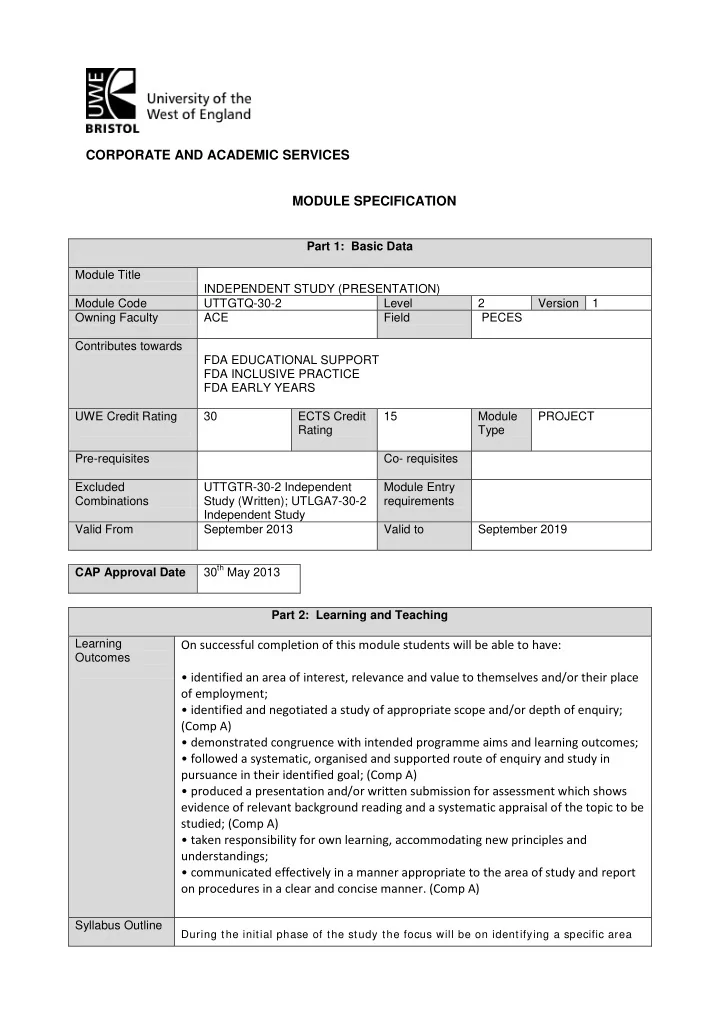
CORPORATE AND ACADEMIC SERVICES MODULE SPECIFICATION Part 1: Basic - - PDF document

corporate and academic services module specification
SMART_READER_LITE
LIVE PREVIEW

CORPORATE AND ACADEMIC SERVICES MODULE SPECIFICATION Part 1: Basic - - PDF document

CORPORATE AND ACADEMIC SERVICES MODULE SPECIFICATION Part 1: Basic Data Module Title INDEPENDENT STUDY (PRESENTATION) Module Code UTTGTQ-30-2 Level 2 Version 1 Owning Faculty ACE Field PECES Contributes towards FDA EDUCATIONAL


slide-1
SLIDE 1

CORPORATE AND ACADEMIC SERVICES MODULE SPECIFICATION

Part 1: Basic Data Module Title INDEPENDENT STUDY (PRESENTATION) Module Code UTTGTQ-30-2 Level 2 Version 1 Owning Faculty ACE Field PECES Contributes towards FDA EDUCATIONAL SUPPORT FDA INCLUSIVE PRACTICE FDA EARLY YEARS UWE Credit Rating 30 ECTS Credit Rating 15 Module Type PROJECT Pre-requisites Co- requisites Excluded Combinations UTTGTR-30-2 Independent Study (Written); UTLGA7-30-2 Independent Study Module Entry requirements Valid From September 2013 Valid to September 2019 CAP Approval Date 30th May 2013 Part 2: Learning and Teaching Learning Outcomes

On successful completion of this module students will be able to have:

  • identified an area of interest, relevance and value to themselves and/or their place
  • f employment;
  • identified and negotiated a study of appropriate scope and/or depth of enquiry;

(Comp A)

  • demonstrated congruence with intended programme aims and learning outcomes;
  • followed a systematic, organised and supported route of enquiry and study in

pursuance in their identified goal; (Comp A)

  • produced a presentation and/or written submission for assessment which shows

evidence of relevant background reading and a systematic appraisal of the topic to be studied; (Comp A)

  • taken responsibility for own learning, accommodating new principles and

understandings;

  • communicated effectively in a manner appropriate to the area of study and report
  • n procedures in a clear and concise manner. (Comp A)

Syllabus Outline

During the initial phase of the study the focus will be on identifying a specific area

slide-2
SLIDE 2

and developing a plan, strategy and study programme relevant to the chosen area. Students will embark on a search of relevant literature with tutorial support. The module will then develop into central investigative activities with tutorial support. The module will culminate in the development of the submission

Contact Hours

Contact time for this module will take the form of independent study guided by supervision from a tutor. It is expected that the tutor will provide the equivalent of 3 hours face to face contact with the student for tutorials in support of their study. This will also include the editing of drafts, online engagement and e-mail contact. Guided study (group & individual tasks, including online engagement): 4 hours Work – related learning activities 68 hours Total contact scheduled hours 52 hours

Teaching and Learning Methods

Given the varied and eclectic nature of the module the learning approaches will be negotiated between the student and the supporting tutor. Independent learning includes hours engaged with essential reading, case study preparation, assignment preparation and completion etc. These sessions constitute an average time per level as indicated in the table below. This module relies heavily

  • n independent learning organised under the supervision of an academic tutor

Workplace learning: This module will involve reflection and evaluation of the workplace and may comprise of an innovation within the workplace. Students will have the opportunity to build upon their work based learning directly .

Key Information Sets Information Key Information Sets (KIS) are produced at programme level for all programmes that this module contributes to, which is a requirement set by HESA/HEFCE. KIS are comparable sets of standardised information about undergraduate courses allowing prospective students to compare and contrast between programmes they are interested in applying for.

Key Information Set - Module data Number of credits for this module 30 Hours to be allocated Scheduled learning and teaching study hours Independent study hours Placement study hours Allocated Hours 300 52 148 100 300

The table below indicates as a percentage the total assessment of the module

slide-3
SLIDE 3

Total assessment of the module: Coursework assessment percentage 100% 100%

IND STUDY Reading Strategy

Essential reading: Students are encouraged to read a wide range of articles and texts concerning the study you wish to engage with some of which are available

  • electronically. There are several texts available which will be listed in the module

handbook and a copy of each is provided in the Library. Where texts are available as e-books, these will be available on the library website. Further reading: All students are encouraged to read widely using the library catalogue, a variety of bibliographic and full text databases and Internet resources. Many resources can be accessed remotely. Guidance to some key authors and journal titles available through the Library will be given in the Module Guide and updated

  • annually. Assignment reference lists are expected to reflect the range of reading

carried out. Access and skills: Students are expected to be able to identify and retrieve appropriate reading. This module offers an opportunity to further develop information skills introduced at Level 1. Students will be given the opportunity to attend the GDP sessions on selection of appropriate databases and search skills. Additional support is available through the Library Services web pages, including interactive tutorials on finding books and journals, evaluating information and

  • referencing. Sign up workshops are also offered by the Library.

Indicative reading list: The list included as part of the module specification provides an indication of the type and level of texts which students might be expected to refer to as part of the work on this module. Current advice on additional reading will be found in the module handbook and on Blackboard.

Indicative Reading List BEDFORD, D (2006) Study skills for foundation degrees London: Fulton

BELL, J.(1999, 3rd Edn.) Doing your Research Project. Buckingham: OUP. London: Centre of Information on Language Teaching and Research

COTTRELL, S (2008) The study skills handbook London: Palgrave

FAIRBAIRN, G.J. & WINCH, C. (1996), Reading, Writing & Reasoning: a Guide for Students, Buckingham: OUP SHARPE, J.A. & HOWARD, K. (2002) The Management of a Student Research Project, (3rd Ed), Aldershot: Gower MARSHALL, L. & ROWLAND, S. (1993) A Guide to Learning Independently, (2nd Ed), Buckingham: OUP WILLIAMS, K. (1999) Developing Writing Skills Oxford: Oxford Centre for Staff Development Additional readings and websites will be identified by the tutor, with reference to the area of study.

Part 3: Assessment

slide-4
SLIDE 4

Assessment Strategy

The Department of Education views assessment and assessment feedback as an integral part of the learning and teaching process and, as such, provides a range of assessment opportunities which are innovative and creative yet rigorous and able to fulfil the requirements of both the University of West of England and relevant professional bodies. There will be both a variety of assessment types and methods utilised throughout each of the programmes and a variety of forms of feedback incorporating formative and summative perspectives on academic and professional development. Further details of the University requirements for Assessment and Assessment Feedback can be found in F6 of Academic Regulations 2012-13 Assessment Criteria adhered to within the Education Department are as follows for level 2 : A: Conceptual Domain (Core) – The assignment demonstrates that the student can use and organise coherently relevant ideas and perspectives to interpret and/or explore issues under study. B: Literature Domain – The assignment demonstrates that the student has an awareness of appropriate literature and can discuss its relevance to the task. C: Contextual Domain – The assignment demonstrates that the student can differentiate contextual factors (e.g. personal, locational, historical, political etc) influencing the area of study. D: Research Domain The assignment demonstrates that the student can plan for and execute a small scale enquiry in a systematic manner, showing how their thinking was affected as the enquiry unfolded and showing that they can discuss the suitability of alternative approaches. E:Ethical Domain The assignment demonstrates that the student has an awareness of ethical issues arising in or associated with the area of study and can discuss how these relate to practical cases. F: Values Domain The assignment demonstrates that the student can clearly identify and articulate their own value position and where relevant, compare it with the value position of others in relation to the area of study. G: Action Domain - The assignment demonstrates that the student can articulate a relationship between theory and practice in the workplace, and can use reflection to develop a personal theory and refine professional practice, with due regard to issues of equity and social justice.

Identify final assessment component and element A1 % weighting between components A and B (Standard modules only) A: B: First Sit Component A (controlled conditions) Description of each element Element weighting

(as % of component)

Presentation of between 20-30 minutes on the chosen area of study given to two tutors or one tutor and a small group of peers.

100

slide-5
SLIDE 5

Documents generated in the process of producing the presentation will be made available upon request. The student must demonstrate to the supervising tutor that the work submitted does not duplicate work previously submitted for assessment for

  • ther modules within the intended programme

Assessm ent criteria: AL2 Together with two other level 2 criteria negotiated with the tutor chosen from BL2 / CL2 / DL2 / EL2 / FL2 / GL2

Resit (further attendance at taught classes is not required) Component A (controlled conditions) Description of each element Element weighting

(as % of component)

Presentation of between 20-30 minutes on the chosen area of study The student must demonstrate to the supervising tutor that the work submitted does not duplicate work previously submitted for assessment for

  • ther modules within the intended programme

Assessm ent criteria: AL2 Together with two other level 2 criteria negotiated with the tutor chosen from BL2 / CL2 / DL2 / EL2 / FL2 / GL2

100 If a student is permitted an EXCEPTIONAL RETAKE of the module the assessment will be that indicated by the Module Description at the time that retake commences.