Correlations in Nuclear Matter and the Symmetry Energy Gerd Rpke, - - PowerPoint PPT Presentation

correlations in nuclear matter and the symmetry energy
SMART_READER_LITE
LIVE PREVIEW

Correlations in Nuclear Matter and the Symmetry Energy Gerd Rpke, - - PowerPoint PPT Presentation

Yerevan, 18. 9. 2013 The Modern Physics of Compact Stars and Relativistic Gravity Correlations in Nuclear Matter and the Symmetry Energy Gerd Rpke, Rostock Supernova Crab nebula, 1054 China, PSR 0531+21 M1, the Crab Nebula. Courtesy of


slide-1
SLIDE 1

Gerd Röpke, Rostock

Yerevan, 18. 9. 2013

The Modern Physics of Compact Stars and Relativistic Gravity
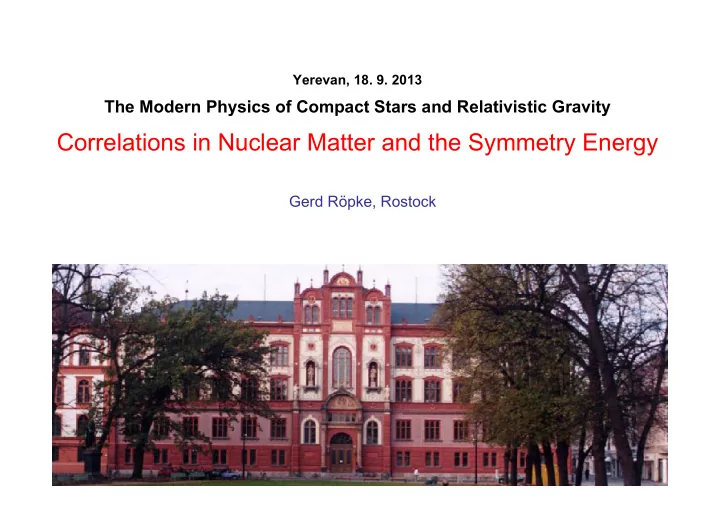
Correlations in Nuclear Matter and the Symmetry Energy

slide-2
SLIDE 2

Supernova

Crab nebula, 1054 China, PSR 0531+21

M1, the Crab Nebula. Courtesy of NASA/ESA

slide-3
SLIDE 3

Supernova explosion

T.Janka

slide-4
SLIDE 4

Core-collapse supernovae

Density. electron fraction, and temperature profile

  • f a 15 solar mass supernova

at 150 ms after core bounce as function of the radius. Influence of cluster formation

  • n neutrino emission

in the cooling region and

  • n neutrino absorption

in the heating region ?

K.Sumiyoshi et al., Astrophys.J. 629, 922 (2005)

slide-5
SLIDE 5

Composition of supernova core

Mass fraction X of light clusters for a post-bounce supernova core

K.Sumiyoshi,

  • G. R.,

PRC 77, 055804 (2008)

slide-6
SLIDE 6

Nuclear matter phase diagram

Core collapse supernovae

  • T. Fischer et al., ApJS 194, 39 (2011)
slide-7
SLIDE 7

Symmetric nuclear matter: Phase diagram

slide-8
SLIDE 8

Nuclear statistical equilibrium (NSE)

Chemical picture:

Ideal mixture of reacting components Mass action law

slide-9
SLIDE 9

Ideal mixture of reacting nuclides

mass number A, charge ZA, energy EA,ν,K, ν internal quantum number, K: center of mass momentum

Nuclear Statistical Equilibrium (NSE)

slide-10
SLIDE 10

Quasiparticle approximation for nuclear matter

Klaehn et al., PRC 2006

slide-11
SLIDE 11

Quasiparticle approximation for nuclear matter

Klaehn et al., PRC 2006

But: cluster formation

Incorrect low-density limit

slide-12
SLIDE 12

Outline

  • Nuclear systems: Quasiparticle approach

Brueckner, HFB; Skyrme, Relativistic Mean Field (RMF)

  • Account of correlations in warm dense matter:

two-particle (deuteron, pairing),

four-particle (alpha-like) correlations, light elements

  • Low-density regions: Nuclear Statistical Equilibrium (NSE)

Hoyle-like states in light expanded nuclei, surface of nuclei, neck emission, alpha matter…

  • Quantum statistical approach (n < 0.15 fm-3, T < 20 MeV)

Equation of state, Beth-Uhlenbeck formula disappearance of clusters at high densities, Pauli blocking

  • Experimental signatures

Heavy Ion Collisions (HIC), Symmetry energy, SN explosions, …

slide-13
SLIDE 13

Nuclear statistical equilibrium (NSE)

Chemical picture:

Ideal mixture of reacting components Mass action law Interaction between the components internal structure: Pauli principle

slide-14
SLIDE 14

Nuclear statistical equilibrium (NSE)

Chemical picture:

Ideal mixture of reacting components Mass action law

Physical picture:

"elementary" constituents and their interaction Interaction between the components internal structure: Pauli principle Quantum statistical (QS) approach, quasiparticle concept, virial expansion

slide-15
SLIDE 15

Many-particle theory

slide-16
SLIDE 16

Many-particle theory

slide-17
SLIDE 17

Different approximations

slide-18
SLIDE 18

Quasiparticle picture: RMF and DBHF

  • C. Fuchs et al.;

J.Margueron et al., Phys.Rev.C 76,034309 (2007)

slide-19
SLIDE 19

Quasiparticle picture: RMF and DBHF

  • C. Fuchs et al.;

J.Margueron et al., Phys.Rev.C 76,034309 (2007)

But: cluster formation Incorrect low-density limit

slide-20
SLIDE 20

Different approximations

slide-21
SLIDE 21

Different approximations

slide-22
SLIDE 22

Effective wave equation for the deuteron in matter

p1

2

2m1 + Δ1 + p2

2

2m2 + Δ 2 # $ % & ' ( Ψd,P(p1, p2) + (1− f p1 − f p2 )V

p1+,p2+

(p1, p2;p1+, p2+)Ψd,P(p1+, p2+) = Ed,PΨd,P(p1, p2)

f p = e(p 2 / 2m−µ)/ kBT +1

[ ]

−1

Fermi distribution function Pauli-blocking

BEC-BCS crossover: Alm et al.,1993 Add self-energy Thouless criterion

Ed (T,µ) = 2µ In-medium two-particle wave equation in mean-field approximation

slide-23
SLIDE 23

Pauli blocking – phase space occupation

momentum space

Fermi sphere px py pz cluster wave function (deuteron, alpha,…) in momentum space P P - center of mass momentum The Fermi sphere is forbidden, deformation of the cluster wave function in dependence on the c.o.m. momentum P The deformation is maximal at P = 0. It leads to the weakening of the interaction (disintegration of the bound state).

slide-24
SLIDE 24

Shift of the deuteron binding energy

G.R., NP A 867, 66 (2011)

Dependence on nucleon density, various temperatures, zero center of mass momentum

thin lines: fit formula

slide-25
SLIDE 25

Cluster decomposition

  • f the self-energy

T-matrices: bound states, scattering states Including clusters like new components chemical picture, mass action law, nuclear statistical equilibrium (NSE)

slide-26
SLIDE 26

Few-particle Schrödinger equation in a dense medium

4-particle Schrödinger equation with medium effects

E HF(p1) + E HF(p2) + E HF(p3) + E HF(p4)

[ ]

( )Ψn,P(p1, p2, p3, p4)

+ (1− f p1 − f p2 )V

p1$ ,p2$

(p1, p2;p1$, p2$)Ψn,P(p1$, p2$, p3, p4) + permutations

{ }

= En,PΨn,P(p1, p2, p3, p4)

slide-27
SLIDE 27

In-medium shift of binding energies of clusters

d t alpha

T=10 MeV

  • M. Beyer et al., PLB 488, 247 (00), A. Sedrakian et al., Ann. Phys; PRC 73, 035803 (06)

Solution of the Faddeev-Yakubovski equation with Pauli blocking

slide-28
SLIDE 28

Shift of Binding Energies of Light Clusters

G.R., PRC 79, 014002 (2009)

  • S. Typel et al.,

PRC 81, 015803 (2010)

Symmetric matter

slide-29
SLIDE 29

Composition of dense nuclear matter

mass number A, charge ZA, energy EA,ν,K, ν: internal quantum number,

  • Inclusion of excited states and continuum correlations
  • Medium effects:

self-energy and Pauli blocking shifts of binding energies, Coulomb corrections due to screening (Wigner-Seitz,Debye)

slide-30
SLIDE 30

Light Cluster Abundances

  • S. Typel et al.,

PRC 81, 015803 (2010)

slide-31
SLIDE 31

Chemical potential of symmetric matter

T[MeV] 2 4 6 8 10 12 14 16 18 20

Isotherms

thin lines: NSE

slide-32
SLIDE 32

Internal energy per nucleon

EOS for symmetric matter - low density region?

Quantum statistical approach: Cluster ? Condensate?

slide-33
SLIDE 33

Clustering phenomena in nuclear matter below the saturation density

Hiroki Takemoto et al., PR C 69, 035802 (2004)

  • FIG. 8. Energy curves of DFSs due to a and 16O clustering in
  • the symmetric nuclear matter by the use of the BB sB4d force. The
  • density of matter is normalized by the saturation density of the
  • uniform matter with the Fermi sphere, r0=0.206 fm−3. The presentation
  • of the curves is similar to that in Fig. 4.
slide-34
SLIDE 34

Phase diagram nuclear matter

slide-35
SLIDE 35

Application to Heavy Ion Reactions

  • Test the EOS

(NSE, virial,… at low densities, Skyrme, DBHF, RMF,… near saturation)

  • Unifying quantum statistical approach, medium effects, Mott effect
  • Symmetry energy
  • Bose enhancement?

Nimrod @ TAMU, 40Ar + 112,124Sn, 64Zn + 112,124Sn; 47 A MeV Open questions: freeze-out model or dynamical transport models? Identification of the source? Yields of p, (n), d, t, 3He, 4He,…

slide-36
SLIDE 36

Light Cluster Abundances

  • S. Typel et al.,

PRC 81, 015803 (2010)

slide-37
SLIDE 37

Pauli blocking in symmetric matter

0.0001 0.001 0.01 0.1 baryon density nB [fm

  • 3]

0.1 0.2 0.3 0.4 0.5 free proton fraction Xp

T =11 MeV T =10 MeV T = 9 MeV T = 8 MeV T = 7 MeV T = 6 MeV T = 5 MeV T = 4 MeV

Free proton fraction as function of density and temperature in symmetric matter. QS calculations (solid lines) are compared with the NSE results (dotted lines). Mott effect in the region nsaturation/5.

slide-38
SLIDE 38

EOS at low densities from HIC

Bose enhancement? chemical constants Yields of clusters from HIC: p, n, d, t, h, α Symmetry energy

slide-39
SLIDE 39

Cluster yields in HIC

in-medium binding energies

slide-40
SLIDE 40

Internal symmetry energy

slide-41
SLIDE 41

Symmetry energy

Heavy-ion collisions, spectra of emitted clusters, temperature (3 - 10 MeV), free energy

  • S. Kowalski et al.,

PRC 75, 014601 (2007)

slide-42
SLIDE 42

Symmetry energy, comparison experiment with theories

J.Natowitz et al., PRL 2010

slide-43
SLIDE 43

Symmetry Energy

Scaled internal symmetry energy as a function of the scaled total density. MDI: Chen et al., QS: quantum statistical, Exp: experiment at TAMU

J.Natowitz et al. PRL, May 2010

slide-44
SLIDE 44

Problems:

  • Transition from α-matter to nucleon matter

Is there a region of metastability?

  • 1. Inclusion of larger Clusters in the equation of state
  • 2. HFB and cluster formation/quartetting
  • 3. EoS at low temperatures/low densities
  • 4. Inclusion of larger nuclei
  • 5. Influence of the symmetry energy
  • n beta equilibrium
slide-45
SLIDE 45

Problems:

  • 1. Inclusion of larger Clusters in the equation of state
  • 2. HFB and cluster formation/quartetting
  • 3. EoS at low temperatures/low densities
  • 4. Inclusion of larger nuclei
  • 5. Influence of the symmetry energy
  • n beta equilibrium:

Diploma thesis work, Armen Sedrakian, 1987?

slide-46
SLIDE 46

Astrophysical Applications

  • Supernova explosions
  • Neutrino transport
  • Neutron star structure
  • Equation of state (EOS)
  • Composition
  • Transport properties (cross sections)
slide-47
SLIDE 47

α cluster in astrophysics

  • S. Typel, Proc. Int. Workshop XII Hadron Physics

Crust of neutron stars

Protons in droplets (heavy nuclei)

α-cluster outside,

at the surface, condensate?

slide-48
SLIDE 48

Composition of supernova core

Mass fraction X

  • f light clusters

for a post-bounce supernova core

K.Sumiyoshi,

  • G. R.,

PRC 77, 055804 (2008)

  • S. Heckel, P. P. Schneider and A. Sedrakian,

Light nuclei in supernova envelopes: a quasiparticle gas model

  • Phys. Rev. C 80, 015805 (2009).
slide-49
SLIDE 49

In-medium modification of transport properties of dense matter

  • D. Blaschke, G. Röpke, H. Schulz, A.D. Sedrakian,

Nuclear in-medium effect on the thermal conductivity and viscosity of neutron star matter PL B 338, 111 (1994)

  • D. Blaschke, G. Röpke, H. Schulz, A.D. Sedrakian, D. Voskresensky,

Nuclear in-medium effects and neutrino emissivity of neutron stars.

  • M. N. R. A. S. 273, 596 (1995)
slide-50
SLIDE 50

Summary

  • Correlations (cluster formation, quantum condensates) are essential

in low-density matter. They are suppressed with increasing density (Pauli blocking).

  • The low-density limit of the nuclear matter EoS can be rigorously treated.

The Beth-Uhlenbeck virial expansion is a benchmark. Larger nuclei and pasta structures must be treated in future works.

  • An extended quasiparticle approach can be given for single nucleon

states and nuclei. In a first approximation, self- energy and Pauli blocking is included. An interpolation between low and high densities is possible.

  • Compared with the standard quasiparticle approach, significant changes

arise in the low-density limit due to clustering. Examples are Bose-Einstein condensation (quartetting), and the behavior of the symmetry energy.

  • Finite Systems (nuclei): Clusters in low-density regions, quantum condensates.

Possibly preformed clusters at surface.

slide-51
SLIDE 51

Thanks

to D. Blaschke, C. Fuchs, Y. Funaki, H. Horiuchi,

  • J. Natowitz, T. Klaehn, Z. Ren, S. Shlomo, P. Schuck,
  • A. Sedrakian, K. Sumiyoshi, A. Tohsaki, S. Typel,
  • H. Wolter, Z. Xu, T. Yamada, B. Zhou

for collaboration to you for attention D.G.

slide-52
SLIDE 52

Supernova

Crab nebula, 1054 China, PSR 0531+21

slide-53
SLIDE 53

Structure of a Neutron star

slide-54
SLIDE 54

Supernova collapse:

spherically symmetric simulations

  • A. Arcones et al.

Neutrino driven winds, PRC 78, 015806 (08)

slide-55
SLIDE 55

Shift of the deuteron binding energy

Dependence on center of mass momentum, various densities, T=10 MeV

G.R., NP A 867, 66 (2011)

thin lines: fit formula

slide-56
SLIDE 56

Deuteron quasiparticle properties

ΔEd

Pauli(T,nB,α) = δEd (0)(T,α)nB + O(nB 2 )

md

*

md (T,nB,α) =1+ δmd

(0)(T,α)nB + O(nB 2 )

T [MeV] delta E [MeV fm^3] delta m* [fm^3] 10 364.3 21.3 4 712.9 87.1

Ed

free = −2.225MeV

Ed

qu(P) = Ed free + ΔEd +

 2md

* P 2 + O(P 4)

slide-57
SLIDE 57

Scattering phase shifts in matter

slide-58
SLIDE 58

Application to Heavy Ion Reactions

  • Test the EOS

(NSE, virial,… at low densities, Skyrme, DBHF, RMF,… near saturation)

  • Unifying quantum statistical approach, medium effects, Mott effect
  • Symmetry energy
  • Bose enhancement?

Nimrod @ TAMU, 40Ar + 112,124Sn, 64Zn + 112,124Sn; 47 A MeV Open questions: freeze-out model or dynamical transport models? Identification of the source? - yields of p, (n), d, t, 3He, 4He,…

slide-59
SLIDE 59

Mott points from cluster yields

  • K. Hagel et al., PRL 108, 062702 (2012)
slide-60
SLIDE 60

Free symmetry energy

symmetry entropy Internal symmetry energy

  • R. Wada et al., Phys. Rev. C 85, 064618 (2012).
slide-61
SLIDE 61

Internal energy per nucleon

T[MeV] 20 18 16 14 12 10 8 6 4 2

Isotherms

thin lines: NSE

  • S. Typel et al., PRC 81, 015803 (2010)
slide-62
SLIDE 62

Composition of dense nuclear matter

mass number A charge ZA energy EA,ν,K ν: internal quantum number

  • Inclusion of excited states and continuum correlations
  • Medium effects:

self-energy and Pauli blocking shifts of binding energies, Coulomb corrections due to screening (Wigner-Seitz,Debye)

  • Bose-Einstein condensation
slide-63
SLIDE 63

α-cluster-condensation

(quartetting)

G.Röpke, A.Schnell, P.Schuck, and P.Nozieres, PRL 80, 3177 (1998)

slide-64
SLIDE 64

α-cluster-condensation

(quartetting)

G.Röpke, A.Schnell, P.Schuck, and P.Nozieres, PRL 80, 3177 (1998)

slide-65
SLIDE 65

Effective wave equation for the deuteron in matter

p1

2

2m1 + Δ1 + p2

2

2m2 + Δ 2 # $ % & ' ( Ψd,P(p1, p2) + (1− f p1 − f p2 )V

p1+,p2+

(p1, p2;p1+, p2+)Ψd,P(p1+, p2+) = Ed,PΨd,P(p1, p2)

f p = e(p 2 / 2m−µ)/ kBT +1

[ ]

−1

Fermi distribution function Pauli-blocking

BEC-BCS crossover: Alm et al.,1993 Add self-energy Thouless criterion

Ed (T,µ) = 2µ In-medium two-particle wave equation in mean-field approximation

slide-66
SLIDE 66

Composition of symmetric nuclear matter

Fraction of correlated matter (virial expansion, Generalized Beth- Uhlenbeck approach, contribution

  • f bound states,
  • f scattering states,

phase shifts)

  • H. Stein et al.,
  • Z. Phys. A351, 259 (1995)
slide-67
SLIDE 67

Self-conjugate 4n nuclei

slide-68
SLIDE 68

Self-conjugate 4n nuclei

slide-69
SLIDE 69

Alpha cluster structure of Be 8

Contours of constant density, plotted in cylindrical coordinates, for 8Be(0+) . The left side is in the laboratory frame while the right side is in the intrinsic frame.

R.B. Wiringa et al., PRC 63, 034605 (01)

slide-70
SLIDE 70

Results

  • M. Chernykh et al., PRL 98, 032501 (07); Y. Funaki et al., PRL 101, 082502 (08)
slide-71
SLIDE 71

Excited light nuclei

decreasing density deuterons? systematics in weakly bound light elements light clusters in neutron matter

Yoshiko Kanada-En'yo Cluster2012,Debrecen

slide-72
SLIDE 72

α cluster in astrophysics

  • S. Typel, Proc. Int. Workshop XII Hadron Physics

Crust of neutron stars

Protons in droplets (heavy nuclei)

α-cluster outside,

at the surface, condensate?

slide-73
SLIDE 73

Free energy per nucleon

preliminary

correlated medium

slide-74
SLIDE 74

Liquid-vapor phase transition

blue: no light cluster, green: with light clusters, QS, red: cluster-RMF

  • S. Typel et al., PRC 81, 015803 (2010)
slide-75
SLIDE 75

Alpha-particle fraction in the low-density limit symmetric matter, T=2, 4, 8 MeV

C.J.Horowitz, A.Schwenk, Nucl. Phys. A 776, 55 (2006)

LS, Shen: higher clusters, excluded volume

slide-76
SLIDE 76
slide-77
SLIDE 77

Cluster - mean field approximation

Cluster (A) interacting with a distribution of clusters (B) in the medium, fully antisymmetrized {HA

0(1...A,1"...A") +

Δ i

A,mfδk,k" + 1

2 ΔVij

A,mfδl,l" − EAνPδk,k"}ψAνP(1"...A") = 0 i, j

i

1"...A"

self-energy

Δ1

A,mf (1) =

V(12,12)ex f *(2) + fB(EBνP) V

1i(1i,1$i$)ψBνP *

(1...B)

i

2...B$

BνP

2

ψBνP(1$...B$)

ΔV

12 A,mf = − 1

2[ f *(1) + f *(2)]V(12,1$2$) − fB(EBνP) V

1i i

2*...B"

BνP

ψBνP

*

(22*...B*)ψBνP(2$2"...B")

effective interaction

f *(1) = f1(1) + fB(EBνP) |ψBνP(1...B) |2

2...B

BνP

phase space occupation

slide-78
SLIDE 78

Self-consistent RPA

Two-time cluster Matsubara Green's functions Equation of motion method Effective Hamiltonian is split into an instantaneous and a dynamic part

J.Dukelsky, G. Roepke, and P.Schuck, NPA 628, 17 (1998)

  • P. Schuck, D.S. Delion, J.Dukelsky, and G. Roepke, in preparation
slide-79
SLIDE 79

Deuteron quasiparticle properties

ΔEd

Pauli(T,nB,α) = δEd (0)(T,α)nB + O(nB 2 )

md

*

md (T,nB,α) =1+ δmd

(0)(T,α)nB + O(nB 2 )

T

[MeV]

delta E [MeV fm3] delta m* [fm3] 10 364.3 21.3 4 712.9 87.1

Ed

free = −2.225MeV

Ed

qu(P) = Ed free + ΔEd + 2

2md

* P 2 + O(P 4) G.R.,PRC 79, 014002 (2009)

slide-80
SLIDE 80

Nuclear matter properties

  • S. Typel, 2012