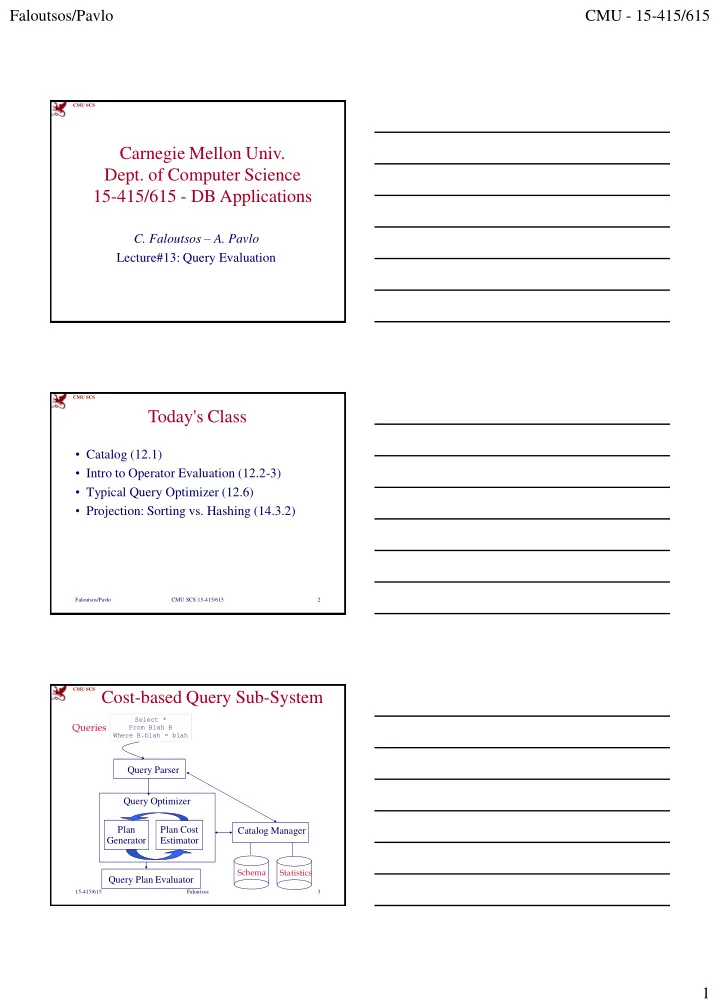
Cost-based Query Sub-System Select * Queries From Blah B Where - - PDF document

cost based query sub system
SMART_READER_LITE
LIVE PREVIEW

Cost-based Query Sub-System Select * Queries From Blah B Where - - PDF document

Faloutsos/Pavlo CMU - 15-415/615 CMU SCS Carnegie Mellon Univ. Dept. of Computer Science 15-415/615 - DB Applications C. Faloutsos A. Pavlo Lecture#13: Query Evaluation CMU SCS Today's Class Catalog (12.1) Intro to Operator


slide-1
SLIDE 1

Faloutsos/Pavlo CMU - 15-415/615 1

CMU SCS

Carnegie Mellon Univ.

  • Dept. of Computer Science

15-415/615 - DB Applications

  • C. Faloutsos – A. Pavlo

Lecture#13: Query Evaluation

CMU SCS

CMU SCS 15-415/615 2

Today's Class

  • Catalog (12.1)
  • Intro to Operator Evaluation (12.2-3)
  • Typical Query Optimizer (12.6)
  • Projection: Sorting vs. Hashing (14.3.2)

Faloutsos/Pavlo

CMU SCS

15-415/615 Faloutsos 3

Cost-based Query Sub-System

Query Parser Query Optimizer Plan Generator Plan Cost Estimator Catalog Manager Query Plan Evaluator

Schema Statistics

Select * From Blah B Where B.blah = blah

Queries

slide-2
SLIDE 2

Faloutsos/Pavlo CMU - 15-415/615 2

CMU SCS

15-415/615 Faloutsos 4

Cost-based Query Sub-System

Query Parser Query Optimizer Plan Generator Plan Cost Estimator Catalog Manager Query Plan Evaluator

Schema Statistics

Select * From Blah B Where B.blah = blah

Queries

CMU SCS

Catalog: Schema

  • What would you store?

– Info about tables, attributes, indices, users

  • How?

– In tables! Attribute_Cat (attr_name: string, rel_name: string; type: string; position: integer)

Faloutsos/Pavlo CMU SCS 15-415/615 5

CMU SCS

Catalog: Schema

  • What would you store?

– Info about tables, attributes, indices, users

  • How?

– In tables! Attribute_Cat (attr_name: string, rel_name: string; type: string; position: integer)

Faloutsos/Pavlo CMU SCS 15-415/615 6

See INFORMATION_SCHEMA discussion from Lecture #7

slide-3
SLIDE 3

Faloutsos/Pavlo CMU - 15-415/615 3

CMU SCS

Catalog: Statistics

  • Why do we need them?

– To estimate cost of query plans

  • What would you store?

– NTuples(R): # records for table R – NPages(R): # pages for R – NKeys(I): # distinct key values for index I – INPages(I): # pages for index I – IHeight(I): # levels for I – ILow(I), IHigh(I): range of values for I

Faloutsos/Pavlo CMU SCS 15-415/615 7

CMU SCS

Catalog: Statistics

  • Why do we need them?

– To estimate cost of query plans

  • What would you store?

– NTuples(R): # records for table R – NPages(R): # pages for R – NKeys(I): # distinct key values for index I – INPages(I): # pages for index I – IHeight(I): # levels for I – ILow(I), IHigh(I): range of values for I

Faloutsos/Pavlo CMU SCS 15-415/615 8

CMU SCS

CMU SCS 15-415/615 9

Today's Class

  • Catalog (12.1)
  • Intro to Operator Evaluation (12.2-3)
  • Typical Query Optimizer (12.6)
  • Projection: Sorting vs. Hashing (14.3.2)

Faloutsos/Pavlo

slide-4
SLIDE 4

Faloutsos/Pavlo CMU - 15-415/615 4

CMU SCS

Query Plan Example

Faloutsos/Pavlo CMU SCS 15-415/615 10

SELECT cname, amt FROM customer, account WHERE customer.acctno = account.acctno AND account.amt > 1000

pcname, amt(samt>1000 (customer⋈account))

Relational Algebra:

CMU SCS

Query Plan Example

Faloutsos/Pavlo CMU SCS 15-415/615 11

SELECT cname, amt FROM customer, account WHERE customer.acctno = account.acctno AND account.amt > 1000

CUSTOMER ACCOUNT

s ⨝ p

acctno=acctno amt>1000 cname, amt

CMU SCS

Query Plan Example

Faloutsos/Pavlo CMU SCS 15-415/615 12

SELECT cname, amt FROM customer, account WHERE customer.acctno = account.acctno AND account.amt > 1000

CUSTOMER ACCOUNT

s ⨝ p

acctno=acctno amt>1000 cname, amt

File Scan Nested Loop “On-the-fly” “On-the-fly” File Scan

slide-5
SLIDE 5

Faloutsos/Pavlo CMU - 15-415/615 5

CMU SCS

Query Plan Example

Faloutsos/Pavlo CMU SCS 15-415/615 13

SELECT cname, amt FROM customer, account WHERE customer.acctno = account.acctno AND account.amt > 1000

CUSTOMER ACCOUNT

s ⨝ p

The output of each

  • perator is the input

to the next operator. Each operator iterates

  • ver its input and

performs some task.

CMU SCS

Operator Evaluation

  • Several algorithms are available for

different relational operators.

  • Each has its own performance trade-offs.
  • The goal of the query optimizer is to choose

the one that has the lowest “cost”.

Faloutsos/Pavlo CMU SCS 15-415/615 14

Next Class: How the DBMS finds the best plan.

CMU SCS

Operator Execution Strategies

  • Indexing
  • Iteration (= seq. scanning)
  • Partitioning (sorting and hashing)

Faloutsos/Pavlo CMU SCS 15-415/615 15

slide-6
SLIDE 6

Faloutsos/Pavlo CMU - 15-415/615 6

CMU SCS

Access Paths

  • How the DBMS retrieves tuples from a

table for a query plan.

– File Scan (aka Sequential Scan) – Index Scan (Tree, Hash, List, …)

  • Selectivity of an access path:

– % of pages we retrieve – e.g., Selectivity of a hash index, on range query: 100% (no reduction!)

Faloutsos/Pavlo CMU SCS 15-415/615 16

CMU SCS

Operator Algorithms

  • Selection:
  • Projection:
  • Join:
  • Group By:
  • Order By:

Faloutsos/Pavlo CMU SCS 15-415/615 17

CMU SCS

Operator Algorithms

  • Selection: file scan; index scan
  • Projection: hashing; sorting
  • Join:
  • Group By:
  • Order By:

Faloutsos/Pavlo CMU SCS 15-415/615 18

slide-7
SLIDE 7

Faloutsos/Pavlo CMU - 15-415/615 7

CMU SCS

Operator Algorithms

  • Selection: file scan; index scan
  • Projection: hashing; sorting
  • Join: many ways (loops, sort-merge, etc)
  • Group By:
  • Order By:

Faloutsos/Pavlo CMU SCS 15-415/615 19

CMU SCS

Operator Algorithms

  • Selection: file scan; index scan
  • Projection: hashing; sorting
  • Join: many ways (loops, sort-merge, etc)
  • Group By: hashing; sorting
  • Order By: sorting

Faloutsos/Pavlo CMU SCS 15-415/615 20

CMU SCS

Operator Algorithms

  • Selection: file scan; index scan
  • Projection: hashing; sorting
  • Join: many ways (loops, sort-merge, etc)
  • Group By: hashing; sorting
  • Order By: sorting

Faloutsos/Pavlo CMU SCS 15-415/615 21

Today Next Class Today Today Next Class

slide-8
SLIDE 8

Faloutsos/Pavlo CMU - 15-415/615 8

CMU SCS

CMU SCS 15-415/615 22

Today's Class

  • Catalog (12.1)
  • Intro to Operator Evaluation (12.2-3)
  • Typical Query Optimizer (12.6)
  • Projection: Sorting vs. Hashing (14.3.2)

Faloutsos/Pavlo

CMU SCS

Query Optimization

  • Bring query in internal form (eg., parse tree)
  • … into “canonical form” (syntactic q-opt)
  • Generate alternative plans.
  • Estimate cost for each plan.
  • Pick the best one.

Faloutsos/Pavlo CMU SCS 15-415/615 23

CMU SCS

Query Plan Example

Faloutsos/Pavlo CMU SCS 15-415/615 24

SELECT cname, amt FROM customer, account WHERE customer.acctno = account.acctno AND account.amt > 1000

CUSTOMER ACCOUNT

s ⨝ p

acctno=acctno amt>1000 cname, amt

slide-9
SLIDE 9

Faloutsos/Pavlo CMU - 15-415/615 9

CMU SCS

Query Plan Example

Faloutsos/Pavlo CMU SCS 15-415/615 25

SELECT cname, amt FROM customer, account WHERE customer.acctno = account.acctno AND account.amt > 1000

CUSTOMER ACCOUNT

s ⨝ p

acctno=acctno amt>1000 cname, amt

CUSTOMER ACCOUNT

s ⨝ p

acctno=acctno amt>1000 cname, amt

CMU SCS

CMU SCS 15-415/615 26

Today's Class

  • Catalog (12.1)
  • Intro to Operator Evaluation (12.2,3)
  • Typical Query Optimizer (12.6)
  • Projection: Sorting vs. Hashing (14.3.2)

Faloutsos/Pavlo

CMU SCS

Duplicate Elimination

  • What does it do, in English?
  • How to execute it?

Faloutsos/Pavlo CMU SCS 15-415/615 27

SELECT DISTINCT bname FROM account WHERE amt > 1000

pDISTINCT bname (samt>1000 (account))

Not technically correct because RA doesn’t have “DISTINCT”

slide-10
SLIDE 10

Faloutsos/Pavlo CMU - 15-415/615 10

CMU SCS

Duplicate Elimination

Faloutsos/Pavlo CMU SCS 15-415/615 28

SELECT DISTINCT bname FROM account WHERE amt > 1000

ACCOUNT

s p

amt>1000 DISTINCT bname

Two Choices:

  • Sorting
  • Hashing

CMU SCS

Sorting Projection

Faloutsos/Pavlo CMU SCS 15-415/615 29

acctno bname amt A-123 Redwood 1800 A-789 Downtown 2000 A-123 Perry 1500 A-456 Downtown 1300

ACCOUNT

s p

amt>1000 DISTINCT bname

Remove Columns Sort Eliminate Dupes

acctno bname amt A-123 Redwood 1800 A-789 Downtown 2000 A-123 Perry 1500 A-456 Downtown 1300 bname Redwood Downtown Perry Downtown bname Downtown Downtown Perry Redwood

X Filter

CMU SCS

Alternative to Sorting: Hashing!

  • What if we don’t need the order of the

sorted data?

– Forming groups in GROUP BY – Removing duplicates in DISTINCT

  • Hashing does this!

– And may be cheaper than sorting! (why?) – But what if table doesn’t fit in memory?

Faloutsos/Pavlo CMU SCS 15-415/615 30

slide-11
SLIDE 11

Faloutsos/Pavlo CMU - 15-415/615 11

CMU SCS

Hashing Projection

  • Populate an ephemeral hash table as we

iterate over a table.

  • For each record, check whether there is

already an entry in the hash table:

– DISTINCT: Discard duplicate. – GROUP BY: Perform aggregate computation.

  • Two phase approach.

Faloutsos/Pavlo CMU SCS 15-415/615 31

CMU SCS

Phase 1: Partition

  • Use a hash function h1 to split tuples into

partitions on disk.

– We know that all matches live in the same partition. – Partitions are “spilled” to disk via output buffers.

  • Assume that we have B buffers.

Faloutsos/Pavlo CMU SCS 15-415/615 32

CMU SCS

Phase 1: Partition

Faloutsos/Pavlo CMU SCS 15-415/615 33

acctno bname amt A-123 Redwood 1800 A-789 Downtown 2000 A-123 Perry 1500 A-456 Downtown 1300

ACCOUNT

s p

amt>1000 DISTINCT bname

Hash

Redwood

Downtown Downtown Perry

Remove Columns

acctno bname amt A-123 Redwood 1800 A-789 Downtown 2000 A-123 Perry 1500 A-456 Downtown 1300 bname Redwood Downtown Perry Downtown

Filter

h1

B-1 partitions

slide-12
SLIDE 12

Faloutsos/Pavlo CMU - 15-415/615 12

CMU SCS

Phase 2: ReHash

  • For each partition on disk:

– Read it into memory and build an in-memory hash table based on a hash function h2 – Then go through each bucket of this hash table to bring together matching tuples

  • This assumes that each partition fits in

memory.

Faloutsos/Pavlo CMU SCS 15-415/615 34

CMU SCS

Phase 2: ReHash

Faloutsos/Pavlo CMU SCS 15-415/615 35

ACCOUNT

s p

amt>1000 DISTINCT bname

h2

Partitions From Phase 1

Redwood

Downtown Downtown Perry key value XXX Downtown YYY Redwood ZZZ Perry

Eliminate Dupes

bname Downtown Perry Redwood

Hash Table

acctno bname amt A-123 Redwood 1800 A-789 Downtown 2000 A-123 Perry 1500 A-456 Downtown 1300

h2 h2

CMU SCS

Analysis

  • How big of a table can we hash using this

approach?

– B-1 “spill partitions” in Phase 1 – Each should be no more than B blocks big

Faloutsos/Pavlo CMU SCS 15-415/615 36

slide-13
SLIDE 13

Faloutsos/Pavlo CMU - 15-415/615 13

CMU SCS

Analysis

  • How big of a table can we hash using this

approach?

– B-1 “spill partitions” in Phase 1 – Each should be no more than B blocks big – Answer: B∙(B-1).

  • A table of N blocks needs about sqrt(N) buffers

– What assumption do we make?

Faloutsos/Pavlo CMU SCS 15-415/615 37

CMU SCS

Analysis

  • How big of a table can we hash using this

approach?

– B-1 “spill partitions” in Phase 1 – Each should be no more than B blocks big – Answer: B∙(B-1).

  • A table of N blocks needs about sqrt(N) buffers

– Assumes hash distributes records evenly!

  • Use a “fudge factor” f >1 for that: we need
  • B ~ sqrt( f ∙N)

Faloutsos/Pavlo CMU SCS 15-415/615 38

CMU SCS

Analysis

  • Have a bigger table? Recursive

partitioning!

– In the ReHash phase, if a partition i is bigger than B, then recurse. – Pretend that i is a table we need to hash, run the Partitioning phase on i, and then the ReHash phase on each of its (sub)partitions

Faloutsos/Pavlo CMU SCS 15-415/615 39

slide-14
SLIDE 14

Faloutsos/Pavlo CMU - 15-415/615 14

CMU SCS

Recursive Partitioning

Faloutsos/Pavlo CMU SCS 15-415/615 40

Hash

h1 h1’

Hash the overflowing bucket again

h2 h2 h2 h2 h2

CMU SCS

Real Story

  • Partition + Rehash
  • Performance is very slow!
  • What could have gone wrong?

Faloutsos/Pavlo CMU SCS 15-415/615 41

CMU SCS

Real Story

  • Partition + Rehash
  • Performance is very slow!
  • What could have gone wrong?
  • Hint: some buckets are empty; some others

are way over-full.

Faloutsos/Pavlo CMU SCS 15-415/615 42

slide-15
SLIDE 15

Faloutsos/Pavlo CMU - 15-415/615 15

CMU SCS

Hashing vs. Sorting

  • Which one needs more buffers?

Faloutsos/Pavlo CMU SCS 15-415/615 43

CMU SCS

Hashing vs. Sorting

  • Recall: We can hash a table of size N

blocks in sqrt(N) space

  • How big of a table can we sort in 2 passes?

– Get N/B sorted runs after Pass 0 – Can merge all runs in Pass 1 if N/B ≤ B-1

  • Thus, we (roughly) require: N ≤ B2
  • We can sort a table of size N blocks in about space

sqrt(N)

– Same as hashing!

Faloutsos/Pavlo CMU SCS 15-415/615 44

CMU SCS

Hashing vs. Sorting

  • Choice of sorting vs. hashing is subtle and

depends on optimizations done in each case

  • Already discussed optimizations for sorting:

– Heapsort in Pass 0 for longer runs – Chunk I/O into large blocks to amortize seek+RD costs – Double-buffering to overlap CPU and I/O

Faloutsos/Pavlo CMU SCS 15-415/615 45

slide-16
SLIDE 16

Faloutsos/Pavlo CMU - 15-415/615 16

CMU SCS

Hashing vs. Sorting

  • Choice of sorting vs. hashing is subtle and

depends on optimizations done in each case

  • Another optimization when using sorting

for aggregation:

– “Early aggregation” of records in sorted runs

  • Let’s look at some optimizations for

hashing next…

Faloutsos/Pavlo CMU SCS 15-415/615 46

CMU SCS

Hashing: We Can Do Better!

  • Combine the summarization into the

hashing process - How?

Faloutsos/Pavlo CMU SCS 15-415/615 47

CMU SCS

Hashing: We Can Do Better!

  • During the ReHash phase, store pairs of the

form <GroupKey, RunningVal>

  • When we want to insert a new tuple into the

hash table:

– If we find a matching GroupKey, just update the RunningVal appropriately – Else insert a new <GroupKey, RunningVal>

Faloutsos/Pavlo CMU SCS 15-415/615 48

slide-17
SLIDE 17

Faloutsos/Pavlo CMU - 15-415/615 17

CMU SCS

Hashing Aggregation

Faloutsos/Pavlo CMU SCS 15-415/615 49

SELECT acctno, SUM(amt) FROM account GROUP BY acctno

h2

Partitions From Phase 1

Redwood

Downtown Downtown Perry key value XXX <A-123, 1200> YYY <A-789,1000> ZZZ <A-456,1500>

Final Result

acctno SUM(amt) A-123 4355 A-789 6895 A-456 7901

Hash Table

Running Totals

h2 h2

CMU SCS

Hashing Aggregation

  • What’s the benefit?
  • How many entries will we have to handle?

– Number of distinct values of GroupKeys columns – Not the number of tuples!! – Also probably “narrower” than the tuples

Faloutsos/Pavlo CMU SCS 15-415/615 50

CMU SCS

So, hashing is better…right?

  • Any caveats?

Faloutsos/Pavlo CMU SCS 15-415/615 51

slide-18
SLIDE 18

Faloutsos/Pavlo CMU - 15-415/615 18

CMU SCS

So, hashing is better…right?

  • Any caveats?
  • A1: Sorting is better on non-uniform data
  • A2: ... and when sorted output is required

later.

  • Hashing vs. sorting:

– Commercial systems use either or both

Faloutsos/Pavlo CMU SCS 15-415/615 52

CMU SCS

Summary

  • Query processing architecture:

– Query optimizer translates SQL to a query plan = graph of iterators – Query executor “interprets” the plan

  • Hashing is a useful alternative to sorting for

duplicate elimination / group-by

– Both are valuable techniques for a DBMS

Faloutsos/Pavlo CMU SCS 15-415/615 53