
SLIDE 1
COVID-19 in Italy
§ Case Fatality Rate
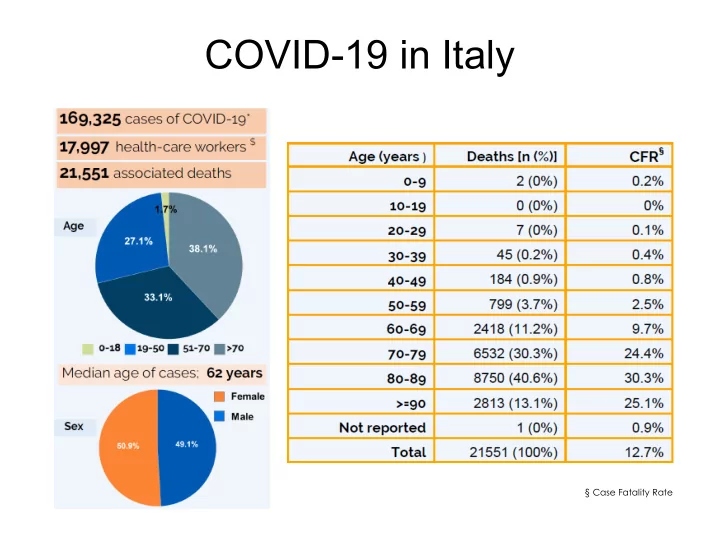
COVID-19 in Italy Case Fatality Rate COVID-19 in Italy COVID-19 - - PowerPoint PPT Presentation
COVID-19 in Italy Case Fatality Rate COVID-19 in Italy COVID-19 in Tuscany n/100.000 3 2 1 Florence - total: 994 (0.26 %) COVID-19 in Italy COVID-19 in Italy: Severity ID/LF-ASD 1 General Population asymptomatic to mild: 81-49%
§ Case Fatality Rate
n/100.000
Florence - total: 994 (0.26 %)
2 3 1
1 - personal preliminary raw data
Main factors of variability
an overall lifetime prevalence up to 44% or even higher when ID and ASD co-occur.
are the most common mental ill-health conditions
very high, with prevalence rates that have estimated to exceed 50%, even in specialized support settings.
diseases, hypertension, respiratory problems, cancer and other conditions associated with a higher risk for SARS-CoV- 2 Acute Respiratory Distress Syndrome and
infections, including H1N1 and RSV, suggests that persons with genetic syndromes including ID and/or ASD (i.e. Down syndrome) are more likely to develop complications and require more hospitalisation than the general population
alteration?
Italian version 1.5 (22/3/2020) English translation (26/3/2020) Advisory Board World Psychiatric Association Action Plan 2021-23 Working Groups on Intellectual Developmental Disorder and Autism Spectrum Disorder Marco O. Bertelli, Maria Luisa Scattoni, Afzal Javed, Muhammad Waqar Azeem, Luis Salvador- Carulla, Kerim M. Munir, and Ashok Roy Already translated in
To be translated in
and self-care
diary)
teachers / rehabilitation staff and important persons
with moderation
activities at home trying to maintain some commonality with the ways in which they were carried out before the lockdown
important to respect the lockdown and hygiene rules
(specify diagnosis and reasons)
activities that can be carried out at home, including occupational, motor, and recreational activities
important for you (use video calls to reinforce these messages)
behaviour and prepare to manage
Tuesday 21 April 2020 9.00am Boston, 5.00pm Florence, 7pm Canberra Hosts: John Mendoza, ConNetica Consulting Luis Salvador-Carulla, Centre for Mental Health Research Australian National University, Canberra, Australia Kerim Munir, MD, MPH, DSc Director of Psychiatry UCEDD Division of Developmental Medicine Boston Children’s Hospital Harvard Medical School No commercial disclosures Support from the Fogarty International Center and National Institute of Mental Health, NIH, USA Support from Grand Challenges Canada and Bill & Melinda Gates Foundation Support from Maternal and Child Health Bureau and Association of University Centers on Disabilities, USA
2
3
Harvard President and his Wife Socially Distances
5
6
7
8
straightforward
– Ins and Outs of Who can provide Telemedicine and Teleheath Services – Trainees excluded – a problem for a major teaching hospital
telehealth - basics of Medícare reimbursement
– Pace setter for other insurers
– Some patients could not download the software or sign on the App – Some patients do not have access to faster broad band internet service – Immigrant patients requiring interpreter services – Lower functioning, non-verbal patients, poor eye contact, poor reciprocity during sessions
Some Advantages:
reimbursement
– Prior to Covid-19 reimbursement rates lower, usage <1:10 visits – Approving services across State borders without requiring credentialing (e.g., New Hampshire, Connecticut, Vermont, Maine, New York)
Efficacy
9
trained therapists
instruction for Early Start Denver Method (with didactic workshops supervision)
children – address health disparities and unmet healthcare needs in IDDs
10
11
– Most children would have heard about the virus, seen people wearing masks – Be reassuring, positive
Be developmentally appropriate
– Answer questions clearly and do not
information – Take the cues from the child, let them express what they learned, provide
– Do not talk to your child when you are feeling anxious or upset, wait for a calmer time – Emphasize the safety precautions in developmentally understandable ways, e.g., washing hands during length of 2 Happy Birthday songs, etc.
– We wipe things to keep them clean – Young children do not have understanding of transmission
mask a costume? – It’s not a costume, they may not feel well – When better, they will stop
grandma? – They will need to be away for a while – Use telephone and video to maintain contact
– School is closed right now; your teacher and other kids are at home like you – Avoid unnecessary detail on illness as younger children may develop fears about attending school
– Rotate toys, use bubble play, listen to music, toss a ball, paint, play catch you, pretend to be different animals, use blocks, puzzles, coloring, stickers, tape
create an obstacle course, read or looking at books together
– While physically distancing, walks, set up a blanket and use quiet and physical activities (as above), go on bicycle and car rides
– preparing meal, setting the table, sorting
patient, as it take longer based on developmental level)
– Divide activities in predictable, shorter periods – Maintain nap and sleep routines
more severe IDDs
Developmental Disabilities Services
families electively (disrupted if visiting home, requiring 14-day sequestration) – or vice versa, parents unable to visit
forgotten-ones-people-with-disabilities-explain-how- pandemic-affects-them- differently/BV7TAB5OKNDJ5EB74IF2G3VESY/
13
– Familiar attachment figure – Unlikely to understand difference between temporary and permanent absence
– May talk about loss or death, but may still expect person to come back – Most children do not realize that everyone will die
– Understanding death as final, irreversible, and inescapable (e.g. Worden, 1996)
regulate sleep and eating behaviors, emotions, social interactions, sense of self, problem solving, as well as physiology, cardiovascular, immune function, temperature regulation, pain sensitivity, and epigenetics
process of adapting to the loss
sudden and traumatic exposures
circumstances” associated with the loss further disrupting developmental functions
15
15-year-old fostered and then adopted adolescent male with Down Syndrome
mother and father)
injuriousness
Harvard Review of Psychiatry . 2008 ; 16(1): 1–12
Linking Objects and Linking Phenomena
– Photograph, clothing, e.g., comb, handkerchief, watch – Gift, note, e.g, letter from a war zone by a soldier before he is killed
and the mourner (self)
mourning
A. Death of a person at least 12 month previously - for children for 6 months
1. Identity disruption, feeling part of self has died - children experience discontinuity as feeling different from others and often self-conscious as a result, e.g., weird or different as a result of being motherless 2. Marked sense of disbelief about the death - children may not understand the permanence of the death 3. Avoidance of reminders that the person is dead – for children include efforts to avoid reminders that the person is dead 4. Intense emotional pain, anger sorrow, bitterness related to the death - children may feel deprived of the person’s help in responding to developmental needs 5. Difficulty moving on with life, e.g., engaging with friends, pursuing interests, planning the future – for children Inability to achieve developmental milestones 6. Emotional numbness - children may not understand this, and adolescents may describe ‘not feeling anything’ 7. Feeling that life is meaningless - children and adolescents may express this as ‘its not worth trying’ ‘nothing really matters anymore’ or ‘my life is ruined’ - Yearning to physically reunite, not SI, but wish to die, concrete thinking 8. Intense loneliness (same)
16
17
18
based services and supports
Disabilities Act
Rationing of Scarce Medical Resources
Office of Civil Rights
19