CS 105 x86-64 Linux Memory Layout x86-64 Linux Memory Layout Tour - - PowerPoint PPT Presentation

▶
cs 105 x86 64 linux memory layout x86 64 linux memory
SMART_READER_LITE
LIVE PREVIEW

CS 105 x86-64 Linux Memory Layout x86-64 Linux Memory Layout Tour - - PowerPoint PPT Presentation

CS 105 x86-64 Linux Memory Layout x86-64 Linux Memory Layout Tour of Black Holes of Computing 00007FFFFFFFFFFF Stack


slide-1
SLIDE 1

Machine-Level Programming V: Miscellaneous Topics Machine-Level Programming V: Miscellaneous Topics

Topics

✁

Linux Memory Layout

✁

Buffer Overflow

✁

C operators and declarations

CS 105 Tour of Black Holes of Computing

– 2 – 105

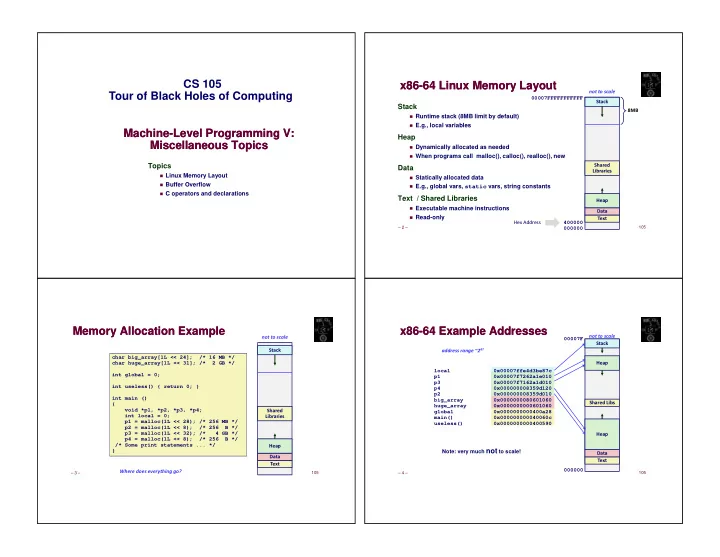
x86-64 Linux Memory Layout x86-64 Linux Memory Layout

Stack

✁

Runtime stack (8MB limit by default)

✁

E.g., local variables

Heap

✁

Dynamically allocated as needed

✁

When programs call malloc(), calloc(), realloc(), new

Data

✁

Statically allocated data

✁

E.g., global vars, static vars, string constants

Text / Shared Libraries

✁

Executable machine instructions

✁

Read-only

  • 00007FFFFFFFFFFF

000000

  • 400000
  • – 3 –

105

Memory Allocation Example Memory Allocation Example

char big_array[1L << 24]; /* 16 MB */ char huge_array[1L << 31]; /* 2 GB */ int global = 0; int useless() { return 0; } int main () { void *p1, *p2, *p3, *p4; int local = 0; p1 = malloc(1L << 28); /* 256 MB */ p2 = malloc(1L << 8); /* 256 B */ p3 = malloc(1L << 32); /* 4 GB */ p4 = malloc(1L << 8); /* 256 B */ /* Some print statements ... */ }

  • – 4 –

105

local 0x00007ffe4d3be87c p1 0x00007f7262a1e010 p3 0x00007f7162a1d010 p4 0x000000008359d120 p2 0x000000008359d010 big_array 0x0000000080601060 huge_array 0x0000000000601060 global 0x0000000000400a28 main() 0x000000000040060c useless() 0x0000000000400590

x86-64 Example Addresses x86-64 Example Addresses

  • ✁
✂

00007F 000000

  • Note: very much not to scale!
slide-2
SLIDE 2

– 5 – 105

Carnegie Mellon

Memory-Referencing Bug Example Memory-Referencing Bug Example

✁

Result is system-specific

fun(0) 3.14 fun(1) 3.14 fun(2) 3.1399998664856 fun(3) 2.00000061035156 fun(4) 3.14 fun(6)

  • typedef struct { /* An "anonymous" structure */

int a[2]; double d; } struct_t; /* "typedef" gives it a type name */ double fun(int i) { volatile struct_t s; s.d = 3.14; s.a[i] = 1073741824; /* 2**30, possibly out of bounds */ return s.d; }

– 6 – 105

Carnegie Mellon

Memory-Referencing Bug Example Memory-Referencing Bug Example

typedef struct { int a[2]; double d; } struct_t;

fun(0) 3.14 fun(1) 3.14 fun(2) 3.1399998664856 fun(3) 2.00000061035156 fun(4) 3.14 fun(6)

  • fun(i)
  • ?
  • ?
  • d7 ... d4
  • d3 ... d0
  • a[1]
  • a[0]
  • struct_t
  • – 7 –

105

Such problems are a BIG deal Such problems are a BIG deal

Generally called a “buffer overflow”

✁

When exceeding the memory size allocated for an array

Why a big deal?

✁

It’s the #1 technical cause of security vulnerabilities

#1 overall cause is social engineering / user ignorance

Most common form

✁

Unchecked lengths on string inputs

✁

Particularly for bounded character arrays on the stack

Sometimes referred to as “stack smashing”

– 8 – 105

String Library Code String Library Code

Implementation of Unix function gets()

✁

No way to specify limit on number of characters to read

Similar problems with other library functions

✁

strcpy, strcat: Copy strings of arbitrary length

✁

scanf, fscanf, sscanf, when given %s conversion specification

/* Get string from stdin */ char *gets(char *dest) { int c = getchar(); char *p = dest; while (c != EOF && c != '\n') { *p++ = c; c = getchar(); } *p = '\0'; return dest; }

slide-3
SLIDE 3

– 9 – 105

Vulnerable Buffer Code Vulnerable Buffer Code

void call_echo() { echo(); } /* Echo Line */ void echo() { char buf[4]; /* Way too small! */ gets(buf); puts(buf); } unix>./bufdemo Type a string:012345678901234567890123 012345678901234567890123 unix>./bufdemo Type a string:0123456789012345678901234 Segmentation Fault

  • – 10 –

105

Buffer Overflow Disassembly Buffer Overflow Disassembly

00000000004006cf <echo>: 4006cf: 48 83 ec 18 sub $0x18,%rsp 4006d3: 48 89 e7 mov %rsp,%rdi 4006d6: e8 a5 ff ff ff callq 400680 <gets> 4006db: 48 89 e7 mov %rsp,%rdi 4006de: e8 3d fe ff ff callq 400520 <puts@plt> 4006e3: 48 83 c4 18 add $0x18,%rsp 4006e7: c3 retq 4006e8: 48 83 ec 08 sub $0x8,%rsp 4006ec: b8 00 00 00 00 mov $0x0,%eax 4006f1: e8 d9 ff ff ff callq 4006cf <echo> 4006f6: 48 83 c4 08 add $0x8,%rsp 4006fa: c3 retq

  • – 11 –

105

Buffer Overflow Stack Buffer Overflow Stack

echo: subq $24, %rsp movq %rsp, %rdi call gets . . . /* Echo Line */ void echo() { char buf[4]; /* Way too small! */ gets(buf); puts(buf); }

  • %rsp
  • call_echo

[3] [2] [1] [0] buf

  • – 12 –

105

Buffer Overflow Stack Example Buffer Overflow Stack Example

echo: subq $24, %rsp movq %rsp, %rdi call gets . . . void echo() { char buf[4]; gets(buf); . . . }

  • %rsp
  • call_echo

[3] [2] [1] [0] buf

  • . . .

4006f1: callq 4006cf <echo> 4006f6: add $0x8,%rsp . . .

  • 00 40 06 f6

00 00 00 00

slide-4
SLIDE 4

– 13 – 105

Buffer Overflow Example #1 Buffer Overflow Example #1

echo: subq $24, %rsp movq %rsp, %rdi call gets . . . void echo() { char buf[4]; gets(buf); . . . }

  • %rsp
  • call_echo

33 32 31 30 buf

  • . . .

4006f1: callq 4006cf <echo> 4006f6: add $0x8,%rsp . . .

  • 00 40 06 f6

00 00 00 00

unix>./bufdemo Type a string:01234567890123456789012 01234567890123456789012

37 36 35 34 31 30 39 38 35 34 33 32 39 38 37 36 00 32 31 30

  • – 14 –

105

Buffer Overflow Example #2 Buffer Overflow Example #2

echo: subq $24, %rsp movq %rsp, %rdi call gets . . . void echo() { char buf[4]; gets(buf); . . . }

  • %rsp
  • call_echo

33 32 31 30 buf

  • . . .

4006f1: callq 4006cf <echo> 4006f6: add $0x8,%rsp . . .

  • 00 00 00 00

unix>./bufdemo Type a string:0123456789012345678901234 Segmentation Fault

37 36 35 34 31 30 39 38 35 34 33 32 39 38 37 36 33 32 31 30

  • 00 40 00 34

– 15 – 105

Buffer Overflow Example #3 Buffer Overflow Example #3

echo: subq $24, %rsp movq %rsp, %rdi call gets . . . void echo() { char buf[4]; gets(buf); . . . }

  • %rsp
  • call_echo

33 32 31 30 buf

  • . . .

4006f1: callq 4006cf <echo> 4006f6: add $0x8,%rsp . . .

  • 00 00 00 00

unix>./bufdemo Type a string:012345678901234567890123 012345678901234567890123

37 36 35 34 31 30 39 38 35 34 33 32 39 38 37 36 33 32 31 30

  • 00 40 06 00

– 16 – 105

Buffer Overflow Example #3 Explained Buffer Overflow Example #3 Explained

  • %rsp
  • call_echo

33 32 31 30 buf

  • . . .

400600: mov %rsp,%rbp 400603: mov %rax,%rdx 400606: shr $0x3f,%rdx 40060a: add %rdx,%rax 40060d: sar %rax 400610: jne 400614 400612: pop %rbp 400613: retq

  • 00 00 00 00

37 36 35 34 31 30 39 38 35 34 33 32 39 38 37 36 33 32 31 30

  • retq main
  • 00 40 06 00
slide-5
SLIDE 5

– 17 – 105

Exploits Based on Overflows Exploits Based on Overflows

Buffer overflow bugs can allow remote machines to execute arbitrary code

  • n victim machines

Distressingly common in real progams

✁

Programmers keep making the same mistakes

✁

Recent measures make these attacks much more difficult

Examples across the decades

✁

Original “Internet worm” (1988)

✁

“IM wars” (1999)

✁

Twilight hack on Wii (2000s)

✁

… and many, many more

You will learn some of the tricks in lab 4

✁

Hopefully to convince you to never leave such holes in your programs!!

– 18 – 105

Example: Original Internet Worm (1988) Example: Original Internet Worm (1988)

Exploited a few vulnerabilities to spread

✁

Early versions of the finger server (fingerd) used gets() to read the argument sent by the client:

finger geoff@cs.hmc.edu

✁

Worm attacked fingerd server by sending phony argument:

finger “exploit-code padding new-return-address” exploit code: executed a root shell on the victim machine with a direct TCP connection to

the attacker.

Once on a machine, scanned for other machines to attack

✁

invaded ~6000 computers in hours (10% of the Internet )

see June 1989 article in Comm. of the ACM

✁

the young author of the worm was prosecuted…

✁

and CERT was formed… still homed at CMU

– 19 – 105

Example 2: IM War Example 2: IM War

July, 1999

✁

Microsoft launches MSN Messenger (instant messaging system).

✁

Messenger clients can access popular AOL Instant Messaging Service (AIM) servers

  • – 20 –

105

IM War (cont.) IM War (cont.)

August 1999

✁

Mysteriously, Messenger clients can no longer access AIM servers

✁

Microsoft and AOL begin the IM war:

AOL changes server to disallow Messenger clients Microsoft makes changes to clients to defeat AOL changes At least 13 such skirmishes

✁

What was really happening?

AOL had discovered a buffer overflow bug in their own AIM clients They exploited it to detect and block Microsoft: the exploit code returned a 4-byte

signature (the bytes at some location in the AIM client) to server

When Microsoft changed code to match signature, AOL changed signature location

slide-6
SLIDE 6

– 21 – 105 Date: Wed, 11 Aug 1999 11:30:57 -0700 (PDT) From: Phil Bucking <philbucking@yahoo.com> Subject: AOL exploiting buffer overrun bug in their own software! To: rms@pharlap.com

  • Mr. Smith,

I am writing you because I have discovered something that I think you might find interesting because you are an Internet security expert with experience in this area. I have also tried to contact AOL but received no response. I am a developer who has been working on a revolutionary new instant messaging client that should be released later this year. ... It appears that the AIM client has a buffer overrun bug. By itself this might not be the end of the world, as MS surely has had its share. But AOL is now *exploiting their own buffer overrun bug* to help in its efforts to block MS Instant Messenger. .... Since you have significant credibility with the press I hope that you can use this information to help inform people that behind AOL's friendly exterior they are nefariously compromising peoples' security. Sincerely, Phil Bucking Founder, Bucking Consulting philbucking@yahoo.com

  • – 22 –

105

Aside: Worms and Viruses Aside: Worms and Viruses

Worm: A program that

✁

Can run by itself

✁

Can propagate a fully working version of itself to other computers

Virus: Code that

✁

Adds itself to other programs

✁

Does not run independently

Both are (usually) designed to spread among computers and to wreak havoc

– 23 – 105

OK, What to Do About Buffer Overflow Attacks? OK, What to Do About Buffer Overflow Attacks?

Avoid overflow vulnerabilities Employ system-level protections Have compiler use “stack canaries” Lets talk about each…

– 24 – 105

  • 1. Avoid Overflow Vulnerabilities in

Code (!)

  • 1. Avoid Overflow Vulnerabilities in

Code (!)

For example, use library routines that limit string lengths

✁

fgets instead of gets

✁

strncpy instead of strcpy

✁

Don’t use scanf with %s conversion specification

Use fgets to read the string Or use %ns where n is a suitable integer

/* Echo Line */ void echo() { char buf[4]; /* Way too small! */ fgets(buf, 4, stdin); puts(buf); }

slide-7
SLIDE 7

– 25 – 105

  • 2. System-Level Protections Can Help
  • 2. System-Level Protections Can Help

Randomized stack offsets

✁

At start of program, allocate random amount of space on stack

✁

Makes it hard for hacker to predict beginning of inserted code

✁

E.g.: 5 executions of memory allocation code

Stack repositioned each time program executes

Nonexecutable code segments

✁

In traditional x86, can mark region of memory as either “read-only” or “writable”

Can execute anything readable

✁

X86-64 added explicit “execute” permission

✁

Stack marked as non-executable

– 26 – 105

  • 3. Stack Canaries can help
  • 3. Stack Canaries can help

Idea

✁

Place special value (“canary”) on stack just beyond buffer

✁

Check for corruption before exiting function

GCC Implementation

✁
  • fstack-protector
✁

Now the default (disabled earlier)

unix>./bufdemo-protected Type a string:0123456 0123456 unix>./bufdemo-protected Type a string:01234567 *** stack smashing detected ***

– 27 – 105

Protected Buffer Disassembly Protected Buffer Disassembly

40072f: sub $0x18,%rsp 400733: mov %fs:0x28,%rax 40073c: mov %rax,0x8(%rsp) 400741: xor %eax,%eax 400743: mov %rsp,%rdi 400746: callq 4006e0 <gets> 40074b: mov %rsp,%rdi 40074e: callq 400570 <puts@plt> 400753: mov 0x8(%rsp),%rax 400758: xor %fs:0x28,%rax 400761: je 400768 <echo+0x39> 400763: callq 400580 <__stack_chk_fail@plt> 400768: add $0x18,%rsp 40076c: retq

  • – 28 –

105

Setting Up Canary Setting Up Canary

echo: . . . movq %fs:40, %rax # Get canary movq %rax, 8(%rsp) # Place on stack xorl %eax, %eax # Erase canary . . . /* Echo Line */ void echo() { char buf[4]; /* Way too small! */ gets(buf); puts(buf); }

  • %rsp
  • call_echo

[3] [2] [1] [0] buf

slide-8
SLIDE 8

– 29 – 105

  • call_echo

Checking Canary Checking Canary

echo: . . . movq 8(%rsp), %rax # Retrieve from stack xorq %fs:40, %rax # Compare to canary je .L6 # If same, OK call __stack_chk_fail # FAIL .L6: . . . /* Echo Line */ void echo() { char buf[4]; /* Way too small! */ gets(buf); puts(buf); }

  • %ebp

[3] [2] [1] [0] %ebx

  • %rsp

33 32 31 30 buf

  • 00 36 35 34
  • – 30 –

105

C Operators C Operators

Operators Associativity

() [] -> . left to right ! ~ ++ -- + - * & (type) sizeof right to left * / % left to right + - left to right << >> left to right < <= > >= left to right == != left to right & left to right ^ left to right | left to right && left to right || left to right ?: right to left = += -= *= /= %= &= ^= != <<= >>= right to left , left to right

Note: Unary +, -, and * have higher precedence than binary forms See ~geoff/c_precedence on Wilkes and Knuth

– 31 – 105

C Pointer Declarations C Pointer Declarations

int *p p is a pointer to int int *p[13] p is an array[13] of pointer to int int *(p[13]) p is an array[13] of pointer to int int **p p is a pointer to a pointer to an int int (*p)[13] p is a pointer to an array[13] of int int *f() f is a function (unknown arguments) returning a pointer to int int (*f)() f is a pointer to a function returning int int (*(*f())[13])() f is a function returning ptr to an array[13]

  • f pointers to functions returning int

int (*(*x[3])())[5] x is an array[3] of pointers to functions returning pointers to array[5] of ints