Cycle 3 2015: Targeted Funding Announcement Applicant Town Hall - - PowerPoint PPT Presentation

cycle 3 2015 targeted funding announcement applicant town
SMART_READER_LITE
LIVE PREVIEW

Cycle 3 2015: Targeted Funding Announcement Applicant Town Hall - - PowerPoint PPT Presentation

Cycle 3 2015: Targeted Funding Announcement Applicant Town Hall Management Strategies for Treatment of Multiple Sclerosis Treatment-Resistant Depression New Oral Anticoagulants (NOACs) Clinical Strategies for Managing and


slide-1
SLIDE 1

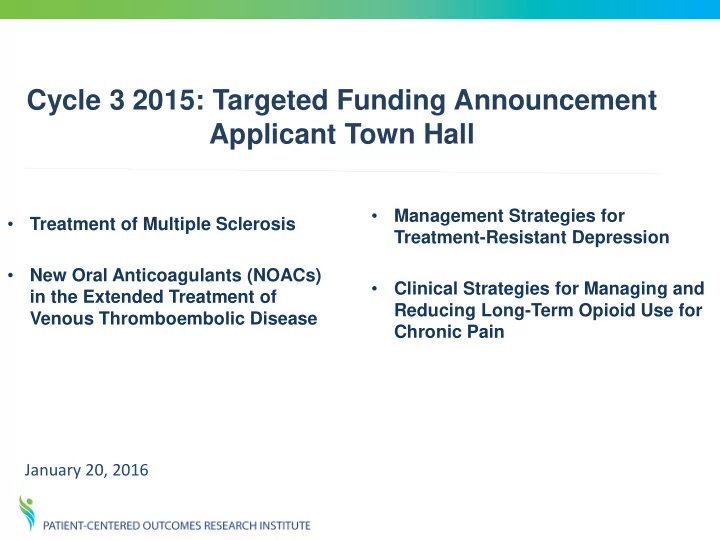
Cycle 3 2015: Targeted Funding Announcement Applicant Town Hall

January 20, 2016

  • Treatment of Multiple Sclerosis
  • New Oral Anticoagulants (NOACs)

in the Extended Treatment of Venous Thromboembolic Disease

  • Management Strategies for

Treatment-Resistant Depression

  • Clinical Strategies for Managing and

Reducing Long-Term Opioid Use for Chronic Pain

slide-2
SLIDE 2

Agenda

Application Requirements Patient Engagement Budget The Merit Review Process Questions

Submitting Questions:

Submit questions via the chat function in Meeting Bridge. Ask a question via phone (an operator will standby to take your questions).

slide-3
SLIDE 3

Today’s Presenters

Julie McCormack, MA Program Officer Clinical Effectiveness Research Maricon Gardner, CRA Associate Contracts Operations Suzanne Schrandt, JD Deputy Director Patient Engagement Allison Ambrosio, MPH Program Associate Clinical Effectiveness Research Layla Lavasani, PhD, MHS Program Officer Clinical Effectiveness Research Diane Bild, MD, MPH Senior Program Officer Clinical Effectiveness Research Carolyn Mohan, DrPH, MPH, MIA Merit Review Officer

slide-4
SLIDE 4

Your letter of intent (LOI) was reviewed and you have been invited to submit a full application.

CONGRATULATIONS!

slide-5
SLIDE 5

LOI Changes

  • You were invited to submit a full application based on the

information you provided in the LOI

  • Please contact PCORI (pfa@pcori.org) if you wish to make any

significant changes to the proposed study including the following: – PI – Institution – Study design – Budget or period of performance – Research question – Aims – Comparators

  • PCORI must approve any changes before the full application is

submitted

slide-6
SLIDE 6

Application Requirements

slide-7
SLIDE 7

Preparing Your Application

  • To begin, all applicants should:
  • Read the funding announcement and review the PCORI

Application Guidelines Document

  • Review the PCORI Research Plan Template
  • Have a copy of your approved LOI readily accessible
  • Carefully consider the feedback you received on your LOI

7

slide-8
SLIDE 8

Milestones/Deliverables Template

Deliverables: Measurable and verifiable

  • utcomes or objects that a

project team must create and deliver according to the contract terms Milestones: Significant events or accomplishments within the project; may have deliverables associated with them

slide-9
SLIDE 9

Research Strategy: Overview

Maximum 20 pages in length Use the Research Plan Template as your guide

  • Background
  • Significance
  • Patient Population
  • Recruitment Plan
  • Estimated Racial/Ethnic and Gender Enrollment Table
  • Study Design or Approach
  • Engagement Plan
  • Research Team and Environment

PLEASE provide all the information requested, as

  • utlined in the template.

Page Limit 20

9

slide-10
SLIDE 10

Research Strategy: Recruitment Plan

Discuss past experiences with recruitment of the target population Provide preliminary evidence of the potential for successful recruitment Provide numbers for the pool of potential participants, those estimated to be eligible, and the expected participation rate Discuss barriers to recruitment and how you plan to overcome them Strategies for successful recruitment – Engaged clinical sites – Clinical advocates – Proactive, experienced research coordinator – Alignment and integration of recruitment activities with clinical workflow

slide-11
SLIDE 11

Research Strategy: Study Design/Approach Tips

Document how proposed study will fill the evidence gap Document efficacy/effectiveness and/or frequency in clinical practice Provide a clear research plan with rigorous methods that adhere to PCORI’s Methodology Standards and accepted best practices A clear justification for the study design and outcome measures Clearly described and justified comparators Sample sizes and power estimates based on careful evaluations of the anticipated effect size Feasibility Realistic strategies for participant recruitment and retention

slide-12
SLIDE 12

Methodology Standards

In any study, methods are critical. PCORI’s Methodology Committee developed Methodology Standards to which patient- centered CER must adhere

Methodology Standards: 11 Specific Categories

  • Formulating Research

Questions

  • Patient-Centeredness
  • Data Integrity and Rigorous

Analyses

  • Preventing/Handling Missing

Data

  • Heterogeneity of Treatment

Effects

  • Data Networks
  • Data Registries
  • Adaptive and Bayesian

Trial Designs

  • Causal Inference
  • Studies of Diagnostic

Tests

  • Systematic Reviews
slide-13
SLIDE 13

Research Plan Template: Dissemination & Implementation Potential

Describe the potential for disseminating and implementing the results of this research in other settings. Describe possible barriers to disseminating and implementing the results of this research in other settings. Describe how you will make study results available to study participants after you complete your analyses. PCORI does not expect applicants to disseminate and implement findings at this time.

Page Limit 2

slide-14
SLIDE 14

Research Plan Template: Replication & Reproducibility of Research and Data Sharing

Describe the ability to reproduce potentially important findings from this research in other data sets and populations. Describe how you will make a complete, cleaned, de- identified copy of the final data set used in conducting the final analyses available within 90 days of the end of the final year of funding, or your data-sharing plan, including the method by which you will make this data set available, if requested. Propose a budget to cover costs of your data-sharing plan, if requested.

Page Limit 2

slide-15
SLIDE 15

Research Plan Template: Protection of Human Subjects

  • Provide a Data and Safety Monitoring Plan that operates

under the auspices of your institution

  • Assure that key personnel are educated on human subjects

protections

– Assure appropriate informed consent – Establish procedures to minimize risks to participants – Establish procedures to protect privacy and maintain confidentiality

  • If you anticipate seeking waiver of individual informed

consent, provide the rationale

  • Refer to NIH standards for research involving human

subjects

Page Limit 5

slide-16
SLIDE 16

Research Plan Template: References Cited

Following scholarly citation practice, list the source material cited in the Research Plan.

Page Limit 10

slide-17
SLIDE 17

Research Plan Template: Appendix

  • PCORI applications may include an appendix for

additional materials the investigators think may be useful – Reviewers will not be required to include the appendices in the review and assessment of the project

  • Examples of additional materials are:

– Survey instruments – Papers and publications

Page Limit 10

slide-18
SLIDE 18

People and Places Template: Biosketch

You may use the NIH biosketch or PCORI’s format Biosketches are required for all key personnel List all partners within the Key Personnel section Patient/Stakeholder Biosketch

Page Limit 5 Per person

slide-19
SLIDE 19

People and Places Template: Project / Performance Site(s)

Demonstrate that the proposed facilities have the appropriate resources required to conduct the project to plan, within budget, and on time. Provide a description of the facilities that will be used during the project, including capacity, capability, characteristics, proximity, and availability to the project

Page Limit 15

Professional Profile/Biosketch

slide-20
SLIDE 20

Letters of Support

  • Save all letters of support as single PDF file prior to uploading

to the PCORI Online System.

  • All letters of support should be addressed to the PI and

demonstrate the commitment of key personnel and supporting

  • rganizations to your proposed project.
  • Letters of support should clearly reflect the substantive

involvement and material contribution to be provided by the signatory parties, and are meant to substantiate the commitment of collaboration of all forms.

slide-21
SLIDE 21

Use of FDA-Regulated Medical Products

All drugs, biologics, devices, and diagnostics used in your study must be FDA-approved

  • Indicate within your application whether investigational

new drug (IND) or other regulatory approval will be needed to conduct your study For example, if your study administers an approved medical product in an off-label manner (e.g., a dose, route, frequency, indication, or patient population that is unapproved by FDA) you may need an IND

  • If uncertain, seek guidance from FDA or your legal

counsel

slide-22
SLIDE 22

Engagement

slide-23
SLIDE 23

Patient-Centeredness

Is the research focused on questions that affect

  • utcomes of interest to patient and their

caregivers?

  • Does the research question address choices that are

important to - and faced frequently by - patients, their caregivers, or clinicians?

  • Is the study powered on outcomes that are important to

patients?

Are the interventions being compared in the study available to patients now?

slide-24
SLIDE 24

Addressing Patient-Centeredness

Provide evidence that the research question(s) and

  • utcomes are important to patients (and/or their

caregivers) Describe your strategy for measuring outcomes that are important to patients. Remember that a study can be patient-centered even if the end-user is not the patient, as long as patients will benefit from its information.

If the end-user is not the patient, be sure to carefully describe how your study is still patient-centered.

slide-25
SLIDE 25

Selecting Important Patient-Centered Outcomes

Do proposed outcomes include outcomes based

  • n input from patients and other stakeholders?

What is the validity of this outcome measure? What is a minimal important difference in this

  • utcome measure?

Have you considered the use of a previously validated patient reported outcome (PRO)?

slide-26
SLIDE 26

Patient and Stakeholder Engagement

Evidence that patients, caregivers, clinicians, and other stakeholders have been and will be engaged in:

  • Formulating the research questions
  • Defining the characteristics of study participants, comparators and
  • utcomes
  • Selecting the important outcomes to be assessed
  • Monitoring study conduct and progress
  • Designing plans for dissemination of study results

Clear statement of the roles and the decision-making authority of all patient and stakeholder research partners An organizational structure that takes into account the Study Advisory Committee which will bring together national patient and stakeholder groups to further the goals of the study

slide-27
SLIDE 27

Patient-Centeredness vs. Patient Engagement

Patient-centeredness is about whether the project aims to answer questions or examine outcomes that matter to patients/caregivers. Patient engagement is about having patients/caregivers as partners in research, as

  • pposed to merely being recruited as study

participants.

slide-28
SLIDE 28

The Engagement Rubric

The rubric is intended to provide guidance to applicants, merit reviewers, awardees, and engagement/program

  • fficers (for creating milestones and monitoring projects)

regarding engagement in the conduct of research. It is divided into three segments:

Planning the Study Conducting the Study Disseminating the Study Results

slide-29
SLIDE 29

Engagement Resources

PCORI’s “Engagement Rubric”

http://www.pcori.org/sites/default/files/PCORI-Engagement-Rubric- with-Table.pdf

Sample Engagement Plans

http://www.pcori.org/sites/default/files/PCORI-Sample-Engagement- Plans.pdf

PCORI Compensation Framework

http://www.pcori.org/sites/default/files/PCORI-Compensation- Framework-for-Engaged-Research-Partners.pdf

Engagement in Research website page

http://www.pcori.org/content/engagement-research

PCORI’s Methodology Standards PC-1 to PC-4

http://www.pcori.org/assets/PCORI-Methodology-Standards1.pdf

slide-30
SLIDE 30

Budget Information

slide-31
SLIDE 31

Budget Templates: Overview Three budget sections must be submitted as part of the online application process:

Detailed Budget Budget Summary Budget Justification NOTE:

A detailed budget is needed for each year of the

  • program. Complete each budget section for the

prime applicant and any/each subcontractor.

slide-32
SLIDE 32

Budget Justification

Narrative that fully supports and explains the basis for the information in the Budget Detail – Provide sufficient detail to understand the basis for costs, the reason that the costs are necessary, and an explanation for major cost variances – Use the budget template to tell PCORI why the costs are reasonable for the work to be performed Breakdown of costs proposed for each consortia or contractor Must specify any other sources of funding that are anticipated to support the proposed research project Provide quotes, indirect cost rate letter, fringe benefit policy

slide-33
SLIDE 33

Costs of Interventions

PCORI will not cover costs for clinical care alternatives that are being compared in the project. PCORI will consider covering costs for ancillary tasks necessary in the implementation or monitoring of a clinical intervention or strategy as part of the research program.

  • Examples include costs for obtaining consent,

collecting data, or monitoring that would not normally be performed in routine care Support for the study by the involved healthcare delivery systems must be documented.

slide-34
SLIDE 34

Guidelines for Intervention Cost/Coverage

Costs for study interventions must be covered by delivery system, payer, manufacturer or developer of the intervention. The willingness of one or more of the stakeholder groups to cover treatment costs, even when one of the proposed intervention arms is not currently covered by insurance, will be taken as strong endorsement

  • f the study by the health system or payer and of the likelihood that they

will implement or use the study‘s findings if definitive. This material support for the study by host delivery system, payer or developer should therefore be discussed in the application. In exceptional cases, PCORI may consider coverage of the co-payment

  • r coinsurance costs of participating patients when that is necessary to

preserve blinding in a study or to assure access to the study for vulnerable populations. Contact PCORI with questions.

slide-35
SLIDE 35

Common Application Errors

Using the wrong browser, access PCORI Online via Chrome

  • r Safari browsers

Not entering information into all required fields in the system Not clicking the ‘Save’ button Having multiple people working on the application at the same time Having the incorrect file extension, only PDF files can be uploaded Not choosing the correct document type from the drop-down menu AO is unable to view the application

slide-36
SLIDE 36

What happens to your application after you submit it?

slide-37
SLIDE 37

Administrative Screening

Applicants must follow administrative requirements set in PCORI’s Application Guidelines.

► Exceeding page limits, budget, or time

limitations

► Not using PCORI’s required templates ► Submitting incomplete sections or applications

Missing the Mark

slide-38
SLIDE 38

Programmatic Screening

► Study deviates from approved LOI ► Study includes cost-effectiveness analysis ► Study is not responsive to PFA and/or does NOT

address the PFA’s “Research Areas of Interest”

► Study is not comparative

Missing the Mark

PFA Responsiveness PCORI Mission Advance Through to Merit Review

slide-39
SLIDE 39

Merit Review

slide-40
SLIDE 40

Building an Inclusive Merit Review

  • Panels include 3 reviewer types to bring diverse

perspectives to the merit review process.

  • Each application is reviewed by 3 scientists,1 patient,

and 1 other stakeholder.

  • The panel chair facilitates discussion and promotes a

culture of mutual respect and understanding among reviewer types. Patients Other Stakeholders Scientists

slide-41
SLIDE 41

Merit Review Criteria

Criterion #1: Potential for the study to fill critical gaps and generate actionable evidence Criterion #2: Potential for the study to be adopted into clinical practice and improve delivery of care Criterion #3: Scientific Merit (Research Design, Analysis, and Outcomes) Criterion #4: Patient-centeredness Criterion #5: Patient and stakeholder engagement Patient and Stakeholder Reviewers Scientist Reviewers

   

    

slide-42
SLIDE 42

Multi-phase process for review Preliminary (online) review In-Person review Post-Panel review (PCORI program staff)

slide-43
SLIDE 43

Submission and Key Dates

What When Application Deadline February 16, 2016 by 5:00pm (ET) Merit Review Dates May 2016 Awards Announced July 2016 Earliest Start Date September 2016

slide-44
SLIDE 44

Where can I find help?

Visit pcori.org/apply

  • Application Guidelines
  • FAQs
  • PCORI Online User Manuals
  • Sample Engagement Plans

Schedule a Call with a Program Officer

  • Submit a request at pcori.org/content/research-inquiry
  • Call 202-627-1884 (programmatic inquiries)
  • E-mail sciencequestions@pcori.org

Contact our Helpdesk

  • E-mail pfa@pcori.org
  • Call 202-627-1885 (administrative and

technical inquiries)

slide-45
SLIDE 45

Q&A

Ask a question via the chat function in Meeting Bridge. Ask a question via phone (an operator will standby to take your questions).

If we are unable to address your question during this time, e-mail the Helpdesk at pfa@pcori.org.