Drilling and the DEC: Responding to New Guidelines Anthony R. - - PowerPoint PPT Presentation

drilling and the dec responding to new guidelines
SMART_READER_LITE
LIVE PREVIEW

Drilling and the DEC: Responding to New Guidelines Anthony R. - - PowerPoint PPT Presentation

Drilling and the DEC: Responding to New Guidelines Anthony R. Ingraffea Ph.D., P.E. Physicians, Scientists, and Engineers for Sustainable and Healthy Energy, Inc. Ithaca, NY July 25, 2011 1 Purpose of An Environmental Impact Statement
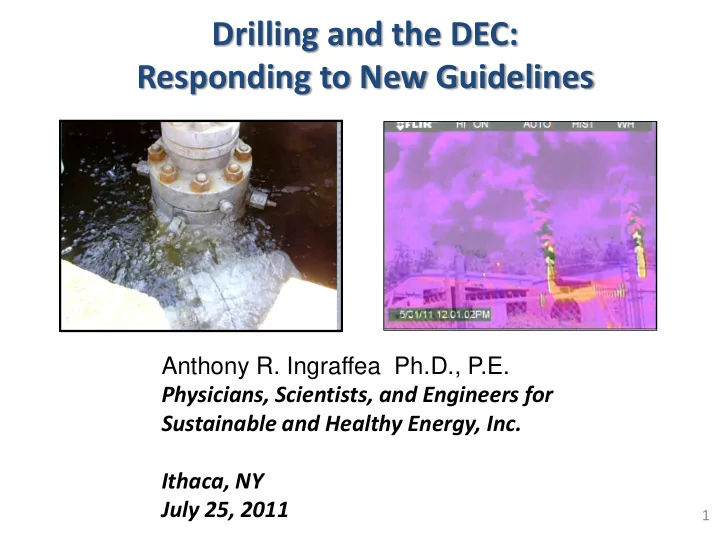

slide-1
SLIDE 1

Drilling and the DEC: Responding to New Guidelines

Anthony R. Ingraffea Ph.D., P.E. Physicians, Scientists, and Engineers for Sustainable and Healthy Energy, Inc. Ithaca, NY July 25, 2011

1

slide-2
SLIDE 2

Purpose of An Environmental Impact Statement

2

Identify Potential Impacts Assess Identified Impacts Propose Mitigation of Identified Impacts Propose Prohibition of Identified Impacts “The DEC proposes to require, via permit condition and/or regulation, that for High Volume Hydraulic Fracturing (HVHF)……

slide-3
SLIDE 3

Focus Tonight on Only Two Potential Impacts and Proposed Actions

3

See Table 11.1 for Roadmap to Impacts and Proposed Actions

slide-4
SLIDE 4

6.6 Greenhouse Gas Emissions: GWP Factors And Time Horizon

4

“Chesapeake Energy Corporation’s July 2009 Fact Sheet on gas emissions states that CO2 has a GWP of 1 and CH4 has a GWP of 23, and that this comparison allows emissions of greenhouse gases to be estimated and reported on an equal basis as CO2e. However, GWP factors are continually being updated, and for the purpose of this analysis as required by the Department‟s 2009 Guide for Assessing Energy Use and Greenhouse Gas Emissions in an Environmental Impact Statement, the 100-Year GWP factors… were used to determine total GHGs as CO2e.” Page 6-197

slide-5
SLIDE 5

6.6 Greenhouse Gas Emissions: GWP Factors And Time Horizon

5

SGEIS ignores much more recent research on GWP’s and difference between HVHF and wells in methane emissions, e.g. Howarth et al. 2011, wherein 100 Year GWP

  • f CH4 is 33 and 20 Year GWP is 105
slide-6
SLIDE 6

6

slide-7
SLIDE 7

Marcellus Well Being “Finished” Outside Dimock, Pa June, 2011: Major Source of Methane Emission

Photo and FLIR Video Courtesy Frank Finan

7

slide-8
SLIDE 8

Compressor Station in PA Under Standard and Infrared Photography: Major Source of Methane Emission as GHG

Video Courtesy of the CHESEPEAKE BAY FOUNDATION

8

slide-9
SLIDE 9

Bubbling in Muncy Creek, Lycoming County, PA: Example of Migration of Methane as GHG

Video Courtesy of Ralph Kisberg, Responsible Drilling Alliance

9

slide-10
SLIDE 10

Identification of Impact and Proposed Mitigations: Table 11.1

10

slide-11
SLIDE 11

Identification of Impact and Proposed Mitigations

11

slide-12
SLIDE 12

Methane Migration to Well Head, Dimock, PA: Major Source of Methane Emission and Indication of Possible Water Well Contamination

12

slide-13
SLIDE 13

The “New” Intermediate Casing Myth

Additional Well Casing to Prevent Gas Migration: In most cases, an additional third, cemented well casing is required around each well to prevent the migration of gas. The three required casings are the surface casing, the new intermediate casing and the production casing. The depths of both surface and intermediate casings will be determined by site-specific conditions.

13

slide-14
SLIDE 14

14

As-Built Casing Layouts for 2 PA Marcellus Wells That Contaminated Water Wells

slide-15
SLIDE 15

15

slide-16
SLIDE 16

Sustained Casing Pressure and Gas Migration Are Chronic Problems

16

Brufatto et al., Schlumberger OilField Review, Autumn, 2003.

slide-17
SLIDE 17

Sustained Casing Pressure and Gas Migration Are Chronic Problems

17

Watson and Bachu, SPE 106817, 2009.

slide-18
SLIDE 18

18

slide-19
SLIDE 19

The suggested, required addition of an INTERMEDIATE, “PROTECTIVE” layer of casing, does NOT prevent methane or other fluid migration. The SGEIS does not contain a statistical analysis from the experience of 3500+ PA Marcellus wells of:

  • Incidents of fluid migration. e.g. # of confirmed well water contaminations
  • Incidents of blowouts, pipeline failures, pad fires, etc.
  • Methane emissions, vented and fugitive
  • Flowback, “produced water”, and brine waste volumes
  • Liquid and solid waste final disposition
  • Citations and enforcements

19

What DEC Did NOT Report from What Was Learned in PA

slide-20
SLIDE 20

Thank You for Attending and Participating Tonight

20